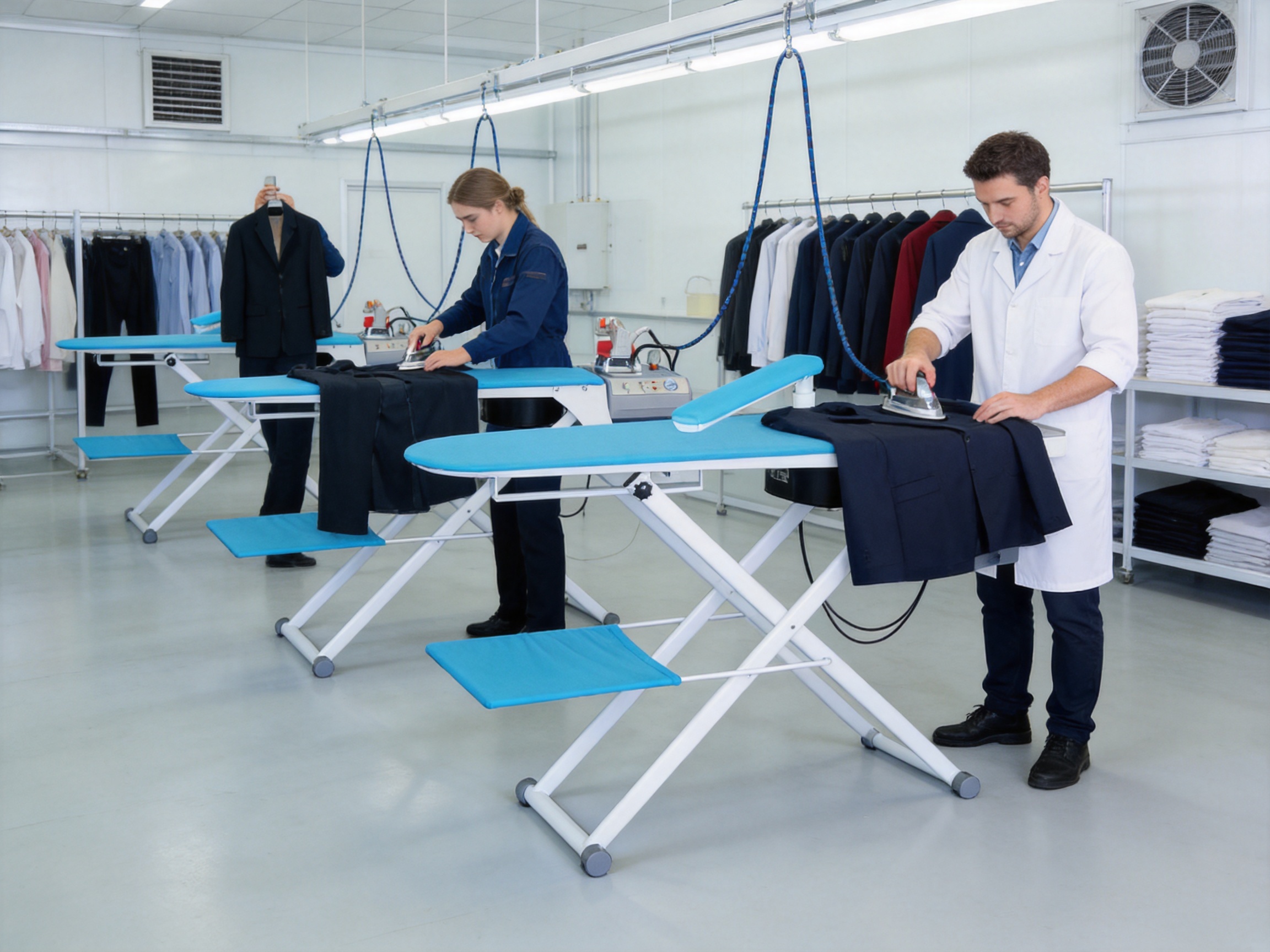
Professional garment finishing depends on more than a hot surface and a conventional iron. In tailoring workshops, dry-cleaning facilities, apparel factories, alteration shops, and commercial laundry operations, operators need equipment that can control fabric, remove moisture and wrinkles, maintain a dependable working temperature, and support repeated production without unnecessary interruptions. The 550W Heating Power Vacuum Ironing Table is designed to meet these requirements through the combination of a heated ironing surface and a 65W vacuum motor.
This configuration gives the operator two important forms of control. The 550W heating system supplies consistent thermal support across the working area, while the vacuum motor helps hold garments securely against the table surface. Together, these functions create a more stable platform for pressing, shaping, finishing, and preparing garments for presentation or further production steps.
Operating at 220 V and supporting both 50 Hz and 60 Hz frequencies, the table is suitable for a wide range of professional working environments. Its design is intended for users who require practical performance, straightforward operation, and dependable results during frequent daily use. Rather than relying only on manual pressure and repeated repositioning, the operator can use the heated and vacuum-assisted surface to improve garment control and pressing efficiency.
The 550W Heating Power Vacuum Ironing Table is a specialized vacuum table for professional garment care and textile production. It integrates an electric heating system with a built-in vacuum motor. The heated surface helps maintain the thermal conditions needed for garment pressing, while the vacuum function creates fabric adhesion that helps prevent movement during finishing operations.
Fabric movement is one of the most common causes of inconsistent pressing results. When a garment shifts during ironing, creases may be transferred to the wrong position, seams can lose alignment, and operators may need to repeat the same task. Vacuum assistance reduces this movement by drawing the fabric toward the table. This is particularly useful when working with lightweight materials, shaped panels, collars, cuffs, trouser legs, sleeves, and garments that require accurate edge or seam control.
The table’s heating power of 550W provides a dedicated source of thermal support. In practical use, this helps the working area remain prepared for pressing and reduces dependence on an unheated surface. A heated table can also assist with moisture management and help maintain a more uniform finishing process when garments are handled repeatedly throughout the day.
With a vacuum motor rated at 65W, the equipment is balanced for garment-control applications rather than excessive power consumption. The motor is intended to provide sufficient suction for holding fabric in place while allowing the operator to reposition garments as needed. This balance between suction and usability is important because a professional ironing table must secure fabric without making every adjustment difficult.
| Product | 550W Heating Power Vacuum Ironing Table |
| Product category | Vacuum Table |
| Working voltage | 220 V |
| Frequency | 50/60 Hz |
| Vacuum motor power | 65 W |
| Heating power | 550 W |
| Primary application | Professional garment pressing and finishing |
| Suitable users | Tailors, dry cleaners, apparel manufacturers, alteration shops, and laundry businesses |

550W Heating Power Vacuum Ironing Table
A conventional ironing station generally depends on the operator to hold the garment in position while applying heat and pressure from above. This method can work for simple garments, but it becomes less efficient when the fabric is delicate, slippery, layered, shaped, or required to meet a precise production standard. The vacuum table changes the working relationship between the garment and the ironing surface.
When the vacuum motor is activated, air is drawn through the table surface. The resulting suction helps keep the fabric in contact with the board. The operator can then focus on controlling the iron, steam, and garment shape instead of repeatedly correcting fabric movement. This can make pressing more predictable and may help reduce the number of repeated passes required to obtain a clean result.
The integrated heating system provides additional support from below. Heat from the table can help maintain a more stable working environment, especially when the operator is processing garments in succession. The heated surface may assist in relaxing fibers, improving moisture evaporation, and supporting the final shape created during pressing. It also helps prevent the table from becoming a cold surface that counteracts the heat supplied by the iron.
These two systems work together rather than functioning as unrelated features. Vacuum holds the fabric, and heat supports the pressing process. The operator therefore gains a more controlled platform for handling areas where accuracy matters, including pockets, lapels, hems, pleats, waistbands, shoulders, collars, and sleeve seams.
The 550W heating system is one of the defining features of this vacuum ironing table. Heated tables are especially useful in professional environments because they contribute thermal support from the working surface. When the table and iron operate as a coordinated system, the garment can be exposed to heat from above and below, depending on the pressing method and material requirements.
This arrangement can improve the consistency of garment finishing. A stable heated surface helps operators maintain a repeatable process instead of working on a surface that changes significantly with room temperature or production duration. For businesses handling many garments in one shift, repeatability is important because consistent finishing affects both product appearance and customer satisfaction.
The heating power is also practical for businesses that need professional performance without installing a large industrial pressing system. It provides a focused solution for garment preparation and finishing while maintaining a relatively straightforward electrical configuration.
The 65W vacuum motor provides the suction needed to hold fabrics against the table. This is valuable when handling materials that slide easily or when working on garments with complex construction. A secure fabric position supports cleaner pressing lines and makes it easier to maintain the relationship between seams, edges, and garment panels.
Vacuum assistance can also reduce the physical effort required from the operator. Without suction, the operator may need one hand to hold the garment while using the other hand to operate the iron. With the garment held more securely by the table, both hands can be used more effectively for smoothing, positioning, or controlling the iron, depending on the workflow.
For production teams, this can contribute to a more organized operating rhythm. Garments can be placed, aligned, pressed, checked, and removed with fewer unnecessary corrections. The benefit is not limited to speed; better control can also help reduce avoidable pressing marks and alignment errors.
The table is designed for operation at 220 V and supports both 50 Hz and 60 Hz frequencies. This makes it suitable for many commercial and industrial electrical environments. Frequency compatibility is useful for export-oriented equipment because it allows the same product configuration to serve customers in different markets, subject to local electrical requirements and appropriate installation practices.
Businesses should always verify the local supply voltage, plug configuration, grounding requirements, and workplace electrical regulations before installation. Correct electrical preparation supports safe operation and helps protect the equipment from avoidable power-related problems.
Fabric control is a central advantage of the product. A stable surface helps the operator work more accurately on garments that require careful shaping. This is especially important for tailoring and garment manufacturing, where small inconsistencies can affect the appearance of the finished item.
The vacuum function may be helpful when pressing thin fabrics, synthetic materials, blended textiles, and garments with areas that tend to lift or move. It can also support the treatment of larger panels, because the operator can secure one section while working on another section without losing the overall alignment.
The product is intended for professional use in environments where equipment may be used frequently. Its combined heating and vacuum functions address two of the most important requirements in repeated pressing: stable temperature support and reliable fabric positioning.
Although productivity depends on the operator, garment type, pressing method, and workflow, a purpose-built vacuum table can be more efficient than a basic non-heated board. It allows the business to establish a more repeatable process and may reduce the need for repeated garment handling. This is particularly valuable in alteration shops, dry cleaners, and small manufacturing facilities that need professional results without the floor space or cost associated with larger automated pressing systems.
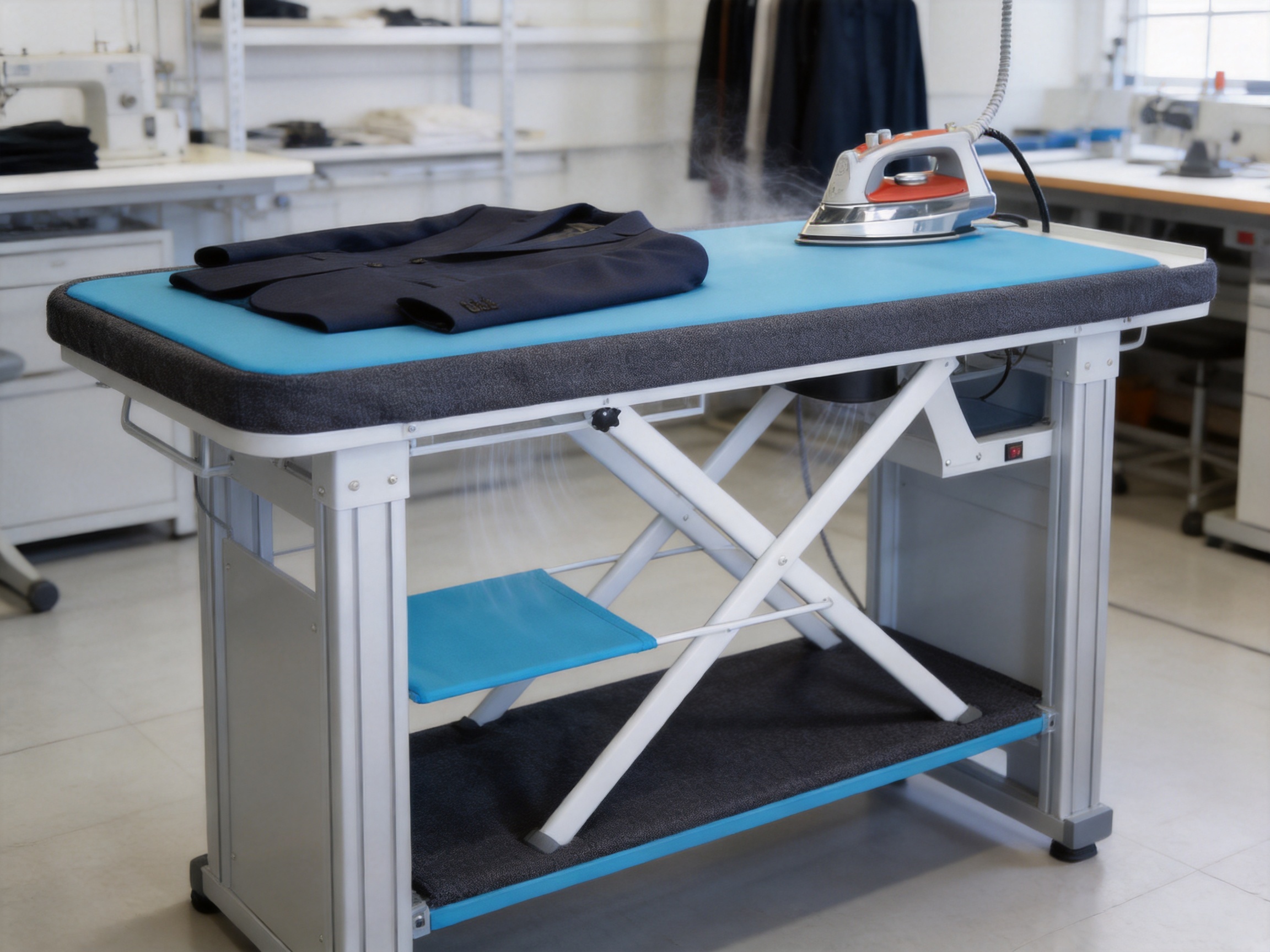
Basic ironing tables provide a flat working surface, but they may not include either active heating or vacuum suction. Their performance depends heavily on the external iron and the operator’s ability to hold the fabric in place. For occasional household use, that arrangement may be adequate. For commercial work, however, the limitations can become more noticeable.
A non-heated table does not actively support thermal consistency from below. The surface may remain relatively cool, and the operator must rely entirely on the iron for heat transfer. The 550W heated design adds another source of controlled thermal support, helping the workplace maintain a more professional pressing environment.
A standard board also provides little assistance when the fabric is slippery or when a garment has a complex shape. The 65W vacuum motor addresses this weakness by helping attach the fabric to the table. The result is a more secure working platform and less dependence on manual holding.
Compared with a basic table, the product can provide:
• More stable fabric positioning during pressing.
• Active heating support from the work surface.
• Better control of seams, edges, panels, and shaped garment areas.
• A more repeatable operating process for frequent production.
• A professional configuration suitable for tailoring and commercial garment care.
Compared with larger industrial pressing systems, the table offers a more compact and practical solution for businesses that need specialized finishing support without investing in a complete automated line. It is suitable for organizations that require improved performance but still depend on flexible, operator-controlled garment handling.
Tailors often work with garments that require careful adjustment and detail finishing. A custom jacket, formal dress, suit, uniform, or coat may contain multiple seams, shaped panels, and areas that must be pressed in a specific direction. Vacuum assistance can help keep the garment aligned while the tailor shapes the fabric.
The heated surface is useful during repeated fitting and alteration work. A tailor may need to press a seam, inspect the result, make an adjustment, and press again. A stable working platform supports this iterative process and helps the operator achieve a clean appearance without excessive movement.
Dry-cleaning businesses process garments made from a wide variety of fibers and construction methods. They may handle shirts, trousers, jackets, uniforms, dresses, coats, and delicate fashion items during the same working day. A vacuum ironing table provides a flexible platform for finishing different garment types after cleaning.
Because customer expectations are closely connected to garment appearance, consistent finishing is essential. The 550W heating system and 65W vacuum motor can support a more controlled finishing routine, helping operators prepare garments for collection, delivery, or display.
In garment factories and smaller apparel production facilities, pressing may take place at several stages. Components can be pressed before assembly, seams can be opened or shaped during production, and completed garments may require final finishing before packaging. The table can support these activities wherever an operator needs secure fabric control and a heated surface.
It is particularly suitable for production departments that need an operator-controlled station rather than a fully automated press. The equipment can be integrated into a broader workflow alongside steam irons, boilers, spray guns, pressing machines, and other garment finishing tools.
Uniforms and workwear often require clear seams, consistent creases, and a clean professional appearance. The vacuum table can help operators manage structured fabrics and multiple garment layers. The heated surface supports finishing operations that prepare garments for inspection and shipment.
Alteration shops need compact equipment that can handle diverse garments efficiently. Since each customer item may have different dimensions and construction, flexibility is important. The product’s operator-controlled design allows users to work on individual areas without requiring a specialized automated mold for every garment type.
Fashion schools and textile training centers can use professional vacuum tables to introduce students to commercial garment finishing methods. Learning on equipment with both heating and suction functions helps students understand fabric control, pressing order, seam shaping, and safe workflow organization.
Jinyun Shengda Sewing Equipment Co., Ltd. was established in 2003 in Huzhen Town, Lishui City, Zhejiang Province, China. The company specializes in the independent research, development, and production of garment ironing and finishing equipment. Its product range includes electric irons, steam irons, hanging irons, spray guns, small steam machines, heat transfer machines, steam boilers, vacuum tables, and related accessories.
This broad product portfolio is an important manufacturing advantage. A company that produces several connected categories of garment equipment can develop a more complete understanding of how heating, steam, vacuum, electrical control, and operator workflow interact. That knowledge can support product development and make it easier to design equipment for real garment production environments.
The company’s history since 2003 also reflects long-term involvement in the sewing and garment equipment sector. Over time, manufacturers in this field gain practical experience in component selection, equipment assembly, quality management, export preparation, customer requirements, and after-sales communication.
According to the supplied company information, the company maintains research and development, management, and sales teams that work together. Cooperation between these functions is valuable because product development should reflect both technical requirements and actual market use. Feedback from distributors and overseas customers can identify opportunities for improvement in usability, reliability, electrical compatibility, packaging, and product configuration.
Independent research and development allows the manufacturer to improve product structures and configurations according to customer requirements rather than relying only on standardized third-party designs. For a vacuum ironing table, this may involve evaluating heating performance, vacuum behavior, electrical components, surface construction, operator convenience, and compatibility with related equipment.
Research and development is also important when serving international customers. Different markets may have different voltage expectations, frequency standards, installation practices, documentation needs, and workplace regulations. A manufacturer with its own development capability is better positioned to respond to these requirements and discuss customized or OEM solutions.
A professional ironing table requires the coordinated assembly of the heating system, vacuum motor, table structure, electrical wiring, controls, surface materials, and protective components. Each part must be positioned correctly so that the final equipment provides stable operation.
Process control during assembly helps reduce variation between units. This is important for customers purchasing multiple machines because similar equipment should deliver similar operating characteristics across a production area. Consistent assembly also supports maintenance and replacement planning.
Quality control should include checks of electrical connections, heating operation, vacuum motor operation, structural stability, and general appearance. Although individual testing procedures may vary by production line, these areas are fundamental to a reliable vacuum ironing table.
The supplied company information states that Shengda follows national and industry standards, including GB4706.1-2005 and GB4706.2-2007, and that its products have passed CCC and CQC certifications. These standards and certifications demonstrate the company’s attention to electrical product safety and quality requirements within the applicable certification framework.
Customers should still confirm the specific certification documents and market requirements for the exact model and destination country before purchase. Importers and distributors may need additional testing, labeling, or documentation depending on local regulations.
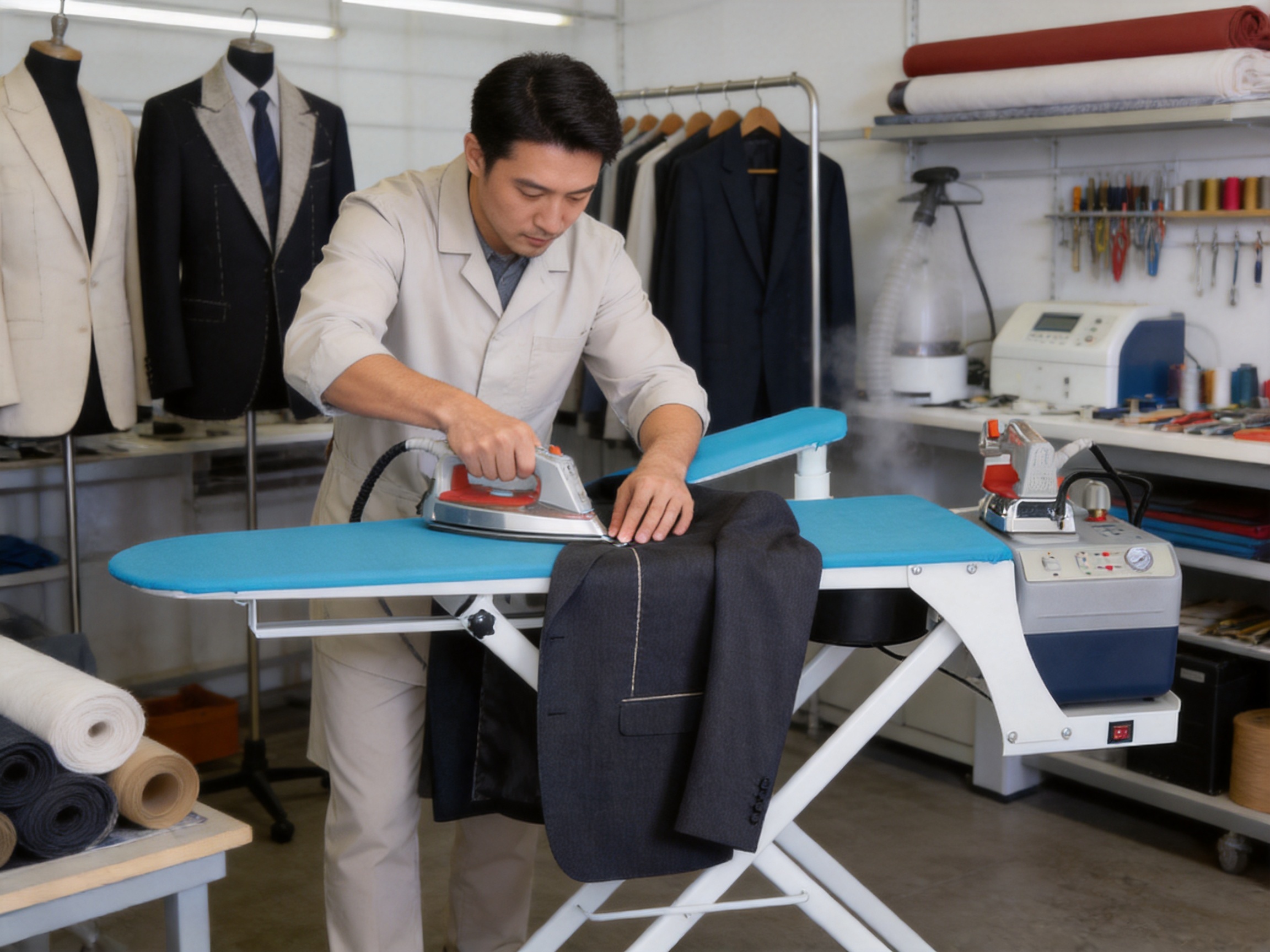
A vacuum ironing table must withstand repeated exposure to heat, moisture, pressure, and garment movement. The work surface should remain stable during use, and the underlying structure should support the operator’s routine without excessive vibration or movement. The combination of a heating element and vacuum motor requires careful attention to electrical separation, insulation, wiring, and heat management.
The 550W heating system and 65W vacuum motor represent the main powered functions of the product. Together, they provide focused performance without the complexity of a larger production line. The electrical system should be connected to an appropriate 220 V supply with suitable grounding and protection.
Operators should keep the surface free from accumulated lint, threads, and loose debris. Textile dust can affect ventilation and may reduce the efficiency of moving components if allowed to build up over time. Regular cleaning is therefore part of responsible equipment ownership.
The table cover and other consumable or wear-related components should also be inspected regularly. A damaged or heavily compressed cover can affect fabric contact and pressing quality. Replacing worn materials according to the manufacturer’s recommendations helps maintain a consistent work surface.
Professional garment finishing becomes easier to manage when each step is performed on equipment suited to the task. The vacuum table can serve as a dedicated station for pressing and shaping, allowing other equipment to be assigned to steaming, spot treatment, heat transfer, or boiler service.
This division of work may help businesses organize production more clearly. Operators can establish a sequence for garment inspection, positioning, vacuum activation, pressing, cooling, quality checking, and removal. A consistent sequence helps new employees learn the process and makes it easier for supervisors to identify potential problems.
Fabric that moves during pressing may require repeated repositioning. Every unnecessary adjustment consumes time and increases the possibility of creating a new crease or losing alignment. The vacuum function helps reduce this problem by supporting fabric adhesion throughout the operation.
The time saved on each garment may be modest, but the cumulative effect can be important in a busy dry cleaner or production workshop. More stable handling can also reduce operator frustration and support a smoother working rhythm.
Customers judge garments by their final appearance. Straight seams, clean edges, properly shaped panels, and smooth surfaces contribute to a professional result. A heated vacuum table gives the operator tools that support these outcomes.
Consistency is especially important when a business processes batches of uniforms, shirts, trousers, or other similar garments. A repeatable station can help operators apply similar methods across the batch, improving visual uniformity before packaging or delivery.
Not every business needs a fully automated pressing line. Some operations require better performance than a conventional board but still need the flexibility of manual control. This product occupies that practical middle position. It provides active heating and vacuum assistance in one table while allowing the operator to control garment placement and pressing technique.
This makes the equipment appropriate for businesses expanding from basic tools toward professional production. It can also supplement existing equipment when a company needs an additional vacuum station to increase capacity.
Before use, the operator should inspect the electrical connection, confirm that the working area is clear, and check that the table surface and cover are in good condition. The garment should be examined for care-label requirements, fabric sensitivity, decorative elements, and construction details that may influence pressing temperature or pressure.
The garment should then be placed on the table with the relevant section aligned to the working area. The operator can activate the vacuum function to help secure the fabric. Depending on the garment and material, it may be useful to work from larger areas toward smaller details, keeping seams and edges aligned as the garment is repositioned.
The iron or steam iron should be used according to the fabric manufacturer’s recommendations. The table’s heating function supports the process but does not replace the need for correct iron temperature, steam control, pressing cloths, or suitable protective methods when required.
After pressing, the operator should allow the garment to stabilize before moving it. Some materials retain shape better when they are allowed to cool while remaining properly aligned. A final visual inspection can identify shine, unwanted creases, displaced seams, moisture marks, or other issues before the garment leaves the station.
Work practices should be adapted to the material. Delicate textiles may require lower temperatures, reduced pressure, pressing cloths, or shorter contact times. Heavy fabrics may require a different pressing sequence. Operators should be trained to follow garment care instructions and internal quality procedures.
Routine maintenance helps preserve both heating and vacuum performance. The table should be switched off and disconnected from the power supply before cleaning, inspection, or service work. Operators should avoid allowing water or cleaning liquids to enter electrical components, controls, the heating system, or the motor assembly.
The working surface should be kept clean and free of lint. Air passages and vacuum openings should be checked periodically because blocked openings may reduce suction. If the vacuum performance changes noticeably, the operator should inspect for obstructions, worn covers, loose connections, or other conditions identified in the product documentation.
The heating function should also be monitored. Uneven heating, unusual odors, repeated electrical protection trips, or abnormal noises should be treated as service indicators. The equipment should be removed from use until a qualified technician has identified the cause.
Maintenance records can be helpful in commercial environments. Recording cleaning, inspection, component replacement, and service events gives managers a clearer view of equipment condition. It can also support planned maintenance rather than waiting for a failure during a busy production period.
Because the product combines electrical heating and vacuum operation, safe use requires attention to both hot surfaces and electrical protection. Operators should receive training before using the table and should understand the function of the controls, the location of the power connection, and the correct shutdown procedure.
The table should be installed on a stable surface with sufficient clearance for ventilation and operator movement. Electrical cables should be positioned so that they do not create a trip hazard or contact hot surfaces. The equipment should not be used in conditions that exceed the manufacturer’s environmental recommendations.
Users should avoid placing combustible materials on or near the heated surface. Garments should be checked for metal objects, plastic parts, adhesives, coatings, and decorations that may react to heat. When working with unfamiliar textiles, a test area or protective pressing method should be considered.
Children and untrained persons should not operate the equipment. When the table is not in use, it should be switched off and disconnected according to workplace procedures. Any repair involving electrical components should be performed by an appropriately qualified technician.
Purchasing professional equipment involves more than selecting power ratings. Customers also need product information, replacement parts, technical communication, packaging support, and assistance with installation or troubleshooting. A manufacturer with a broad product range and export experience can provide useful support throughout the equipment’s service life.
Jinyun Shengda Sewing Equipment Co., Ltd. serves domestic and overseas customers and exports products to Southeast Asia, Central Asia, South America, Africa, and other regions. This international experience is relevant to distributors and buyers who need communication across different markets and shipping environments.
The company identifies customization and OEM services as part of its business strengths. This may benefit importers, wholesalers, and equipment distributors that require particular labeling, packaging, product configurations, or market-oriented arrangements. Any customization should be discussed in detail before order confirmation, including technical specifications, minimum quantities, certification requirements, delivery schedules, and documentation.
A broad product portfolio also allows customers to source related equipment from one manufacturer. A business may need a vacuum table together with electric irons, steam irons, spray guns, steam boilers, heat transfer machines, or accessories. Consolidated sourcing can simplify communication and product coordination, although buyers should evaluate each model according to its own technical and compliance requirements.
Before ordering the 550W Heating Power Vacuum Ironing Table, buyers should confirm the intended application. A tailor processing custom garments may prioritize surface control and flexibility, while a factory may focus on production capacity, serviceability, and consistency across multiple units.
Electrical compatibility should be verified carefully. The product is specified for 220 V operation and 50/60 Hz frequency compatibility. Buyers should confirm whether the destination facility uses the same voltage, whether a suitable grounded outlet is available, and whether local authorities require additional certification.
Purchasers should also ask about packaging dimensions, shipping weight, replacement covers, spare electrical components, warranty terms, operating instructions, and recommended maintenance intervals. These details are particularly important for international orders and for distributors stocking equipment for multiple customers.
For larger projects, buyers may request information about production capacity, inspection procedures, lead times, OEM options, and quality documentation. Clear communication at the quotation stage reduces misunderstandings and helps both parties define the expected product configuration.
End users should evaluate the table’s location within the workshop. There should be enough space to place garments without dragging them across other equipment. Lighting should be sufficient for inspecting seams and surfaces, and the operator should be able to work without excessive bending or reaching.
The main function is to provide a heated and vacuum-assisted surface for professional garment pressing and finishing. The 550W heating system supports thermal performance, while the 65W vacuum motor helps hold fabric securely against the table.
The product is designed for 220 V operation. It supports both 50 Hz and 60 Hz frequencies. Buyers should verify local electrical requirements and installation conditions before use.
Yes. Its operator-controlled design and combination of heating and vacuum functions make it suitable for tailoring workshops, alteration shops, and other small or medium-sized garment businesses that need professional finishing support.
Yes. Dry cleaners can use the table for finishing shirts, trousers, jackets, uniforms, dresses, coats, and other garments. Operators should always follow the care instructions and use suitable pressing temperatures for each textile.
The vacuum motor draws air through the table surface and helps secure the garment. This reduces unwanted fabric movement and supports more accurate pressing of seams, edges, panels, collars, cuffs, and other garment areas.
The heating function provides thermal support from the table surface. It can help create a more consistent pressing environment, support moisture management, and reduce reliance on a cold or unheated board.
No. The table is designed to work as part of a garment finishing system. A suitable iron or steam iron is still used to apply pressing heat, pressure, and, where appropriate, steam from above.
It can be used in apparel manufacturing and other production environments that require operator-controlled pressing. It is appropriate for component pressing, seam shaping, final garment finishing, and similar tasks. The required number of tables depends on production volume and workflow design.
It can support work with many fabric types, but the operator must follow the care requirements for each textile. Delicate fabrics may require lower temperatures, pressing cloths, controlled pressure, or testing on an inconspicuous area.
Routine care includes cleaning lint and debris from the work area, checking vacuum openings, inspecting the cover, monitoring heating performance, and examining electrical connections according to qualified service procedures. The table should be disconnected before cleaning or maintenance.
The supplied company information states that customization and OEM services are among the company’s advantages. Buyers should discuss the exact requirements, including labeling, packaging, technical configuration, certification, order quantity, and delivery schedule.
Potential users include tailoring workshops, dry cleaners, garment factories, alteration businesses, uniform producers, commercial laundries, fashion schools, textile training centers, and distributors of professional ironing equipment.
Buyers should review the voltage, frequency, heating power, vacuum motor power, installation requirements, working environment, garment types, expected production volume, spare-part availability, and local compliance requirements before ordering.
The 550W Heating Power Vacuum Ironing Table combines two practical functions that are essential to professional garment finishing: active heating and vacuum-assisted fabric control. Its 550W heating system helps support consistent thermal conditions, while the 65W vacuum motor helps prevent fabric movement during pressing. The result is a stable and versatile work platform for tailors, dry cleaners, apparel manufacturers, alteration shops, and other garment professionals.
Compared with a basic non-heated ironing board, the product offers greater process control and more direct support for repeatable production. Compared with larger automated systems, it provides a compact operator-controlled solution for businesses that need professional performance with workflow flexibility.
The manufacturer’s experience in garment ironing equipment, independent research and development, broad product portfolio, international distribution, certification awareness, and OEM capability further strengthens the product’s commercial value. By combining practical specifications with a manufacturing background focused on garment equipment, the company is positioned to serve both individual professional users and larger distributors.
For businesses seeking improved pressing stability, consistent fabric handling, and a more efficient finishing station, this vacuum ironing table is a capable addition to a professional garment care or production workflow.
1. Product specification sheet for the 550W Heating Power Vacuum Ironing Table, including voltage, frequency, vacuum motor power, and heating power.
2. Manufacturer company profile and product portfolio information supplied for Jinyun Shengda Sewing Equipment Co., Ltd.
3. General principles of professional garment pressing, vacuum table operation, fabric handling, and textile finishing.
4. GB4706.1-2005, Safety of Household and Similar Electrical Appliances—General Requirements.
5. GB4706.2-2007, Safety Requirements for Household and Similar Electrical Appliances—Particular Requirements for Electric Irons.
6. General workplace guidance for electrical equipment safety, heat management, textile handling, and preventive maintenance.
 +86-578-3158872 / +86-578-3158958
 jyshengda@163.com / caroying@jy-shengda.com
 No. 8 Nanyi Rd, Huzhen Industrial Park, Zhejiang, China
Copyright © Jinyun Shengda Sewing Equipment Co., Ltd. All Rights Reserved.
Ironing Press Machine Equipment Factory
 English
 中文简体
 русский
 عربى