Professional garment care depends on more than heat alone. A reliable ironing system must combine stable temperature, controlled steam, smooth movement, operator comfort, safe handling, and long-term durability. The ST-K All Steam Iron has been developed around these requirements, offering a practical solution for garment factories, tailoring workshops, laundries, clothing stores, hotels, uniform services, and other businesses that need consistent finishing results.
Designed with a high-quality stainless steel soleplate, an ergonomic handle, adjustable steam flow, a return air valve, and a protected steam hose, the ST-K All Steam Iron is intended to make demanding ironing work more efficient. Its construction emphasizes both performance and ease of operation, helping users remove wrinkles from different fabrics while reducing unnecessary physical strain.
The product is manufactured by Jinyun Shengda Sewing Equipment Co., Ltd., a professional Chinese producer of ironing equipment and related machinery. Since its establishment in 2003, the company has focused on independent research, development, production, quality improvement, and international distribution. Its product range includes electric irons, steam irons, hanging irons, spray guns, small steam machines, heat transfer machines, steam boilers, vacuum tables, and accessories.
This article examines the ST-K All Steam Iron in detail. It explains its structure, operating advantages, manufacturing strengths, maintenance requirements, application areas, and competitive value. It also shows why a well-designed all-steam iron can become an important part of a complete professional pressing system.

ST-K All Steam Iron
Garment finishing is the stage at which clothing receives its final visual and tactile improvement. Even garments that have been cut and sewn accurately may show creases from production, transportation, storage, or handling. Pressing removes these unwanted marks and helps shape collars, sleeves, seams, hems, pockets, waistbands, and other areas.
In a professional environment, ironing must be repeatable. Operators may process hundreds or thousands of garments in a working day, so equipment must deliver stable results without causing fabric damage. A commercial iron must also be comfortable enough for extended use and durable enough to withstand frequent operation.
Steam plays an essential role because moisture softens textile fibers and allows them to respond more easily to heat and pressure. When steam is distributed consistently, wrinkles can be released more quickly than with dry heat alone. However, excessive steam may create moisture marks, while insufficient steam may force the operator to apply additional pressure or repeat the same movement.
The ST-K All Steam Iron addresses this need through integrated steam control. The operator can adjust the steam flow according to the material, garment construction, and desired finishing effect. Delicate fabrics may require gentle steam and light contact, while thicker fabrics may benefit from stronger steam penetration and more deliberate pressing.
An all-steam iron is particularly useful when connected to a suitable steam supply system. It can become part of a wider workstation that includes a steam boiler, vacuum table, sleeve board, pressing table, or other garment-finishing accessories. This flexibility allows businesses to configure the iron according to their output volume and production requirements.
The ST-K All Steam Iron is built as a professional pressing tool rather than a basic household appliance. Its design focuses on the working relationship between the soleplate, handle, steam circuit, hose, controls, and operator. Every component influences the final result, because an iron that heats well but is uncomfortable or difficult to control may reduce productivity.
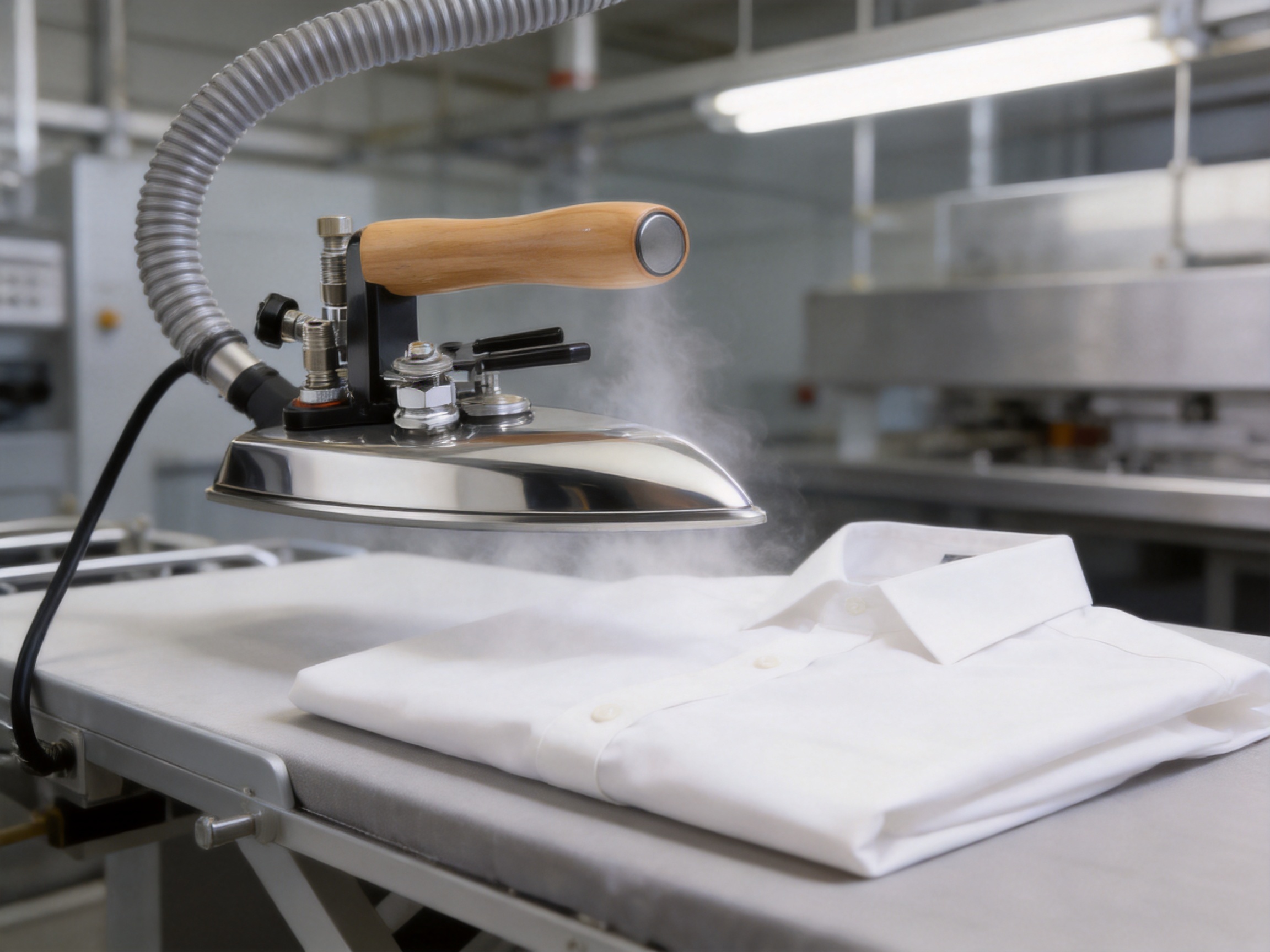
The stainless steel soleplate forms the main contact surface. It is designed to distribute heat evenly across the working area and glide smoothly over fabric. A polished soleplate helps reduce drag, allowing the user to move across garments with less effort. It also supports more uniform contact when the operator is shaping edges, seams, or larger fabric panels.
The handle has been specially designed for grip and control. Its shape supports natural hand positioning and places operating controls within convenient reach. This is important during repetitive work, because awkward grip angles can increase wrist tension and hand fatigue.
The steam system includes adjustable steam flow and a return air valve. These elements are intended to support more efficient and consistent steam delivery. The protected steam hose is covered with a protective sleeve that helps reduce wear caused by movement, bending, heat, and repeated handling.
Maintenance accessibility is another part of the product design. Components that can be inspected, cleaned, or cared for without unnecessary difficulty help reduce downtime. A clean soleplate and properly maintained steam path support better performance over the service life of the equipment.
| Component | Primary Function | Operational Benefit |
|---|---|---|
| Stainless steel soleplate | Transfers heat and pressure to the fabric | Even heating, smooth movement, and resistance to corrosion |
| Ergonomic handle | Provides grip and operating control | Improved comfort and reduced hand fatigue |
| Steam flow adjustment | Controls the amount of steam released | Better suitability for different fabric types |
| Return air valve | Supports steam efficiency within the system | More consistent steam performance |
| Protective hose sleeve | Shields the steam hose from external wear | Improved durability and flexible operation |
| Accessible maintenance design | Allows cleaning and routine care | Reduced downtime and dependable operation |
The soleplate is one of the most important parts of any iron. It directly contacts the garment and determines how heat and pressure are transferred. A poor soleplate may create uneven temperature zones, catch on fabric, develop surface damage, or become difficult to clean. The ST-K uses a high-quality stainless steel soleplate to address these common concerns.
Stainless steel provides a combination of strength, heat resistance, corrosion resistance, and surface durability. In a professional ironing environment, the soleplate may be exposed to steam, moisture, finishing residues, and repeated friction. A suitable stainless steel construction helps maintain the working surface under these conditions.
Even heat distribution helps the operator work with greater confidence. When the soleplate maintains a more uniform temperature, the user can move across a garment without repeatedly correcting cold spots or applying excessive pressure. This can shorten processing time and help create a consistent appearance from one garment to the next.
The polished surface is also designed to glide smoothly over textiles. Smooth movement is especially valuable when pressing long seams, broad panels, trousers, skirts, shirts, jackets, and other garments with extended surfaces. Reduced drag allows the operator to guide the iron more accurately while using less physical effort.
Another advantage is resistance to scratches and corrosion. While proper care is still essential, a durable stainless steel surface is better suited to frequent use than a fragile contact surface. Routine wiping can remove residue and preserve the appearance and performance of the soleplate.
In comparison with lower-quality ironing tools, the ST-K soleplate is designed to offer a better balance between heat transfer, durability, and smooth operation. This balance is valuable for businesses that cannot afford frequent equipment replacement or inconsistent finishing quality.
Different fabrics respond differently to heat, moisture, pressure, and movement. Lightweight materials can be sensitive to excessive temperature or steam, while heavier textiles may require more moisture and sustained contact. The stainless steel soleplate provides a stable working surface, while the adjustable steam function allows the operator to adapt the process.
For delicate materials, the user can reduce steam output and use controlled movement. For cotton, linen, workwear, denim, or heavier blended fabrics, a higher steam setting may help relax fibers and release deep creases. The operator remains responsible for selecting an appropriate working method, but the iron provides the flexibility needed for varied production.
Productivity is closely connected to operator comfort. In professional pressing, an employee may hold and move an iron repeatedly for several hours. Even a technically capable product can become inefficient if its handle causes excessive pressure on the palm, wrist, fingers, or forearm.
The ST-K All Steam Iron features a specially designed handle intended to provide a more secure and comfortable grip. Its ergonomic form supports controlled movement and helps the operator guide the iron across different garment shapes. A stable grip is particularly important when working around collars, cuffs, curved seams, pockets, and narrow sections.
Buttons for steam activation are positioned for convenient operation. Easy access means the user can adjust steam without interrupting the ironing flow or changing hand position unnecessarily. This small design detail can make a significant difference during repetitive work.
The lightweight construction further supports maneuverability. A lighter tool generally requires less effort to lift, reposition, and guide. This is beneficial when the operator must move quickly between different sections of a garment or handle a large volume of products during one shift.
Comfort also contributes to quality. When an operator experiences less fatigue, it becomes easier to maintain consistent movement and pressure. Reduced fatigue may help prevent hurried strokes, missed wrinkles, accidental contact with unsuitable areas, or inconsistent finishing near seams and edges.
Ergonomic equipment does not eliminate the need for correct working posture, suitable table height, rest periods, and safe handling practices. However, it can reduce unnecessary strain by making the tool easier to hold and control. The ST-K design supports this principle through its handle shape, manageable weight, and accessible controls.
Businesses can further improve operator comfort by pairing the iron with a correctly sized ironing table or vacuum table. The workstation should allow the user to keep the shoulders relaxed, the wrist in a natural position, and the garment within easy reach. Proper steam hose routing is also important, because the hose should not pull against the operator or interfere with movement.
Steam control is a central advantage of the ST-K All Steam Iron. Garments are not uniform products, and a single steam setting cannot provide ideal results for every material. Adjustable steam flow allows the operator to select a suitable output for the task at hand.
A lower steam setting may be useful for thin or delicate fabrics, areas that require gentle shaping, or garments where excess moisture could be undesirable. A higher setting may support faster wrinkle release on dense materials, layered seams, jackets, uniforms, or workwear.
The ability to control steam also helps users develop a more efficient working rhythm. Instead of releasing steam continuously, the operator can apply it when and where it is needed. This can help limit unnecessary moisture, reduce resource waste, and improve the overall consistency of the finishing process.
The return air valve contributes to steam efficiency by supporting a more stable steam flow within the system. Consistency matters because irregular steam output can produce uneven results and force the operator to repeat movements. A reliable steam response allows the user to coordinate heat, moisture, pressure, and motion more effectively.
Steam performance depends on the full installation, including the steam source, hose condition, connections, pressure, water quality, and maintenance. The ST-K is designed to work as part of a professional ironing setup, so correct installation and routine inspection remain important for achieving the best results.
| Fabric or Task | Suggested Steam Approach | Reason for Adjustment |
|---|---|---|
| Lightweight fabric | Use controlled, moderate or low steam | Helps avoid excessive moisture and overworking the surface |
| Cotton shirt | Use moderate steam with smooth passes | Supports efficient wrinkle release and shaping |
| Linen garment | Use sufficient steam and deliberate movement | Helps relax strong natural-fiber creases |
| Heavy uniform or workwear | Use stronger steam when appropriate | Improves penetration through dense or layered material |
| Collar, cuff, or seam | Use localized steam and controlled pressure | Supports accurate shaping in small areas |
The steam hose is a working connection between the iron and the steam supply. Because it moves continuously during operation, it can be exposed to bending, rubbing, twisting, heat, and repeated stress. A damaged or poorly protected hose may reduce steam performance and create a safety concern.
The ST-K All Steam Iron includes a protective sleeve around the steam hose. This sleeve helps shield the hose from external wear and contributes to longer service life. It also supports flexibility, allowing the operator to move the iron without feeling restricted by the connection.
Flexible hose movement is especially important when pressing large garments or working around three-dimensional shapes. The operator may need to change direction frequently, reach across a table, or lift the iron slightly to reposition it. The hose should follow these movements without sharp kinks or unnecessary resistance.
Correct hose management remains essential. The hose should be routed so that it does not contact sharp edges, interfere with the operator’s feet, or become trapped beneath equipment. It should also be inspected regularly for visible damage, stiffness, leakage, or unusual heat exposure.
By combining hose protection with suitable installation practices, businesses can reduce avoidable interruptions and maintain more dependable steam delivery. This is one of the practical details that distinguishes a professional ironing tool from a basic iron designed only for occasional use.
Maintenance directly affects the operating life of ironing equipment. Residue on the soleplate can transfer to garments, while deposits in the steam system may reduce flow or affect performance. A maintenance-friendly product helps users address these issues before they become major problems.
The ST-K All Steam Iron has an accessible design intended to simplify cleaning and routine care. The stainless steel soleplate can be wiped down to remove surface residue. Regular cleaning helps preserve smooth movement and reduces the risk of transferring contamination onto finished garments.
Users should allow the equipment to cool safely before cleaning and follow the applicable operating instructions. Abrasive tools or unsuitable chemical products should be avoided if they may scratch or damage the working surface. Steam connections should be checked periodically, and the hose should be examined for signs of wear.
Water quality can also affect steam equipment. Depending on the local water supply and the connected steam system, mineral deposits may accumulate over time. A suitable water treatment or boiler maintenance program can help protect the wider installation. The exact procedure should follow the requirements of the steam generator and workplace equipment.
Routine care offers several benefits. It helps preserve steam consistency, reduces unexpected downtime, maintains a clean working surface, and supports a longer product life. For a production business, these benefits can translate into lower operating disruption and more predictable finishing quality.
At the beginning of each working period, operators should visually inspect the iron, handle, controls, soleplate, hose, and connections. Any unusual odor, leakage, electrical issue, or irregular steam behavior should be reported before continued use.
During operation, the soleplate should be kept free from excessive residue. If the iron contacts adhesive, plastic, printed material, or other substances that may melt or transfer, it should be cleaned using an appropriate method after it has been made safe.
At the end of the working period, the iron should be stored in a stable position with the hose arranged without sharp bends. Regular maintenance records can be useful in factories and commercial laundries, especially where several irons are used across multiple workstations.
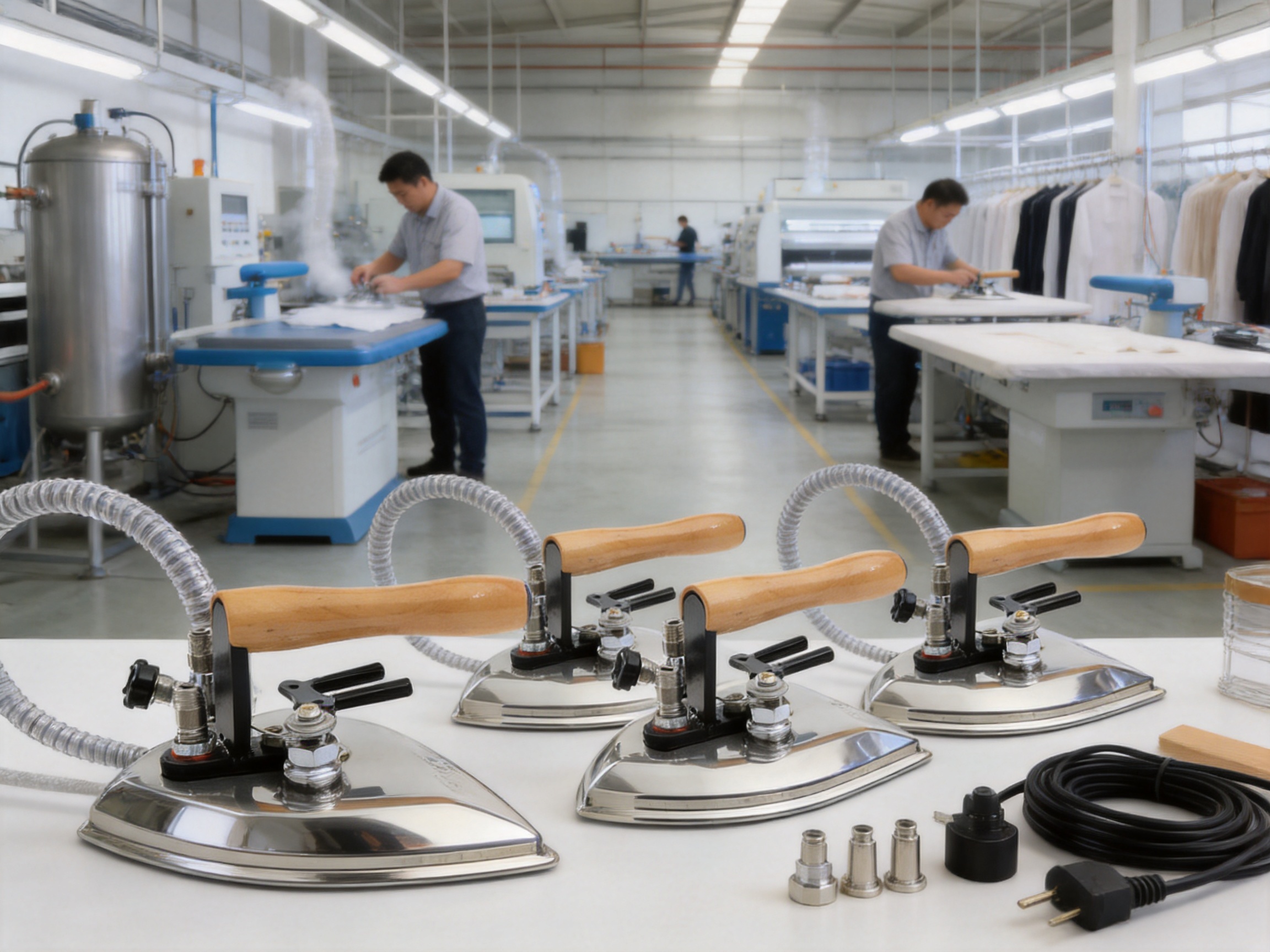
The performance of an ironing tool depends not only on its visible design but also on the manufacturing system behind it. Jinyun Shengda Sewing Equipment Co., Ltd. has specialized in ironing equipment since 2003. Its experience covers product development, production, management, sales, and service.
The company emphasizes independent research and development. This approach enables it to improve structures, controls, materials, and product functions according to market requirements. Rather than treating an iron as an isolated appliance, the company develops products within a broader portfolio of garment-finishing equipment.
This product portfolio includes electric irons, all-steam irons, hanging irons, spray guns, small steam machines, heat transfer machines, steam boilers, vacuum tables, and accessories. Such product breadth provides an understanding of how different pieces of equipment must work together in a garment workshop or industrial finishing line.
The company’s teams in research and development, management, and sales work together to support product improvement and customer service. Cooperation between these functions can help manufacturers identify common field requirements, improve product details, and respond more effectively to different export markets.
Manufacturing experience also supports customization and OEM services. Different customers may require variations in packaging, electrical specifications, branding arrangements, technical documentation, or system configuration. A manufacturer with a broad product base and established production experience is better positioned to discuss these requirements.
The company follows national and industry standards, including GB4706.1-2005 and GB4706.2-2007, and its products have passed CCC and CQC certifications. These certifications and standards indicate attention to electrical safety, product compliance, and manufacturing control. Buyers should still confirm the specific certification and electrical configuration applicable to the product order and destination market.
Professional ironing equipment must be evaluated across more than one performance category. Heat stability, steam delivery, insulation, mechanical strength, hose durability, handle security, surface quality, and control response all contribute to product reliability.
A responsible manufacturing process begins with suitable material selection. The stainless steel soleplate must provide a stable surface and withstand repeated heating and cooling. The handle must remain secure during movement. Steam-related components must be suitable for the intended pressure and temperature conditions. Protective elements such as the hose sleeve must be integrated without limiting flexibility.
Assembly accuracy is also important. Misalignment can affect the way the soleplate contacts fabric, while poor connections may lead to steam leakage or inconsistent operation. Inspection during production helps identify these issues before the finished product reaches the customer.
Testing may include visual checks, electrical safety checks, functional operation, steam response, control operation, and inspection of the completed assembly. A comprehensive approach improves confidence that the iron will perform as intended in a commercial environment.
Quality control is especially valuable for export products. International customers may operate the equipment under different voltage systems, climate conditions, water qualities, and work schedules. Clear specifications and careful production management help reduce installation problems and support stable use across different regions.
| Quality Area | Importance in Professional Use | Expected Result |
|---|---|---|
| Material selection | Determines resistance to heat, corrosion, and wear | Stable product performance over repeated use |
| Assembly precision | Affects safety, balance, and steam connections | Reliable operation and better handling |
| Steam system inspection | Influences flow consistency and efficiency | Controlled steam output |
| Electrical testing | Supports safe connection and operation | Reduced risk of electrical faults |
| Surface inspection | Protects garments from scratches or contamination | Smooth and clean contact with fabric |
| Final functional testing | Confirms product operation before shipment | Improved customer confidence and fewer failures |
The ST-K All Steam Iron offers several advantages over basic irons intended for occasional household use. The first is its professional orientation. It is designed for repetitive garment finishing, where durability, steam control, handling comfort, and maintenance access are essential.
A household iron may include a simple steam function, but it is not always designed for connection to a professional steam supply or for continuous production use. The ST-K, by contrast, is developed as part of an ironing equipment product family and can be integrated into a commercial workstation.
The second advantage is adjustable steam control. Users can adapt output to different fabrics and garment structures instead of relying on one fixed steam behavior. This flexibility can improve results and help reduce unnecessary moisture.
The third advantage is the stainless steel soleplate. A durable, smooth, and corrosion-resistant surface is valuable where the iron is used frequently. It supports efficient movement and can be maintained through regular cleaning.
The fourth advantage is ergonomics. A specially shaped handle and convenient controls help the operator work more comfortably. In production environments, this can contribute to better consistency and lower fatigue.
The fifth advantage is hose protection. A protected and flexible hose can help extend service life and make the iron easier to maneuver. This feature is particularly relevant to businesses that use steam irons throughout the working day.
The sixth advantage is manufacturer support. A company that produces boilers, vacuum tables, heat transfer machines, spray guns, and accessories can provide a broader equipment perspective than a supplier focused on a single consumer iron. This may simplify sourcing for customers developing or upgrading a complete garment-finishing area.
Garment factories require consistent finishing across many product lines. The ST-K All Steam Iron can be used for final pressing, seam correction, collar shaping, sleeve finishing, and preparation before inspection or packing. Its adjustable steam output supports different fabrics and styles within the same production environment.
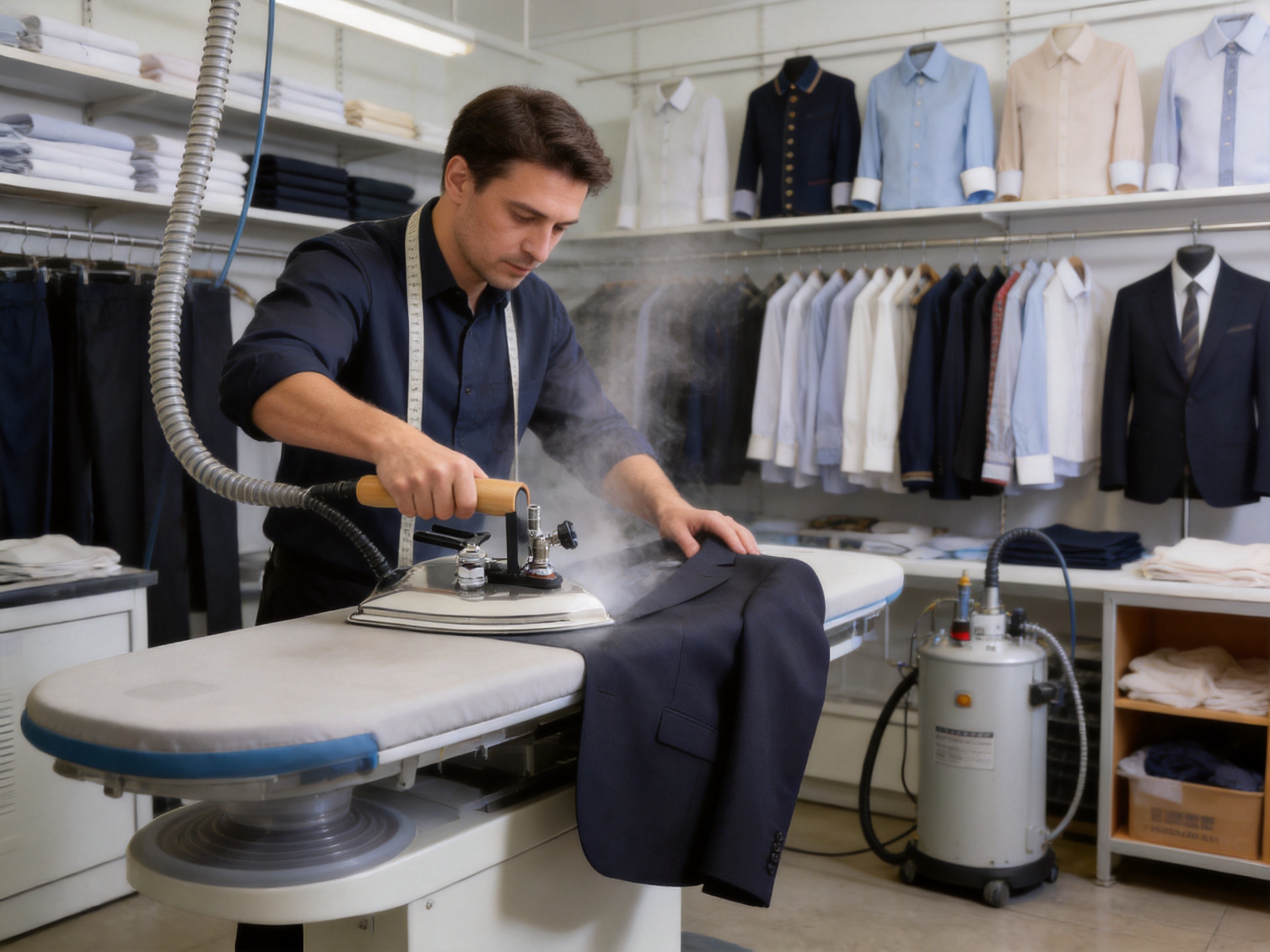
Tailors and custom clothing professionals often work with garments that require precise shaping. The iron’s smooth soleplate, accessible controls, and manageable handling can support detailed work on jackets, trousers, shirts, dresses, and formalwear.
Laundries process a wide variety of textiles and often operate under demanding schedules. A durable all-steam iron can help restore a clean, presentable appearance to uniforms, household textiles, hospitality garments, and customer clothing.
Hotels may use professional ironing equipment for housekeeping, uniforms, table textiles, curtains, and guest services. Reliable steam performance and easy movement are valuable when staff must finish garments quickly while maintaining a high standard of presentation.
Retail businesses and fashion sample rooms use irons to prepare garments for display, fitting, photography, shipment, and customer presentation. Controlled steam can help remove packaging creases without exposing the clothing to unnecessary stress.
Uniform suppliers and workwear companies often handle dense materials, repeated sizes, and high-volume orders. The ST-K can support finishing operations where durability, steam penetration, and operator comfort are important considerations.
The ST-K All Steam Iron performs best when it is integrated into a suitable working environment. A complete pressing station may include a steam boiler, vacuum table, pressing table, lighting, garment supports, sleeve boards, and storage for accessories.
A steam boiler provides the steam source required by the iron. The boiler should be selected according to the number of irons, expected operating hours, pressure requirements, and available electrical or fuel supply. When the steam system is correctly matched, the iron can deliver more stable performance.
A vacuum table can improve garment handling by helping position fabric and remove excess moisture during pressing. It can also support better shape control and reduce the need for repeated repositioning. The iron and table should be arranged so that the operator can move naturally between steam application and garment adjustment.
Accessories may include heat-resistant rests, replacement hoses, protective covers, cleaning tools, and specialized pressing attachments. These items can support safety, organization, and maintenance. A well-planned workstation is more efficient than a collection of disconnected tools.
Ergonomic layout should be considered during installation. The iron rest should be stable and within easy reach. The hose should have enough length for normal movement but should not form loops that create a tripping or snagging hazard. Electrical and steam connections should be positioned securely and inspected regularly.
Before ironing, the operator should identify the fabric type, garment construction, and areas requiring special attention. Care labels and internal production instructions should be followed. When the material is unfamiliar, testing on a concealed area can help confirm a suitable heat and steam approach.
The garment should be placed flat or supported in a way that matches the intended pressing action. Wrinkles should be worked out progressively rather than forced with excessive pressure. Steam should be applied in a controlled manner, followed by smooth movement of the soleplate.
For seams, the operator may need to align the garment carefully before pressing. For collars and cuffs, localized movement and moderate pressure can produce better shaping than broad, rapid strokes. For large panels, the iron should move in a consistent direction to avoid creating new folds.
Operators should avoid leaving the hot soleplate stationary on one area for too long. They should also avoid pulling the hose sharply or placing the iron where it may fall. Good working habits protect both the garment and the equipment.
Training is an important part of product performance. Even a well-designed iron cannot compensate for incorrect temperature selection, poor posture, unsuitable steam levels, or careless handling. Basic training helps staff understand how to use the controls and how to respond to different fabric conditions.
Distributors and industrial buyers should evaluate the ST-K All Steam Iron according to the needs of the intended market. Important questions include the available voltage, steam source, expected daily usage, replacement parts, packaging requirements, certification needs, and service support.
Electrical specifications should be confirmed before ordering. The destination country may have different voltage, frequency, plug, and safety requirements. Buyers should also confirm whether the iron will be connected to a central steam boiler or another approved steam supply arrangement.
Order volume and product configuration may influence packaging and OEM options. A manufacturer with customization experience may be able to support specific labeling, documentation, or distribution requirements. Such arrangements should be discussed clearly before production.
After-sales support is another important consideration. Buyers should ask about operating instructions, maintenance recommendations, spare parts, warranty conditions, and technical communication. A long-term supplier relationship is especially valuable for businesses that distribute equipment to multiple customers.
Jinyun Shengda Sewing Equipment Co., Ltd. serves domestic and overseas markets, with products exported to Southeast Asia, Central Asia, South America, Africa, and other regions. Its international experience can support communication about different market conditions and shipment requirements.
Commercial equipment should be evaluated not only by purchase price but also by operating efficiency and service life. A durable iron that performs consistently may provide better value than a low-cost product that requires frequent replacement or creates production delays.
Adjustable steam flow can help users avoid releasing more steam than necessary. Controlled steam application may reduce wasted moisture and support more efficient work. Smooth soleplate movement can also reduce repeated passes, potentially saving time and energy during high-volume operations.
Maintenance contributes to cost efficiency as well. A clean soleplate transfers heat and pressure more effectively, while a well-maintained steam system supports stable output. Preventive care can reduce the likelihood of sudden breakdowns and unplanned production interruptions.
Product durability also has an environmental dimension. Extending the useful life of equipment reduces the need for frequent replacement and limits material waste. Stainless steel construction, protected hose design, and maintainable components all contribute to a more sustainable ownership cycle when properly cared for.
Actual energy and water consumption will depend on the complete system, working conditions, steam boiler, fabric type, operator technique, and operating schedule. Buyers should evaluate the iron as part of the full pressing installation rather than as an isolated component.
When purchasing professional ironing equipment, the manufacturer’s experience can be as important as the product’s visible features. A company that has worked in the industry for many years is more likely to understand the practical problems faced by garment producers, laundries, tailors, and distributors.
Since 2003, Jinyun Shengda Sewing Equipment Co., Ltd. has developed and produced a range of equipment for garment finishing. This experience supports a broader understanding of steam generation, ironing, pressing surfaces, heat transfer, and related workflow requirements.
The company’s focus on independent development allows it to refine product details over time. Its multiple product categories also make it possible to provide equipment for different stages of a customer’s operation. Buyers may source an individual iron, replace an existing unit, or develop a more complete set of equipment.
Customization and OEM services provide additional flexibility. Customers with specific distribution markets or private-label requirements can discuss their needs with the manufacturer. The company’s stated advantages include reliable quality, diverse products, competitive costs, professional service, and convenient shipment.
A manufacturer’s commitment to standards and certifications also provides a foundation for responsible procurement. Compliance does not replace proper installation or safe operation, but it demonstrates that product safety and quality have been incorporated into the manufacturing process.
| Advantage | How It Supports Users | Business Value |
|---|---|---|
| Stainless steel soleplate | Provides smooth, even, and durable fabric contact | Consistent finishing and longer service potential |
| Ergonomic handle | Improves grip and control during extended use | Better operator comfort and work consistency |
| Adjustable steam flow | Allows steam levels to suit different materials | Greater versatility across product lines |
| Return air valve | Supports efficient and stable steam delivery | Fewer repeated passes and more predictable results |
| Protected steam hose | Reduces wear while preserving flexibility | Lower risk of hose-related interruptions |
| Easy maintenance | Simplifies cleaning and routine care | Reduced downtime and lower maintenance burden |
| Professional manufacturer | Provides product experience and equipment range | More convenient sourcing and technical support |
| OEM and customization capability | Supports different customer and market requirements | Greater flexibility for distributors and projects |
The ST-K is a professional all-steam iron designed for garment finishing. It uses a stainless steel soleplate, adjustable steam flow, an ergonomic handle, a return air valve, and a protected steam hose. It is suitable for commercial and industrial ironing applications.
Yes. The adjustable steam function allows users to adapt steam output to different fabric types and garment structures. Operators should still follow fabric care instructions and select suitable heat, steam, pressure, and movement for each material.
The stainless steel soleplate is designed to provide even heat distribution, smooth movement, corrosion resistance, and durability. These characteristics support efficient wrinkle removal and help maintain reliable contact with garments during repeated use.
The specially designed handle supports a more comfortable grip and better control. Its shape and accessible steam controls can help reduce hand fatigue and make repetitive ironing movements easier to manage.
The protective sleeve helps reduce wear caused by bending, rubbing, heat, and repeated movement. It also supports flexible handling, allowing the operator to move the iron more freely around a garment.
Yes. It can be used for final pressing, seam finishing, collar and cuff shaping, wrinkle removal, and other garment production tasks. It is also suitable for tailoring workshops, laundries, hotels, uniform services, and clothing stores.
The ST-K is designed for use within a professional steam ironing system. The correct boiler, pressure, connection, and installation should be selected according to the product specifications and the requirements of the complete workstation.
Routine care includes cleaning the soleplate, inspecting the hose and connections, checking steam performance, and storing the iron safely. The connected steam system should also receive appropriate maintenance, including attention to water quality and mineral deposits.
Yes. The manufacturer produces electric irons, steam irons, hanging irons, spray guns, small steam machines, heat transfer machines, steam boilers, vacuum tables, and related accessories. This product range can support customers building or upgrading a complete garment-finishing system.
The company identifies customization and OEM services among its business advantages. Buyers should discuss required specifications, labeling, packaging, documentation, certification, and order quantities with the manufacturer before production.
The company states that it follows national and industry standards, including GB4706.1-2005 and GB4706.2-2007, and that its products have passed CCC and CQC certifications. Customers should confirm the exact certification documents applicable to their selected model and destination market.
Buyers should confirm electrical specifications, steam requirements, intended application, order quantity, packaging, spare parts, warranty conditions, certification needs, delivery arrangements, and technical support. These details help ensure that the product matches the customer’s working environment.
The ST-K All Steam Iron combines the main features required for professional garment finishing: a durable stainless steel soleplate, controlled steam output, an efficient return air valve, an ergonomic handle, a flexible protected hose, and an easy-maintenance design.
Its advantages are practical rather than purely decorative. Even heat distribution supports consistent pressing, smooth soleplate movement improves handling, adjustable steam provides flexibility, and the ergonomic grip helps reduce fatigue during extended use. Together, these features can improve both operator experience and production efficiency.
The product also benefits from the manufacturing experience of Jinyun Shengda Sewing Equipment Co., Ltd. The company has operated in the sewing and ironing equipment field since 2003, with capabilities covering research and development, production, quality improvement, OEM services, export, and professional support.
For garment factories, tailoring businesses, laundries, hotels, uniform suppliers, and distributors, the ST-K All Steam Iron offers a versatile solution for daily pressing work. When correctly installed, operated, and maintained, it can become a dependable component of a modern garment-finishing workstation.
1. Product information supplied for the ST-K All Steam Iron, including construction, advantages, features, and application details.
2. Manufacturer information supplied for Jinyun Shengda Sewing Equipment Co., Ltd., including company history, product categories, export markets, and service capabilities.
3. GB4706.1-2005, Safety of Household and Similar Electrical Appliances: General Requirements.
4. GB4706.2-2007, Safety Requirements for Household and Similar Electrical Appliances Relating to Electric Irons.
5. General professional garment-finishing principles concerning steam, heat, pressure, fabric handling, equipment maintenance, and workstation ergonomics.
6. General industrial equipment purchasing practices relating to electrical specifications, steam-system compatibility, OEM requirements, certification, maintenance, and after-sales support.
 +86-578-3158872 / +86-578-3158958
 jyshengda@163.com / caroying@jy-shengda.com
 No. 8 Nanyi Rd, Huzhen Industrial Park, Zhejiang, China
Copyright © Jinyun Shengda Sewing Equipment Co., Ltd. All Rights Reserved.
Ironing Press Machine Equipment Factory
 English
 中文简体
 русский
 عربى