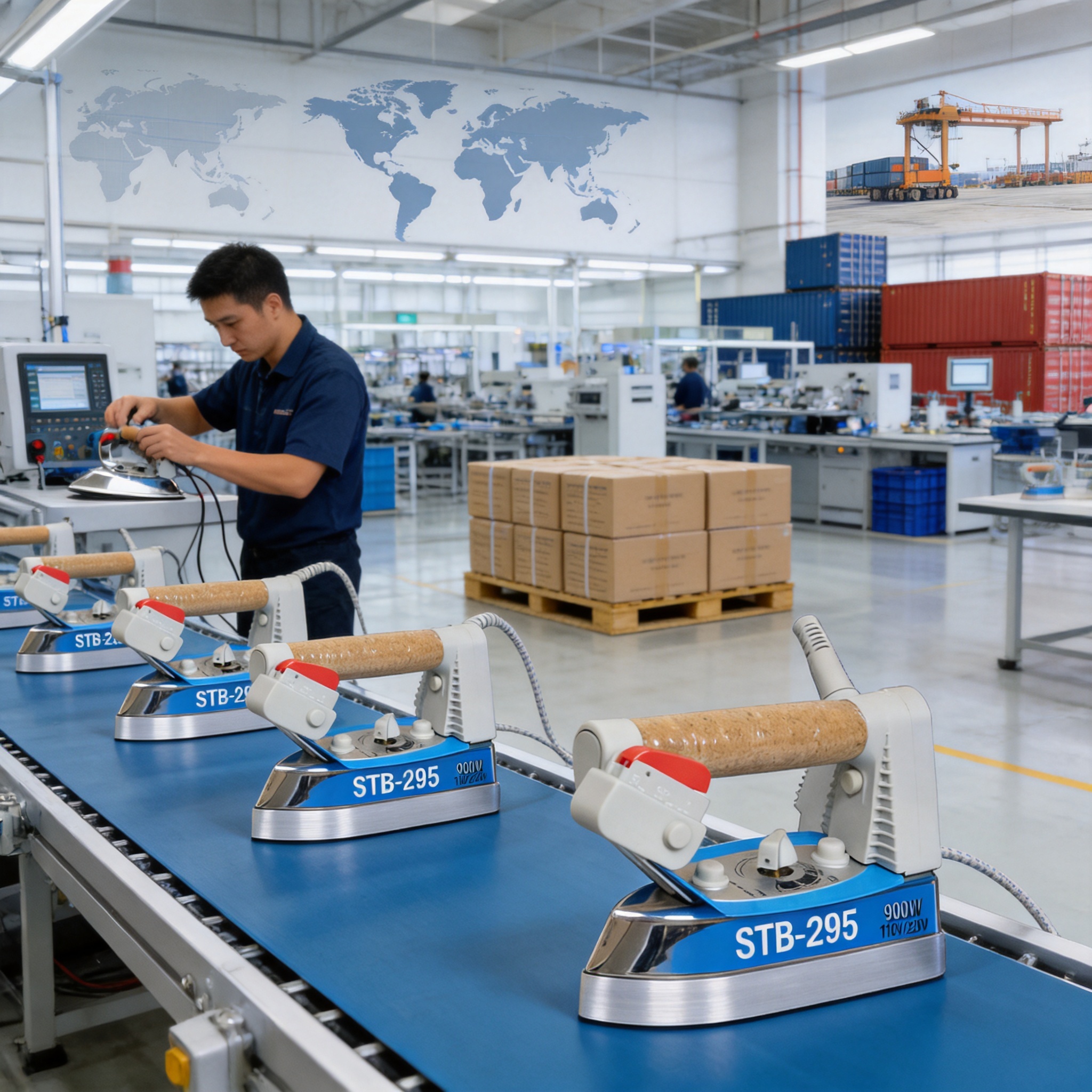
The STB-295 Dual Voltage Design Electric Iron is a practical garment-care solution developed for users who require dependable heating performance, convenient handling, and international electrical compatibility. Combining a 900W heating system with a lightweight 1.55kg construction, the iron is designed to support both household ironing and professional textile-finishing applications. Its dual-voltage capability allows operation at either 110V or 220V, making it suitable for different electrical environments and especially useful for international distributors, mobile professionals, hotels, garment workshops, and households that require flexible equipment.
Although electric irons may appear simple compared with large-scale pressing machines or industrial steam systems, the quality of their engineering has a direct effect on productivity, fabric safety, user comfort, and final garment appearance. An iron that heats slowly, distributes heat unevenly, sticks to fabric, or becomes difficult to control can reduce efficiency and create unnecessary risks. The STB-295 addresses these practical concerns through a balanced combination of heating power, non-stick soleplate technology, compact construction, and operational versatility.
This article examines the product’s principal features, application value, competitive advantages, construction considerations, quality-oriented manufacturing approach, and the strengths of the company behind it. It also explains how the iron can fit into broader garment-care operations and concludes with a detailed question-and-answer section for buyers, distributors, and end users.
The STB-295 is an electric iron created for efficient wrinkle removal and controlled textile finishing. It provides a 900W power rating and supports two common voltage standards: 110V and 220V. This configuration helps simplify product distribution across different markets and reduces the need for separate electrical versions when serving customers in regions with different mains supplies.
With a net weight of approximately 1.55kg, the iron is substantial enough to provide stable contact with fabrics while remaining manageable during extended use. Weight is an important factor in ironing equipment. A very light iron may require excessive downward pressure to remove wrinkles, while an overly heavy model can cause hand, wrist, and shoulder fatigue. The STB-295 is positioned as a balanced design that supports effective pressing without making maneuverability unnecessarily difficult.
The precision-crafted soleplate features an advanced non-stick coating. This surface is intended to glide smoothly across different fabric types and reduce the possibility of snagging, sticking, or dragging. Smooth movement supports more consistent results and helps operators work through garments with fewer interruptions.
| Product Model | STB-295 |
| Product Type | Electric Iron |
| Voltage | 110V/220V |
| Power | 900W |
| Weight | 1.55kg |
| Soleplate | Precision-crafted surface with non-stick coating |
| Primary Applications | Household garment care and professional textile finishing |
| Product Positioning | Compact, portable, dual-voltage ironing equipment |
The model is therefore suitable for users who need more capability than a basic household iron but do not require a large steam press, vacuum table, or complete industrial finishing line. Its compact format makes it easier to integrate into small workspaces, retail alteration areas, hotel laundry rooms, tailoring studios, sample rooms, and garment production support departments.
Effective ironing begins with reliable heat. Wrinkles are created when textile fibers become displaced, compressed, or exposed to moisture and pressure. To restore a smooth appearance, the iron must deliver sufficient and consistent thermal energy across the soleplate. Insufficient heat can lead to repeated passes over the same area, while unstable heat may produce inconsistent results from one section of a garment to another.
The STB-295 uses a 900W heating system designed for rapid heat-up and steady operating performance. For everyday users, fast heat-up reduces waiting time before garments can be prepared. In professional environments, the benefit is even more significant because reduced preparation time can contribute to better workflow continuity.
A stable heating system also supports predictable operator control. When heat output remains consistent, the user can develop a reliable working rhythm based on fabric type, garment construction, and desired finish. Predictability is valuable in tailoring, alterations, hospitality laundry, retail presentation, and small-scale manufacturing, where appearance standards may be repeated across multiple items.
The 900W rating provides a useful compromise between heating capability and manageable energy consumption. It is powerful enough to support regular pressing tasks while remaining appropriate for settings where the iron may be used alongside other equipment. Small workshops and household users often have limited electrical capacity, so equipment that provides practical heating performance without requiring an oversized power supply can be easier to install and operate.
The power specification also makes the product suitable for international sourcing. Distributors can position the iron for a wide range of users, from domestic consumers to professional operators who need a compact finishing tool. Electrical compatibility remains an important part of equipment selection, especially when products are shipped across borders.
One of the most distinctive features of the STB-295 is its dual-voltage design. The iron is specified for both 110V and 220V operation. These voltage standards are used in different countries and regions, and a product that accommodates both can provide greater flexibility for importers, distributors, travelers, commercial users, and multinational organizations.
A dual-voltage design can simplify purchasing decisions because buyers do not necessarily need to identify a completely different model for every destination market. It may also reduce inventory complexity for distributors. Instead of maintaining separate product lines for 110V and 220V regions, a suitable dual-voltage configuration can support broader market coverage, subject to correct setup and local electrical requirements.
For international use, voltage selection must always follow the product’s operating instructions and the requirements of the local electrical system. Users should verify the correct setting before connecting the iron to a power source. Appropriate plugs, adapters, grounding arrangements, and local safety practices should also be observed. Dual-voltage capability improves versatility, but it does not remove the need for responsible electrical installation and operation.
For wholesalers and importers, dual-voltage equipment can offer several commercial advantages:
First, it can make product planning more efficient. A product suitable for multiple voltage environments may be easier to include in export catalogs and regional distribution programs.
Second, it can improve usability for customers who travel or operate in more than one country. Mobile garment professionals, international hospitality groups, costume departments, and event-service teams may value equipment that is not limited to one electrical standard.
Third, dual-voltage capability supports the company’s broader export orientation. Jinyun Shengda Sewing Equipment Co., Ltd. serves customers in Southeast Asia, Central Asia, South America, Africa, and other regions. A flexible electrical design is well aligned with the practical requirements of these markets.

STB-295 Dual Voltage Design Electric Iron
Weight affects nearly every aspect of manual ironing. It influences how much pressure the operator must apply, how quickly the iron can be repositioned, and how much fatigue develops over the course of a workday. The STB-295 weighs 1.55kg, giving it a practical balance between pressing contact and maneuverability.
The iron is heavy enough to assist with wrinkle removal without requiring excessive downward force in many normal applications. At the same time, its compact structure allows the operator to move around collars, cuffs, seams, pleats, pockets, and shaped garment sections with greater control than may be possible with larger equipment.
For household users, comfortable handling can make routine garment care less tiring. For professional users, it may contribute to better endurance during repeated operations. When an operator can maintain a natural grip and reposition the iron smoothly, the risk of inconsistent pressing caused by fatigue may be reduced.
Professional textile finishing involves repeated forward, backward, diagonal, and lateral movements. Operators must often adjust their technique according to material thickness, garment construction, and the location of seams or decorative details. A compact iron is advantageous because it can be guided precisely across smaller areas without the bulk associated with large pressing equipment.
The 1.55kg structure also makes the iron suitable for workstations where the operator alternates between several tools. A tailoring or alteration station may use an electric iron for detail work, a steam source for softening fibers, and a vacuum table for final shaping. In such settings, a portable iron can complement rather than replace larger finishing equipment.
The soleplate is the part of an iron that directly contacts the garment, so its surface quality is central to performance. The STB-295 uses a precision-crafted soleplate with an advanced non-stick coating. The purpose of this coating is to encourage smooth movement over fabric and reduce unwanted adhesion.
A smooth, non-stick surface can provide several practical benefits. It can help the iron glide across cotton, polyester blends, uniform fabrics, household textiles, and other common materials. It can reduce resistance when changing direction and may help the operator work more quickly through detailed garment sections.
Reduced sticking is also important for fabric protection. If a soleplate drags or adheres to a textile, it can interfere with the appearance of the material and make it more difficult to maintain a uniform finish. Smooth movement helps the user apply heat and pressure in a controlled manner rather than forcing the iron across the surface.
Precision in soleplate production involves more than applying a surface coating. The shape, flatness, edge treatment, and overall finish of the soleplate influence how heat and pressure are transferred. A carefully made soleplate should support stable contact while allowing the operator to access narrow or shaped areas of a garment.
The STB-295 is intended to provide a practical surface for both broad pressing and detail work. The design can be useful when handling shirt fronts, trouser legs, collars, cuffs, sleeves, seams, and other areas where control is essential. For garment professionals, these details can have a direct effect on presentation quality.
Like all coated ironing surfaces, the soleplate should be maintained according to the manufacturer’s care recommendations. Users should avoid abrasive cleaning methods, unsuitable chemicals, and contact with materials that could damage the coating. Proper care helps preserve smooth operation and extend service life.
The STB-295 has a broad application range because it combines domestic convenience with professional-oriented characteristics. It can serve as a primary iron in a home, a backup tool in a commercial laundry room, or a detail-finishing device in a tailoring and garment-production environment.
At home, the iron can be used for daily clothing maintenance, school uniforms, business shirts, trousers, dresses, household linens, and other fabrics that require a smooth appearance. The 900W heating system supports practical heat-up performance, while the manageable weight helps users complete routine tasks without handling an overly bulky appliance.
The dual-voltage design may also appeal to households with international mobility or customers purchasing products for use in more than one country. However, users must operate the unit in accordance with its voltage instructions and local safety standards.
Tailors and alteration specialists often need equipment that can handle detail work. Garments may require pressing around seams, hems, pockets, collars, cuffs, waistbands, and shaped sections. A compact electric iron can be easier to control in these areas than a larger press.
The STB-295 may also function as a supplementary tool alongside a steam boiler, vacuum table, or specialized pressing machine. Larger systems are useful for high-volume operations, while a manual iron remains valuable for finishing details and correcting small areas.
Small garment factories and sample rooms frequently require flexible equipment rather than a single large machine. Sample development may involve frequent changes between fabrics, patterns, and construction techniques. A portable iron can support prototype preparation, seam opening, shaping, and presentation before a sample is reviewed or photographed.
In production support areas, the iron can be used to improve the appearance of finished goods before inspection, packing, or shipment. Its compact footprint allows it to fit into workstations where floor space is limited.
Hotels and hospitality facilities require reliable garment-care tools for uniforms, curtains, linens, guest services, and maintenance operations. The STB-295 can be considered for staff areas or service rooms where a compact electric iron is more convenient than a larger industrial system.
Uniform suppliers and event-service organizations may also benefit from a dual-voltage model when equipment is deployed across multiple locations. The combination of portability, heating performance, and fabric-friendly movement can support routine presentation requirements.
Retail stores, clothing brands, and visual-merchandising teams often need to remove creases before garments are placed on display. A compact iron can be stored near the sales floor, stockroom, or fitting-room support area. Smooth operation is particularly important when employees must quickly refresh clothing without damaging delicate or finished surfaces.
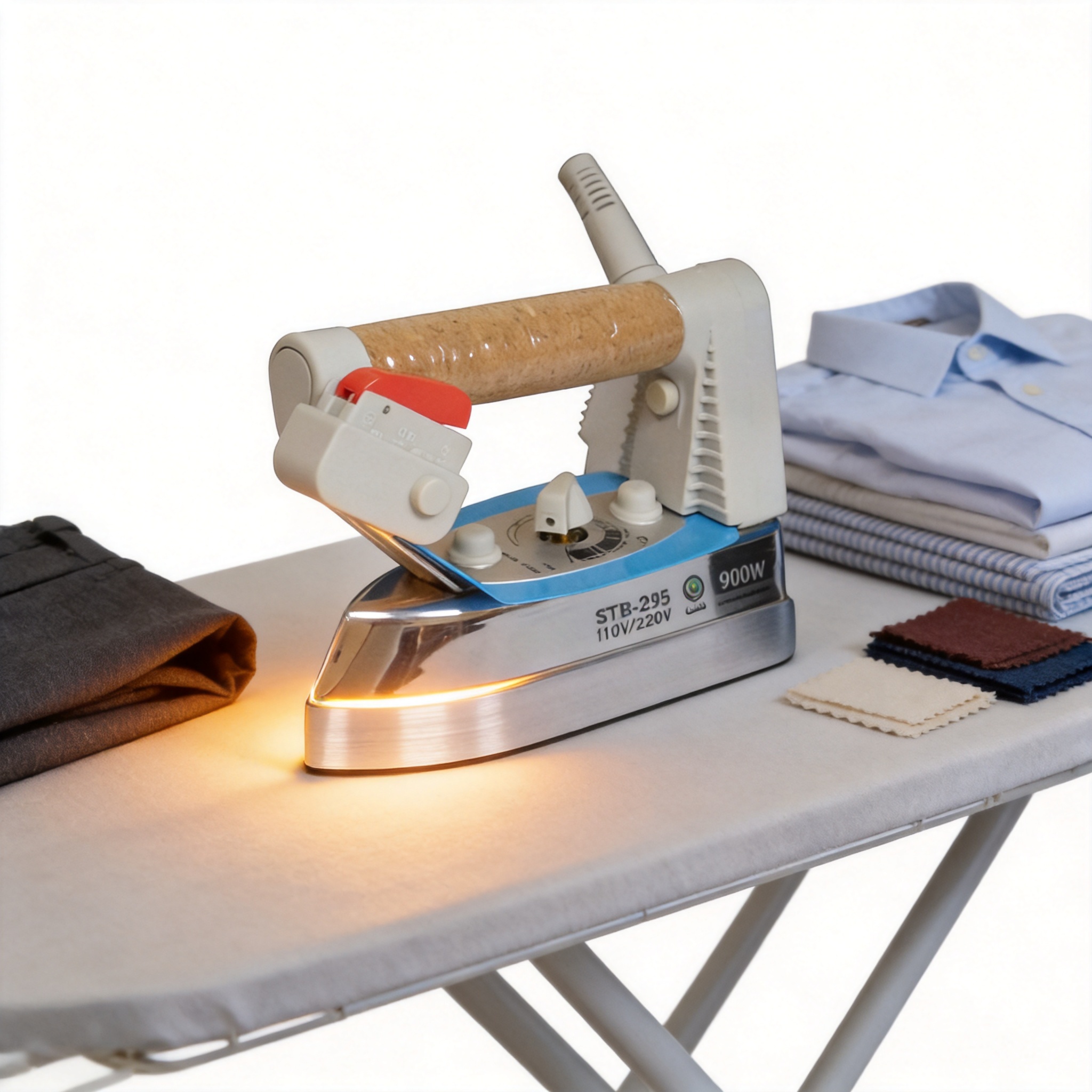
The STB-295 offers several characteristics that distinguish it from a basic single-voltage household iron. These advantages are relevant to both end users and commercial buyers.
Many standard electric irons are designed for only one voltage environment. A dual-voltage model can serve a wider range of markets and users. This flexibility is particularly valuable for exporters and distributors who need products that can be positioned across multiple regions.
The 900W heating system is appropriate for users who expect more than occasional light-duty operation. It supports regular pressing work and can help reduce delays caused by slow heat-up or repeated passes.
At 1.55kg, the STB-295 is designed for controlled movement. Compared with heavier industrial equipment, it is easier to carry and reposition. Compared with extremely lightweight irons, it can provide a more substantial pressing feel.
The coated soleplate is intended to reduce friction and sticking. This can improve the operator’s sense of control and support smoother finishing across a variety of garments.
Some domestic irons are optimized only for household use, while some industrial presses are too large for small workshops. The STB-295 occupies a useful middle position. It can meet household needs while also serving tailoring, alteration, retail, hospitality, and textile-finishing applications.
| Evaluation Area | Basic Single-Voltage Iron | STB-295 Advantage |
| Electrical Compatibility | Usually limited to one voltage | Supports 110V/220V operation |
| Heating Capability | Varies by model | 900W heating system |
| Handling | May be too light or too heavy | Balanced 1.55kg construction |
| Surface Movement | Depends on soleplate quality | Precision-crafted non-stick soleplate |
| Market Suitability | Often domestic-focused | Household and professional textile finishing |
| Distribution Flexibility | May require regional versions | One dual-voltage design for broader markets |
Product performance depends not only on the visible design but also on the company’s ability to manage research, development, production, quality control, and customer service as an integrated process. Jinyun Shengda Sewing Equipment Co., Ltd. was established in 2003 and specializes in the independent research, development, and manufacture of ironing and garment-finishing equipment.
The company’s product range includes electric irons, steam irons, hanging irons, spray guns, small steam machines, heat transfer machines, steam boilers, vacuum tables, and related accessories. This broad portfolio gives the manufacturer experience across several connected areas of textile-care technology.
Knowledge gained from producing different categories of equipment can support more informed product development. For example, experience with steam systems may help the company understand moisture and heat management, while experience with vacuum tables can contribute to an awareness of garment shaping and finishing workflow. A manufacturer with a broad product range can also better understand how individual tools operate within a complete production environment.
The company emphasizes independent research and development. This capability is important because it allows the manufacturer to adjust product designs according to market requirements instead of relying solely on standardized external solutions.
Independent development can cover many stages of a product’s life cycle, including concept planning, component selection, structural design, heating-system integration, soleplate development, safety considerations, production testing, and continuous improvement. In a competitive equipment market, the ability to refine products over time is a significant strength.
For the STB-295, product development priorities are reflected in its combination of dual-voltage operation, 900W heating performance, manageable weight, and non-stick soleplate construction. These features address practical user needs rather than focusing only on appearance.
According to the company information, its research and development, management, and sales teams work closely together. This type of internal cooperation can help manufacturers identify market needs more quickly and turn customer feedback into product improvements.
Close coordination also supports more accurate communication with distributors. Technical specifications, packaging requirements, customization requests, production schedules, and after-sales questions can be handled more efficiently when the relevant departments share information.
Since its establishment in 2003, the company has developed experience in a specialized equipment sector. Its portfolio includes several brands and a range of products designed for garment care and textile finishing. This experience supports familiarity with different customer groups, from household and small-business users to professional operators and export distributors.
A broad product portfolio may also strengthen supply coordination. Customers purchasing several categories of equipment can communicate with one manufacturer rather than managing unrelated suppliers for electric irons, steam boilers, vacuum tables, and accessories.
Electrical ironing equipment must be designed and manufactured with attention to heating safety, insulation, electrical connections, mechanical stability, and user handling. The company states that it follows national and industry standards, including GB4706.1-2005 and GB4706.2-2007. It also states that its products have passed CCC and CQC certifications.
Standards and certifications provide an important framework for product safety and quality evaluation. They indicate that equipment is assessed according to applicable requirements rather than being produced without structured controls. For importers and professional buyers, certification information can support supplier evaluation and market-entry planning.
However, certification requirements may vary by destination country. Importers should confirm whether additional testing, labeling, documentation, plug configurations, or approvals are required in the intended market. The manufacturer’s existing compliance experience can help, but local regulatory verification remains the responsibility of the buyer and importer.
Important quality areas for an electric iron include heating consistency, electrical insulation, power-cord reliability, switch or control performance, soleplate flatness, coating adhesion, housing durability, and resistance to normal operating stress.
Manufacturing quality should also address consistency between units. A product specification is most useful when individual items produced in different batches provide similar performance. Controlled assembly, inspection procedures, component management, and production testing all contribute to this consistency.
For distributors, quality is closely connected to reputation. Reliable products can reduce customer complaints, warranty claims, replacement costs, and interruptions in downstream sales. This is one reason why supplier experience, standards compliance, and production capability should be evaluated together.
The company identifies customization and OEM services among its advantages. These services can be valuable for distributors, wholesalers, regional brands, and organizations seeking products with specific commercial requirements.
OEM cooperation may involve branding, packaging, documentation, product configuration, labeling, color selection, or other approved modifications. The exact scope depends on project requirements, order quantities, technical feasibility, and applicable compliance rules.
Customization can help a distributor create a more differentiated product offering. Instead of competing only on price, the buyer may develop a product package suited to a specific market segment, such as hotel supplies, tailoring equipment, travel products, or household garment care.
International buyers often require more than a product specification. They may need export packaging, shipping coordination, technical documents, voltage information, certificates, spare-part guidance, and responsive communication. The company’s stated export experience and convenient shipment services are relevant to these needs.
Its location in Huzhen Industrial Park, Zhejiang, China, provides access to established manufacturing and transportation networks. The company describes its position at the junction of Lishui, Jinhua, and Taizhou as beneficial for transportation and information exchange. Efficient logistics can help reduce lead-time uncertainty and support more organized export operations.
Buyers should still confirm production schedules, minimum order quantities, inspection procedures, packaging specifications, shipping terms, and after-sales arrangements before placing an order. Clear documentation benefits both supplier and customer.
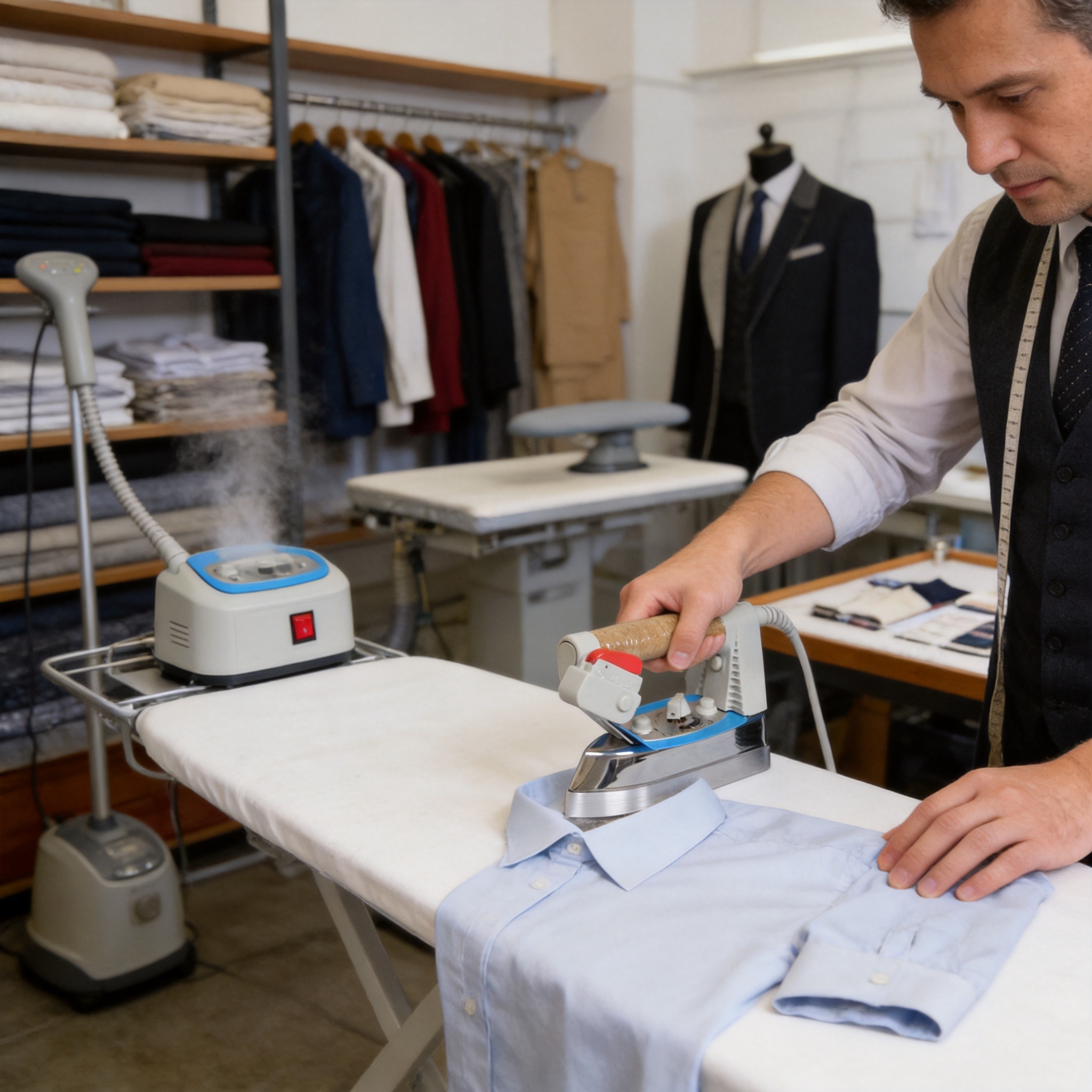
The STB-295 can be used independently, but it can also function as one component in a broader garment-finishing system. Different textile operations require different tools, and the most efficient setup is often based on assigning each tool to the task for which it is best suited.
A steam boiler can provide a larger and more continuous steam source for production environments. A vacuum table can help remove moisture, stabilize fabric, and improve garment shape. A heat transfer machine can support the application of graphics, labels, or decorative transfers. A spray gun may assist with local moisture application or specific finishing requirements. The electric iron can then provide detailed manual pressing and final touch-up work.
This complementary role makes the STB-295 useful even in facilities that already own larger equipment. It can be kept at a detail station, used for urgent corrections, or assigned to sample development while larger machines handle high-volume work.
In a tailoring shop, the iron may be used after stitching to open seams, shape collars, flatten hems, and refine garment details.
In a garment workshop, it may support sample construction, intermediate pressing, final inspection, and packaging preparation.
In a hotel or uniform department, it may be used for staff clothing and small textile items that do not justify the use of a large industrial press.
In a retail environment, it may refresh garments before display or customer presentation.
In a household, it may serve as the main garment-care appliance for routine wrinkle removal.
Users should read the product instructions before operating the iron. The correct voltage setting must be selected before connection, and the iron should be used with an appropriate electrical outlet and plug arrangement.
The soleplate should be kept clean and free of residue. Users should avoid dragging the iron over zippers, pins, rough surfaces, adhesive materials, or other objects that could scratch or contaminate the coating. When working with unfamiliar fabrics, testing on an inconspicuous area is a prudent practice.
Garments should be sorted according to fiber type, thickness, color, and care requirements. Lower heat settings are generally appropriate for heat-sensitive materials, while heavier or more resistant fabrics may require higher settings within the product’s operating range. Users should follow garment-care labels and avoid applying excessive heat to materials that may melt, scorch, or deform.
The iron should be placed securely when temporarily set aside. It should be unplugged after use and allowed to cool before storage or cleaning. The power cord should not be sharply bent, pulled, or wrapped tightly around a hot appliance.
Regular care can help maintain smooth soleplate movement and reliable operation. The outer housing can be wiped with a suitable soft cloth after the iron has cooled. Abrasive tools and harsh chemicals should not be used unless specifically approved by the manufacturer.
Users should periodically inspect the cord, plug, housing, soleplate, and any control components. If damage, unusual odor, smoke, electrical arcing, or irregular heating is observed, operation should stop and the unit should be evaluated by qualified service personnel.
Commercial buyers should evaluate the STB-295 according to the intended market and application. The dual-voltage feature is especially relevant for export orders, but buyers should confirm the required plug type, labeling, instruction language, packaging, and certification documents for each destination.
Expected usage volume should also be considered. A household may require occasional operation, while a tailoring shop or commercial laundry may use the iron repeatedly throughout the day. Buyers with high-volume requirements should discuss operating conditions, recommended duty cycles, maintenance, spare parts, and service support with the supplier.
Order planning should include packaging and transportation. Although the product is compact, appropriate protection is still necessary to prevent damage to the soleplate, coating, housing, controls, and power cord during shipment.
Potential buyers may wish to confirm whether the voltage selection is manual or automatic, which plug configurations are available, what documentation accompanies the product, whether OEM packaging is supported, and what minimum order quantities apply.
They may also ask about production lead time, inspection standards, sample availability, warranty terms, spare parts, replacement components, shipping arrangements, and after-sales communication.
These discussions help ensure that the product is suitable not only from a technical perspective but also from a commercial and regulatory standpoint.
Jinyun Shengda Sewing Equipment Co., Ltd. combines specialized manufacturing experience with a broad range of garment-finishing products. Its stated strengths include independent research and development, reliable quality, diverse product categories, competitive costs, professional service, customization, OEM support, and convenient shipment.
The company’s customer base extends beyond the domestic market. Its products are mainly exported to Southeast Asia, Central Asia, South America, Africa, and other regions. This international exposure can provide useful knowledge of differing operating environments, customer expectations, distribution models, and electrical requirements.
The company also owns several established product brands, including Silver Star, Platinum Dragon, Tingshun, Jiasheng, Shengtai, and Jiangxin. While the STB-295 is evaluated here primarily according to its technical specifications, the existence of multiple product lines indicates experience in serving different segments of the ironing-equipment market.
Its location in Zhejiang provides access to an important manufacturing region with established supplier networks and transport connections. For export customers, manufacturing location can affect logistics, supplier coordination, communication, and shipment planning.
The STB-295 stands out through a combination of features that are practical rather than excessive. Its 900W heating system supports efficient garment care, while the 110V/220V dual-voltage design expands its international usefulness. The 1.55kg weight provides a balance between pressing contact and maneuverability, and the non-stick soleplate is intended to improve smooth movement across fabrics.
Its greatest advantage is versatility. It can serve ordinary household users while also addressing the needs of tailoring shops, garment workshops, hotel departments, retail teams, sample rooms, and professional textile-finishing operations. It can operate as a standalone iron or complement more advanced equipment such as steam boilers and vacuum tables.
The company behind the product adds further value through research and development, a wide equipment portfolio, manufacturing experience since 2003, stated compliance with relevant standards, export capability, and OEM and customization support. These factors are particularly important for distributors and commercial customers who evaluate suppliers on more than product appearance or initial price.
For buyers seeking a compact electric iron with international electrical flexibility and professional-oriented features, the STB-295 represents a balanced option. Its suitability will depend on the specific voltage setting, fabric requirements, operating frequency, compliance needs, and distribution market, but its design addresses many common demands in modern garment care.
The STB-295 is a dual-voltage electric iron designed for household garment care and professional textile-finishing applications.
The product specification lists 110V/220V operation. Users must select and confirm the correct voltage according to the instructions and local electrical system before use.
The iron has a 900W heating system. This power level is intended to provide practical heat-up performance and consistent operation for routine pressing tasks.
The stated weight is 1.55kg. This provides a balance between stable garment contact and manageable movement during manual ironing.
The non-stick coating is designed to help the iron glide across fabrics more smoothly and reduce sticking, dragging, and snagging during operation.
Yes. It is suitable for applications such as tailoring, garment alterations, sample development, retail preparation, hotel uniform care, and textile finishing. It may also be used as a detail tool alongside larger equipment.
The dual-voltage design supports broader international use. Importers should still verify plug types, labeling, certification, voltage-selection instructions, and local regulatory requirements before distribution.
Yes. The electric iron can complement a steam boiler, vacuum table, heat transfer machine, spray gun, or other garment-finishing equipment. Each machine can be assigned to the task best suited to its design.
The product is manufactured by Jinyun Shengda Sewing Equipment Co., Ltd., a Zhejiang-based company specializing in ironing and garment-finishing equipment.
The company was established in 2003 and focuses on the independent research, development, and production of electric irons, steam irons, hanging irons, spray guns, small steam machines, heat transfer machines, steam boilers, vacuum tables, and related accessories.
The company states that it provides customization and OEM services. Buyers should discuss branding, packaging, specifications, order quantities, documentation, and technical feasibility directly with the manufacturer.
The company states that it follows standards including GB4706.1-2005 and GB4706.2-2007 and that its products have passed CCC and CQC certifications. Buyers should confirm the exact documents applicable to the selected model and destination market.
The soleplate should be kept clean and protected from abrasive tools, unsuitable chemicals, sharp objects, adhesive materials, and rough surfaces. Cleaning should be performed only after the iron has cooled and according to manufacturer recommendations.
Users should verify the voltage setting, inspect the cord and plug, confirm that the soleplate is clean, review the garment-care label, and place the iron on a stable surface when it is not being used.
Its main differentiating features include dual-voltage capability, a 900W heating system, a 1.55kg balanced construction, a precision-crafted non-stick soleplate, and suitability for both household and professional textile-finishing work.
The STB-295 Dual Voltage Design Electric Iron is a compact and versatile solution for users who value dependable heat, smooth fabric movement, practical weight, and international operating flexibility. Its 900W heating system supports efficient pressing, while the 110V/220V design makes it adaptable to a wider range of electrical environments. The 1.55kg construction encourages controlled handling, and the non-stick soleplate helps support a smooth finishing process.
Its application range extends from everyday home ironing to tailoring, garment alteration, hospitality, retail, sample preparation, and professional textile finishing. The iron can work independently or form part of a broader equipment system that includes steam boilers, vacuum tables, heat transfer machines, spray guns, and accessories.
The manufacturer contributes additional value through long-term industry experience, independent research and development, a diverse product portfolio, quality-oriented production, stated compliance with national and industry standards, international export experience, and OEM and customization support. Together, these characteristics make the STB-295 a practical option for buyers seeking a reliable electric iron with broader market suitability and professional-oriented performance.
1. Product specification sheet for the STB-295 Dual Voltage Design Electric Iron, including voltage, power, weight, construction, and application information.
2. Company profile and manufacturing information supplied by Jinyun Shengda Sewing Equipment Co., Ltd.
3. GB4706.1-2005, General Safety Requirements for Household and Similar Electrical Appliances.
4. GB4706.2-2007, Particular Safety Requirements for Electric Irons.
5. General textile-care and garment-finishing practices concerning heat, pressure, fabric handling, soleplate maintenance, and operator safety.
6. Manufacturer-provided information regarding CCC and CQC certification, export markets, OEM services, customization, and product development capabilities.
 +86-578-3158872 / +86-578-3158958
 jyshengda@163.com / caroying@jy-shengda.com
 No. 8 Nanyi Rd, Huzhen Industrial Park, Zhejiang, China
Copyright © Jinyun Shengda Sewing Equipment Co., Ltd. All Rights Reserved.
Ironing Press Machine Equipment Factory
 English
 中文简体
 русский
 عربى