Professional garment finishing requires more than a heated surface and a conventional iron. Tailors, dry cleaners, apparel factories, uniform suppliers, alteration shops, and textile service businesses need equipment that can control fabric, maintain stable heat, support efficient handling, and deliver consistent results throughout long production cycles. The 550W Heating Power Vacuum Ironing Table is designed to meet these requirements through the combination of a 550W heating system, a 65W vacuum motor, a stable working surface, and compatibility with a 220V, 50/60Hz electrical environment.
This vacuum ironing table is built for applications in which precision, repeatability, and operator control are essential. The vacuum function helps hold garments securely against the table, reducing movement during pressing and making it easier to shape seams, collars, cuffs, pockets, waistbands, and other detailed areas. At the same time, the integrated heating system supports consistent thermal performance across the working surface, helping operators achieve smooth and professional results without repeatedly repositioning the garment.
Unlike a basic ironing board, this equipment combines active fabric adhesion with controlled heating. Unlike an oversized industrial pressing system, it offers a practical format for businesses that need reliable professional performance without excessive complexity. Its balanced power configuration makes it suitable for regular production work, finishing stations, sample rooms, garment repair services, and commercial pressing environments.
The equipment is manufactured by Jinyun Shengda Sewing Equipment Co., Ltd., a specialist producer of ironing equipment and related machinery with experience in product development, manufacturing, quality management, customization, and export service. The company’s product range includes electric irons, steam irons, hanging irons, spray guns, small steam machines, heat transfer machines, steam boilers, vacuum tables, and accessories. This broad product knowledge supports the development of coordinated garment-finishing solutions rather than isolated products.
With its combination of heating performance, vacuum fabric control, practical electrical compatibility, and professional manufacturing support, the 550W Heating Power Vacuum Ironing Table is a dependable choice for businesses seeking higher productivity and more uniform finishing quality.

550W Heating Power Vacuum Ironing Table
The 550W Heating Power Vacuum Ironing Table is a professional garment-finishing workstation designed to provide a stable and controlled pressing environment. Its two most important operating functions are the heated work surface and the vacuum system. The heated surface supports the pressing process by supplying controlled thermal energy, while the vacuum motor draws air through the working area to help keep the fabric in position.
The vacuum motor has a rated power of 65W. This power level is suitable for creating effective fabric adhesion during pressing operations while maintaining a practical overall energy configuration. Secure fabric placement is especially valuable when working with lightweight textiles, slippery materials, shaped garments, or sections that need accurate alignment. By helping prevent shifting, the vacuum function can reduce repeated adjustments and improve the consistency of finished garments.
The heating system has a rated power of 550W. This provides the working surface with the thermal capacity required for routine garment pressing and finishing. Stable heat helps the operator work more efficiently because the fabric can be processed under a consistent temperature condition instead of depending entirely on the heat retained by a separate hand iron or an intermittently heated board.
The table operates at 220V and is compatible with 50/60Hz frequency systems. The supplied technical information includes a voltage entry shown as “220W”; in practical electrical terminology, voltage is expressed in volts, so the operating specification is understood as 220V. Buyers should confirm the exact plug, wiring, and local electrical requirements before installation or shipment.
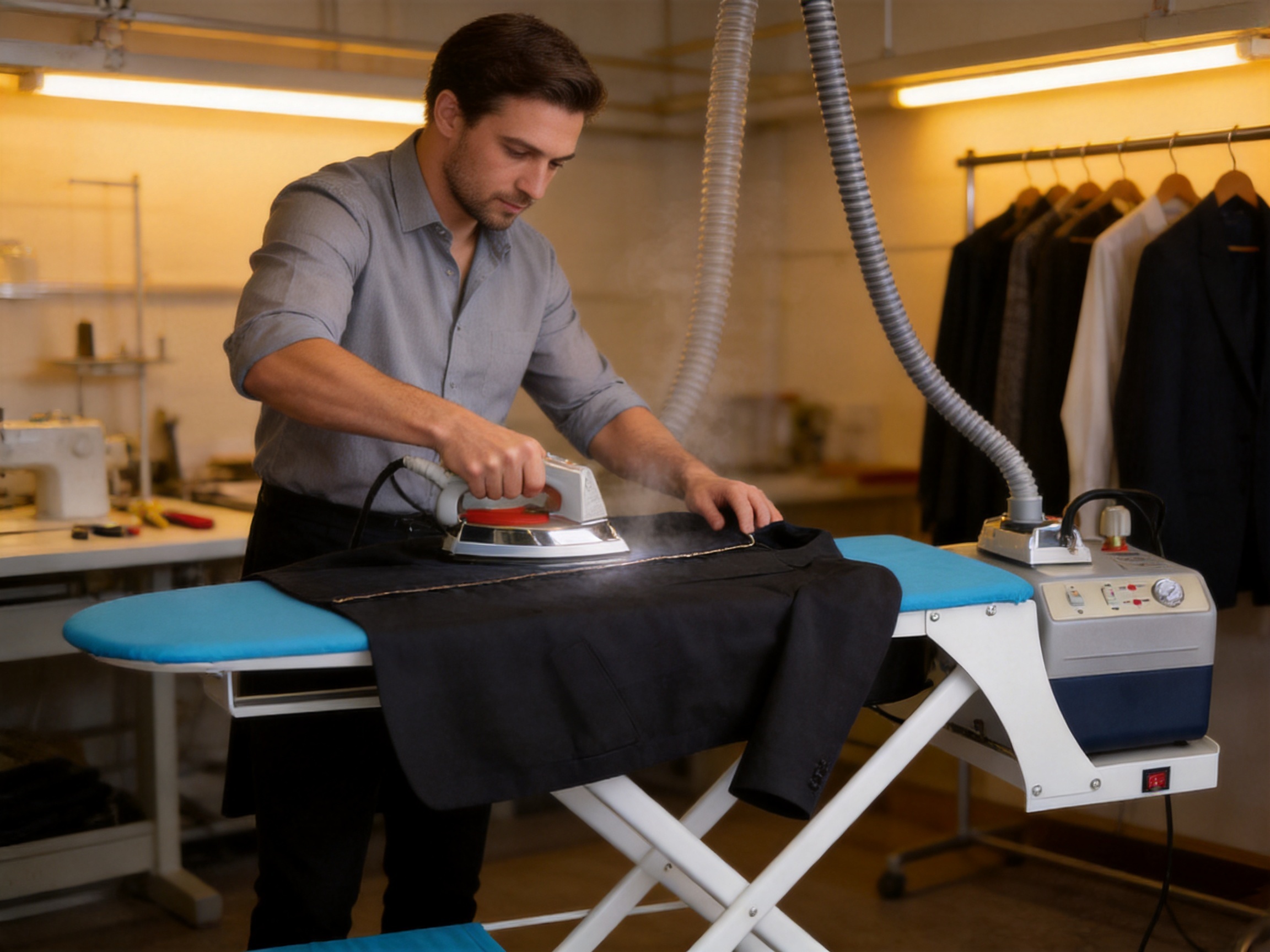
The table’s working concept is straightforward. The operator places the garment on the surface, activates the heating and vacuum functions as required, and performs the pressing operation with improved control. The vacuum action helps hold the fabric close to the surface, while the heated table contributes to efficient shaping and moisture management when used with an appropriate iron or steam iron.
This design is suitable for single-operator workstations and can be integrated into a wider garment production line. It may be positioned near sewing machines, steam generators, boilers, finishing stations, quality-control areas, or packing departments. Its versatility enables businesses to use the same equipment for production pressing, final inspection, repair, alteration, and sample development.
| Product name | 550W Heating Power Vacuum Ironing Table |
| Product category | Vacuum Table |
| Operating voltage | 220V |
| Frequency | 50/60Hz |
| Vacuum motor power | 65W |
| Heating power | 550W |
| Primary application | Professional garment pressing and finishing |
| Vacuum function | Fabric adhesion and positioning support |
| Heating function | Warm working surface for controlled garment finishing |
| Recommended users | Tailors, dry cleaners, garment manufacturers, alteration shops, and finishing departments |
The specification profile shows a carefully balanced machine rather than an unnecessarily oversized system. The 550W heating power provides useful thermal support, while the 65W vacuum motor supplies active fabric control. This division of functions allows the table to address two major challenges in pressing: maintaining appropriate heat and keeping the garment stable.
Heat is one of the central factors in garment finishing. It helps relax textile fibers, improve crease removal, shape garment components, and support the creation of clean seam lines. When heat is distributed through the working surface, the operator gains a more stable base for pressing. This can be particularly useful when the garment must remain flat while a hand iron or steam iron is used to complete the finish.
The 550W heating system is designed to provide consistent thermal performance during routine operation. A stable heated surface can reduce the contrast between hot and cool areas that may otherwise affect the final appearance. It also helps the operator maintain a predictable workflow, since the table contributes heat continuously rather than relying only on residual warmth.
Consistent heating is important for a wide range of applications. In tailoring, it can support the shaping of lapels, collars, sleeve heads, and trouser creases. In dry-cleaning operations, it can assist with final touch-up work after cleaning and drying. In garment factories, it can support pressing between production stages and final presentation before inspection or packaging.
The table does not replace the need to select an appropriate iron temperature for each textile. Different fibers and fabric constructions respond differently to heat, pressure, moisture, and dwell time. Operators should always follow the garment care label, fabric supplier recommendations, and workplace procedures. The advantage of the heated table is that it creates a more supportive pressing environment in which the operator can work with greater consistency.
Thermal stability can also contribute to production efficiency. When the working area remains ready for pressing, operators spend less time waiting for the surface to reach a useful operating condition. A smooth process is especially valuable in high-frequency environments where many garments must pass through the finishing station during a working shift.
The vacuum function is one of the defining advantages of this product over a conventional non-vacuum ironing board. The 65W vacuum motor creates suction through the table surface, helping the fabric adhere to the work area. This active hold-down effect provides a more controlled pressing experience.
Fabric movement can cause several problems. A garment may shift away from the intended alignment, a seam may move during pressing, or a lightweight material may lift and wrinkle under the iron. These issues can lead to repeated work, uneven creases, inaccurate shaping, and increased operator fatigue. By drawing the fabric toward the surface, the vacuum system helps reduce these unwanted movements.
The vacuum function is valuable when working with garments that include shaped components. Collars, cuffs, pocket flaps, pleats, darts, and curved seams often require careful positioning. The operator can place the garment accurately and use the vacuum action to help maintain that position while applying heat and pressure.
Vacuum adhesion can also help protect the workflow when several pressing actions are performed in sequence. For example, an operator may align a seam, press it, reposition a nearby section, and continue along the garment. The stable surface makes each movement more controlled and can reduce the need to hold the fabric manually.
The 65W motor is an efficient component within the overall machine configuration. It provides a dedicated vacuum function without requiring a large motor assembly. This supports a practical balance between fabric control and energy use. The result is a professional workstation that focuses power where it matters most: the heating area and the suction system.
Vacuum performance may vary according to fabric thickness, surface condition, garment construction, table covering, filter condition, and installation environment. Regular cleaning and appropriate maintenance help preserve effective airflow. Operators should also avoid placing materials over the suction area in a way that blocks air movement.
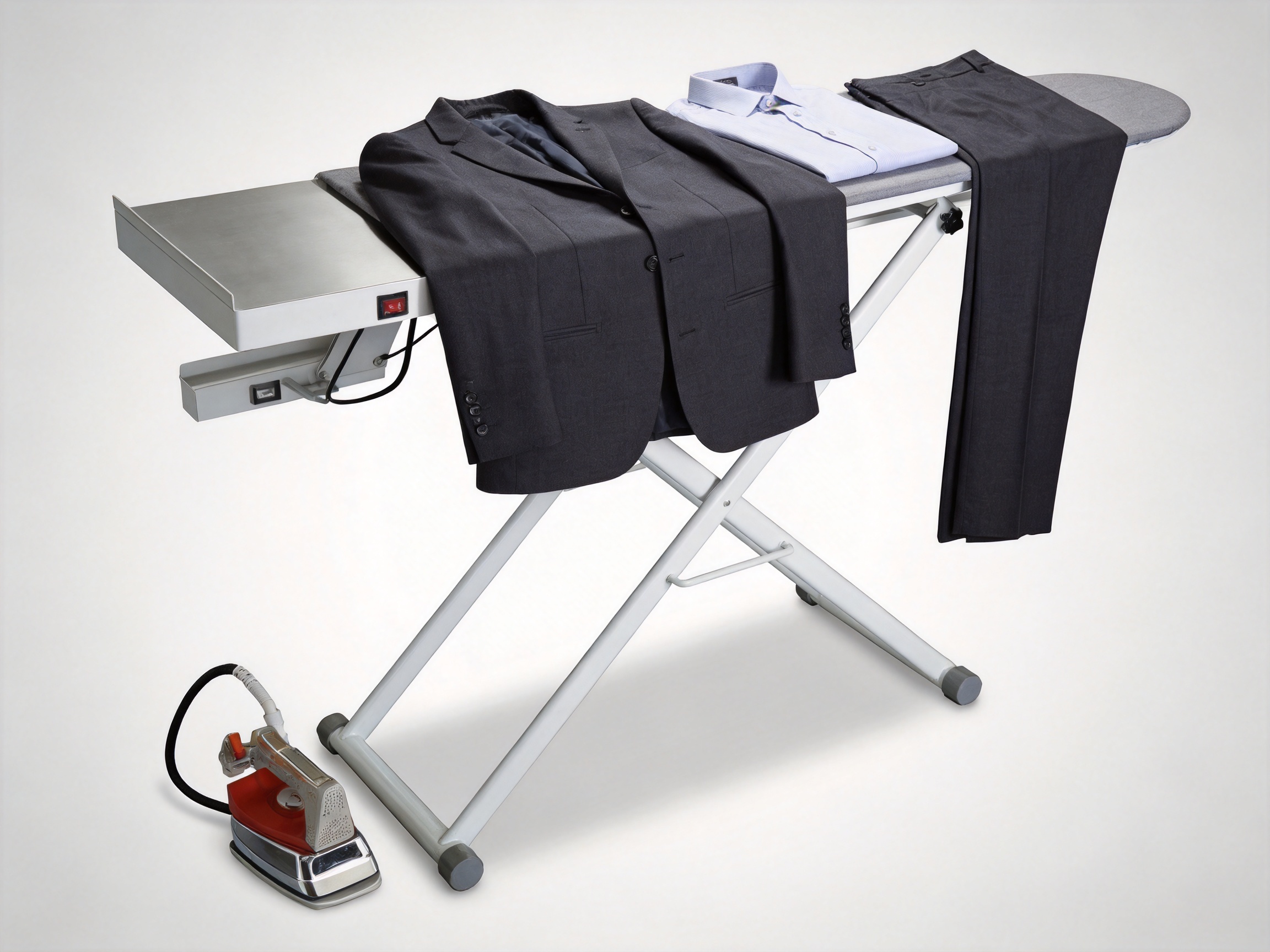
A conventional ironing board generally provides a passive surface. It may support the garment, but it does not actively hold the fabric in place and may not provide integrated heating. The 550W Heating Power Vacuum Ironing Table offers a more capable workstation by combining heat and suction in one system.
The first advantage is improved fabric stability. When the material remains closer to the work surface, the operator can concentrate on the pressing action instead of continuously correcting the garment position. This is especially beneficial for slippery, lightweight, delicate, or multi-layered textiles.
The second advantage is greater process consistency. A stable surface and controlled heat help reduce variation between garments. In commercial environments, consistent results are important for brand presentation, customer satisfaction, rework reduction, and quality inspection.
The third advantage is improved operator productivity. Less time spent repositioning fabric can translate into shorter handling cycles. The operator can move through the garment more systematically, which is valuable when processing uniforms, shirts, trousers, jackets, workwear, hospitality garments, or repeated production batches.
The fourth advantage is better support for detailed pressing. Conventional boards can be adequate for simple flat surfaces, but professional garments often include areas where accuracy is critical. Vacuum adhesion helps the operator manage seams, edges, folds, and shaped sections more effectively.
The fifth advantage is workstation integration. A vacuum table can serve as part of a larger finishing system that includes steam irons, electric irons, steam boilers, spray guns, and heat transfer equipment. This allows a business to develop a coordinated workflow using equipment from a manufacturer experienced in multiple garment-finishing technologies.
Not every business needs a large automated pressing line. High-volume factories may require specialized tunnel finishers, form finishers, or automated presses, but many tailors, dry cleaners, alteration shops, and medium-sized garment producers need a flexible workstation that can handle varied garments. The 550W Heating Power Vacuum Ironing Table fills this practical middle ground.
Its power configuration is substantial enough for professional use while remaining focused on a single operator’s work area. This can make it easier to install in a compact production room, a sample department, or a retail alteration environment. Businesses can add stations according to demand rather than investing immediately in a large and inflexible system.
A compact professional workstation can also simplify training. Operators can learn a clear operating sequence: prepare the table, position the garment, activate the relevant functions, press the material, inspect the result, and complete the next section. Simpler procedures can reduce the learning curve for new employees while preserving the benefits of industrial-style equipment.
The table is also suitable for varied production quantities. It can support occasional professional pressing in an alteration shop as well as continuous work in a garment-finishing department. This versatility helps protect the investment because the equipment can remain useful as the business changes its product mix.
Compared with highly specialized systems, a vacuum ironing table can provide broader application flexibility. The operator can work on garments of different sizes and constructions without needing a dedicated mold for every style. This adaptability is useful for custom tailoring, small-batch manufacturing, repair services, and sample development.
Tailors require control over every detail of a garment. Small alignment errors can affect the appearance of a jacket, suit, shirt, dress, or pair of trousers. The vacuum table supports accurate pressing by helping maintain fabric position as the garment is shaped.
During tailoring, the table may be used for pressing seams open, setting crease lines, shaping collars, refining lapels, stabilizing cuffs, and preparing garments for fitting. Because the operator can work section by section, the equipment is suitable for both standard garments and customized designs.
Dry-cleaning businesses often need a dependable finishing station after cleaning and drying. Garments may require crease removal, shape restoration, collar adjustment, sleeve finishing, or final presentation before customer collection. The heated vacuum surface can help make these finishing operations more systematic.
In customer-facing environments, appearance and turnaround time are both important. A professional table helps the operator deliver a cleaner result while reducing unnecessary handling. Its use can contribute to a more polished service and a consistent presentation of finished garments.
In garment factories, pressing may occur at several points in the production process. Intermediate pressing can improve the accuracy of later sewing operations, while final pressing can prepare garments for inspection and packing. The vacuum table can serve as a dedicated station for details that require individual operator control.
It is suitable for factories producing shirts, uniforms, trousers, jackets, dresses, workwear, schoolwear, hospitality garments, and other apparel products. The exact application depends on the fabric, garment design, and production method, but the basic benefits of stable positioning and thermal support apply across many categories.
Alteration work often involves individual garments with different materials, sizes, and construction details. A flexible pressing station is therefore more useful than equipment designed only for repetitive factory batches. The operator can use the table to prepare hems, refine seams, restore garment shape, and complete alterations with greater precision.
Sample rooms need equipment that can support experimentation and rapid changes. Designers and technicians may work with new fabrics, revised patterns, and small production quantities. The vacuum table provides a stable and professional surface for evaluating how a garment responds to pressing and shaping.
Uniform suppliers often process repeated garment styles and require consistent finishing across many pieces. The table can assist with the final presentation of shirts, trousers, jackets, aprons, and other workwear. Its controlled workstation format is suitable for businesses that need quality consistency without installing a fully automated line.
The product is manufactured by Jinyun Shengda Sewing Equipment Co., Ltd., established in 2003 in Huzhen Town, Lishui City, Zhejiang Province, China. The company operates in a region connected to Lishui, Jinhua, and Taizhou, providing access to transportation networks, industrial resources, suppliers, and information channels.
One of the company’s important strengths is its focus on independent research, development, and production. Rather than limiting its role to distribution, the company develops and manufactures a broad range of ironing and garment-processing equipment. This supports deeper knowledge of heating systems, steam applications, electrical components, operator needs, and production workflows.
The company’s product portfolio includes electric irons, steam irons, hanging irons, spray guns, small steam machines, heat transfer machines, steam boilers, vacuum tables, and accessories. This range allows the manufacturer to understand how different pieces of equipment work together in a professional garment-finishing environment.
Product development benefits from cooperation among research and development, management, and sales teams. Feedback from customers and distribution partners can be used to identify practical requirements such as stable heating, convenient operation, suitable electrical configurations, product durability, and ease of shipment. This communication helps connect factory production with real working conditions.
The 550W Heating Power Vacuum Ironing Table reflects this application-oriented approach. Its design focuses on functions that directly affect garment finishing: thermal support, active fabric control, practical power distribution, and compatibility with common professional workflows. The product is not defined only by a single power rating; its value comes from how the heating and vacuum systems work together.
The manufacturer also provides customization and OEM services. These services can be useful for importers, distributors, private-label businesses, equipment wholesalers, and professional garment-service companies. Depending on project requirements, buyers may discuss branding, packaging, product configuration, electrical standards, documentation, and shipment arrangements with the supplier.
A manufacturer with a broad product range can also help buyers plan complementary equipment. A customer purchasing a vacuum table may later require steam irons, electric irons, spray guns, boilers, heat transfer machines, or replacement accessories. Working with a single experienced source can simplify product coordination, communication, and after-sales support.
Quality in garment-finishing equipment depends on more than the visible appearance of the machine. Heating components, electrical connections, vacuum airflow, switches, insulation, structural stability, and working-surface materials all contribute to safe and reliable operation. A professional manufacturer must therefore consider the complete equipment system.
Shengda follows national and industry standards identified in the supplied company information, including GB4706.1-2005 and GB4706.2-2007. The company’s products have also passed CCC and CQC certifications. Buyers should request current certificates and confirm that the specific model, voltage configuration, and shipment version correspond to the documentation provided for their order.
Standards awareness provides a framework for product design, inspection, and electrical safety. It also gives distributors and end users a clearer basis for evaluating equipment before purchase. In international transactions, buyers should verify the certification requirements of the destination market, since local regulations may differ according to country, voltage, plug type, and product classification.
Reliable manufacturing also involves consistency between batches. A product should maintain its essential performance characteristics when produced repeatedly. Attention to component selection, assembly procedures, inspection routines, packaging, and shipping preparation can help reduce variation and protect the equipment before it reaches the customer.
The company’s experience since 2003 provides a foundation for continuous improvement. Long-term manufacturing experience can help identify common service issues, improve production procedures, refine product details, and support more effective communication with distributors and professional users.
Before operation, the table should be placed on a stable, level surface with sufficient clearance around the working area. The operator should verify that the power supply corresponds to the 220V, 50/60Hz specification and that the plug, socket, and electrical protection are suitable for the installation.
The working surface should be clean and free from objects that could interfere with fabric placement or airflow. The operator should also check that the table covering and suction area are correctly positioned. Any visible damage to the power cord, switches, surface, or housing should be addressed before use.
The garment should be placed according to the pressing task. Seams, edges, and shaped sections should be aligned before the vacuum function is engaged. Accurate initial placement helps the suction system support the intended position rather than holding an incorrectly aligned garment.
For multi-layered garments, the operator should ensure that layers are smooth and free from unwanted folds. When working around buttons, zippers, prints, decorations, or heat-sensitive components, the operator should follow suitable pressing procedures and use protective materials where necessary.
The heating system can be activated to prepare the surface for pressing. The vacuum function can then be used to stabilize the fabric. The operator should select an appropriate iron temperature and steam setting for the textile being processed. Heat, pressure, moisture, and pressing time should be controlled according to the material and garment construction.
It is generally good practice to begin with a suitable test area when working with an unfamiliar fabric. This helps confirm that the temperature and pressing method will not cause shine, distortion, color change, or other damage. The heated table supports the process, but correct operator judgment remains essential.
After pressing, the operator should inspect the section for smoothness, alignment, crease definition, fabric shine, and shape. The vacuum function may help hold the garment during cooling, which can support the stability of the finished form. The operator can then release the fabric and proceed to the next section.
A systematic inspection routine improves repeatability. In factory use, operators may follow quality standards for seam appearance, crease location, garment symmetry, and overall presentation. In tailoring and dry-cleaning, inspection may focus on the customer’s specific requirements and the restoration of the garment’s intended shape.
Regular maintenance helps preserve the performance of both the heating system and the vacuum motor. Operators should keep the working area clean and remove lint, thread, dust, and fabric particles that may accumulate during normal use. Excessive debris can affect airflow and may reduce the effectiveness of the vacuum function.
The vacuum path and any accessible filter or protective screen should be checked according to the equipment instructions. A blocked airflow path can place unnecessary strain on the motor and reduce fabric adhesion. Cleaning procedures should always be performed with the equipment switched off and disconnected from the power supply.
The table covering should be inspected for wear, contamination, compression, or damage. A worn or unsuitable covering can affect airflow, fabric movement, and pressing quality. Replacement materials should be compatible with the table and appropriate for the operating temperature.
Electrical components should be checked by qualified personnel when necessary. The power cord, plug, switches, and connections should not be repaired by untrained operators. If unusual noise, overheating, electrical odor, unstable heating, or reduced suction occurs, the equipment should be turned off and inspected before further use.
Maintenance schedules may vary according to operating hours, fabric type, workplace conditions, and production volume. A busy garment factory may require more frequent cleaning than a small alteration shop. Recording basic maintenance activities can help identify trends and prevent avoidable downtime.
The equipment combines a 550W heating system with a 65W vacuum motor. This configuration provides focused power for the two functions most directly related to professional pressing. Businesses can evaluate energy use according to operating time, local electricity rates, production volume, and the number of stations in operation.
Productivity should not be measured only by electrical consumption. A stable and efficient workstation may reduce rework, operator movement, fabric repositioning, and finishing defects. These factors can influence total operating cost, especially when many garments are processed each day.
Improved consistency can also protect material value. Garments that require repeated pressing or correction consume additional labor time. In some cases, poor finishing can lead to rejection, customer complaints, delayed shipment, or product reclassification. A professional vacuum table supports a more controlled process that can help reduce such risks when used correctly.
Businesses should also consider workstation layout. Positioning the table near the relevant steam, ironing, inspection, or packing equipment can reduce unnecessary movement. A well-planned layout supports better workflow and can make the benefits of the table more visible in daily production.
Purchasing professional equipment involves more than selecting a technical specification. Buyers may need assistance with model selection, electrical compatibility, shipping preparation, spare parts, packaging, operating information, and future equipment expansion. Manufacturer support can simplify these decisions.
Shengda serves customers in China and overseas markets, including Southeast Asia, Central Asia, South America, Africa, and other regions. International experience can help the company communicate with distributors and users who operate under different market conditions and shipping requirements.
The company emphasizes reliable quality, diverse products, competitive costs, professional service, convenient shipment, customization, and OEM support. These strengths are relevant to importers and distributors that need a dependable supply partner rather than a one-time transaction.
For larger orders, buyers can discuss production quantities, packaging requirements, inspection arrangements, spare parts, labeling, and delivery schedules in advance. Clear communication before production helps reduce misunderstandings and allows the equipment to be prepared for its intended market.
For end users, manufacturer support can also be valuable when establishing a complete pressing department. The company’s product portfolio makes it possible to consider vacuum tables together with irons, steam boilers, spray guns, heat transfer machines, and accessories. This integrated approach can help businesses select equipment that fits their workflow.
Before ordering the 550W Heating Power Vacuum Ironing Table, buyers should confirm the operating voltage and frequency required at the installation site. The standard information identifies 220V and 50/60Hz compatibility, but plug style, local electrical regulations, grounding requirements, and certification rules may vary.
Buyers should evaluate the intended workload. The table is suitable for professional garment finishing, but the appropriate number of units depends on daily garment volume, staffing, production cycle time, and the number of pressing operations required. A business with high throughput may benefit from multiple identical stations for consistent operator training and maintenance.
Fabric types should also be considered. Most garment-finishing operations involve a mixture of woven fabrics, knitted materials, blends, synthetic fibers, and natural fibers. The operator must select appropriate heat and pressing practices for each material. Equipment performance and fabric safety depend on correct use.
Importers should request product documentation, packaging details, certification information, spare-parts availability, and warranty terms before confirming an order. If private labeling or OEM production is required, branding, packaging artwork, minimum order quantity, inspection standards, and delivery conditions should be agreed in writing.
It is also advisable to confirm the scope of supply. Buyers should clarify whether the shipment includes the table covering, electrical accessories, operating instructions, protective packaging, and any other components required for normal installation. A complete supply agreement supports smoother receiving and commissioning.
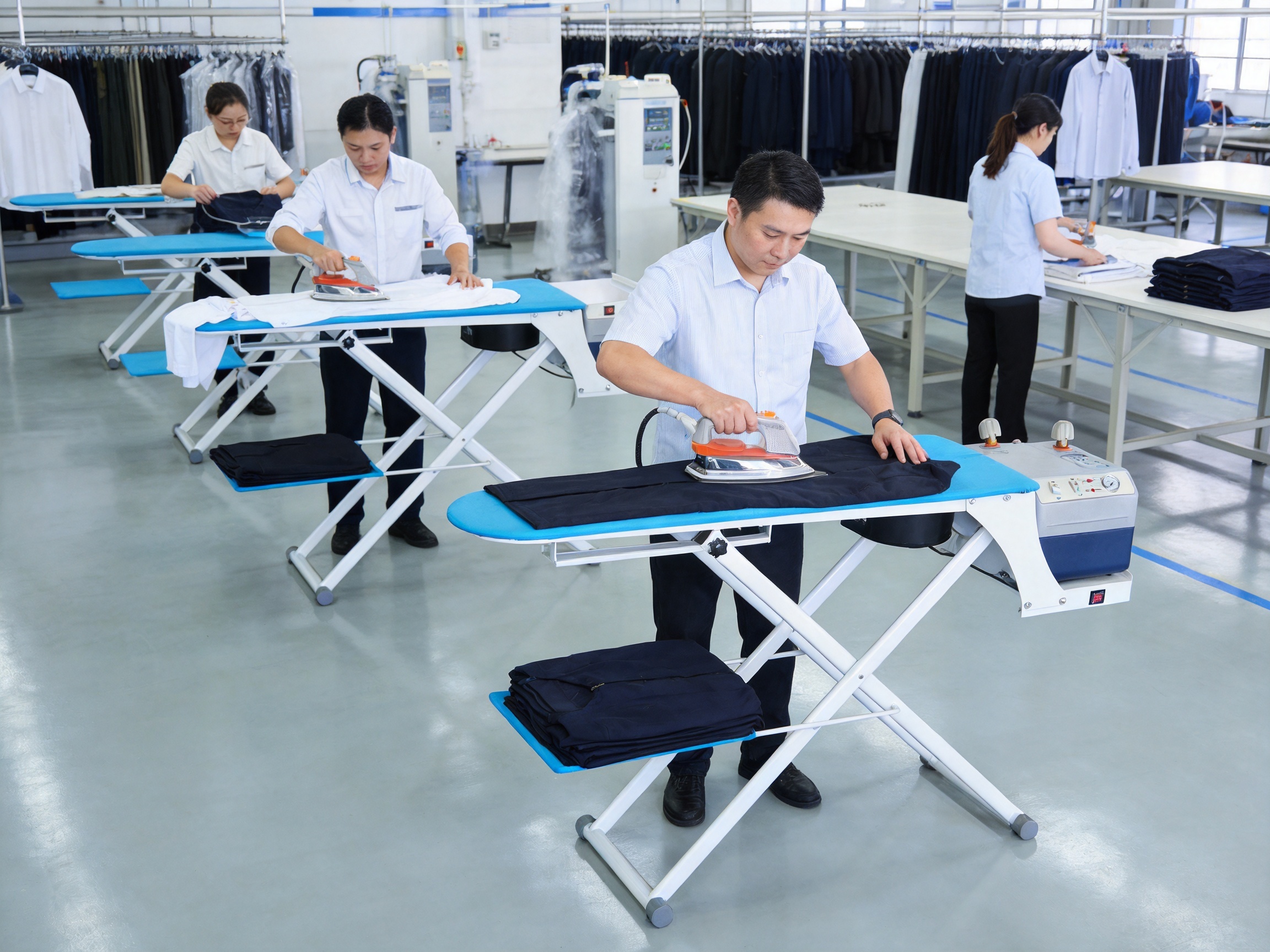
The table provides a heated working surface and an active vacuum function for professional garment pressing. The heating system supplies 550W of thermal power, while the 65W vacuum motor helps hold fabric securely against the table during pressing.
The vacuum function helps reduce fabric movement, shifting, and lifting. This gives the operator better control when pressing seams, collars, cuffs, pleats, pockets, curved sections, and other detailed garment areas.
The supplied product information identifies the operating voltage as 220V and the frequency as 50/60Hz. One specification line shows “220W” for voltage, but watts measure power rather than voltage. Buyers should confirm the final electrical specification and plug configuration with the supplier before ordering.
Yes. Its heating and vacuum functions are appropriate for final garment finishing, crease removal, shape restoration, and presentation work in dry-cleaning and garment-care businesses.
Yes. Tailors can use the table for pressing seams, shaping collars and lapels, refining cuffs, preparing hems, and completing custom garments. The vacuum function is particularly useful when accurate fabric positioning is required.
Yes. The table can be used in intermediate pressing, final finishing, sample rooms, quality-control areas, and packing preparation. The number of machines required depends on production volume and workflow design.
No. The table is a supporting workstation rather than a complete replacement for an iron or steam iron. Its heated surface and vacuum function work with suitable pressing equipment to create a more controlled finishing process.
The table can support many common garment fabrics, but the operator must select the correct temperature, steam level, pressure, and pressing time for each material. A test area should be used when the textile is unfamiliar or heat-sensitive.
The operator should keep the suction area clean and remove lint, dust, and fabric particles. Accessible filters or airflow components should be checked according to the equipment instructions. Maintenance must be performed with the machine switched off and disconnected.
The operator should check for blocked airflow, a dirty filter, an incorrectly positioned table covering, or excessive debris. If the problem continues, qualified service personnel should inspect the motor and related components.
The company information states that its products have passed CCC and CQC certifications and that the company follows standards including GB4706.1-2005 and GB4706.2-2007. Buyers should request current documentation for the exact model and shipment configuration.
Yes. The company provides customization and OEM services. Buyers should discuss branding, packaging, electrical configuration, order quantities, documentation, and inspection requirements before production.
Yes. The manufacturer produces electric irons, steam irons, hanging irons, spray guns, small steam machines, steam boilers, heat transfer machines, and accessories. These products can be considered when creating a coordinated garment-finishing setup.
Tailors, dry cleaners, alteration shops, garment manufacturers, uniform suppliers, sample rooms, repair services, and professional finishing departments can all benefit from the table’s combination of heating and fabric control.
The 550W Heating Power Vacuum Ironing Table is designed for businesses that need more control and consistency than a basic ironing board can provide. Its 550W heating system supports stable thermal performance, while the 65W vacuum motor helps secure fabric during pressing. Together, these functions create a practical workstation for professional garment finishing.
The table is suitable for tailoring, dry cleaning, garment manufacturing, alterations, sample development, uniform production, and other textile applications. Its balanced configuration provides useful professional performance without requiring the complexity of a large automated pressing line.
Its value is strengthened by the manufacturing capabilities of Jinyun Shengda Sewing Equipment Co., Ltd. The company has operated since 2003 and specializes in independent research, development, and production of ironing equipment, steam systems, vacuum tables, heat transfer machines, and related accessories. Its broad product range, OEM capability, quality focus, standards awareness, export experience, and professional service support make it a suitable partner for both individual equipment buyers and larger distribution projects.
For businesses seeking improved pressing control, efficient garment handling, and repeatable finishing quality, this vacuum ironing table offers a dependable foundation for a professional workstation. Correct installation, suitable operating practices, regular maintenance, and appropriate fabric settings will help users obtain the best performance from the equipment.
1. Product technical information for the 550W Heating Power Vacuum Ironing Table, including operating voltage, frequency, vacuum motor power, and heating power.
2. Manufacturer-provided company profile for Jinyun Shengda Sewing Equipment Co., Ltd., including company history, product categories, export markets, OEM services, and quality commitments.
3. General professional garment-finishing practices concerning heat, pressure, moisture, fabric positioning, seam control, and textile handling.
4. GB4706.1-2005, General Requirements for Household and Similar Electrical Appliances.
5. GB4706.2-2007, Relevant Safety Requirements for Electrical Irons and Similar Appliances.
6. General equipment-maintenance principles for heated work surfaces, vacuum motors, electrical connections, filters, and textile-processing workstations.
 +86-578-3158872 / +86-578-3158958
 jyshengda@163.com / caroying@jy-shengda.com
 No. 8 Nanyi Rd, Huzhen Industrial Park, Zhejiang, China
Copyright © Jinyun Shengda Sewing Equipment Co., Ltd. All Rights Reserved.
Ironing Press Machine Equipment Factory
 English
 中文简体
 русский
 عربى