Modern garment production requires more than a strong iron and a skilled operator. Professional finishing depends on the ability to control heat, moisture, pressure, airflow, visibility, and work positioning at the same time. When these factors are properly coordinated, garments can be shaped accurately, seams can be opened cleanly, wrinkles can be removed efficiently, and finished products can achieve a consistent appearance from the first piece to the last. The ST-B1-G Multi-Size Vacuum Table is designed for this demanding environment, combining powerful heating, vacuum fixation, optional heated work areas, multiple tabletop sizes, and integrated illumination in one industrial workstation.
As a professional vacuum table for garment factories, tailoring workshops, clothing exporters, uniform producers, and high-end apparel finishers, the ST-B1-G focuses on practical production needs. Its 4KW heating pipe supports rapid and stable heating, while the 750W vacuum motor creates a working vacuum pressure of at least 150Pa. Together, these systems help operators position fabric securely and finish garments with greater control. Optional tabletop heating and arm heating provide additional flexibility for applications that require warmth across different parts of the working surface.
The equipment is manufactured by Jinyun Shengda Sewing Equipment Co., Ltd., a Chinese producer with experience in electric irons, steam irons, spray guns, heat transfer machines, steam boilers, vacuum tables, and related ironing equipment. The company has developed a broad product range for garment production and has built distribution channels in domestic and international markets. Its manufacturing approach combines independent research and development, product improvement, quality control, customization, and OEM support.
This article examines the design, performance, operational advantages, applications, maintenance requirements, and manufacturing strengths associated with the ST-B1-G Multi-Size Vacuum Table. It also explains how the unit can compare favorably with less flexible vacuum tables and why selecting a manufacturer with broad product expertise can benefit professional buyers.
A vacuum table is a specialized finishing platform that uses airflow beneath or around the work surface to hold fabric in place. During pressing, steaming, shaping, or inspection, the vacuum helps prevent fabric from shifting. It can also assist with moisture management by drawing air through the material and away from the working area. This creates a more stable environment for finishing operations than a simple flat table.
In garment manufacturing, fabric movement is a major source of inconsistency. Lightweight textiles can lift or slide when exposed to steam. Stretch fabrics may distort if the operator pulls them across an unstable surface. Delicate materials may develop unwanted impressions if pressure is applied unevenly. Structured garments can also be difficult to position correctly when the work platform does not provide enough support.
A vacuum table addresses these challenges by combining a solid working platform with controlled suction. The operator can place a garment or panel on the table, activate the vacuum, and use the resulting airflow to keep the material stable. This is particularly valuable when shaping collars, cuffs, lapels, seams, trouser legs, jacket fronts, uniforms, and other components that require precise positioning.
The ST-B1-G is designed for industrial use rather than occasional household pressing. Its high-power heating pipe, dedicated vacuum motor, optional heated components, and range of table dimensions allow it to serve different production scales. The equipment can be integrated into a professional ironing station or used as part of a larger finishing line that includes steam boilers, irons, presses, spray guns, and garment inspection equipment.
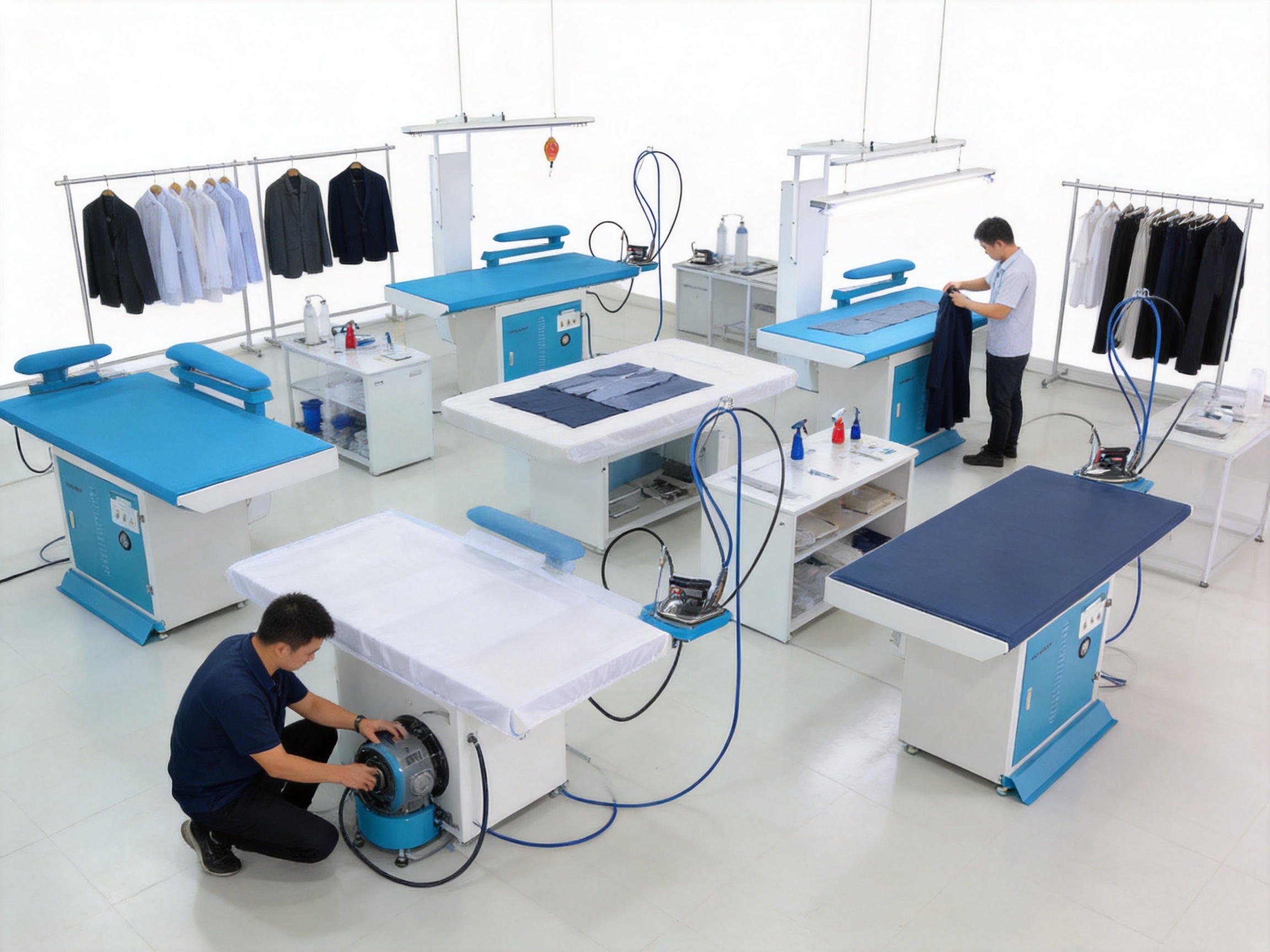
The ST-B1-G Multi-Size Vacuum Table is available with three tabletop size options: 800 by 1200 millimeters, 800 by 1500 millimeters, and 900 by 1800 millimeters. This range allows buyers to select a work area according to garment dimensions, available floor space, and production volume. A compact configuration can be suitable for smaller workshops or specialized operations, while the larger version provides more room for coats, dresses, uniforms, bedding-related items, and broad fabric panels.
The main heating pipe is rated at 4KW. This provides the thermal capacity needed for a demanding industrial workstation. Rapid heating can reduce waiting time between production tasks, while sufficient heat reserve helps the table maintain useful operating conditions during continuous work. Actual heating behavior will depend on environmental conditions, fabric type, work procedures, and the selected configuration, but the high rated heating power gives the machine a strong foundation for professional use.
The vacuum motor is rated at 750W, and the stated vacuum pressure is at least 150Pa. The motor supplies the airflow required to hold materials in place and support the finishing process. Strong and consistent suction is especially useful when working with slippery, thin, layered, or steam-affected textiles. By stabilizing the material, the vacuum system helps operators focus on shaping and finishing rather than repeatedly repositioning the garment.
Tabletop heating is available as an optional 1000W function. Arm heating is also optional, with a rated power of 350W. These options allow the table to be configured for operations that require additional heat in the main working area or on an extended arm section. Buyers can therefore match the equipment to their workflow instead of paying for features that may not be necessary in every application.
The machine operates on a 220V power supply and has a rotational speed of 1400r/min for the motor system. Integrated illumination improves visibility over the working area. Better lighting can be particularly helpful when handling dark fabrics, matching patterns, checking seam lines, identifying surface irregularities, or performing detailed work during long production shifts.
| Specification | ST-B1-G Configuration | Production Value |
|---|---|---|
| Main heating pipe power | 4KW | Supports fast and effective heating for industrial finishing |
| Vacuum motor power | 750W | Provides airflow for fabric fixation and moisture management |
| Vacuum pressure | At least 150Pa | Helps stabilize garments and fabric panels during work |
| Optional tabletop heating | 1000W | Provides additional heat across the primary work surface |
| Optional arm heating | 350W | Supports detailed work on sleeves, narrow sections, and shaped areas |
| Power supply | 220V | Suitable for compatible industrial electrical installations |
| Motor rotational speed | 1400r/min | Supports the operating performance of the vacuum system |
| Table size options | 800×1200mm, 800×1500mm, or 900×1800mm | Allows selection according to product size and available workspace |
| Lighting | Integrated illumination | Improves visibility during precision garment finishing |
Heat is a central element in professional garment finishing. It softens fibers, helps relax creases, supports shaping, and improves the appearance of pressed surfaces. However, a heating system must offer more than a high rating. It should also be appropriate for repeated production use, compatible with the work surface, and capable of supporting a smooth workflow.
The 4KW heating pipe of the ST-B1-G gives the machine considerable heating capacity compared with basic tables designed for light-duty applications. This power is valuable when the operator needs to prepare the work surface quickly or maintain suitable heat through consecutive operations. High heating capacity can reduce idle periods and help the equipment meet the rhythm of a busy production department.
Another benefit is the ability to support different material categories. Garment factories may work with cotton, polyester, wool blends, linen, denim, uniform fabrics, technical fabrics, and decorative textiles. Each material reacts differently to temperature, moisture, and pressure. A strong heating system gives operators more room to establish appropriate working conditions, while trained personnel remain responsible for choosing safe settings and suitable techniques for each textile.
When heating is combined with vacuum, the result is more controlled than heating alone. The vacuum can hold the fabric against the table while heat is applied. This reduces unwanted movement and makes it easier to maintain the intended shape. On garments with seams, darts, pleats, or layered sections, stable contact can improve the repeatability of the finishing process.
The optional 1000W tabletop heating function adds another level of configuration. In some workflows, operators require heat directly across the main table surface rather than only from a separate iron or steam tool. This option can help warm the area where panels are positioned, especially when the operation involves repeated shaping or drying. It also allows a buyer to specify a more advanced configuration for applications that demand a heated work surface.
The vacuum system is one of the most important features of the ST-B1-G. A 750W motor provides the mechanical power for air extraction, while the stated vacuum pressure of at least 150Pa supports fabric fixation. The purpose is not simply to create suction. The purpose is to make the garment more manageable and the operator’s work more repeatable.
When fabric is placed on a conventional table, it may slide as the iron passes over it. Steam can make the problem worse by temporarily changing the fabric’s flexibility and surface behavior. The operator may need to use one hand to hold the garment and the other hand to operate the iron or steamer. This limits precision and can slow production. Vacuum fixation reduces the need for constant manual restraint.
By drawing the fabric toward the working surface, the vacuum table helps maintain alignment. It can be useful for opening seams, setting edges, flattening panels, shaping pockets, preparing collars, and finishing large garment sections. It also supports more consistent results when multiple operators work on the same product because the work surface provides a stable foundation for standard procedures.
Vacuum airflow can also assist with cooling and moisture removal. After steam is applied, airflow through the table can help reduce residual moisture in the fabric. Faster stabilization may reduce the risk of a garment losing its shape after pressing. The actual performance will depend on fabric construction, steam quantity, table covering, and production technique, but the combination of heat and vacuum is widely suited to professional finishing processes.
Compared with a simple ironing board, a vacuum table is therefore a production tool rather than just a support surface. It helps coordinate the physical conditions under which pressing takes place. The ST-B1-G’s motor capacity, dedicated vacuum system, and industrial construction make it more appropriate for sustained garment operations than equipment intended only for occasional use.
One of the most practical advantages of the ST-B1-G is its availability in three tabletop dimensions. Production facilities do not all work with the same garments, and floor layouts vary considerably. A table that is ideal for a coat manufacturer may be unnecessarily large for a small tailoring workshop. Conversely, a compact table may limit productivity in a factory handling long garments and broad panels.
The 800 by 1200 millimeter size can help facilities that need an industrial vacuum table while conserving floor space. It may be appropriate for smaller workrooms, repair departments, sampling areas, or operations focused on relatively compact garments. It can also serve as a supplementary station alongside larger equipment.
The 800 by 1500 millimeter version provides a balanced working area for many general garment applications. It offers additional length for trousers, jackets, shirts, uniforms, and medium-sized textile panels without requiring the footprint of the largest option. For many clothing factories, this configuration can provide a practical combination of capacity and space efficiency.
The 900 by 1800 millimeter option is intended for buyers who require a broad working surface. The increased length and width can be beneficial when finishing coats, long dresses, large uniform components, wide fabric sections, or multiple small pieces in sequence. It may also support a more ergonomic workflow by reducing the need to reposition large items repeatedly.
Offering multiple sizes is an advantage over one-size equipment because it gives buyers more control over installation planning and capital investment. Rather than adapting the production department to an unsuitable table, the purchaser can select a version according to current requirements. This is also helpful for OEM buyers and distributors serving different markets, as the same product family can cover several workshop configurations.
The optional arm heating function is rated at 350W. An arm section can be valuable when operators need to work on sleeves, narrow garment sections, trouser legs, cuffs, shoulders, and other shaped areas that are difficult to position on a completely flat surface.
Flat tables are efficient for large panels, but many garment components have three-dimensional forms. Sleeves and legs, for example, may require internal support to prevent unwanted creasing on the opposite side. A heated arm can provide a more focused area for detailed finishing. When combined with vacuum fixation, it can help the operator stabilize a narrow section while applying heat, steam, and pressure.
The optional nature of the arm heater is commercially useful. Not every customer needs the same configuration. A workshop specializing in shirts may require a different setup from a factory producing jackets or uniforms. By selecting the arm heating option only where it provides value, buyers can build a more suitable equipment package and avoid unnecessary complexity.
Finishing quality depends on what the operator can see. Small defects such as seam puckering, uneven edges, faint wrinkles, shine marks, thread remnants, and pattern misalignment may not be obvious under weak or inconsistent lighting. Integrated illumination helps create a clearer view of the working area.
This feature is particularly useful for dark materials, black uniforms, deep-colored wool, densely woven fabrics, and garments with fine decorative details. Better visibility can also support quality inspection immediately after pressing. Operators can identify areas that need additional work before the product moves to packing or final inspection.
Lighting contributes to ergonomics as well. In a busy production room, operators may work for many hours and deal with changing ambient conditions. A dedicated light source over the table can reduce dependence on general room lighting. It may help the operator maintain a consistent working position and reduce the need to lean excessively toward the garment.
Although illumination does not replace operator skill, it strengthens the overall workstation design. The ST-B1-G combines visibility with heat and vacuum control, creating a more complete environment for precise garment finishing.
When comparing vacuum tables, purchasers often look beyond the nameplate. The most useful comparison considers heating capacity, motor power, table dimensions, optional functions, workflow suitability, and manufacturer support. A low-cost table may appear attractive at the initial purchasing stage, but it may provide less heating capacity, fewer size choices, limited customization, or a weaker support structure.
The ST-B1-G has several features that can give it an advantage over basic competitors. First, its 4KW heating pipe is designed for industrial-level performance. Second, the 750W vacuum motor provides dedicated suction power rather than relying on a minimal airflow system. Third, the product is available in three table sizes, allowing customers to choose a configuration based on actual production needs.
The optional 1000W tabletop heating and 350W arm heating further distinguish the machine from fixed-configuration tables. These functions allow the equipment to be adapted to different finishing methods. A buyer can order a standard arrangement for general use or select enhanced heating features for more specialized garment operations.
Integrated illumination is another practical differentiator. Some competing products may require a separate lamp or additional installation work. A built-in lighting solution keeps visibility features closer to the primary workstation and can simplify layout planning.
The company’s broad product range is also relevant when evaluating long-term supplier value. A buyer purchasing a vacuum table may later require steam boilers, electric irons, spray guns, heat transfer machines, or accessories. Working with a manufacturer that produces related equipment can simplify product matching, technical communication, spare-part discussions, and future expansion.
It is important for buyers to compare actual specifications rather than relying only on general claims. Electrical standards, voltage requirements, table construction, motor performance, heating behavior, warranty terms, and after-sales support should all be checked before ordering. The ST-B1-G provides a strong listed configuration, but the final suitability should always be assessed against the buyer’s local power supply, product range, working conditions, and regulatory requirements.
Jackets and coats often contain multiple layers, structured seams, collars, lapels, linings, and shaped panels. These components require accurate positioning and controlled pressure. The larger table options provide room for broad garment sections, while vacuum fixation helps prevent shifting during shaping and seam opening.
Uniform factories typically prioritize consistency and repeatability. Workers may process large quantities of shirts, trousers, jackets, workwear, school uniforms, or service garments. A stable vacuum table can help standardize finishing procedures across shifts. The integrated light is useful for checking seams, insignia areas, edge alignment, and surface appearance.
Shirts and blouses involve collars, cuffs, plackets, sleeves, and curved sections. The optional arm heating function can be valuable for narrow or shaped components. The primary table remains useful for front panels, back panels, and larger sections that need controlled pressing and vacuum support.
Trousers and skirts require attention to creases, waistbands, pockets, hems, and long seams. The 800 by 1500 millimeter or 900 by 1800 millimeter configurations can provide sufficient length for positioning longer components. Vacuum support may help maintain straight lines and reduce movement while the operator works along the garment.
High-value garments demand careful handling. A small visible mark, distorted seam, or uneven edge can affect the perceived quality of the finished product. The ST-B1-G’s combination of controlled heating, vacuum fixation, illumination, and optional shaped-area heating supports detailed work in tailoring studios and luxury apparel departments.
Sampling rooms often handle many fabrics and garment styles in small quantities. Flexibility is important because the operator may move from a compact blouse to a long coat or from a lightweight textile to a heavier structured material. The choice of table size and optional functions can help the equipment support varied development work.
Production managers evaluate equipment according to more than individual machine performance. They also consider output consistency, operator efficiency, floor utilization, training requirements, maintenance, and integration with other equipment. The ST-B1-G addresses these broader concerns through its multi-function workstation design.
A stable work surface can reduce repeated repositioning. When garments stay aligned, operators may complete tasks with fewer interruptions. The vacuum system also creates a repeatable base for standard operating procedures. Managers can train workers to follow defined steps for positioning, heating, suction, shaping, and inspection.
The different tabletop sizes can support better floor planning. A compact installation may be selected for a sample room or narrow work area, while a larger unit can be positioned in a dedicated finishing department. Choosing the correct size helps avoid wasting valuable factory space and may improve movement around the workstation.
Optional functions support phased investment. A customer can begin with the configuration required for current production and later specify additional equipment or related machinery as business needs develop. The manufacturer’s wider product range can also make it possible to source complementary equipment from a coordinated supplier.
Visibility improvements may support quality control by allowing operators to inspect surfaces during the finishing operation. Detecting defects early is usually more efficient than discovering them after packing or shipment. A well-lit workstation therefore contributes not only to convenience but also to process control.
The ST-B1-G is supported by the manufacturing experience of Jinyun Shengda Sewing Equipment Co., Ltd. The company was established in 2003 in Huzhen Town, Lishui City, Zhejiang Province, China. Its location at the junction of Lishui, Jinhua, and Taizhou provides access to transportation networks and industrial resources.
The company specializes in independent research, development, and production. Its product categories include electric irons, steam irons, hanging irons, spray guns, small steam machines, heat transfer machines, steam boilers, vacuum tables, and accessories. This broad portfolio gives the company practical knowledge of the interconnected systems used in garment finishing.
Manufacturing a vacuum table requires coordination between electrical components, heating elements, motors, airflow channels, surface materials, structural parts, controls, and safety considerations. Experience across related ironing equipment can support better product matching and a more complete understanding of how the machine will be used in a factory.
The company emphasizes continuous product improvement and quality upgrades. For industrial buyers, this is important because garment equipment must perform repeatedly rather than only during a demonstration. Product development should consider heating response, motor operation, operator convenience, maintenance access, surface durability, and compatibility with production routines.
Research and development, management, and sales teams work together within the company’s operating model. This cooperation can improve communication between customer requirements and product configuration. Buyers seeking custom specifications or OEM services may benefit from discussing table size, optional heating functions, electrical requirements, packaging, labeling, and other commercial details with a supplier that supports customization.
The company owns several brands, including Silver Star, Platinum Dragon, Tingshun, Jiasheng, Shengtai, and Jiangxin. These brands reflect its experience in serving different market segments and product categories. For international customers, a multi-brand manufacturing background can indicate familiarity with distributor requirements and varied regional preferences.
Electrical garment equipment must be designed and manufactured with attention to safety, reliability, and compliance. The company states that it follows national and industry standards, including GB4706.1-2005 and GB4706.2-2007. It also states that its products have passed CCC and CQC certifications.
Certification and standards awareness do not eliminate the need for buyers to verify local requirements. Importers should confirm whether the supplied configuration meets the regulations of the destination market, including electrical voltage, plug type, grounding, labeling, documentation, and inspection procedures. Nevertheless, a manufacturer that works within recognized standards provides a stronger starting point for responsible procurement.
Quality management should cover the complete production process. Heating components should be selected and installed correctly. Motors and electrical assemblies should be checked for proper operation. The table structure should remain stable under repeated use. The working surface and covering materials should be suitable for heat, steam, pressure, and continuous handling. Lighting and optional heating components should also be verified before shipment.
For buyers, it is reasonable to request product specifications, test information, operating instructions, packing details, and any available certification documents. Clear documentation supports installation, operator training, maintenance planning, and customs procedures.
Garment factories and distributors often have requirements that differ from standard catalog configurations. A facility may need a particular tabletop size, electrical arrangement, heating combination, brand label, packaging format, or control specification. The company identifies customization and OEM services as part of its business advantages.
Customization can be especially useful for distributors. A distributor may need product labeling that matches its market identity, packaging adapted to its logistics process, or a product range arranged for different customer segments. The ST-B1-G’s three size options and optional heating features already provide a useful starting point for such product planning.
OEM cooperation should be managed through clear technical documentation. Buyers should specify the required voltage, frequency, table size, heating options, motor requirements, branding, accessories, packing method, and inspection standards. Both parties should confirm which features are standard and which require engineering approval or minimum order quantities.
A manufacturer with in-house product development capabilities may be better positioned to evaluate such requests than a trading company that only resells finished equipment. The company’s experience in independent development and production can support communication from initial inquiry through sample confirmation and mass production.
Before installation, the purchaser should prepare a level and stable floor area with sufficient clearance around the machine. The selected table size should be considered together with operator movement, garment storage, steam equipment, electrical connections, and ventilation. The 900 by 1800 millimeter version requires more floor length than the compact model, so layout planning is essential.
The 220V power supply should be verified before commissioning. Because the main heating pipe is rated at 4KW and optional heating elements add further electrical load, the installation should be connected to a suitable circuit by qualified personnel. Grounding, protective devices, cable capacity, and local electrical regulations should be checked before use.
Operators should be trained to understand the relationship between fabric type, heat, steam, vacuum, pressure, and dwell time. A powerful machine does not mean that every fabric should be treated with maximum heat. Delicate or heat-sensitive materials require appropriate procedures. Sample testing and manufacturer guidance should be used when introducing unfamiliar textiles.
The table covering should be kept clean and correctly fitted. A damaged, excessively compressed, or contaminated covering can affect airflow and finishing quality. Operators should also avoid placing sharp objects, wet packaging materials, or unsuitable items on the heated surface.
Integrated illumination should be positioned and used in a way that provides clear visibility without creating glare. The work area should remain free of unnecessary items so that the operator can handle garments safely and efficiently.
Preventive maintenance helps protect the performance of a vacuum table and reduces avoidable downtime. Operators should inspect the table surface, covering, electrical cables, switches, lighting, and vacuum function as part of a regular routine. Any abnormal noise, overheating, smell, vibration, or reduction in suction should be reported promptly.
The vacuum system deserves particular attention. Dust, fibers, lint, and loose threads can accumulate around airflow passages and filters. If the design includes accessible filter or suction components, they should be cleaned according to the manufacturer’s instructions. Restricted airflow can reduce vacuum effectiveness and place additional stress on the motor.
The heating system should be monitored for uneven heating or delayed temperature response. Operators should not attempt unauthorized repairs to electrical or heating components. Qualified technicians should inspect wiring, connections, thermostatic components, and heating elements when service is required.
The table covering may need replacement after extended use. A worn covering can reduce airflow, create uneven pressure, or transfer marks to garments. Replacement materials should be compatible with the machine’s heat and vacuum requirements. Buyers should ask about recommended consumables and spare parts when placing an order.
Regular cleaning is also important for product quality. Fibers, adhesive residues, dust, and loose threads can affect the appearance of finished garments. A clean workstation supports both equipment reliability and professional presentation.
Although the ST-B1-G is a high-power industrial machine, efficient operation depends on how it is used. Operators can reduce unnecessary energy consumption by organizing batches, avoiding prolonged idle heating, maintaining the vacuum system, and selecting the appropriate optional functions for the task.
A clean and correctly maintained airflow system can operate more effectively than a restricted system. Proper table covering maintenance may also improve heat and vacuum transfer. Training workers to place garments efficiently can reduce repeated heating, repositioning, and rework.
High-quality finishing equipment can support material efficiency by reducing avoidable defects. When garments are finished consistently, fewer pieces may require reprocessing or correction. This can save fabric, labor, energy, packaging materials, and production time. The economic and environmental benefits will depend on the facility’s operating procedures, but process stability is a useful foundation.
Manufacturers also contribute to efficiency through product durability, maintainability, and spare-part availability. A machine that can be maintained and repaired is less likely to become prematurely obsolete. Buyers should consider total operating value rather than only the initial purchase price.
The correct size depends on the largest typical garment, the required handling direction, the production volume, and the available floor area. Buyers should measure the space before ordering and consider access routes for delivery and installation.
The 800 by 1200 millimeter version is a practical choice where space is limited or where the equipment will support smaller products and specialized tasks. It may also be suitable for a secondary station in a finishing department.
The 800 by 1500 millimeter version offers a versatile middle configuration. It can support general garment production while maintaining a manageable footprint. Buyers handling shirts, trousers, jackets, uniforms, and moderate-sized panels may find this size suitable for everyday work.
The 900 by 1800 millimeter version is better suited to larger products and operations where garment repositioning should be minimized. It provides a generous work area for long or wide items, although the factory must have sufficient room for safe operator movement and service access.
When selecting between the sizes, purchasers should also consider whether the table will be used by one operator or as part of a coordinated production line. A larger surface is not always better if it restricts movement or creates unnecessary reach distances. The best choice is the size that supports the actual product mix and work method.
A vacuum table is one part of a larger garment finishing system. Factories may need to coordinate it with steam boilers, irons, spray guns, heat transfer machines, and accessories. A supplier that understands these product categories can help customers develop a more compatible equipment package.
Jinyun Shengda Sewing Equipment Co., Ltd. has specialized in these related categories since its establishment in 2003. Its product portfolio covers both heat-producing and steam-related equipment as well as vacuum tables and accessories. This breadth can be useful for buyers who want to consolidate procurement or develop a complete workstation concept.
The company reports that its products are exported to Southeast Asia, Central Asia, South America, Africa, and other regions. International distribution experience may support communication concerning packaging, shipment, documentation, market preferences, and OEM requirements. Buyers should still confirm specific export arrangements, lead times, shipping terms, and service conditions for each order.
Supplier selection should also include an evaluation of communication quality. A reliable supplier should be able to provide clear specifications, answer configuration questions, confirm electrical details, explain optional functions, and support the buyer during installation and operation. Professional service is particularly important when the machine will be used in a high-volume factory where downtime can affect delivery schedules.
The value of the ST-B1-G comes from its combination of productivity features rather than from one specification alone. The 4KW heating system supports demanding operations. The 750W vacuum motor helps stabilize fabric. Optional heating functions allow customization. Multiple sizes improve installation flexibility. Illumination supports visibility and inspection.
For a growing garment business, these features can help create a more capable finishing department without requiring several separate workstations for every task. A single multi-function table may support preparation, pressing, shaping, inspection, and moisture management, depending on the production process.
For an established factory, the machine can serve as a dedicated station for a specific product line or as additional capacity during peak periods. The largest table size may be useful in a department handling coats or long garments, while the compact version can support sampling or alteration work.
For distributors, the product family provides opportunities to serve different customers with one recognizable equipment platform. The three sizes and optional functions allow the distributor to create product packages for small workshops, medium factories, and larger garment producers.
Commercial value should always be measured against the buyer’s real operating conditions. Expected production volume, operator skill, fabric types, electrical costs, service access, replacement parts, and delivery requirements all influence the final return on investment. A detailed quotation and technical confirmation are recommended before purchase.
Before ordering the ST-B1-G Multi-Size Vacuum Table, buyers should confirm the desired tabletop size and verify that it fits the planned production area. The buyer should also identify whether tabletop heating or arm heating is required for the intended product range.
The electrical configuration should be checked carefully. Confirm the 220V requirement, local frequency, plug and socket arrangement, grounding method, circuit capacity, and installation responsibilities. High-power heating equipment should be installed in accordance with local electrical safety requirements.
Buyers should request confirmation of the motor specification, vacuum pressure, heating pipe rating, optional heating ratings, table construction, illumination arrangement, control method, and included accessories. These details should appear clearly in the quotation or technical document.
For export orders, packaging and shipping conditions should be discussed in advance. The purchaser should confirm dimensions, gross weight, loading method, shipping marks, documentation, inspection procedures, and any destination-market certification needs.
After-sales support should also be evaluated. Ask about warranty coverage, technical assistance, recommended maintenance, spare parts, replacement table coverings, and service response. A reliable support plan can be as important as the initial product specification.
The ST-B1-G is designed for professional garment finishing, including pressing, shaping, seam opening, fabric fixation, moisture management, and detailed inspection. It is suitable for garment factories, tailoring workshops, uniform producers, sampling rooms, and luxury apparel operations.
The main heating pipe is rated at 4KW. This provides strong heating capacity for demanding industrial finishing work.
The vacuum motor is rated at 750W. The listed vacuum pressure is at least 150Pa, supporting fabric fixation and airflow during garment finishing.
Yes. Tabletop heating is available as an optional 1000W function, and arm heating is available as an optional 350W function. Buyers can select the configuration that best matches their production requirements.
The table is available in three sizes: 800 by 1200 millimeters, 800 by 1500 millimeters, and 900 by 1800 millimeters. The correct choice depends on garment dimensions, workspace, and production workflow.
Yes. Integrated illumination is included to improve visibility during precision work and surface inspection.
The listed power supply is 220V. Buyers should verify local electrical compatibility, frequency, grounding, and installation requirements before ordering.
Yes. The 900 by 1800 millimeter option provides a larger working area for coats, long dresses, uniforms, wide fabric sections, and other large items. The final selection should be based on the buyer’s typical product size and available floor area.
Vacuum fixation helps hold fabric in place while the operator applies heat, steam, pressure, or shaping techniques. It can reduce material movement, support alignment, improve repeatability, and assist with moisture removal after steaming.
The manufacturer identifies customization and OEM services among its business advantages. Buyers should discuss branding, packaging, electrical configuration, table size, optional functions, documentation, and order quantities directly with the supplier.
The company produces electric irons, steam irons, hanging irons, spray guns, small steam machines, heat transfer machines, steam boilers, vacuum tables, and accessories. This range can help buyers source complementary equipment for garment finishing operations.
Maintenance should include regular cleaning, inspection of the table covering, checking of airflow passages and filters, observation of motor operation, and inspection of electrical and heating components by qualified personnel. The manufacturer’s operating and maintenance instructions should be followed.
No. The company states that its products have passed CCC and CQC certifications and follow relevant standards, including GB4706.1-2005 and GB4706.2-2007. Importers must still verify destination-market regulations, voltage requirements, labeling, grounding, and other applicable obligations.
The ST-B1-G Multi-Size Vacuum Table is a comprehensive industrial workstation for garment finishing. Its 4KW heating pipe provides substantial thermal capacity, while the 750W vacuum motor and minimum 150Pa vacuum pressure help secure materials during pressing and shaping. Optional 1000W tabletop heating and 350W arm heating allow the equipment to be adapted to different production methods.
The three available tabletop sizes make the product suitable for a wide range of factories and workshops. Integrated illumination improves visibility, supports detailed workmanship, and assists with final surface inspection. Together, these functions offer practical advantages over simpler, less configurable tables.
The manufacturer strengthens the product offering through experience in independent research, development, and production of garment ironing equipment. Its broad product portfolio, quality and standards awareness, customization capabilities, OEM support, and international distribution experience make it a suitable supplier for customers seeking professional finishing equipment.
For garment businesses that need stable fabric control, strong heating performance, flexible configuration, and a dependable industrial workstation, the ST-B1-G provides a well-rounded solution. Buyers should select the appropriate size and optional functions according to their product range, floor layout, electrical system, and production objectives.
1. Product specification sheet for the ST-B1-G Multi-Size Vacuum Table, including heating, vacuum, electrical, rotational speed, and tabletop size information.
2. Manufacturer company profile for Jinyun Shengda Sewing Equipment Co., Ltd., including company history, product categories, research and development activities, OEM services, export markets, and certifications.
3. General industrial garment-finishing practices concerning heat application, vacuum fixation, steam handling, fabric positioning, and final inspection.
4. GB4706.1-2005, General Requirements for Household and Similar Electrical Appliances.
5. GB4706.2-2007, Safety Requirements for Electric Irons and Similar Appliances.
6. General equipment purchasing and maintenance principles for industrial ironing stations, vacuum tables, heating systems, and garment production workstations.

ST-B1-G Multi-Size Vacuum Table
The ST-B1-G Multi-Size Vacuum Table combines high-capacity heating, powered vacuum fixation, configurable work areas, optional specialized heating, and integrated lighting for professional garment finishing.
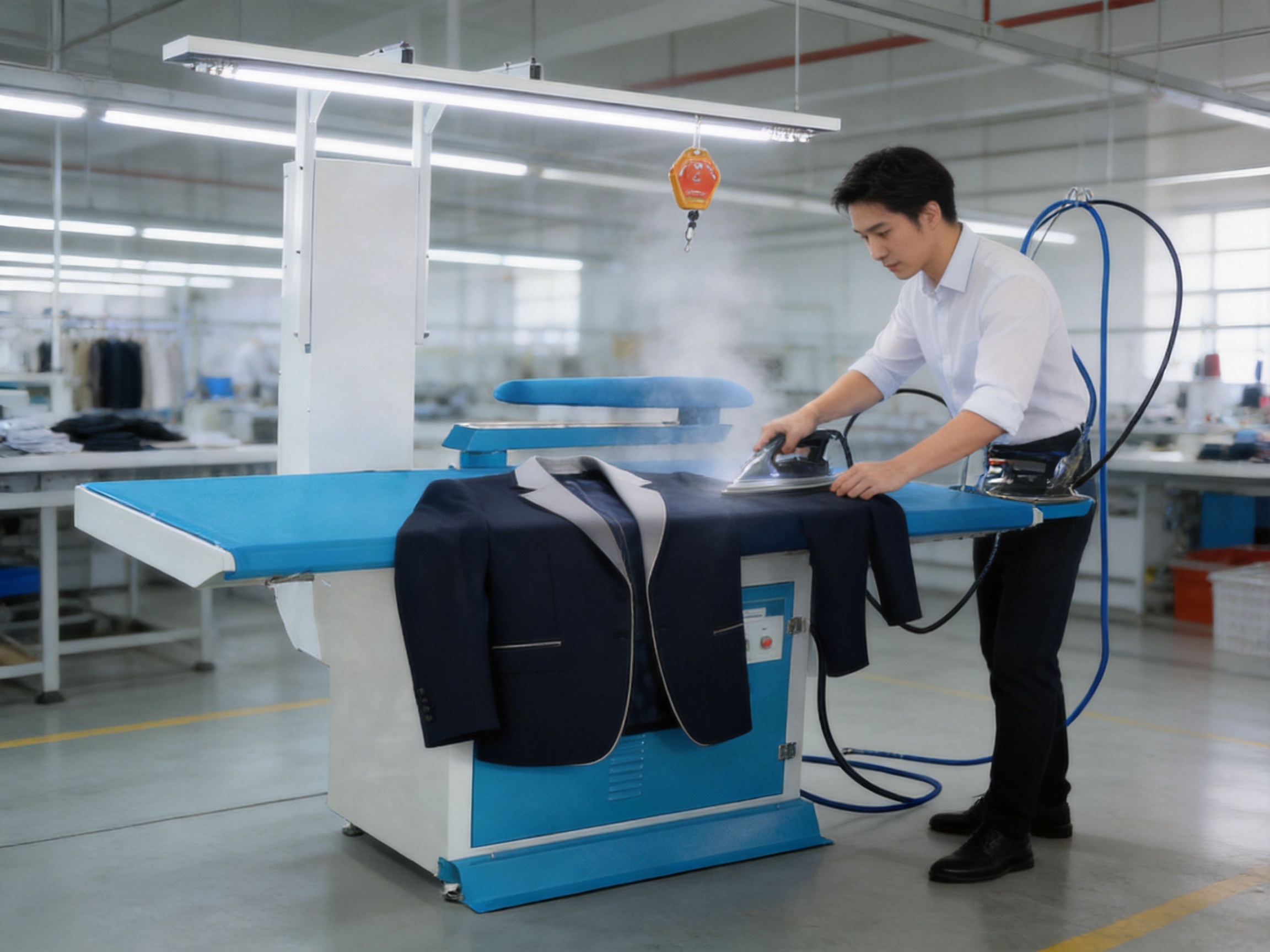
Its selection of 800 by 1200 millimeters, 800 by 1500 millimeters, and 900 by 1800 millimeters allows different garment producers to choose a suitable balance between working capacity and floor-space efficiency.
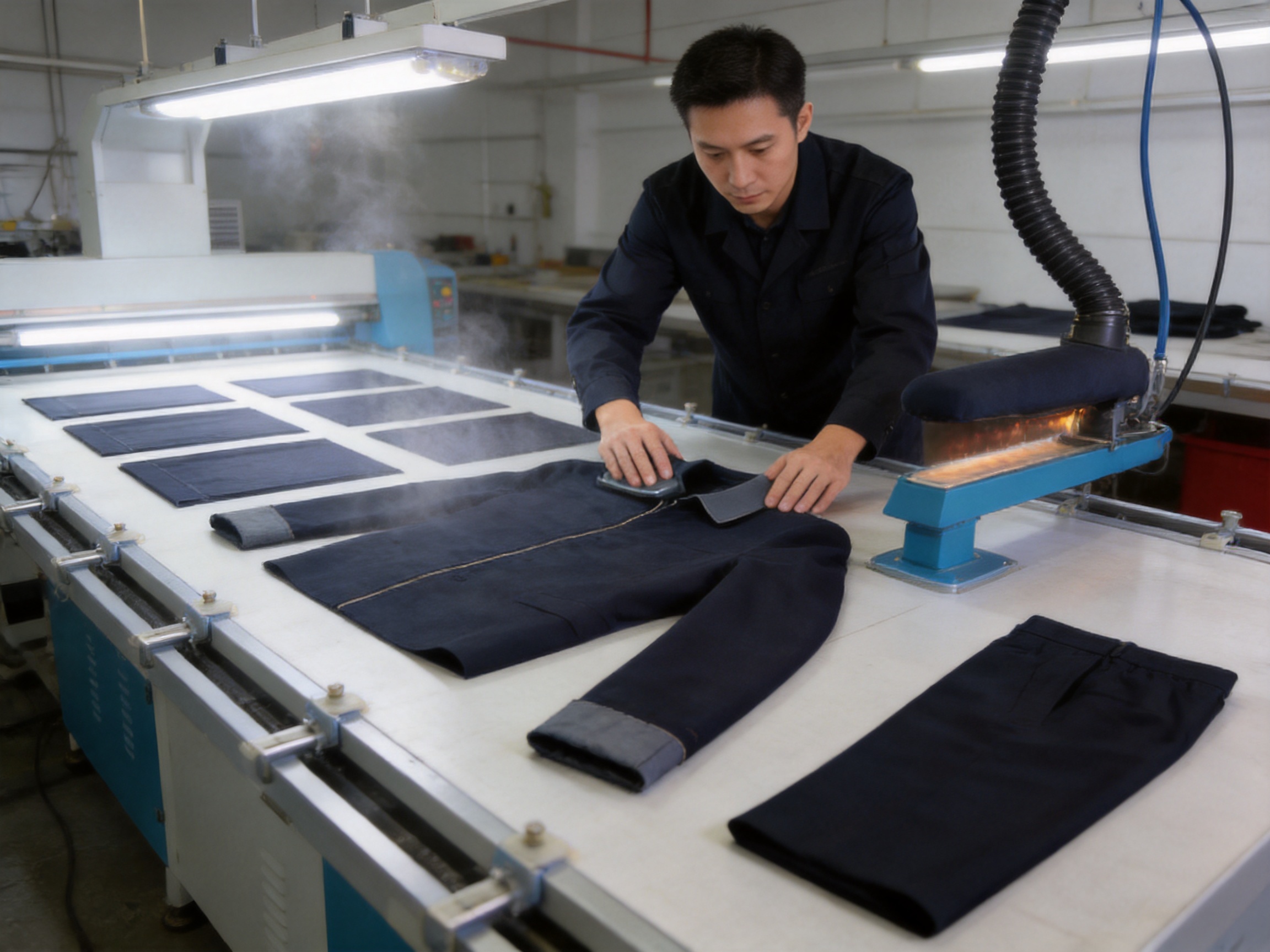
With manufacturing experience across vacuum tables, irons, steam equipment, spray guns, heat transfer machines, and accessories, the supplier can support complete garment-finishing equipment requirements as well as customized and OEM projects.
 +86-578-3158872 / +86-578-3158958
 jyshengda@163.com / caroying@jy-shengda.com
 No. 8 Nanyi Rd, Huzhen Industrial Park, Zhejiang, China
Copyright © Jinyun Shengda Sewing Equipment Co., Ltd. All Rights Reserved.
Ironing Press Machine Equipment Factory
 English
 中文简体
 русский
 عربى