In textile production, garment finishing, printing, dyeing, advertising, and related industrial operations, cleaning equipment must deliver more than a simple stream of liquid. Professional users need a tool that is easy to handle, reliable during repeated work, economical to maintain, and capable of producing consistent results on different surfaces. The ST-120 Spray Gun is designed to meet these practical requirements through a combination of lightweight construction, stable spraying performance, convenient operation, and flexible nozzle options.
A spray gun used in a production environment must support speed without sacrificing precision. Operators may need to remove stains from fabric, clean printed materials, treat localized marks, or apply cleaning solutions in difficult-to-reach areas. A heavy, poorly balanced, or inconsistent tool can increase fatigue and reduce productivity. The ST-120 addresses these challenges with a compact structure, an ergonomic grip, a 0.65-liter tank, and a 40-watt operating system designed for practical cleaning applications.
This article examines the product’s construction, operating advantages, application range, maintenance requirements, manufacturing strengths, quality approach, and position in comparison with ordinary cleaning tools. It also explains why a professional manufacturer with experience in electric irons, steam equipment, spray guns, heat transfer machines, vacuum tables, and accessories can provide a more complete solution for garment and textile businesses.
The ST-120 Spray Gun is a compact cleaning tool developed for users who require controlled liquid spraying in industrial and commercial environments. It operates at 220 volts, 50 hertz, and 40 watts, with a net weight of approximately 1.0 kilogram. Its integrated tank has a capacity of 0.65 liters, providing a practical balance between working time and portability.
The product is suitable for a wide range of applications, including knitting factories, dyeing workshops, apparel production lines, advertising production, printing operations, and general textile maintenance. Its purpose is not limited to one particular material. Depending on the cleaning liquid and application method, it can support spot cleaning, stain treatment, localized surface cleaning, and other tasks where a controlled spray is preferable to manual wiping or larger cleaning equipment.
The ST-120 combines a strong cleaning capability with a stable spray pattern. This combination is important because excessive spray can oversaturate a fabric or surface, while insufficient spray may require repeated treatment. A consistent output allows operators to develop a predictable working method and achieve more uniform results from one item to the next.
The unit is also designed with user comfort in mind. Its lightweight body helps reduce the physical burden associated with prolonged operation. The grip and overall structure are intended to support natural hand positioning, allowing the operator to guide the tool accurately while minimizing unnecessary strain on the hand and wrist.
| Product Item | Specification |
| Product Type | Professional spray gun |
| Model | ST-120 |
| Voltage | 220V |
| Power | 40W |
| Frequency | 50Hz |
| Weight | 1.0kg |
| Tank Capacity | 0.65L |
| Optional Accessories | Angled nozzles |
| Typical Applications | Knitting, dyeing, apparel, advertising, printing, and textile cleaning |
Weight is a major consideration when selecting a handheld industrial tool. In many garment and textile operations, cleaning is not performed for only a few minutes. Operators may work through batches of garments, fabric panels, printed products, or finished goods. If the equipment is unnecessarily heavy, the user may experience discomfort, slower movement, and reduced precision as the work period continues.
At approximately 1.0 kilogram, the ST-120 is designed to remain manageable during extended use. The lightweight design makes it easier to lift, carry, and reposition. It also helps operators move around workstations without the inconvenience associated with bulky cleaning systems. This portability is especially useful in factories where cleaning tasks take place at multiple stations rather than at one fixed location.
A compact handheld device can also support more efficient storage. The ST-120 requires less space than large floor-standing cleaning equipment and can be kept close to the production area. Easy access reduces preparation time and allows workers to respond promptly when a stain or localized cleaning requirement is identified.
Lightweight construction does not mean that the equipment is intended only for occasional use. The design is focused on balancing portability with stable performance. A professional spray gun must be sufficiently robust for regular work while remaining comfortable enough for operators to control accurately. The ST-120 is positioned around this balance, providing a practical alternative to improvised bottles, oversized sprayers, or tools designed for unrelated applications.
Operator fatigue can affect both productivity and work quality. As fatigue increases, users may hold the tool at inconsistent angles, move too quickly, or apply too much liquid to compensate for reduced control. A balanced and lightweight spray gun helps reduce these risks by allowing the operator to maintain a more stable posture and hand position.
The ergonomic structure also supports more comfortable operation around seams, collars, cuffs, printed images, narrow fabric sections, and other areas that require close attention. Better control can lead to more accurate treatment and less unnecessary use of cleaning liquid.
The ST-120 can be moved easily between workstations, inspection areas, finishing departments, and packing sections. This is valuable for small and medium-sized businesses that may not have dedicated cleaning rooms. The operator can bring the equipment directly to the product instead of transporting large quantities of garments or fabric to a central machine.
Portability also benefits service teams and mobile production environments. When cleaning is needed at a customer site, sample room, printing studio, or temporary production area, a compact spray gun is easier to transport than a full-size cleaning system.
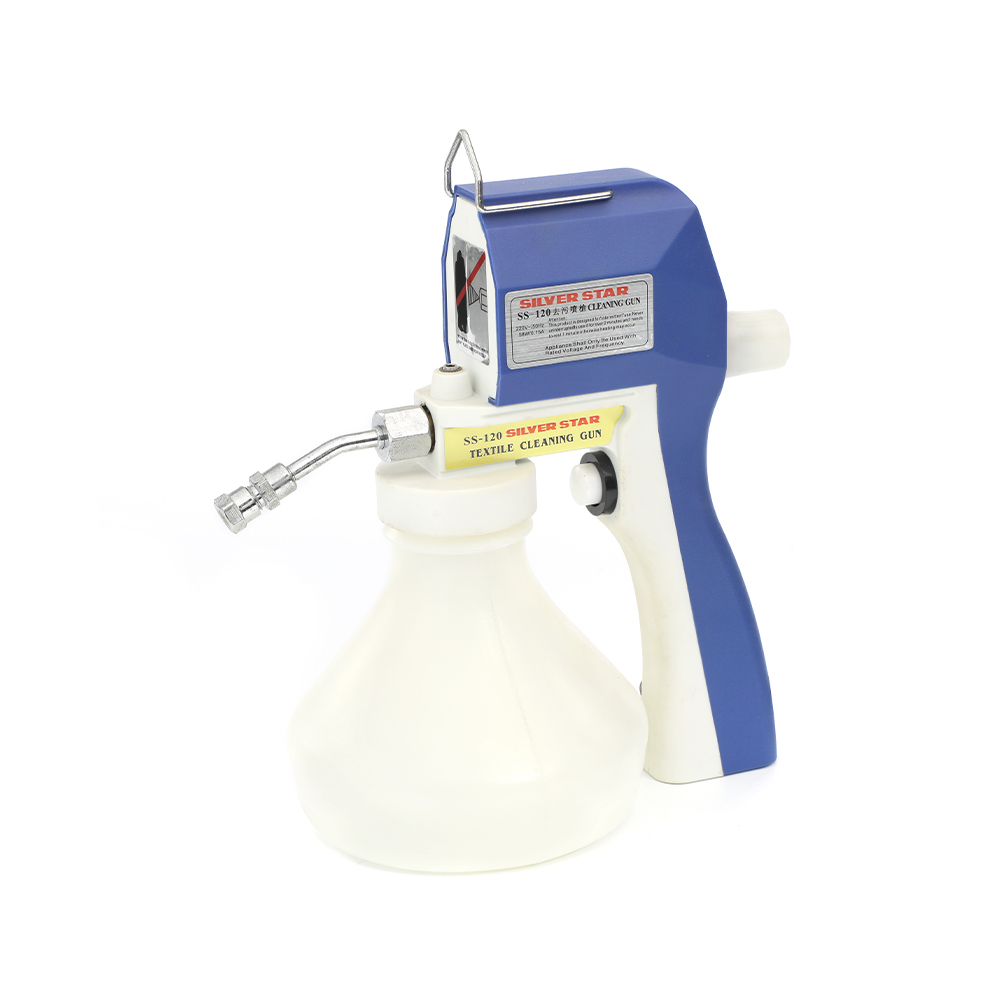
ST-120 Spray Gun
Cleaning performance is one of the most important factors in a spray gun. A professional tool must produce enough force to help loosen dirt and stains while allowing the operator to control the treatment area. The ST-120 is designed to provide strong cleaning power for common textile and surface cleaning tasks.
Its performance is particularly relevant in apparel and textile production, where localized marks may appear during sewing, handling, printing, dyeing, or transportation. Rapid treatment can help prevent a minor stain from becoming a reason for rejection or reprocessing. By directing the spray only where it is needed, operators can reduce the risk of treating large areas unnecessarily.
The stable spray pattern is another important advantage. A consistent pattern helps distribute the cleaning solution more evenly and supports repeatable work. When the output is irregular, some areas may receive too much liquid while others receive too little. This can create uneven drying, unnecessary rework, and inconsistent appearance. Stable delivery makes it easier to establish standard operating procedures for different fabrics and stain types.
Different materials require different amounts of liquid and different application distances. A delicate fabric may need gentle, targeted treatment, while a more durable material may benefit from a stronger application. The ST-120’s user-friendly controls allow the operator to adjust spray intensity according to the task.
Controlled application has several benefits. It can reduce liquid waste, support more accurate stain treatment, and help protect surrounding areas. It also gives experienced operators the flexibility to adapt their technique without changing to a completely different machine.
In a production environment, control is closely connected with cost management. Excessive cleaning liquid increases material consumption and may extend drying time. A stable spray gun allows operators to use a more measured quantity, contributing to a more efficient workflow.
Spot cleaning is often more efficient than washing or treating an entire product. A garment with a small mark does not always need to be sent through a complete cleaning process. A targeted spray gun can address the affected area while leaving the rest of the product undisturbed.
This approach is useful for finished garments, uniforms, textile samples, promotional materials, printed products, and fabric goods awaiting inspection. It may also help reduce handling damage because the operator can work on a specific area without repeatedly moving the entire item through a larger machine.
One of the notable features of the ST-120 is the availability of optional angled nozzles. A standard straight nozzle may be suitable for open surfaces, but it can be less convenient when the operator needs to reach around seams, edges, corners, recessed sections, or narrow spaces. Angled nozzles improve access and allow the spray direction to be matched more closely to the workpiece.
Different industries often have different cleaning geometries. In apparel production, an operator may need to treat the inside of a sleeve, the edge of a collar, or a location near a seam. In printing, the tool may be used around a graphic or on a narrow panel. In advertising production, signs and display materials may include corners and raised elements that are difficult to approach with a straight tool.
The availability of nozzle options gives the ST-120 greater versatility than a fixed-purpose sprayer. Users can select the configuration that suits their working environment instead of adapting every task to one rigid spray direction. This flexibility can improve comfort and precision while reducing awkward wrist positions.
Angled nozzles are especially helpful when the target area cannot be approached directly. The operator can hold the main body in a comfortable position while directing the spray toward the required point. This can reduce unnecessary bending, twisting, and wrist rotation during repetitive work.
Better access also supports more accurate cleaning. When the nozzle reaches the target area naturally, the operator is less likely to spray beyond the stain or apply liquid from an excessive distance. This contributes to better control of the treatment zone.
Not every business has the same production layout. Some users work on horizontal tables, while others handle hanging garments, fabric rolls, or upright printed materials. A flexible nozzle arrangement helps the same basic spray gun adapt to these different conditions.
This adaptability is valuable for companies that process multiple product categories. Instead of purchasing a separate tool for every cleaning position, users can configure one professional unit for several related tasks. The result is a more efficient equipment investment and a simpler maintenance program.
Ergonomics is sometimes treated as a secondary feature, but it has a direct influence on daily productivity. A spray gun that is uncomfortable to hold may cause users to shorten work sessions, take more frequent breaks, or develop inconsistent handling habits. The ST-120 is designed around a user-friendly structure intended to support longer periods of controlled operation.
The grip is shaped to promote a natural hand position. The operator can hold the tool securely while maintaining the ability to guide the spray accurately. A practical grip is particularly important during detailed work, because the user may need to make small movements around a stain or printed design.
Ergonomic design also supports workplace safety. When a tool is easy to control, the operator is less likely to drop it, lose balance, or make sudden corrective movements. Although safe operation also depends on training and proper protective equipment, a manageable tool provides a strong foundation for responsible use.
For businesses with multiple shifts, comfort can influence workforce consistency. When operators can use the equipment with less physical strain, the transition between shifts is easier, and work methods are more likely to remain stable. This can support product quality across the entire working day.
Textile and garment facilities can be demanding environments. Equipment may be exposed to frequent handling, repeated movement, cleaning liquids, dust, fibers, and continuous production schedules. For this reason, a professional spray gun must be designed for regular use rather than occasional household cleaning alone.
The ST-120 is built with durable materials and a robust structure intended to support long-term service. Durability helps reduce interruptions caused by premature wear and can lower the long-term cost of ownership. A product that remains reliable over repeated work cycles provides greater value than a low-cost tool that requires frequent replacement.
Stable performance also supports operator confidence. When a spray gun behaves predictably, users can concentrate on the condition of the fabric or surface instead of constantly correcting the equipment. Consistent operation can make it easier to train new staff because the working process is based on repeatable tool behavior.
Equipment cost should be evaluated over its service life rather than only at the time of purchase. Frequent replacement can create hidden expenses, including downtime, staff adjustment, spare parts, shipping, and disposal. A durable spray gun can help reduce these costs by remaining useful for a longer period.
The ST-120’s durable construction is therefore an advantage for production departments that depend on regular cleaning. It can contribute to a more stable equipment budget and reduce the risk that a basic cleaning function becomes unavailable during an urgent order.
In professional manufacturing, consistency is as important as speed. If the same stain is treated differently on different garments, the final appearance may vary. A stable spray output and straightforward control system help operators repeat established cleaning methods across a batch.
Businesses can create internal procedures based on fabric type, stain condition, spray intensity, working distance, and treatment time. The ST-120 does not eliminate the need for skilled judgment, but it provides a dependable tool that supports standardized processes.
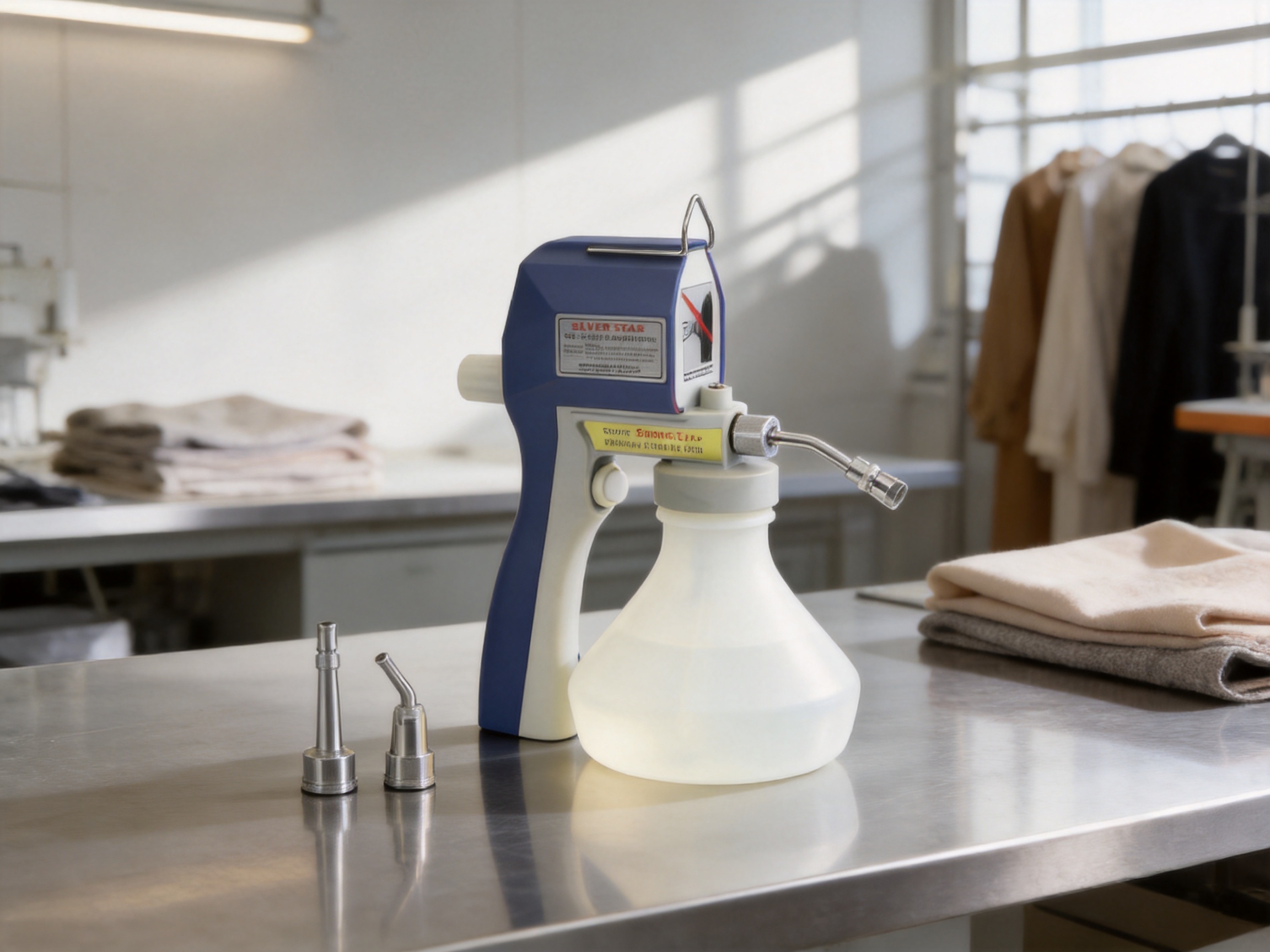
Maintenance is an important part of spray gun performance. Residue, dust, fibers, or unsuitable liquid can affect the spray pattern and reduce operating efficiency. A product that is difficult to disassemble or clean may be neglected, increasing the risk of blockage or uneven performance.
The ST-120 is designed to allow straightforward cleaning and maintenance. Users can disassemble accessible components, clean the relevant parts, and reassemble the tool for future use. This practical structure helps operators keep the equipment in suitable working condition without relying on complicated procedures.
Routine maintenance should include emptying unused liquid when appropriate, rinsing the tank according to the cleaning solution manufacturer’s instructions, checking the nozzle for residue, and wiping the external body. Electrical components should be protected from direct water exposure, and the unit should be disconnected from the power supply before maintenance begins.
Before use, the operator should confirm that the selected liquid is compatible with the equipment and the material being treated. The tank should not be overfilled beyond its practical capacity. The nozzle should be checked for blockage, and the power supply should match the stated 220V and 50Hz specifications.
During operation, the spray gun should be held at a controlled distance from the workpiece. The operator should begin with a small test area whenever the fabric, surface, or cleaning solution is unfamiliar. This approach helps identify possible color changes, spreading, or material sensitivity before broader treatment begins.
After use, the tank and spray path should be cleaned as required. The equipment should be stored in a dry location away from excessive heat, moisture, and unauthorized access. Proper storage protects the product and supports a longer service life.
The performance of any spray gun depends partly on the liquid being used. A liquid that is too thick, contains unsuitable particles, or reacts with the material may cause poor spraying or damage. Users should follow the cleaning solution supplier’s instructions and maintain appropriate workplace ventilation.
The ST-120 is a delivery tool, not a substitute for chemical selection or fabric testing. Professional results are achieved when the equipment, liquid, material, and operating method are considered together.
Knitting operations may produce fabric panels, rolls, or finished textile products that require localized cleaning after handling or processing. The ST-120 can help operators treat visible marks without interrupting the entire production process. Its portability allows the tool to be used near inspection tables, finishing areas, and packing stations.
Because textile materials can differ significantly in absorbency, texture, and color stability, controlled spray application is important. The operator can adjust the treatment according to the fabric and work on a limited area before deciding whether additional cleaning is necessary.
Dyeing and finishing departments often handle materials that require careful inspection. Small marks, residue, or localized contamination may need to be addressed before products move to the next stage. The ST-120 provides a convenient method for applying cleaning liquid directly to the affected area.
Its stable spray pattern can help limit unnecessary moisture, while the optional angled nozzles support access around edges and narrow sections. This is useful where the operator needs precision rather than broad-area saturation.
Apparel factories regularly inspect garments for marks caused by sewing, handling, pressing, packaging, or transportation. A handheld spray gun can be used at several points in the production flow, including after sewing, during quality inspection, and before final packing.
The compact structure is suitable for workstations where space is limited. Operators can keep the equipment nearby and respond quickly to a garment that requires spot treatment. This can help reduce rework and protect delivery schedules.
Advertising production may involve printed fabrics, display panels, signage, banners, and other visual materials. Clean surfaces are important because stains, dust, or marks can affect the appearance of a finished display. The ST-120 can provide targeted treatment without requiring large cleaning equipment.
Optional angled nozzles may be useful when working around frames, corners, seams, or raised design elements. The operator can direct the spray toward a specific location while keeping the main body in a comfortable position.
Printing facilities may need to clean substrates, remove localized marks, or maintain the appearance of printed materials. A stable spray pattern supports controlled application around graphics and printed areas. Operators should always test the cleaning solution and method on a comparable sample before treating valuable finished materials.
The equipment’s manageable weight is helpful in printing environments where workpieces may be large, flexible, or positioned on different tables. The spray gun can be moved around the work area more easily than a heavy fixed system.
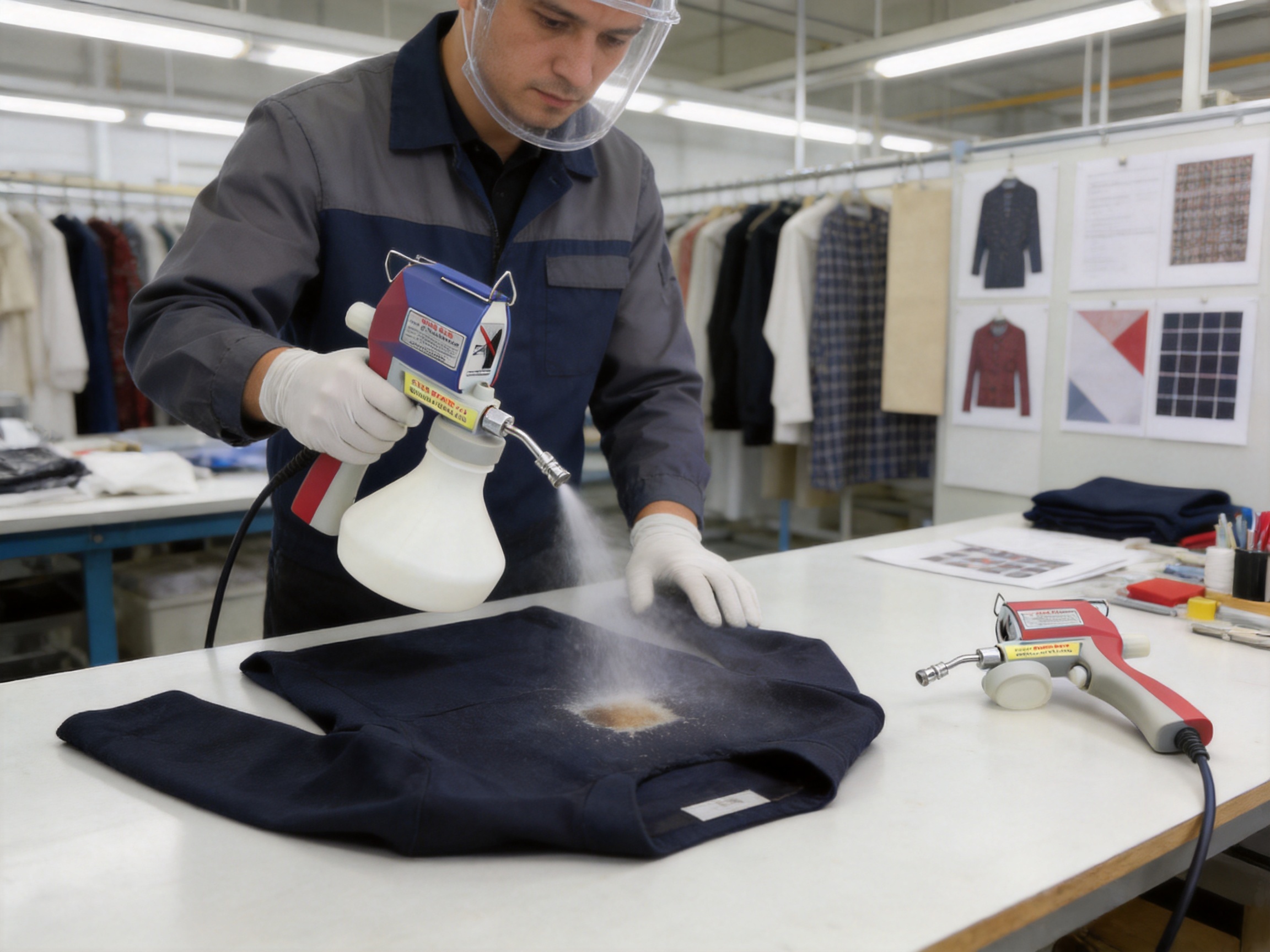
The ST-120 offers several advantages over improvised or general-purpose cleaning methods. A manual bottle may be inexpensive, but it may not produce a consistent spray pattern or sufficient cleaning force. A household sprayer may not be designed for repeated industrial handling. A large cleaning machine may provide high capacity but lack the portability required for localized treatment.
The ST-120 is positioned between these extremes. It provides the convenience of a handheld tool while offering features intended for professional work, including stable performance, a dedicated tank, ergonomic handling, optional nozzle configurations, and a durable structure.
| Evaluation Factor | Ordinary Manual Bottle | Large Fixed Cleaning System | ST-120 Spray Gun |
| Portability | High | Low | High |
| Spray Consistency | Variable | Generally stable | Stable and controlled |
| Localized Treatment | Possible but less precise | Less convenient | Well suited |
| Operator Comfort | Depends on design | Not applicable to handheld work | Ergonomic structure |
| Access to Narrow Areas | Limited | Depends on system | Improved with angled nozzles |
| Storage Requirement | Low | High | Low to moderate |
| Industrial Use | Limited | Suitable for high-volume work | Suitable for flexible spot cleaning |
Manual wiping can spread a stain, damage a delicate surface, or create an uneven appearance if excessive pressure is used. A spray gun allows the operator to apply cleaning liquid before wiping or follow a defined treatment process. This can improve control and reduce unnecessary mechanical contact with the material.
Large fixed machines can be effective for high-volume or broad-area work, but they may not be economical for every cleaning task. The ST-120 is more suitable when the problem is localized, the workpiece is too large to move conveniently, or the production area requires a mobile solution.
Consumer sprayers may not be designed for the frequency, control, or durability required in a factory. Professional users need predictable operation and a structure that can withstand regular handling. The ST-120 provides a more focused solution for businesses that regard cleaning as part of quality control rather than an occasional household activity.
The quality of a spray gun depends not only on its visible design but also on the manufacturer’s engineering, production management, testing discipline, and after-sales support. The producing company has specialized in ironing and textile equipment since 2003 and has developed a product range that includes electric irons, steam irons, hanging irons, spray guns, small steam machines, heat transfer machines, steam boilers, vacuum tables, and related accessories.
This product breadth provides useful manufacturing experience. Equipment used in garment finishing often shares common requirements, including electrical safety, heat and moisture management, ergonomic operation, durable materials, stable performance, and compatibility with professional workflows. Experience across multiple categories can help a manufacturer understand how individual machines fit into a complete production line.
The company emphasizes independent research, development, and production. This approach provides greater control over product improvement than simple trading or assembly based entirely on external designs. Internal coordination among research and development, management, and sales teams allows customer feedback and market requirements to be considered during product upgrades.
Independent research and development supports continuous improvement in product structure, electrical configuration, usability, and manufacturing methods. For a spray gun, development may include improving the balance of the body, optimizing liquid delivery, refining the nozzle connection, strengthening frequently handled parts, and making cleaning more convenient.
Product development is most effective when it considers real operating conditions. Textile factories may prioritize portability, while printing businesses may require precise application around graphics. A manufacturer with experience serving different markets can identify common needs while preserving flexibility for specific applications.
The manufacturer’s product range includes equipment used before, during, and after garment production. Steam boilers can provide centralized steam, vacuum tables can support pressing and shaping, irons can assist with finishing, and spray guns can address localized cleaning tasks. Heat transfer machines support decoration and printing-related work, while accessories help complete the workstation.
This integrated capability can simplify equipment sourcing for customers. Instead of managing unrelated suppliers for every category, a buyer may obtain multiple types of equipment from one experienced production organization. This can support more consistent communication, spare-parts planning, technical consultation, and shipment coordination.
The company states that its products follow national and industry standards, including GB4706.1-2005 and GB4706.2-2007. It also reports that its products have passed CCC and CQC certifications. These standards and certifications indicate an emphasis on electrical safety and formal quality requirements.
Users should confirm the exact certification status and applicable documentation for the specific product, destination market, voltage configuration, and order before purchase. Regional regulations may differ, and professional buyers should verify that the selected equipment complies with local installation and workplace requirements.
Reliable manufacturing involves more than final inspection. Quality begins with product design and continues through material selection, component assembly, electrical checks, functional testing, packaging, and shipment preparation. A structured process helps reduce the likelihood of defects that could affect safety, performance, or service life.
For a spray gun, relevant quality checks may include confirming power specifications, inspecting the tank and liquid path, verifying nozzle connection, checking switch operation, evaluating spray stability, and examining the external body for assembly problems. Packaging must also protect the product from impact and movement during transportation.
The company’s experience in domestic distribution and overseas export provides practical knowledge of logistics and customer requirements. Products are exported to Southeast Asia, Central Asia, South America, Africa, and other regions. Serving different markets requires attention to documentation, packaging, electrical configurations, communication, and shipment coordination.
Close coordination between engineering, production, quality management, and sales teams can improve responsiveness. When a customer reports an operating issue or requests a product adjustment, information can be communicated through the organization rather than being lost between independent suppliers.
This coordination is particularly valuable for OEM and customization projects. Businesses may require specific labels, packaging, accessories, electrical settings, or product combinations. A manufacturer with its own research and production capabilities is generally better positioned to evaluate and implement such requirements.
The company identifies customization and OEM services as part of its business strengths. For distributors and professional equipment suppliers, OEM capability can support private-label sales, market-specific packaging, and coordinated product portfolios.
Customization should be discussed in detail before production. Important points may include minimum order quantity, label format, packaging design, electrical standards, nozzle configuration, spare parts, inspection procedures, and delivery schedule. Clear technical communication helps ensure that the final product matches the intended application.
Before purchasing a spray gun, a business should evaluate the type of materials being cleaned, the average daily working time, the required spray intensity, the available power supply, the preferred nozzle configuration, and the cleaning solutions to be used. The ST-120 is particularly suitable for users seeking a lightweight, mobile tool for localized or repeated cleaning tasks.
Businesses should also consider the layout of the work area. If products are inspected at multiple locations, a portable spray gun can save movement and handling time. If the operation involves only one fixed process with very high volume, a larger system may be more appropriate. The right choice depends on the balance between capacity, flexibility, cost, and operator comfort.
Procurement teams should confirm whether the 220V, 50Hz specification matches the intended facility. They should also ask about available nozzle options, spare parts, warranty coverage, packaging, technical documents, recommended cleaning liquids, and maintenance procedures.
For export orders, buyers should confirm the destination’s electrical and certification requirements. They should also establish whether the product will be used in a humid, dusty, or chemically active environment and request appropriate operating guidance.
Production managers should consider whether the tool can be integrated into current inspection and finishing procedures. They should assess how quickly operators can learn the controls, how often the tank needs refilling, how easy the unit is to clean, and whether its spray pattern is appropriate for the materials handled.
A short trial on representative materials is recommended. Testing can help determine suitable spray intensity, working distance, cleaning solution, and treatment time. It can also reveal whether optional angled nozzles would improve workflow efficiency.
Electrical and liquid-handling equipment should be used responsibly. Operators should read the relevant instructions before use, inspect the power cord and plug, and avoid operating the spray gun if electrical components appear damaged. The tool should be disconnected before cleaning, disassembly, or maintenance.
Users should wear suitable protective equipment when working with cleaning chemicals. Depending on the liquid, this may include gloves, eye protection, protective clothing, and appropriate ventilation. Cleaning solutions should never be mixed unless the chemical supplier specifically confirms that the combination is safe.
The spray gun should be directed only toward the intended work surface. Operators should protect nearby electrical devices, finished products, and personnel from unintended spray. Children and untrained individuals should not operate the equipment.
Material testing is also essential. Some dyes, coatings, prints, synthetic fibers, and finishes may react differently to cleaning liquids. A small hidden-area test can help reduce the risk of discoloration, spreading, shrinkage, or surface damage.
The value of the ST-120 extends beyond its initial purchase price. A lightweight and dependable cleaning tool can support faster response to production defects, reduce unnecessary product rejection, and help maintain the appearance of finished goods. Its compact size can also reduce workspace requirements.
When operators can treat a localized issue quickly, products may spend less time waiting for rework. This can support shorter internal processing times and more predictable delivery. In competitive garment and printing markets, even small improvements in workflow can contribute to better customer service.
The equipment can also support quality culture. A dedicated spray gun shows that cleaning and presentation are treated as formal parts of production rather than improvised final steps. Standardized tools make it easier to train employees, measure results, and improve procedures.
Durability and maintenance access further improve long-term value. A product that can be cleaned easily and kept in service reduces the likelihood of avoidable downtime. Combined with professional technical support and access to related equipment, the ST-120 can become part of a broader finishing and quality-control system.
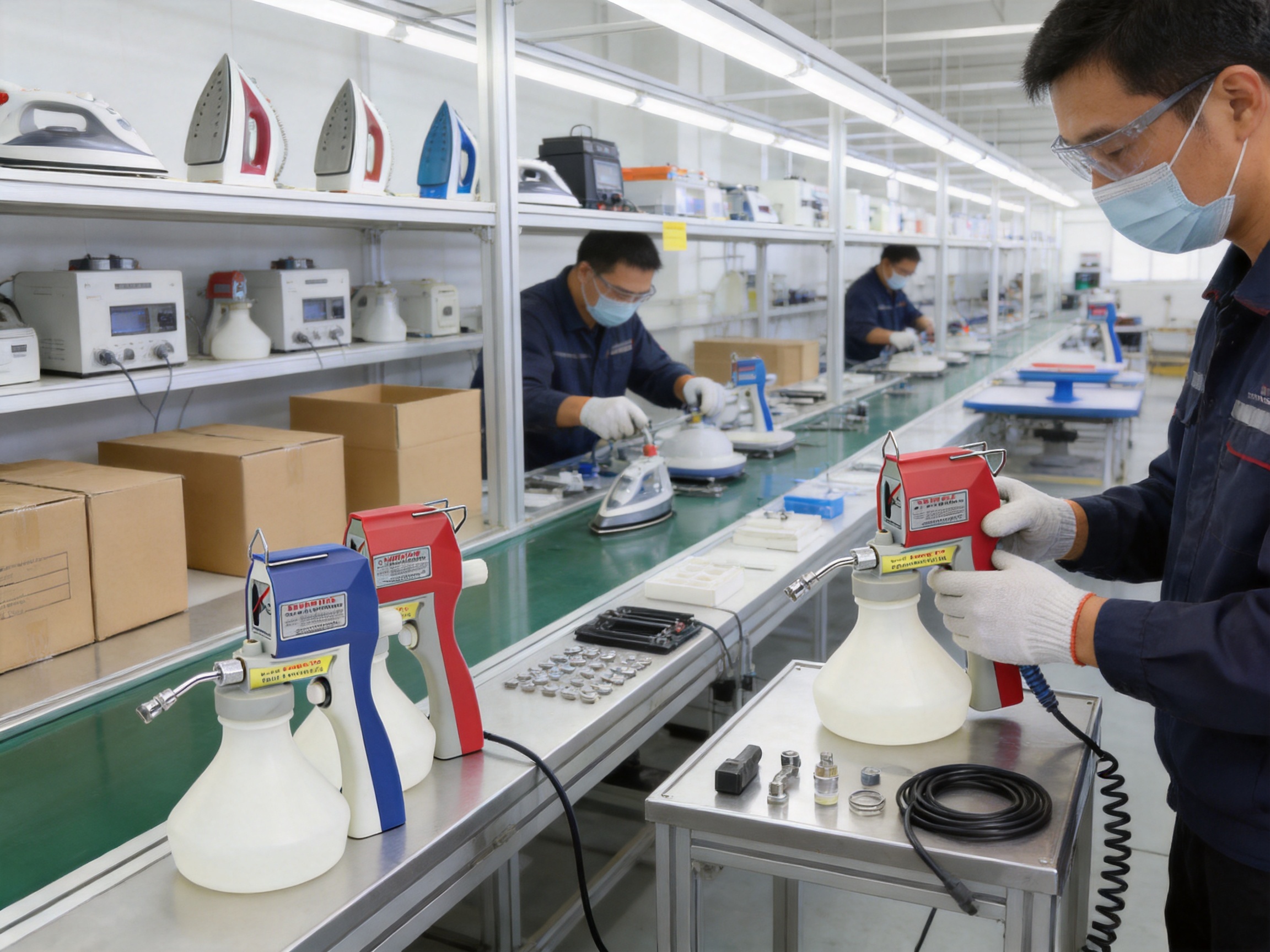
The ST-120 is designed for localized cleaning and controlled liquid application in industries such as knitting, dyeing, apparel, advertising, printing, and textile production. It helps operators address stains, dirt, and marks without relying on large fixed cleaning equipment.
The product is rated at 220 volts, 40 watts, and 50 hertz. Buyers should confirm that these specifications match the electrical supply at the intended workplace and should verify local requirements for exported equipment.
The ST-120 weighs approximately 1.0 kilogram. Its lightweight design is intended to reduce fatigue and make the unit easier to move between workstations.
The tank capacity is 0.65 liters. This capacity provides a practical balance between portability and working convenience for spot-cleaning applications.
Yes. Optional angled nozzles are available for applications that require improved access to corners, edges, seams, narrow sections, or other difficult-to-reach areas.
The ST-120 is designed for regular professional applications and is constructed with durable materials. Actual operating suitability depends on the work schedule, cleaning liquid, maintenance routine, and working environment. Users should follow proper operating and maintenance procedures.
The product includes user-friendly controls intended to help operators adjust spray intensity according to the cleaning task. Users should test the selected setting on a suitable sample before treating valuable or sensitive materials.
The spray gun is intended for applications involving textiles, garments, printed materials, advertising products, and related surfaces. Because materials and finishes vary, users should confirm chemical compatibility and perform a small test before full treatment.
Maintenance generally includes cleaning the tank and liquid path as appropriate, checking the nozzle for residue, wiping the external body, protecting electrical components from water, and storing the unit in a dry location. The power supply should be disconnected before cleaning or disassembly.
The ST-120 is designed for professional use and combines a stable spray pattern, strong cleaning capability, ergonomic handling, a dedicated 0.65-liter tank, optional angled nozzles, and a durable structure. These features make it more suitable for repeated industrial workflows than a basic manual bottle.
The manufacturer identifies OEM and customization services among its business capabilities. Specific requirements such as labeling, packaging, electrical configuration, accessories, minimum order quantities, and delivery schedules should be confirmed directly before placing an order.
Yes. The company’s product range includes electric irons, steam irons, hanging irons, spray guns, small steam machines, heat transfer machines, steam boilers, vacuum tables, and related accessories. This range allows customers to source several types of textile and garment equipment from one experienced supplier.
The ST-120 Spray Gun is a practical solution for businesses that need controlled, mobile, and repeatable cleaning performance. Its lightweight 1.0-kilogram structure supports comfortable handling, while the 40-watt system, 0.65-liter tank, stable spray pattern, and adjustable controls provide the functionality required for many professional applications.
Optional angled nozzles increase flexibility, especially when operators must reach seams, corners, edges, and narrow sections. The ergonomic design helps reduce fatigue, and the durable construction supports regular use in demanding textile, garment, printing, advertising, and dyeing environments. Easy maintenance further contributes to reliable ownership and long-term value.
Beyond the product itself, the manufacturer’s experience in independent research, development, and production strengthens the overall offering. Its broad range of ironing and textile equipment, attention to national and industry standards, export experience, OEM capability, and focus on quality and customer service provide a solid foundation for professional buyers.
For companies seeking a compact cleaning tool that can complement garment finishing, inspection, and production workflows, the ST-120 offers a balanced combination of portability, control, versatility, and durability. When paired with suitable cleaning solutions, trained operators, regular maintenance, and appropriate safety procedures, it can help improve the efficiency and consistency of everyday industrial cleaning tasks.
1. Product specification sheet for the ST-120 Spray Gun, including voltage, power, frequency, weight, tank capacity, and nozzle options.
2. Manufacturer-provided product information concerning applications in knitting, dyeing, apparel, advertising, printing, and textile cleaning.
3. Manufacturer-provided information concerning independent research and development, production capabilities, OEM services, export markets, and related ironing equipment.
4. General principles of ergonomic handheld tool design and operator fatigue reduction in industrial workplaces.
5. General guidance on textile spot cleaning, material testing, chemical compatibility, and controlled liquid application.
6. GB4706.1-2005, General Requirements for Household and Similar Electrical Appliances.
7. GB4706.2-2007, Applicable Safety Requirements for Electric Irons and Similar Appliances.
8. General workplace practices for electrical safety, chemical handling, equipment maintenance, and protective operation.
 +86-578-3158872 / +86-578-3158958
 jyshengda@163.com / caroying@jy-shengda.com
 No. 8 Nanyi Rd, Huzhen Industrial Park, Zhejiang, China
Copyright © Jinyun Shengda Sewing Equipment Co., Ltd. All Rights Reserved.
Ironing Press Machine Equipment Factory
 English
 中文简体
 русский
 عربى