The ST-7 Steam Boiler is a compact industrial steam-generation system designed to support garment factories, tailoring workshops, ironing stations, textile production lines, and other applications that depend on a reliable supply of steam. Its combination of a 3 kW heating system, automated water refill, pressure monitoring, stainless steel construction, and self-draining capability provides a practical solution for businesses that need consistent steam without installing a large central boiler system.
Steam is an essential working medium in many industrial processes. In clothing and textile production, it is used for removing wrinkles, shaping garments, setting seams, preparing fabrics, and improving the final appearance of finished products. However, the quality of the steam supply directly influences productivity, operating costs, equipment life, and product quality. A boiler that produces unstable, wet, or insufficient steam can create delays, increase maintenance requirements, and negatively affect garments.
The ST-7 has been developed to address these practical requirements. It produces rated steam at 151°C and operates within a rated steam pressure range of 0.35 to 0.4 MPa. Its compact packing dimensions of 550 x 330 x 430 mm make it suitable for production areas where floor space is limited. The unit is powered by a 220 V electrical supply and uses a 3 kW heating system to generate steam efficiently for a wide range of small and medium-duty applications.
Unlike a large centralized steam plant, the ST-7 can be installed close to the equipment that consumes steam. This arrangement reduces the need for complicated piping, shortens the distance steam must travel, and simplifies installation. For businesses expanding their production capacity or setting up individual ironing stations, this decentralized approach can provide an economical and flexible alternative.

ST-7 Steam Boiler
The ST-7 Steam Boiler is engineered as a compact steam source for industrial users who require dependable performance in a manageable package. It is particularly suitable for garment ironing operations, steam irons, vacuum ironing tables, pressing equipment, finishing stations, and other applications in which consistent steam delivery is important.
The boiler uses electrical heating to convert water into steam. Once connected to a suitable water supply and electrical source, the automated refill system helps maintain the required water level. This reduces the need for operators to monitor and refill the tank manually during normal operation. The boiler is also fitted with a built-in pressure gauge so that users can observe internal pressure and operate the equipment with greater control.
A self-draining valve is included to make routine cleaning and maintenance easier. During operation, minerals, sediment, and other contaminants may gradually collect inside a boiler. If these substances are not removed, they can reduce heating efficiency and affect the quality of the steam. The self-draining design allows accumulated water and deposits to be released more conveniently, helping operators maintain the unit in good condition.
The internal tank is made from stainless steel. This material is valued in steam equipment because it offers resistance to corrosion, supports long-term durability, and is easier to clean than many ordinary metal alternatives. The stainless steel construction also helps the boiler maintain a hygienic and stable internal environment for steam generation.
| Model | ST-7 |
| Product type | Industrial electric steam boiler |
| Heating power | 3 kW |
| Rated steam temperature | 151°C |
| Rated steam pressure | 0.35–0.4 MPa |
| Electrical supply | 220 V |
| Packing dimensions | 550 x 330 x 430 mm |
| Pressure monitoring | Built-in pressure gauge |
| Water management | Automated refill system |
| Maintenance system | Self-draining valve |
| Tank material | Stainless steel |
The specifications show that the ST-7 is designed for users who need a focused steam solution rather than a large, complex utility installation. The rated figures should always be evaluated together with the application, connected equipment, water quality, operating schedule, and local electrical and safety requirements.
Steam quality has a direct effect on the performance of ironing and textile equipment. Steam that contains excessive water droplets can dampen garments, create uneven finishing results, and require additional drying or pressing time. In contrast, dry steam transfers heat effectively while limiting unwanted moisture. This makes it especially valuable when working with delicate fabrics, layered garments, finished apparel, and materials that must retain their shape.
The ST-7 is designed to provide continuous dry steam for suitable applications. Dry steam helps operators achieve more predictable results because the heat is delivered with less excess moisture. This can support faster wrinkle removal, cleaner pressing lines, and more consistent garment finishing. It can also reduce the possibility of water marks and moisture-related handling problems.
In a production environment, consistency is just as important as output. An operator may be able to compensate for minor variations during occasional use, but repeated pressure or temperature fluctuations can reduce productivity across an entire work shift. A stable steam source allows operators to develop a repeatable working method and helps production supervisors maintain consistent quality standards.
Steam quality also affects equipment protection. Water droplets, mineral deposits, and contamination can travel through connected steam lines or tools. By supporting dry steam production and providing a self-draining maintenance feature, the ST-7 helps users reduce the conditions that can contribute to internal contamination and premature wear. Proper maintenance and correct operation remain essential, but the boiler’s design provides a useful foundation for long-term service.
One of the key advantages of the ST-7 is its ability to supply steam close to the point of use. Traditional centralized steam arrangements may require long pipelines, multiple valves, insulation, condensate management, and extensive installation work. These systems can be appropriate for large factories, but they may be excessive for smaller facilities, individual production departments, or businesses that need to add steam capacity gradually.
The ST-7 reduces the need for complicated piping. Its compact form allows it to be positioned near the ironing equipment or steam tools that require supply. A shorter connection distance can simplify installation and reduce the number of components required between the boiler and the application. This can help reduce initial project costs, installation time, and the amount of floor space used by supporting infrastructure.
A localized boiler also offers operational flexibility. If one production area needs additional steam, a dedicated unit can be installed without redesigning a complete central utility system. This makes the ST-7 suitable for workshops, sample rooms, alterations departments, small garment factories, educational facilities, and production lines that operate independently.
Another benefit is the possibility of incremental expansion. A company may begin with one boiler for a limited number of steam tools and add equipment as production increases. This approach avoids investing in a large system before the actual demand is established. It also allows different departments to manage their own steam requirements more directly.
Although the ST-7 is compact, users should still plan the installation carefully. Adequate ventilation, safe electrical connections, accessible controls, suitable water quality, and sufficient clearance for maintenance are important. Steam equipment must be installed and operated according to applicable local regulations and professional safety practices.
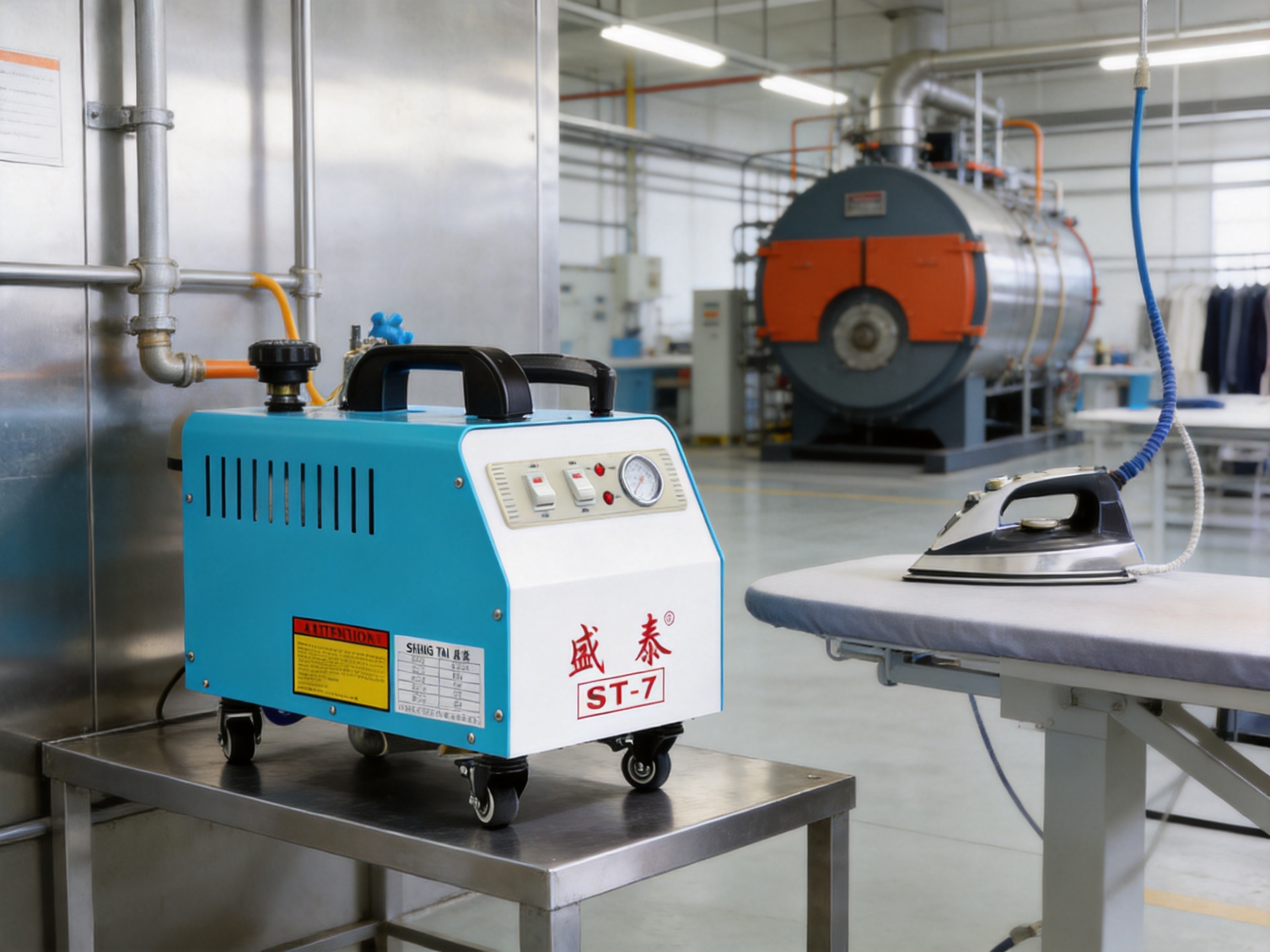
Manual water management can interrupt production. If an operator must repeatedly stop work to check the tank and add water, the steam supply becomes less convenient and labor requirements increase. The ST-7 incorporates an automated water refill system to help maintain an appropriate internal water level during operation.
Automatic refill provides several practical advantages. First, it reduces the need for constant supervision. Operators can concentrate on garment handling, ironing, pressing, and quality control instead of repeatedly monitoring the water supply. Second, it helps support more continuous steam generation. By replenishing water when required, the system can reduce interruptions caused by a low water level.
Automated refill can also improve work organization. In a busy production area, the person using a steam iron may not be the same person responsible for equipment maintenance. A reliable water management system reduces dependence on frequent manual checks and helps the team work according to a more predictable routine.
Lower supervision requirements may also contribute to labor efficiency. This does not mean that the boiler can be left unattended or operated without inspection. Operators should still check the pressure gauge, observe the equipment for unusual sounds or leaks, and perform scheduled cleaning. Automatic refill is a convenience and productivity feature, not a replacement for responsible operation.
Water quality should be considered when using any steam boiler. Hard water may contain minerals that accumulate inside the heating chamber and connected components. Depending on local conditions, users may need filtration, treated water, or a regular descaling program. Appropriate water management helps preserve heating performance and extends the useful life of the boiler.
The built-in pressure gauge gives operators a direct indication of internal steam pressure. This is important because pressure is closely related to steam performance and operating safety. By checking the gauge, users can confirm whether the boiler is approaching or maintaining the expected working range.
Visible pressure information helps operators identify abnormal conditions earlier. If pressure rises unusually slowly, the issue may relate to water supply, heating performance, a connection, or steam demand. If pressure behaves unexpectedly, the operator can stop and inspect the system before a minor issue develops into a more serious interruption.
Pressure monitoring also supports consistent production. Ironing and pressing tools perform more predictably when they receive a suitable steam supply. Operators can use the gauge as part of their normal start-up and operating checks, helping them understand when the boiler is ready for use and whether the system remains within the expected range.
The pressure gauge is designed for monitoring and control; it should not be treated as the only safety device. Industrial steam equipment must be used with appropriate protective systems, trained personnel, and correct installation procedures. Users should follow the operating instructions supplied with the equipment and comply with applicable workplace safety requirements.
Pressure visibility can support faster troubleshooting. For example, an operator may notice reduced steam performance and check the gauge before inspecting the connected iron or hose. If the pressure is normal, attention can shift toward the downstream equipment. If the pressure is low, the boiler, water supply, heating system, or steam demand can be investigated.
This simple diagnostic value can reduce unnecessary service calls and help maintenance personnel identify the likely source of a problem. It also makes the equipment more accessible to new operators because the gauge provides a clear reference point during training.
Production space is valuable. Many garment workshops and textile businesses operate in buildings where every square meter must support productive activity. Large steam systems may require a separate boiler room, extensive piping, and additional service space. The ST-7 is designed to provide useful steam capacity in a compact package measuring 550 x 330 x 430 mm for packing purposes.
The compact design makes the unit easier to position in small workshops, production rooms, finishing areas, and equipment zones. It can be integrated into a layout without taking excessive space away from worktables, storage, material handling routes, or operator movement.
A smaller footprint may also simplify transportation and relocation. Businesses that change their production layout frequently can benefit from equipment that is easier to move and reinstall. The ST-7 can support flexible planning during seasonal production, factory expansion, department reorganization, or the installation of additional ironing stations.
Compact construction does not mean that installation planning can be ignored. The boiler should be positioned on a stable surface with sufficient access to controls, connections, drainage components, and service points. Operators should also maintain safe separation from combustible materials and avoid placing the unit where steam, heat, or water discharge could affect people or other equipment.
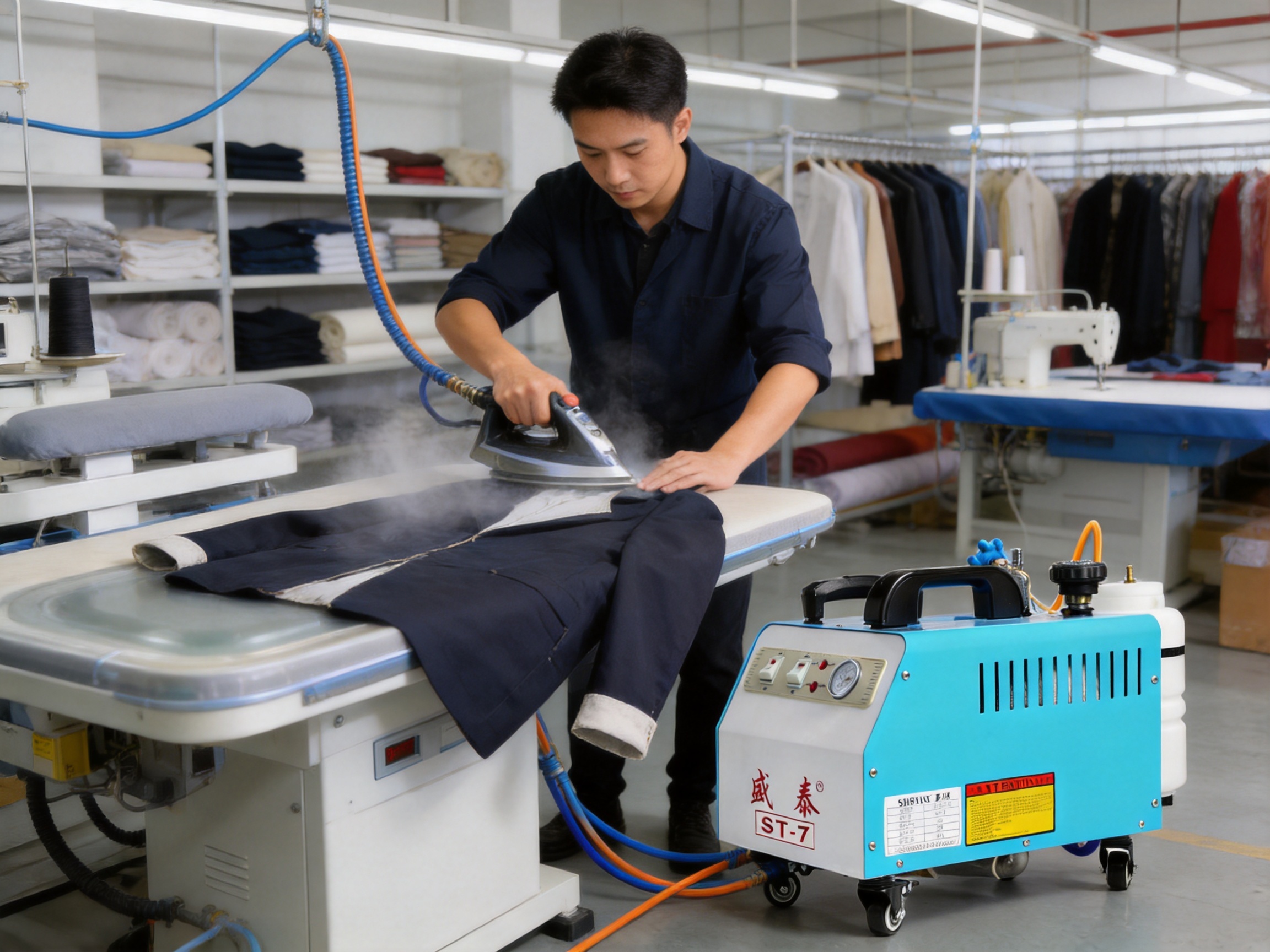
The internal tank of the ST-7 is made from high-quality stainless steel. Stainless steel is widely used in equipment that handles water and steam because it provides strong resistance to corrosion under appropriate operating conditions. It is also durable, cleanable, and suitable for repeated heating and cooling cycles.
Corrosion resistance is especially important in a boiler because the internal tank is exposed to heated water, steam, dissolved minerals, and changing pressure conditions. A durable tank can help maintain structural integrity and reduce the risk of premature deterioration. The material also supports easier maintenance because smooth metal surfaces are generally simpler to inspect and clean.
The value of stainless steel extends beyond the tank itself. A reliable internal structure contributes to the stability of the entire steam-generation process. When the tank remains in good condition, the heating system can work more effectively, the water level can be managed more consistently, and the risk of contamination can be reduced.
Material selection is only one part of durability. The useful life of the boiler also depends on correct water treatment, regular draining, appropriate pressure operation, electrical maintenance, and timely replacement of worn components. The ST-7 is designed to make these maintenance activities practical, but the operating team must carry them out consistently.
The self-draining valve is one of the ST-7’s most practical maintenance features. During steam generation, dissolved minerals and other particles may settle inside the tank. If they remain for extended periods, deposits can accumulate around heating components and reduce the transfer of heat from the electrical elements to the water.
By opening the drain as part of an appropriate maintenance routine, users can remove residual water, sediment, and contaminants. This helps keep the tank cleaner and supports more efficient operation. Regular draining may also assist with identifying unusual discoloration, excessive sediment, or other signs that the water supply needs attention.
The valve simplifies a task that might otherwise require more time-consuming disassembly. Easier maintenance encourages users to follow a regular cleaning schedule rather than postponing service until performance has already declined. This is important for businesses that depend on the boiler every day.
Drainage should only be performed using a safe procedure. The boiler must be shut down, allowed to cool as necessary, and isolated according to the manufacturer’s operating instructions. Hot water and steam can cause serious injury. Operators should use appropriate protective equipment and ensure that drainage water is discharged safely.
A recommended maintenance routine may include checking the water supply, inspecting electrical connections, observing the pressure gauge, cleaning the tank at suitable intervals, examining hoses and fittings, and confirming that the drain valve operates properly.
The exact maintenance frequency depends on operating hours, water hardness, steam demand, and the environment in which the boiler is used. A lightly used workshop may require a different schedule from a high-volume garment factory. Recording inspections and cleaning activities can help managers identify trends and plan preventive maintenance before a failure affects production.
Businesses evaluating a small steam boiler often compare several factors, including installation requirements, steam consistency, maintenance effort, footprint, energy use, and total operating cost. The ST-7 offers a balanced combination of features that can be advantageous when compared with basic or less integrated steam-generation solutions.
First, the ST-7 is designed to minimize installation complexity. A simple, localized arrangement may be more practical than constructing a long steam distribution network for a small operation. This can reduce pipework, support faster commissioning, and make future layout changes easier.
Second, the automated water refill system provides greater convenience than a manually filled tank. Continuous water management can reduce interruptions and limit the amount of operator attention required during normal production.
Third, the boiler is designed to produce dry steam. Compared with equipment that releases excessive moisture, dry steam can improve garment finishing, reduce dampness, and support more precise work on sensitive fabrics.
Fourth, the built-in pressure gauge gives operators useful real-time information. Some basic steam sources may provide limited visibility into operating conditions, making it harder to identify problems early. The ST-7’s gauge supports more informed operation and troubleshooting.
Fifth, the stainless steel tank and self-draining valve contribute to durability and maintenance convenience. A product that is easier to clean and inspect can provide better long-term value than one that requires difficult access or frequent specialist intervention.
Finally, the compact dimensions allow the ST-7 to serve facilities where a larger boiler would be impractical. It can offer an efficient balance between steam capability and space requirements without forcing a small business to install an oversized system.
The ST-7 is well suited to many stages of garment production. In cutting and sewing operations, steam may be used to relax fabrics, shape components, and prepare materials for assembly. During finishing, steam is used to remove wrinkles, improve drape, set collars and cuffs, and create a clean appearance before packaging.
Tailoring and alteration shops can use the boiler to support steam irons and pressing equipment. These businesses often need professional finishing quality but may not have room for a centralized steam plant. The ST-7 provides a compact source that can be located near the work area.
Garment factories may use it for sample development, quality-control stations, repair departments, or individual production zones. Its localized configuration allows a factory to provide steam to a particular department without changing the entire facility’s utility system.
Uniform manufacturers, apparel exporters, laundry-related workshops, upholstery businesses, and textile sample rooms may also benefit from reliable dry steam. The suitability of the boiler depends on the required steam volume and connected equipment, so buyers should evaluate their actual demand before selecting a configuration.
In educational and vocational training environments, a compact boiler can support practical instruction in garment construction and professional pressing. Its visible gauge, straightforward controls, and manageable dimensions can make it easier for instructors to demonstrate correct steam equipment operation.
Small workshops can use the ST-7 as their main steam source. Medium-sized facilities may use one or more units for separate work areas. Larger factories can use it as a supplementary system for departments that operate independently from the main boiler room.
This scalability is valuable because production requirements are not always uniform. A sample room may operate intermittently, while a finishing line may require steam continuously. Dedicated local boilers allow each area to receive an appropriately managed supply rather than relying entirely on one central source.
The ST-7 is produced by Jinyun Shengda Sewing Equipment Co., Ltd., a manufacturer established in 2003 in Zhejiang, China. The company specializes in the research, development, and production of ironing and garment-care equipment, including electric irons, steam irons, hanging irons, spray guns, small steam machines, heat transfer machines, steam boilers, vacuum tables, and related accessories.
This product range gives the manufacturer practical experience across the complete garment-finishing equipment chain. A steam boiler is not an isolated product in a professional ironing environment. It must work effectively with irons, pressing tools, vacuum tables, steam hoses, valves, and other accessories. Experience in several connected product categories helps the manufacturer understand how a boiler is used in real production conditions.
The company maintains research and development, management, and sales teams that work together to improve products and support customers. This cooperation can help transfer market feedback into product development. Issues identified by users, such as installation convenience, maintenance access, control simplicity, or steam stability, can be considered during future design improvements.
Independent research and development is an important manufacturing strength. It allows a producer to control more of the design process instead of depending entirely on external specifications. This can support improvements in heating systems, water management, tank construction, pressure control, product layout, and serviceability.
The company also provides customization and OEM services. These capabilities may be useful for distributors, equipment integrators, and international buyers that require specific product configurations, labeling, packaging, or market-oriented adjustments. Customization should always be discussed in relation to technical feasibility, certification, minimum order requirements, and production schedules.
Reliable steam equipment requires more than a heating element and a tank. Product reliability depends on material selection, assembly accuracy, electrical safety, pressure control, water-level management, connection quality, inspection procedures, and consistency across production batches.
The manufacturer states that it follows national and industry standards, including GB4706.1-2005 and GB4706.2-2007. It also reports that its products have passed CCC and CQC certifications. Buyers should confirm the exact certification scope and documentation for the model and configuration being purchased, especially when importing equipment or installing it in a regulated industrial environment.
Standards-based production provides a framework for evaluating electrical safety, component selection, insulation, grounding, temperature management, and other critical factors. Certification and compliance documentation can also help distributors and end users complete internal purchasing reviews and local installation approvals.
Quality management should continue throughout the manufacturing process. Incoming materials must be checked, tanks and electrical components must be assembled carefully, and finished products should be inspected before shipment. Pressure-related equipment also benefits from systematic testing of fittings, gauges, valves, and water-management functions.
Packaging is another important part of product reliability. The listed packing size of 550 x 330 x 430 mm reflects the compact nature of the ST-7 and supports organized logistics. Proper packaging should protect the tank, gauge, valves, electrical components, and external surfaces during transportation and storage.
The manufacturer has established distribution channels in China and supplies customers in Southeast Asia, Central Asia, South America, Africa, and other regions. International experience can help a supplier understand the practical needs of different markets, including documentation, packaging, communication, shipment coordination, and application support.
Export-oriented production also encourages attention to product consistency. Overseas customers often require clear specifications, stable supply, dependable packaging, and responsive communication because replacement parts and technical assistance may involve longer distances. A manufacturer with established export activity is generally better positioned to coordinate these requirements.
Professional service is particularly important for steam equipment. Customers may need guidance on installation, water management, maintenance intervals, spare parts, operating procedures, or integration with existing ironing systems. The manufacturer’s product range and service structure can provide useful support from product selection through after-sales operation.
For distributors, a broad product portfolio can create additional commercial opportunities. A supplier capable of providing boilers, irons, vacuum tables, spray guns, heat transfer machines, and accessories may allow buyers to source several related products from one manufacturing partner. This can simplify communication, product training, spare-parts planning, and shipment management.
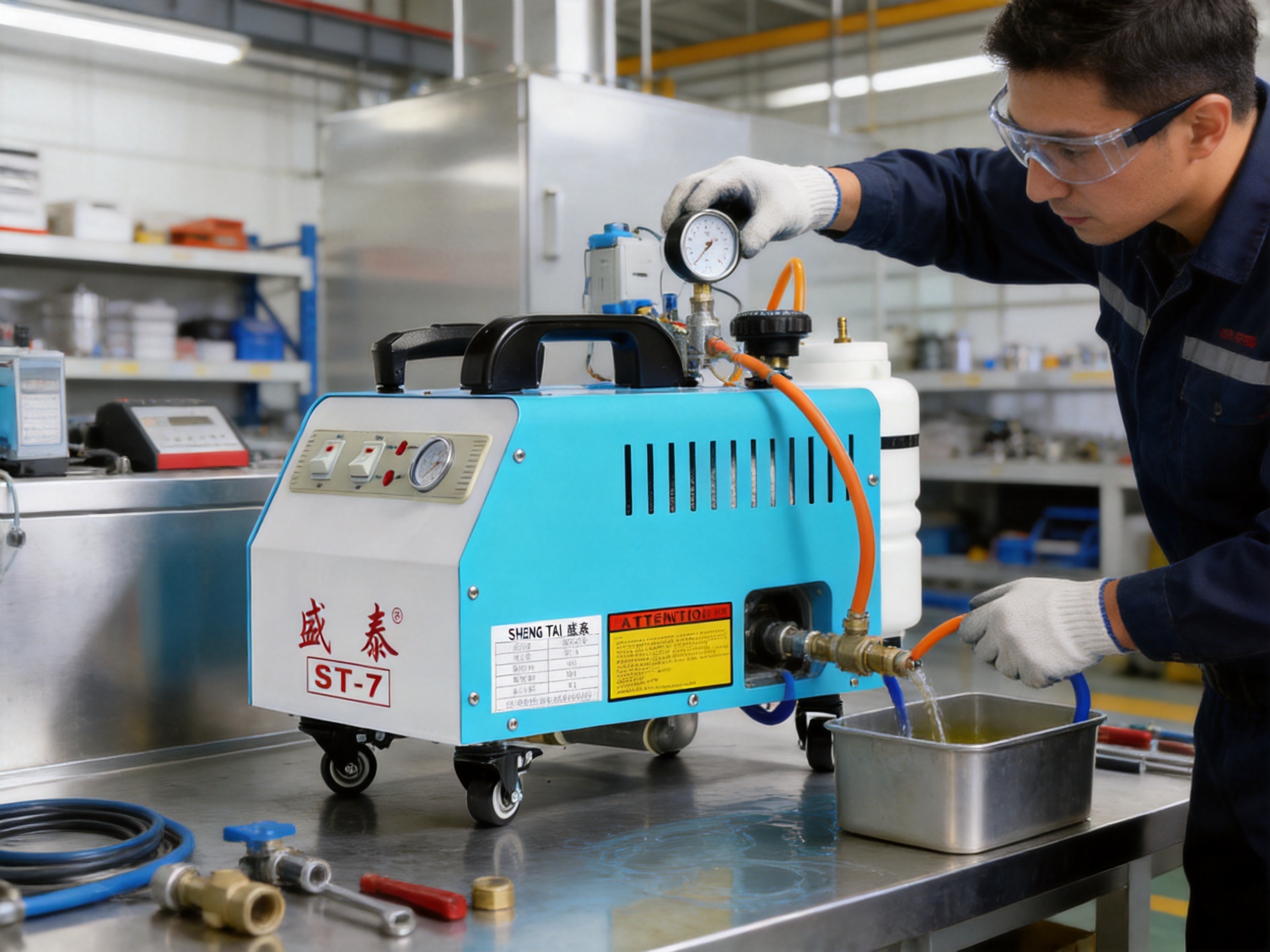
Before installing the ST-7, the user should confirm that the electrical supply, water source, drainage arrangement, floor or support surface, and ventilation conditions are appropriate. The 220 V power requirement should be connected through a properly rated electrical circuit with suitable protection and grounding.
The boiler should be located in an area that is dry, accessible, and protected from accidental impact. Operators need clear access to the pressure gauge, controls, water connections, and self-draining valve. The installation area should also allow maintenance personnel to inspect the unit without moving other machinery.
Steam connections should be installed using suitable components and procedures. Hoses, fittings, valves, and connected irons must be rated for the pressure and temperature of the application. Poorly fitted or unsuitable connections can cause leaks, reduce steam performance, and create safety hazards.
During commissioning, the operator should check for leaks, confirm that the water refill system works correctly, observe the pressure gauge, and verify that steam reaches the connected equipment as expected. Any unusual sound, smell, vibration, leakage, or pressure behavior should be investigated before routine production begins.
Training is also important. Operators should understand the start-up sequence, normal pressure range, water requirements, shutdown procedure, drainage process, and emergency response. Clear instructions help prevent misuse and allow problems to be reported promptly.
The 3 kW heating power gives the ST-7 a defined electrical input suitable for its intended scale of operation. Actual energy consumption depends on operating time, steam demand, water temperature, ambient conditions, insulation, connected equipment, and the frequency of steam release.
Efficient operation begins with matching the boiler to the application. A unit that is too small may struggle to meet demand and operate continuously at maximum load. A unit that is significantly oversized may increase acquisition and operating costs without providing proportional benefits. Users should evaluate the number of steam tools, expected working hours, garment volume, and required steam pressure before purchase.
The localized design can reduce indirect costs by limiting the need for extensive piping and infrastructure. Maintenance access, automated water refill, and self-draining capability may also reduce labor time. When assessing total cost, buyers should consider not only the purchase price but also installation, energy, water treatment, cleaning, spare parts, downtime, and operator requirements.
Regular maintenance supports energy efficiency. Mineral buildup can act as an insulating layer around heating components, making the boiler work harder to heat water. Draining and cleaning at appropriate intervals help preserve heat transfer and reduce avoidable energy loss.
A practical maintenance program should be divided into daily, periodic, and professional inspection tasks. Daily checks may include observing the pressure gauge, checking for visible leakage, confirming that steam delivery is normal, and verifying that the water refill system functions correctly.
Periodic maintenance may include draining the tank, removing sediment, inspecting the drain valve, checking hoses and fittings, examining electrical connections, and reviewing the condition of the pressure gauge. The frequency should be adjusted according to water hardness and operating intensity.
Professional inspection may be appropriate for electrical testing, pressure-related checks, component replacement, and any repair that requires opening protected sections of the equipment. Operators should not bypass safety features or attempt unauthorized modifications.
Maintenance records can improve reliability. A simple log can record the date of cleaning, operating hours, water-treatment actions, observed pressure behavior, repairs, and replaced components. Over time, these records help identify recurring problems and establish a maintenance interval suited to the facility.
Steam equipment must be treated as potentially hazardous because it combines heat, pressure, water, and electricity. Operators should receive suitable training and use the equipment only for its intended purpose.
Never open connections or drain the boiler while it is pressurized or hot unless the procedure specifically permits it and appropriate protective measures are in place. Hot steam and water can cause severe burns. The boiler should be shut down and depressurized according to the operating instructions before maintenance.
Electrical connections should remain dry and protected. Any damaged cable, plug, switch, or control component should be inspected and replaced by a qualified person. The unit should be properly grounded, and protective electrical devices should be used as required by local regulations.
Operators should monitor the pressure gauge and stop the equipment if readings become abnormal. Leaks, unusual odors, excessive vibration, repeated electrical tripping, or irregular water levels should be reported immediately.
Safety labels and operating instructions should remain visible. When the boiler is installed in a shared production area, employees who do not operate the equipment should also be informed about hot surfaces, steam outlets, drainage points, and restricted access areas.
For a growing garment business, equipment decisions must balance current needs with future flexibility. The ST-7 can support growth by providing a practical steam source without requiring a large initial infrastructure investment. A workshop can begin with a compact system and expand its steam capacity as production volume increases.
The boiler can also support the creation of dedicated finishing stations. Separating steam supply by department may help production managers organize work more efficiently and reduce dependence on a single central utility point. If one area changes its layout, the local steam system may be easier to adapt.
Reliable equipment contributes to customer satisfaction. Garments that are cleanly pressed, properly shaped, and consistently finished are more likely to meet buyer expectations. The ST-7’s dry steam production, pressure visibility, and continuous water management can support the repeatability required for professional presentation.
For equipment distributors, the product offers a compact model that can complement a broader portfolio of ironing and garment-finishing machinery. Its technical features are easy to communicate, while its applications cover workshops, factories, tailoring businesses, and specialized production departments.
Before purchasing the ST-7, buyers should define the intended application and expected steam demand. Important questions include how many steam irons or tools will be connected, how many hours the unit will operate each day, and whether production will be continuous or intermittent.
The buyer should also confirm the local electrical supply, water quality, installation conditions, available floor space, drainage arrangements, and applicable certification requirements. If the product is being exported or integrated into a larger machine system, documentation and packaging requirements should be discussed in advance.
It is also useful to evaluate service support. Buyers should ask about operating instructions, spare parts, warranty conditions, maintenance recommendations, technical communication, and delivery schedules. These details can have a significant effect on the total ownership experience.
A suitable boiler is not selected only by heating power. Steam pressure, steam dryness, automatic water management, tank material, maintenance access, safety controls, and integration with existing equipment all influence performance. The ST-7 provides a strong combination of these features for its intended compact industrial applications.
The ST-7 is a compact electric steam boiler designed to generate steam for industrial ironing, garment finishing, textile production, pressing equipment, and related applications. It uses a 3 kW heating system and operates with a 220 V electrical supply.
The rated steam temperature is 151°C. Actual operating conditions can vary depending on water supply, connected equipment, operating pressure, and application requirements.
The rated steam pressure is listed as 0.35–0.4 MPa. Users should operate the boiler according to the manufacturer’s instructions and applicable local safety requirements.
The ST-7 includes an automated water refill system. This helps maintain the required water level during normal use and reduces the need for frequent manual intervention. Operators must still inspect the water system and perform routine maintenance.
Dry steam contains less unwanted moisture than wet steam. It can help remove wrinkles, shape garments, and deliver heat more evenly while reducing the risk of excessive dampness, water marks, and moisture-related finishing problems.
The pressure gauge allows operators to monitor internal steam pressure. It supports normal operating checks, helps users confirm readiness, and can assist with troubleshooting if steam performance changes.
The self-draining valve allows residual water, sediment, and contaminants to be removed more conveniently. Regular drainage helps support cleanliness, heating efficiency, and long-term boiler performance.
The internal tank is made from stainless steel. This provides resistance to corrosion, supports durability, and makes routine cleaning and inspection more practical.
Yes. Its compact dimensions, localized steam supply, automated refill system, and simple operating design make it suitable for many small workshops, tailoring businesses, sample rooms, and garment-finishing areas. The actual suitability depends on the required steam volume and connected equipment.
It can be used in a large factory as a dedicated or supplementary steam source for a particular department, sample room, repair area, or finishing station. A factory should evaluate total steam demand before deciding whether one or several units are required.
Maintenance may include pressure checks, water-system inspections, regular draining, sediment removal, inspection of hoses and fittings, electrical checks, and periodic professional servicing. Maintenance frequency depends on water quality, operating hours, and production intensity.
Yes. Hard water can introduce minerals that accumulate inside the tank and around heating components. Filtration, appropriate water treatment, and regular draining or descaling can help reduce the effects of mineral buildup.
Users should confirm the 220 V electrical supply, grounding and circuit protection, water source, drainage, ventilation, stable support surface, access for maintenance, safe steam connections, and compliance with local regulations.
The manufacturer produces a broad range of garment and ironing equipment, including electric irons, steam irons, hanging irons, spray guns, small steam machines, heat transfer machines, vacuum tables, steam boilers, and accessories. This can help buyers source compatible equipment from one supplier.
The company states that it provides customization and OEM services. Specific options, technical requirements, packaging, certifications, order quantities, and production schedules should be confirmed directly for each project.
The ST-7 Steam Boiler is a practical solution for businesses that need dependable steam generation without the complexity of a large centralized boiler system. Its 3 kW heating power, 151°C rated steam temperature, 0.35–0.4 MPa pressure range, 220 V supply, and compact dimensions make it suitable for a broad range of garment and textile applications.
Its major advantages include efficient local steam delivery, reduced piping requirements, automated water refill, continuous dry steam production, built-in pressure monitoring, stainless steel tank construction, user-friendly controls, self-draining maintenance, and low routine maintenance requirements. Together, these features support productivity, operating convenience, equipment protection, and consistent garment-finishing quality.
The manufacturer strengthens the product offering through independent research and development, experience in related ironing equipment, OEM and customization capabilities, international distribution experience, quality-focused production, and reported compliance with relevant standards and certifications. This combination makes the ST-7 suitable not only for individual workshops but also for distributors, garment factories, and production facilities seeking a compact and flexible steam solution.
As with all pressure and electrical equipment, proper installation, operator training, water management, inspection, and maintenance are essential. When correctly selected and responsibly operated, the ST-7 can provide a dependable foundation for industrial ironing, textile finishing, and professional garment production.
1. ST-7 Steam Boiler product specifications and technical description supplied for product evaluation.
2. Manufacturer-provided information regarding steam boiler features, applications, construction, maintenance, and product advantages.
3. Manufacturer-provided company profile covering research and development, production capabilities, export markets, OEM services, and quality management.
4. General industrial guidance on electric steam boiler operation, pressure monitoring, water treatment, drainage, and preventive maintenance.
5. General garment-finishing practices concerning steam ironing, wrinkle removal, fabric shaping, pressing, and textile production quality control.
 +86-578-3158872 / +86-578-3158958
 jyshengda@163.com / caroying@jy-shengda.com
 No. 8 Nanyi Rd, Huzhen Industrial Park, Zhejiang, China
Copyright © Jinyun Shengda Sewing Equipment Co., Ltd. All Rights Reserved.
Ironing Press Machine Equipment Factory
 English
 中文简体
 русский
 عربى