
ST-8S Steam Boiler
The ST-8S Steam Boiler is a compact, automated steam-generation solution designed for professional ironing, garment-care, textile, and light industrial applications. It combines a 3 kW heating system, automated water refill, continuous dry steam production, pressure monitoring, liquid-level protection, and a stainless steel interior in one practical unit. Its 220 V electrical configuration and compact packing size make it suitable for workshops, garment factories, tailoring facilities, laundries, hotels, uniform departments, and other workplaces that require dependable steam without installing a large central boiler system.
Steam quality has a direct effect on productivity, garment appearance, operating costs, and equipment life. A boiler that generates unstable pressure, excessive moisture, or inconsistent steam can slow production and create problems such as water spotting, uneven pressing, fabric damage, and frequent maintenance interruptions. The ST-8S addresses these concerns with a design centered on stable steam delivery, simple operation, and reduced manual supervision.
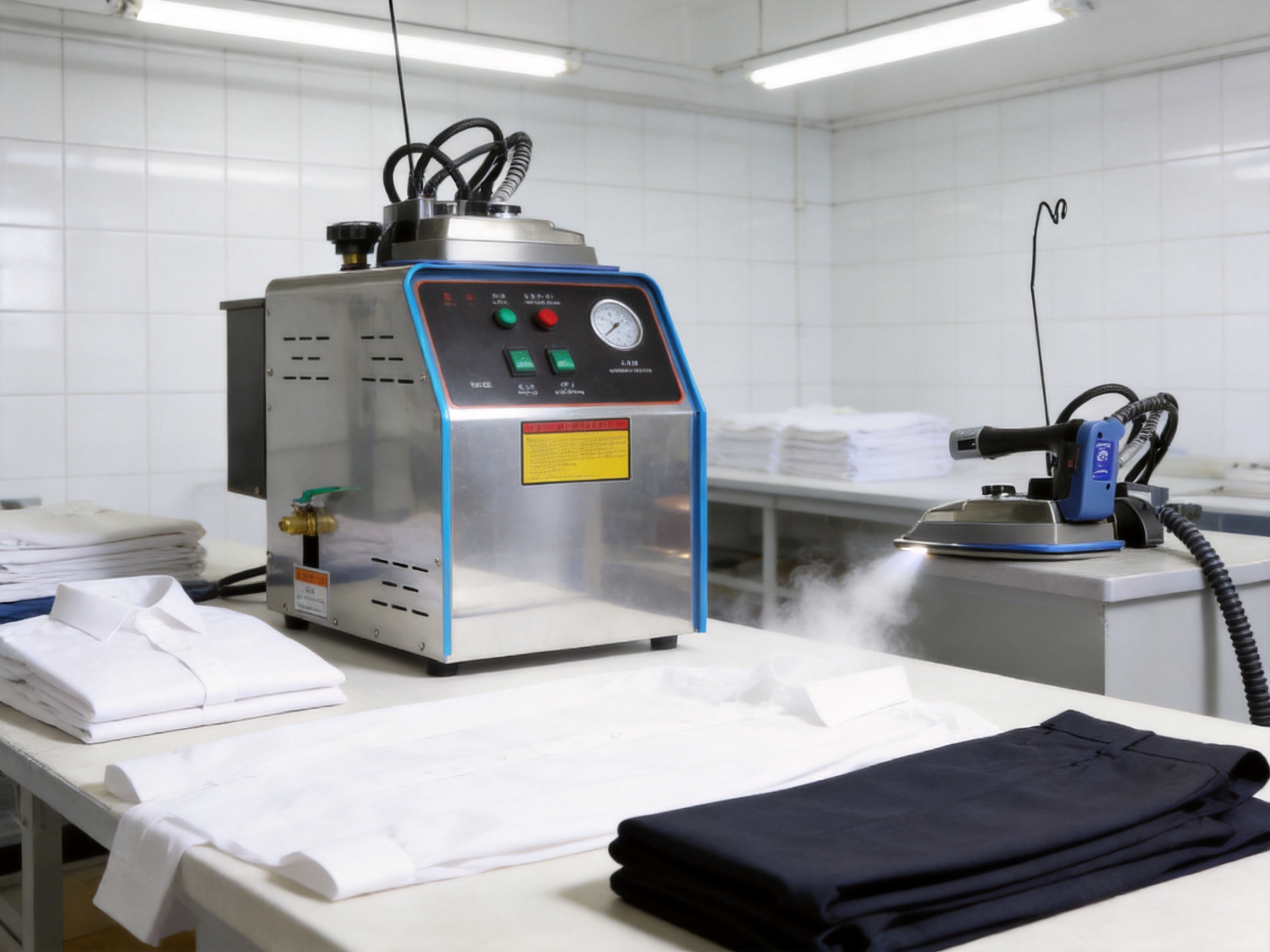
Unlike a basic manually filled steam generator, the ST-8S is equipped with a fully automated water refill system. This allows the boiler to maintain its water supply during operation and reduces the need for an operator to repeatedly stop work and add water. The machine also includes a liquid-level alarm, a built-in pressure gauge, a self-draining valve, and a stainless steel inner tank. These features support safer operation, easier maintenance, and more consistent performance over extended working periods.
For businesses looking for an efficient steam source without the space, infrastructure, and operating complexity of a large industrial boiler room, the ST-8S offers a balanced combination of capacity, control, durability, and convenience.
The ST-8S Steam Boiler is engineered to provide reliable steam for applications that require continuous or repeated steam output. Its 3 kW heating power enables the unit to generate steam efficiently while maintaining a compact physical format. The boiler operates on a 220 V power supply, making it appropriate for many standard commercial and workshop electrical environments.
The rated steam temperature is listed as 151, and the rated steam pressure is listed at 0.35–0.4 MPa. These specifications provide an operating range suitable for professional garment finishing and a variety of steam-assisted processes. The exact operating conditions should always be matched with the requirements of the connected iron, press, spray gun, or other steam-consuming equipment.
The unit is designed with an emphasis on practical usability. Operators can monitor internal pressure through the built-in pressure gauge, while the liquid-level alarm provides an early warning when the water supply requires attention. The automated refill system helps the boiler continue working with less interruption, while the self-draining valve simplifies routine cleaning and water discharge.
With a packing size of 590 x 355 x 525 mm, the ST-8S can be transported, stored, and positioned more easily than many larger steam-generation systems. Its compact dimensions are particularly valuable for workshops with limited floor space or for production lines that need a dedicated steam source near the work area.
| Product Item | Specification |
| Model | ST-8S |
| Product Type | Steam Boiler |
| Heating Power | 3 kW |
| Rated Steam Temperature | 151 |
| Rated Steam Pressure | 0.35–0.4 MPa |
| Power Supply | 220 V |
| Packing Size | 590 x 355 x 525 mm |
| Water Management | Fully automated water refill system |
| Steam Type | Continuous dry steam |
| Monitoring | Built-in pressure gauge and liquid-level alarm |
| Maintenance Feature | Self-draining valve |
| Inner Tank Material | Stainless steel |
Professional garment finishing depends on controlled heat, moisture, pressure, and timing. Steam softens and relaxes textile fibers, allowing wrinkles to be removed more efficiently than with dry heat alone. However, steam must be delivered in a controlled form. Excess water can create damp patches, water marks, uneven finishing, and longer drying times. Insufficient steam can reduce productivity and force operators to repeat the same ironing operation.
Dry steam is especially valuable in clothing production and finishing. When steam contains fewer water droplets, it can transfer heat and moisture more evenly to the fabric. This helps operators achieve a cleaner finish while reducing the possibility of wet garments or moisture-related defects. The ST-8S is designed to provide continuous dry steam, supporting applications where appearance and consistency are important.
Stable steam also helps improve workflow. Operators can spend more time pressing, shaping, steaming, and finishing products instead of waiting for the boiler to recover or repeatedly managing its water supply. In a commercial environment, even small interruptions can accumulate into significant production losses. A boiler that supports uninterrupted work can therefore contribute to improved daily output.
Consistent steam is not only useful for clothing. It can support textile sampling, garment repair, hotel laundry operations, uniform maintenance, curtain finishing, upholstery work, and other processes in which controlled steam helps remove creases or improve the appearance of finished products.
One of the primary advantages of the ST-8S is its fully automated water refill system. Conventional small boilers may require the operator to monitor the water tank manually and stop operation when the water level becomes low. This approach creates additional labor and can interrupt production at inconvenient times. It may also encourage inconsistent operating habits if staff members do not refill the unit promptly.
The automatic refill function helps the boiler maintain an appropriate water supply during operation. By reducing the need for repeated manual filling, it allows the operator to remain focused on the primary task, whether that involves garment pressing, steam finishing, textile preparation, or another application. This is especially useful in busy work environments where one operator may be responsible for several activities.
Automated water management can also make working procedures easier to standardize. Staff members do not need to rely solely on visual checks or personal judgment to determine when the boiler requires additional water. Instead, the system is designed to manage the refill process as part of normal operation, while the liquid-level alarm provides an additional indication when attention may be required.
Compared with basic competitors that depend entirely on manual refilling, the ST-8S offers a more convenient operating experience. The advantage is not limited to comfort. Fewer interruptions can help maintain production rhythm, reduce idle time, and support more consistent output during long working sessions.
Although automated filling reduces manual intervention, proper water quality remains important. Operators should follow the recommended water requirements and maintenance procedures for the installation environment. Regular inspection of the water supply, inlet connections, and internal condition helps maintain reliable performance over time.
The ST-8S is designed to produce continuous dry steam for applications that require a dependable steam supply. Continuous output is important when multiple garments must be finished in sequence or when the boiler is connected to equipment that is used repeatedly throughout the working day.
Dry steam production helps reduce the presence of unwanted water droplets in the steam output. In garment applications, this supports cleaner pressing and reduces the risk of leaving damp marks on delicate or finished fabrics. It also helps operators work more efficiently because less time may be needed to wait for garments to dry after steaming.
The quality of steam can affect both the appearance of products and the life of connected equipment. Excess moisture may contribute to corrosion, mineral deposits, or contamination in steam lines and tools if maintenance is neglected. By focusing on dry steam delivery and incorporating a self-draining valve, the ST-8S provides a practical foundation for effective steam-system care.
Dry steam should not be confused with completely moisture-free vapor under every operating condition. Actual steam quality can be influenced by water quality, operating pressure, installation, connected hoses, ambient conditions, and maintenance. For that reason, users should install and operate the boiler according to applicable technical instructions and use suitable steam accessories.
The built-in pressure gauge gives operators direct visibility of the boiler’s internal pressure. This is an important feature for practical operation because steam equipment should not be managed without information about its pressure condition. A visible gauge allows the user to observe the working state and identify unusual changes more easily.
Pressure information is also helpful when coordinating the boiler with connected equipment. Different irons, presses, and steam tools may have different working requirements. By observing the gauge, the operator can better understand whether the boiler is operating within the expected range and whether the system has reached a suitable condition for use.
The rated steam pressure of the ST-8S is listed at 0.35–0.4 MPa. This specification indicates the designed pressure range stated for the model. Operators should not attempt to exceed the specified operating limits or modify the pressure-control system without authorization from qualified technical personnel.
In addition to the gauge, the boiler is designed with straightforward controls. Simple operation is a competitive advantage for workplaces that employ multiple operators or experience regular staff changes. A clear and uncomplicated control arrangement helps reduce training requirements and makes it easier for users to follow consistent startup, operation, shutdown, and maintenance procedures.
A user-friendly control system also supports productivity. Operators can spend less time learning complex settings and more time performing the production task. At the same time, simple controls should be combined with proper training. Users need to understand pressure limits, water requirements, electrical safety, drainage procedures, and emergency responses before operating the boiler.
The integrated liquid-level alarm is designed to alert users when the water level becomes too low. Water-level monitoring is essential for boiler safety because insufficient water can affect heating performance and may create the risk of overheating or equipment damage.
An alarm provides a practical layer of protection by calling attention to a condition that may not be immediately visible during busy production. It is especially valuable when the operator is focused on garment handling or when the boiler is positioned slightly away from the main workstation.
The alarm works together with the automated refill system. Under normal conditions, the refill function helps maintain the water supply, while the alarm provides an indication if the level falls outside the expected range or if attention is needed. This combination supports more dependable operation than a system that relies solely on manual observation.
Safety features should be viewed as part of a complete operating practice rather than a replacement for maintenance. Users should inspect the water supply, electrical connections, pressure gauge, hoses, valves, and drainage system regularly. Any unusual noise, leakage, pressure behavior, or alarm activity should be investigated before continued operation.
The ST-8S uses a stainless steel inner tank. Stainless steel is widely used in steam-generation equipment because it offers durability and resistance to corrosion under appropriate operating conditions. The material provides a robust internal structure capable of supporting regular heating and cooling cycles.
A high-quality stainless steel interior can also contribute to longer service life when the boiler is correctly maintained. Water contains minerals and other substances that may accumulate inside a boiler over time. A corrosion-resistant tank material helps the equipment withstand normal use, although it does not eliminate the need for periodic inspection, drainage, and cleaning.
The inner tank is exposed to heat, pressure, water, and mineral deposits. Its quality therefore affects the reliability of the entire boiler. The use of stainless steel reflects a design priority toward durability and stable long-term operation rather than short-term cost reduction based on less resistant materials.
Compared with low-cost equipment using less durable internal construction, the stainless steel interior can provide an important ownership advantage. A more durable internal tank may help reduce the risk of premature deterioration and support more predictable maintenance planning. The actual service life will depend on water quality, operating frequency, pressure conditions, cleaning, and compliance with maintenance instructions.
Maintenance is essential for any steam boiler. Heating water can leave mineral deposits, sediment, and other contaminants inside the tank and connected passages. If these substances are allowed to accumulate, they may reduce heating efficiency, obstruct valves, affect steam quality, and increase the workload placed on the system.
The ST-8S includes a self-draining valve to simplify the removal of water and accumulated contaminants. This feature makes routine maintenance more convenient and helps users empty the boiler when required. Easier drainage encourages better maintenance habits because the process is less complicated and less time-consuming.
Regular draining can support efficient operation by reducing the buildup of deposits. It can also help prepare the equipment for storage, transportation, or service. Maintenance intervals should be determined according to operating frequency, water quality, usage conditions, and the manufacturer’s instructions.
The self-draining valve is particularly valuable in commercial environments where equipment must return to service quickly. A boiler that is difficult to drain may receive less frequent attention, increasing the possibility of long-term performance problems. By providing a dedicated drainage solution, the ST-8S makes basic care more accessible to operators.
Before draining, the boiler must be shut down and allowed to cool as required by the operating instructions. Steam and hot water can cause serious burns. Drainage should be performed by trained personnel using suitable protective procedures and directing the discharge to a safe location.
Space is a significant consideration in garment workshops, tailoring rooms, laundries, and production facilities. Large boiler systems may require dedicated rooms, additional piping, ventilation planning, and substantial installation work. The ST-8S offers a more compact alternative for operations that need reliable steam but do not require the capacity of a centralized boiler plant.
Its packing size is 590 x 355 x 525 mm. These dimensions make the product easier to transport and position in a working environment. It can be placed near the point of use, helping reduce unnecessary steam-line length and allowing operators to access the controls and gauge conveniently.
A compact boiler can also provide greater flexibility during facility changes. Businesses may be able to relocate the unit when production lines are rearranged or when additional workstations are installed. This can be helpful for small and medium-sized enterprises that need to adapt their workspace as order volumes and product types change.
Compact size does not mean that installation requirements can be ignored. The boiler should be placed on a stable surface with adequate clearance for inspection, ventilation, electrical connection, water supply, drainage, and service access. The installation area should be protected from conditions that could damage the equipment or create safety risks.
The ST-8S has a 3 kW heating power rating and operates on 220 V. This configuration provides a practical balance between steam-generation capability and electrical simplicity. Many workshops and commercial facilities can integrate a 220 V unit more easily than equipment requiring specialized high-voltage infrastructure.
A 3 kW heating system is suitable for applications that need a dedicated steam supply without the scale of a large industrial boiler. The actual steam output and recovery behavior will depend on water temperature, ambient conditions, operating pressure, usage pattern, connected equipment, and installation quality.
Electrical efficiency is influenced by more than the heater rating. Proper insulation, regular descaling, appropriate water levels, correct pressure control, and good maintenance all contribute to effective energy use. Mineral buildup can reduce heat transfer and increase the time required to generate steam, so maintenance is directly connected to operating economy.
The 220 V power configuration may also simplify replacement planning for businesses that already use compatible ironing equipment. However, electrical installation should be completed by qualified personnel. The power supply must be suitable for the rated load, correctly grounded, and protected in accordance with local electrical regulations.
The ST-8S offers several practical advantages over simple steam boilers that rely on manual filling, limited monitoring, and difficult drainage. These advantages are especially relevant to users who value productivity and operating convenience.
First, the automated water refill system reduces the frequency of manual intervention. An operator can focus on garment finishing instead of repeatedly stopping to check and refill the tank. This is a meaningful benefit during long production periods.
Second, the continuous dry steam design supports cleaner and more consistent work. Compared with equipment that produces wetter steam, the ST-8S is better suited to processes where excess moisture can affect fabric appearance or finishing time.
Third, the built-in pressure gauge gives the operator direct operating information. Some basic units provide limited feedback, making it harder to identify whether the boiler is working normally. A visible gauge supports more informed operation and troubleshooting.
Fourth, the liquid-level alarm adds a useful protection feature. Manual systems may depend entirely on the operator noticing a low-water condition. An alarm provides an additional warning and helps reduce the likelihood of unattended low-water operation.
Fifth, the self-draining valve makes routine maintenance easier. Equipment that is simple to drain and clean is more likely to receive regular care. This can contribute to better steam quality, reduced deposits, and longer equipment life.
Sixth, the stainless steel inner tank provides a durable internal foundation. Material quality is an important distinction between professional equipment and low-cost products designed primarily for occasional use.
Finally, the compact 220 V design provides flexibility. It can be suitable for workplaces that need professional steam without the installation requirements of a large central boiler. These combined features give the ST-8S a practical advantage in environments where reliability, convenience, and space efficiency are important.
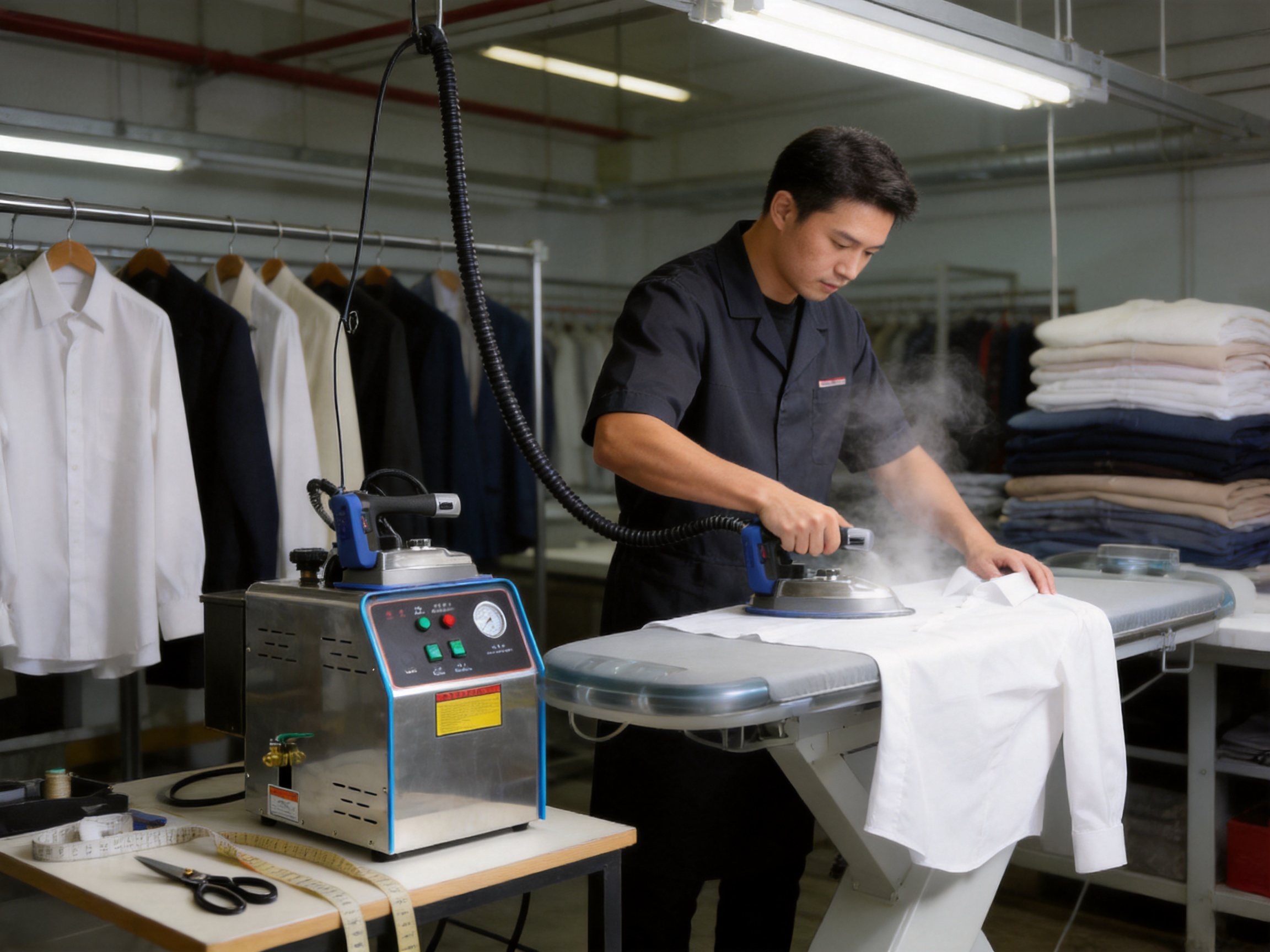
In garment factories, steam is used for shaping, pressing, seam opening, collar forming, sleeve finishing, final inspection, and presentation. The ST-8S can provide a dedicated steam supply for workstations that require reliable output throughout the production day.
Consistent dry steam can help improve the appearance of finished garments and reduce moisture-related interruptions. The automated refill system is also useful when operators need to process many garments in sequence.
Tailors and alteration professionals often work with different fabrics and garment constructions. They require a steam source that is easy to control and does not occupy excessive space. The ST-8S provides a practical solution for removing wrinkles, reshaping fabric, and preparing garments for fitting or delivery.
Its compact format allows it to be integrated into a professional tailoring environment without requiring a large dedicated boiler room. The pressure gauge and simple controls also support efficient daily use.
Laundries need dependable steam for finishing shirts, uniforms, table linens, curtains, and other textile products. A boiler with automated water management can reduce interruptions during repeated processing cycles.
The self-draining valve is beneficial in laundry environments because water quality and operating frequency can result in mineral accumulation. Regular drainage and cleaning help support stable performance.
Hotels may use steam equipment for uniforms, guest garments, bedding, curtains, and housekeeping textiles. The ST-8S can serve as a compact steam source for maintenance rooms or laundry departments where reliable garment presentation is important.
Its relatively compact design allows hotel operators to make efficient use of limited service-space areas. The liquid-level alarm and pressure gauge also help staff monitor the unit during routine operations.
Schools, hospitals, transportation companies, restaurants, and public institutions often need to maintain uniforms and workwear. The ST-8S can support regular pressing and finishing without the infrastructure of a large industrial boiler system.
Because the unit is designed for straightforward operation, it can be incorporated into standardized maintenance and garment-care procedures after appropriate staff training.
Textile designers, sample rooms, and product-development departments use steam to evaluate fabric behavior and refine garment construction. Controlled steam can help shape samples, relax fibers, and improve the presentation of prototypes.
The ability to monitor pressure and use continuous dry steam is useful when repeatability matters. A consistent steam source can help development teams compare results across different samples and production trials.
The ST-8S is produced by Jinyun Shengda Sewing Equipment Co., Ltd., a manufacturer established in 2003 in Zhejiang, China. The company specializes in the independent research, development, and production of electric irons, steam irons, hanging irons, spray guns, small steam machines, heat transfer machines, steam boilers, vacuum tables, and related accessories.
This product range gives the manufacturer experience across several connected areas of garment-care and ironing technology. A company that develops boilers alongside irons, pressing equipment, vacuum tables, and steam accessories can consider how individual products function together in a complete workstation rather than treating the boiler as an isolated device.
The company maintains research and development, management, and sales teams that work together on product improvement and customer service. This integrated structure can support communication between technical development and market requirements. It also provides a foundation for adapting products to different users, applications, and regional expectations.
The manufacturer emphasizes independent research and development, quality improvement, customization, OEM services, and professional support. These capabilities are important for distributors and commercial buyers who may require product specifications, packaging arrangements, labels, documentation, or other adjustments for their market.
Manufacturing strength is not limited to the final assembly stage. It also includes component selection, process control, inspection, functional testing, packaging protection, and after-sales communication. For steam equipment, each of these steps can affect the user experience. A boiler must be assembled correctly, tested for its intended operating behavior, protected during shipment, and supported with appropriate operating information.
The company reports compliance with national and industry standards, including GB4706.1-2005 and GB4706.2-2007, and states that its products have passed CCC and CQC certifications. Buyers should request current certification documents and verify that the specific model and production batch meet the requirements applicable to their destination market.
The development of a steam boiler begins with the relationship between heating power, tank structure, operating pressure, steam quality, water management, control logic, and user safety. The ST-8S reflects an engineering approach that combines these elements in a compact format.
Design decisions such as the use of a stainless steel inner tank, integrated pressure monitoring, low-water indication, automated refill, and self-draining show an emphasis on the full operating cycle. The product is not designed only to generate heat; it is designed to support filling, heating, monitoring, steam delivery, draining, and routine maintenance.
Material selection influences durability and reliability. The stainless steel inner tank is especially important because it is exposed to water and heat. Other components, including heating elements, valves, gauges, alarms, connectors, and electrical parts, must be selected for compatibility with the operating environment.
Consistent component specifications help reduce variation between production units. Suitable materials also make it easier to establish inspection standards and replacement procedures. For buyers, this contributes to more predictable procurement and maintenance planning.
Correct assembly is essential for pressure and steam equipment. Connections must be properly fitted, control components must be installed in the correct positions, and electrical systems must be assembled according to the intended design. Process control helps ensure that each production unit follows the same assembly requirements.
A disciplined manufacturing process can reduce avoidable problems such as loose connections, incorrect wiring, misaligned components, or inadequate sealing. It also makes final inspection more effective because production personnel can compare the completed unit with defined standards.
Steam boilers should be inspected for heating performance, pressure behavior, water management, alarm response, drainage function, and general operating stability. Functional checks help identify problems before products are packaged and shipped.
Inspection is particularly important for features that directly affect user confidence. The pressure gauge should provide usable information, the liquid-level alarm should respond appropriately, the refill system should operate correctly, and the self-draining valve should be accessible and functional.
Steam equipment may be exposed to vibration, impact, humidity, and repeated handling during shipment. Proper packaging protects the boiler, controls, gauge, valves, connections, and external surfaces. The stated packing size of 590 x 355 x 525 mm provides a clear reference for logistics planning and warehouse management.
Appropriate packaging also supports international distribution. The company exports products to Southeast Asia, Central Asia, South America, Africa, and other regions. Experience with overseas customers can help the manufacturer understand the importance of shipping protection, product identification, documentation, and communication across different markets.
Different distributors and professional users may have different requirements for voltage, labeling, packaging, accessories, manuals, and product presentation. The manufacturer identifies customization and OEM service as part of its business strengths.
For commercial buyers, OEM capability can simplify the development of a product line under a private label or support market-specific packaging. It can also help distributors create a consistent range of steam boilers, irons, vacuum tables, and related equipment.
Customization should be evaluated carefully because changes to electrical specifications, pressure systems, controls, or accessories may affect certification and safety requirements. Buyers should confirm technical feasibility, minimum order quantities, lead times, testing arrangements, documentation, and destination-market compliance before placing an order.
A manufacturer with experience in several categories of ironing equipment may also be able to recommend compatible accessories or workstation combinations. This can be useful for customers planning a complete garment-finishing system rather than purchasing one standalone machine.
The ST-8S should be installed in a clean, stable, and suitably ventilated location. There should be enough space around the boiler for operation, inspection, drainage, and service. The unit should not be placed where it is exposed to unnecessary water spray, corrosive substances, excessive dust, or unstable temperatures.
The electrical supply must match the 220 V rating and provide adequate capacity for the 3 kW heating load. Proper grounding and suitable electrical protection are essential. Installation should be performed by a qualified professional who understands local electrical regulations and the requirements of steam equipment.
Steam hoses and connected tools should be suitable for the operating temperature and pressure. Connections must be secure, correctly routed, and protected from sharp bends or mechanical damage. Operators should avoid placing hoses where they can create a trip hazard or come into contact with unprotected skin.
The water supply should meet the manufacturer’s recommendations. Water with high mineral content can increase scale formation and maintenance requirements. If water treatment is necessary, the selected method should be compatible with the boiler and should not introduce substances that could damage internal components.
Before the first use, personnel should review the operating instructions, identify the pressure gauge and liquid-level alarm, understand the refill process, and learn how to use the self-draining valve safely. Proper training is an important part of installation because equipment performance depends on both machine design and operating practice.
Regular maintenance helps preserve steam quality, heating efficiency, safety, and service life. Operators should inspect the boiler at intervals appropriate to its workload and water quality. Daily or routine checks may include looking for leaks, unusual sounds, damaged hoses, loose connections, and abnormal pressure behavior.
The water supply and automatic refill system should be checked to ensure that the boiler receives water correctly. If the refill function appears slow, irregular, or inactive, the system should be inspected before continued heavy operation.
The liquid-level alarm should be treated as an important operational feature. If the alarm activates unexpectedly or fails to respond when required, qualified service personnel should examine the system. Operators should never bypass safety warnings or continue using equipment with unexplained alarm behavior.
Drainage should be performed according to the recommended schedule. The boiler must be shut down, depressurized, and cooled as required before the self-draining valve is opened. Removing accumulated water and sediment can help reduce scale and maintain more stable operation.
The stainless steel inner tank should be inspected as part of scheduled service. The presence of heavy scale, corrosion, unusual discoloration, or persistent steam-quality problems may indicate a need for deeper cleaning or professional inspection.
Electrical parts should be checked by qualified personnel. Any damaged cable, plug, switch, terminal, or heating component should be repaired or replaced using suitable parts. Unauthorized modifications can create safety risks and may affect certification or warranty conditions.
Steam boilers combine electricity, hot water, high temperature, and pressure. Operators must treat the equipment as a professional appliance rather than a simple water heater. Training should cover startup, normal operation, low-water warnings, shutdown, drainage, emergency isolation, and basic troubleshooting.
The pressure gauge should be observed during use. If pressure rises beyond the expected range, fluctuates abnormally, or fails to develop, the unit should be stopped and inspected. Users should never adjust or remove pressure-related components without qualified technical authorization.
Operators should avoid opening the boiler or drainage system while it is pressurized or hot. Steam and hot water can cause severe burns. Appropriate protective equipment and safe working procedures should be used during maintenance.
The boiler should not be left operating in an unsuitable environment or without the supervision required by the workplace’s safety policy. The area around the unit should be kept clear, and emergency access to the power supply should remain available.
Following these practices allows users to benefit from the ST-8S’s automated functions while maintaining responsible control over the equipment. Automation reduces routine labor, but it does not remove the need for inspection, training, and professional maintenance.
Before purchasing the ST-8S, buyers should evaluate the required steam tools, expected daily workload, available electrical supply, water quality, installation area, and maintenance resources. The boiler should be selected according to the connected equipment and intended application rather than by power rating alone.
Distributors should confirm the product specification, packaging dimensions, electrical requirements, documentation, warranty terms, spare-parts availability, and shipment conditions. They may also wish to discuss OEM labeling, packaging design, accessory combinations, and market-specific certification.
End users should consider whether a compact independent boiler or a larger central system is more appropriate. The ST-8S is particularly suitable for operations that need professional steam generation in a compact format. Facilities with many high-consumption steam stations may need to compare the required capacity with the output of the selected model.
Water quality should be discussed before installation. If the local water supply contains a high level of minerals, the buyer should establish a suitable treatment and cleaning plan. This can reduce operating problems and make maintenance costs more predictable.
Technical support is also important. A product supplier should be able to provide operating guidance, installation information, maintenance recommendations, and assistance with replacement components. The manufacturer’s experience in steam boilers and related ironing equipment can be valuable when building a complete equipment solution.
The ST-8S is used to generate steam for garment pressing, textile finishing, tailoring, laundries, hotels, uniform departments, sample rooms, and other professional applications. It can supply steam to suitable irons, presses, spray guns, or related equipment.
The heating power is 3 kW. The actual steam-generation performance depends on operating conditions, water temperature, pressure, connected equipment, and maintenance.
The model is designed for a 220 V power supply. The electrical installation should be checked by qualified personnel to ensure that the circuit, grounding, protection, and load capacity are suitable.
The ST-8S is equipped with a fully automated water refill system. This reduces the need for frequent manual filling, although the water supply, refill system, and liquid-level alarm should still be checked regularly.
Continuous dry steam helps provide a more consistent steam supply with fewer unwanted water droplets. This can reduce moisture-related problems during garment pressing and textile finishing and can support a cleaner final appearance.
The built-in pressure gauge provides a visible indication of internal pressure. It helps operators monitor the working condition of the boiler and identify unusual pressure changes that may require attention.
The integrated liquid-level alarm is designed to alert the operator when the water level becomes too low. The operator should follow the recommended procedure, check the water supply and refill system, and avoid continuing operation if the condition cannot be corrected safely.
The stainless steel inner tank provides a durable and corrosion-resistant internal structure. It is suitable for an environment involving water and heat, although regular cleaning and correct water management remain necessary.
The self-draining valve makes it easier to remove water, sediment, and contaminants from the boiler. Easier drainage supports routine cleaning and can help maintain heating efficiency and steam quality.
The listed rated steam pressure is 0.35–0.4 MPa. Operators should remain within the specified operating limits and should not modify pressure-control components without qualified technical approval.
The listed rated steam temperature is 151. The exact temperature at the point of use can vary according to pressure, connected equipment, hose length, ambient conditions, and operating status.
Yes. Its compact format, 220 V power supply, automated refill system, and simple controls make it suitable for many small and medium-sized professional workshops. The required steam capacity should be compared with the workload and connected tools before purchase.
The stated packing size is 590 x 355 x 525 mm. Buyers should allow additional space for safe installation, ventilation, operation, inspection, and drainage beyond the packing dimensions.
The manufacturer identifies customization and OEM services among its business capabilities. Customers should discuss labeling, packaging, technical specifications, certification, minimum quantities, lead times, and documentation before confirming an order.
Maintenance may include checking the water supply, automatic refill function, liquid-level alarm, pressure gauge, hoses, electrical connections, valves, and general condition. Regular drainage and cleaning are important, especially where the water contains significant mineral content.
Electrical and steam-related installation should be completed by qualified personnel. Operators should receive training before use and should follow the applicable installation, safety, and maintenance instructions.
The ST-8S Steam Boiler is designed for businesses that need dependable steam generation without the complexity and space requirements of a large central boiler system. Its 3 kW heating power, 220 V configuration, compact format, and rated pressure range provide a practical foundation for professional garment and textile applications.
Its strongest advantages come from the combination of features rather than from a single specification. Automated water refill reduces manual work, continuous dry steam supports cleaner finishing, the pressure gauge provides operating visibility, the liquid-level alarm adds protection, the stainless steel inner tank supports durability, and the self-draining valve simplifies maintenance.
The manufacturer’s experience in electric irons, steam irons, spray guns, small steam machines, heat transfer equipment, vacuum tables, steam boilers, and accessories provides a broad product foundation for garment-care solutions. Its stated research and development capability, OEM support, overseas distribution experience, and quality-oriented production approach make it a suitable partner for distributors and professional users seeking coordinated equipment supply.
When correctly installed, operated, and maintained, the ST-8S can support efficient daily production in garment factories, tailoring shops, laundries, hotels, uniform departments, and textile workrooms. For buyers comparing compact steam boilers, it offers a balanced solution focused on convenience, steam consistency, monitoring, durability, and practical long-term use.
1. Product specification sheet for the ST-8S Steam Boiler, including model, heating power, rated temperature, pressure, voltage, and packing dimensions.
2. Product technical information covering automated water refill, continuous dry steam production, pressure monitoring, liquid-level alarm, self-draining valve, and stainless steel construction.
3. Manufacturer company information concerning product development, manufacturing categories, OEM services, export markets, and customer support.
4. General principles of steam generation, pressure monitoring, water-quality management, and maintenance for professional garment-finishing equipment.
5. General electrical and workplace safety practices for commercial heating and steam-generation equipment.
6. National and industry standards identified in the supplied company information, including GB4706.1-2005 and GB4706.2-2007.
 +86-578-3158872 / +86-578-3158958
 jyshengda@163.com / caroying@jy-shengda.com
 No. 8 Nanyi Rd, Huzhen Industrial Park, Zhejiang, China
Copyright © Jinyun Shengda Sewing Equipment Co., Ltd. All Rights Reserved.
Ironing Press Machine Equipment Factory
 English
 中文简体
 русский
 عربى