Reliable steam generation is essential in garment care, textile production, commercial laundry, tailoring, upholstery, cleaning, and many other professional applications. When steam quality is inconsistent, equipment performance suffers, fabrics may become excessively wet, production cycles can slow down, and operators may face unnecessary maintenance requirements. The ST-750 Steam Boiler is designed to address these challenges with a compact construction, a 4-liter water capacity, continuous dry steam production, integrated pressure monitoring, and a liquid level alarm.
The ST-750 combines the practical advantages of a portable steam generator with the working capacity expected from professional equipment. It is suitable for operations that need a steady steam supply but do not have the space, budget, or installation requirements for a large fixed boiler system. Its 1600W boiler power supports efficient steam generation, while the included 900W iron power makes the configuration especially suitable for garment finishing and pressing work.
Manufactured by Jinyun Shengda Sewing Equipment Co., Ltd., the ST-750 reflects the company’s experience in electric irons, steam irons, small steam machines, steam boilers, vacuum tables, spray guns, heat transfer machines, and related equipment. The company’s integrated research, development, production, management, and sales capabilities support a product approach based on practical design, consistent quality, customization, and service.
This article examines the ST-750 Steam Boiler in detail, including its specifications, operating advantages, safety features, application areas, manufacturing strengths, maintenance considerations, and position compared with less capable steam-generation solutions.

ST-750 Steam Boiler
The ST-750 Steam Boiler is a compact steam-generation unit developed for professional and commercial use. It is equipped with a 4-liter water tank, a built-in pressure gauge, and a liquid level alarm. These features help users maintain a reliable steam supply while monitoring important operating conditions.
Its central function is the production of continuous dry steam. In practical terms, dry steam contains less unwanted liquid water than ordinary wet steam. This is particularly important when steam is applied directly to clothing, textiles, upholstery, or other materials that may be damaged, marked, or delayed by excess moisture.
The boiler is available in 220V and 110V versions. This voltage flexibility allows the product to serve different electrical markets and makes it easier for distributors, importers, workshops, and commercial users to select a suitable configuration for their local power systems.
With a boiler power rating of 1600W and an iron power rating of 900W, the ST-750 is configured to support both steam generation and garment pressing functions. The 4-liter tank reduces the frequency of refilling compared with smaller steam generators, helping operators maintain a smoother workflow during extended working periods.
The product has a listed packing size of 480 x 305 x 450 millimeters. This compact format is advantageous where floor space is limited or where the equipment must be moved between workstations. It can be integrated into tailoring shops, garment finishing areas, small laundries, uniform departments, alteration businesses, and other environments that require professional steam without a large boiler room.
The following table summarizes the main specifications provided for the ST-750 Steam Boiler.
| Item | Specification |
|---|---|
| Model | ST-750 |
| Voltage | 220V / 110V |
| Boiler power | 1600W |
| Iron power | 900W |
| Water capacity | 4 liters |
| Packing size | 480 x 305 x 450 millimeters |
| Primary steam characteristic | Continuous dry steam |
| Monitoring equipment | Built-in pressure gauge |
| Safety notification | Liquid level alarm |
Specifications should always be confirmed with the supplier before ordering, especially when a buyer requires a particular plug, electrical configuration, production accessory, packaging arrangement, or market-specific compliance document.
Steam quality has a direct effect on work quality. Steam that contains excessive water can leave fabrics damp, create visible spots, slow down finishing, and make it difficult to achieve a clean professional appearance. In contrast, a controlled supply of dry steam is better suited to processes that require heat and moisture in a balanced form.
For garment pressing, dry steam helps relax fabric fibers without unnecessarily saturating the material. Operators can shape collars, cuffs, seams, sleeves, trouser legs, jackets, uniforms, and other garments with greater control. The result can be a more efficient finishing process and less waiting time for materials to dry.
Dry steam is also useful in cleaning and treatment applications. Where steam is used to loosen dirt, soften fibers, or support surface sanitation, excess liquid water may reduce convenience and increase the chance of wet surfaces. A continuous dry steam output helps create a more predictable working condition.
The ST-750 is designed around this requirement. Its steam-generation system is intended to deliver continuous steam without unwanted water droplets in the output. This capability is one of the main distinctions between a professional steam boiler and a basic water-heating device that produces irregular, moisture-heavy vapor.
Water capacity affects productivity. A steam generator with a very small tank may require frequent stopping, cooling, refilling, and restarting. Every interruption creates a break in the operator’s workflow. In a professional setting, repeated refilling can increase labor time and make production planning more difficult.
The ST-750 uses a 4-liter water tank, providing a useful balance between operating duration and compactness. The larger tank reduces the need for constant refilling while avoiding the size and installation demands associated with a large industrial boiler system.
This capacity is valuable in garment workshops, tailoring businesses, small factories, uniform departments, dry-cleaning support areas, and commercial pressing stations. Operators can complete more work between water checks, and supervisors can organize tasks around a more stable steam supply.
A 4-liter capacity is also practical for businesses that need mobility. A very large tank can make a machine difficult to move and may require a fixed location, dedicated plumbing, or structural support. The ST-750 is intended to remain relatively compact and portable, allowing users to place it where steam is needed rather than permanently dedicating a large area to the boiler.
Actual operating duration depends on factors such as steam demand, working temperature, attachment selection, operator technique, water quality, and ambient conditions. Therefore, the 4-liter tank should be understood as a capacity advantage rather than a guaranteed number of operating hours.
Many workshops need professional steam but cannot accommodate a large centralized steam system. Space may be limited by the building layout, the number of workstations, or the need to preserve room for cutting tables, sewing machines, storage, and customer service. A compact steam boiler can be installed closer to the point of use and can reduce unnecessary movement of garments and hoses.
The ST-750’s listed packing dimensions of 480 x 305 x 450 millimeters indicate a space-conscious design. The equipment can be considered for small and medium-sized work areas where portability is important. It may be moved between pressing stations, production rooms, demonstration areas, service locations, or temporary workspaces, subject to safe handling procedures.
Portability provides several advantages over a fixed steam installation. A business can add steam capability without extensive building modification. A distributor can present the equipment to customers more easily. A training center can move the unit between classrooms. A garment contractor can use it in different sections of a workshop as production requirements change.
Compact equipment is also easier to store when not in use. This is useful for seasonal businesses, mobile alteration services, event garment preparation, and facilities that require steam only during particular production periods.
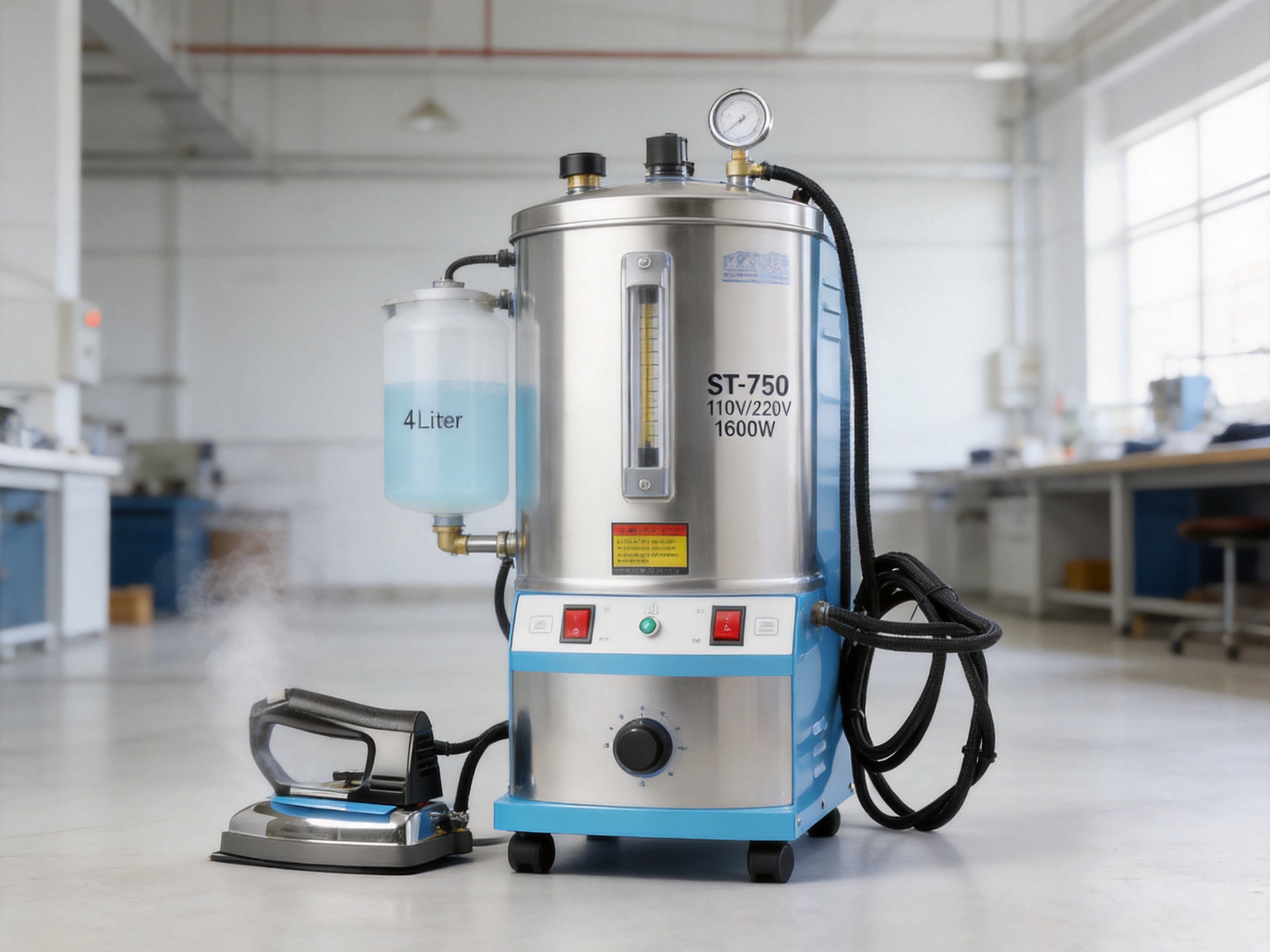
A pressure gauge provides a direct visual indication of the boiler’s internal pressure. This helps the operator understand the machine’s operating condition instead of relying only on sound, heat, or steam output. Visible pressure information is especially useful when the machine is used by multiple operators or when a supervisor needs to check equipment status quickly.
Monitoring pressure supports better operational control. Users can observe whether the boiler is building pressure as expected and can identify unusual changes that may require attention. A gauge also helps operators coordinate their work with the machine’s operating cycle, reducing unnecessary waiting and improving the rhythm of pressing or steaming tasks.
The pressure gauge is not a substitute for proper training or safety procedures. Operators should follow the product instructions, avoid interfering with pressure-control components, and never attempt unauthorized repairs while the equipment is hot, energized, or pressurized.
Compared with basic steam devices that provide little or no operating information, the ST-750 gives users a clearer view of the steam-generation process. This is a practical advantage for professional environments where equipment status must be easy to understand.
Water level management is essential for boiler safety and service life. If a heating system operates with insufficient water, internal components may be exposed to excessive heat. Such a condition can reduce reliability, damage parts, and create avoidable maintenance costs.
The ST-750 includes a liquid level alarm designed to alert the user when the water level is too low. This feature encourages timely attention and helps prevent operation under unsuitable water conditions. It is especially useful in busy workshops where operators may be concentrating on garments, production schedules, or customer orders.
An alarm does not eliminate the need for regular inspection. Users should still check the water level according to the operating instructions, use appropriate water, keep the tank clean, and respond promptly when an alarm is activated. The alarm should be viewed as an additional layer of awareness within a broader safe-use procedure.
This feature gives the ST-750 an advantage over simple heating devices without liquid-level notification. By combining a water-capacity design with a low-level warning, the product supports more disciplined operation and reduces the likelihood of neglect-related problems.
The listed 900W iron power makes the ST-750 particularly relevant to garment care and pressing applications. A steam boiler and iron used as a coordinated system can provide a more consistent workflow than relying on a separate household iron and an independent steam source.
Professional ironing requires more than high temperature. Operators need stable steam, suitable handling, predictable heat, and equipment that can withstand repeated use. The ST-750’s boiler power and iron power are configured to support this type of coordinated operation.
In garment finishing, steam helps relax wrinkles and allows the operator to shape materials. It can be used for final presentation, seam opening, sleeve shaping, collar finishing, pressing of uniforms, and preparation of garments for packaging or display. The precise method depends on the fabric, garment construction, and the operator’s training.
Using a dedicated steam boiler can also reduce the need to refill a small iron reservoir repeatedly. The separate 4-liter water capacity supports longer work cycles and allows the operator to focus on the garment rather than constantly managing a small water chamber.
For businesses that already operate vacuum tables, pressing equipment, spray guns, or other garment machines, the ST-750 can be considered as part of a broader finishing system. Its steam output may support multiple work processes, provided the final configuration and connection requirements are confirmed before purchase.
The ST-750 is not intended to compete solely on the basis of maximum industrial output. Its principal advantage is the combination of useful capacity, dry steam, monitoring, portability, and integrated ironing support in one compact solution.
Compared with a small household steam iron or compact consumer steamer, the ST-750 provides a 4-liter water capacity and a dedicated 1600W boiler. This arrangement is better suited to repeated professional use, where frequent refilling can interfere with productivity.
Compared with a large fixed boiler system, the ST-750 requires less space and is easier to relocate. Small businesses can obtain professional steam capability without immediately investing in a full central steam infrastructure.
The built-in pressure gauge and liquid level alarm provide information and warnings that are not always available on basic steam equipment. These features improve operator awareness and support a more controlled working routine.
The emphasis on continuous dry steam makes the ST-750 more suitable for applications where unwanted water droplets are undesirable. This is a meaningful distinction in clothing, textile, upholstery, and precision cleaning work.
The availability of 220V and 110V versions supports international distribution and gives buyers more flexibility when matching equipment to local electrical systems. The correct voltage must be selected before shipment and installation.
These advantages should be evaluated against the buyer’s required steam volume, operating schedule, available power, workspace, local regulations, and desired accessories. The most appropriate machine is determined by the application rather than by a single specification.
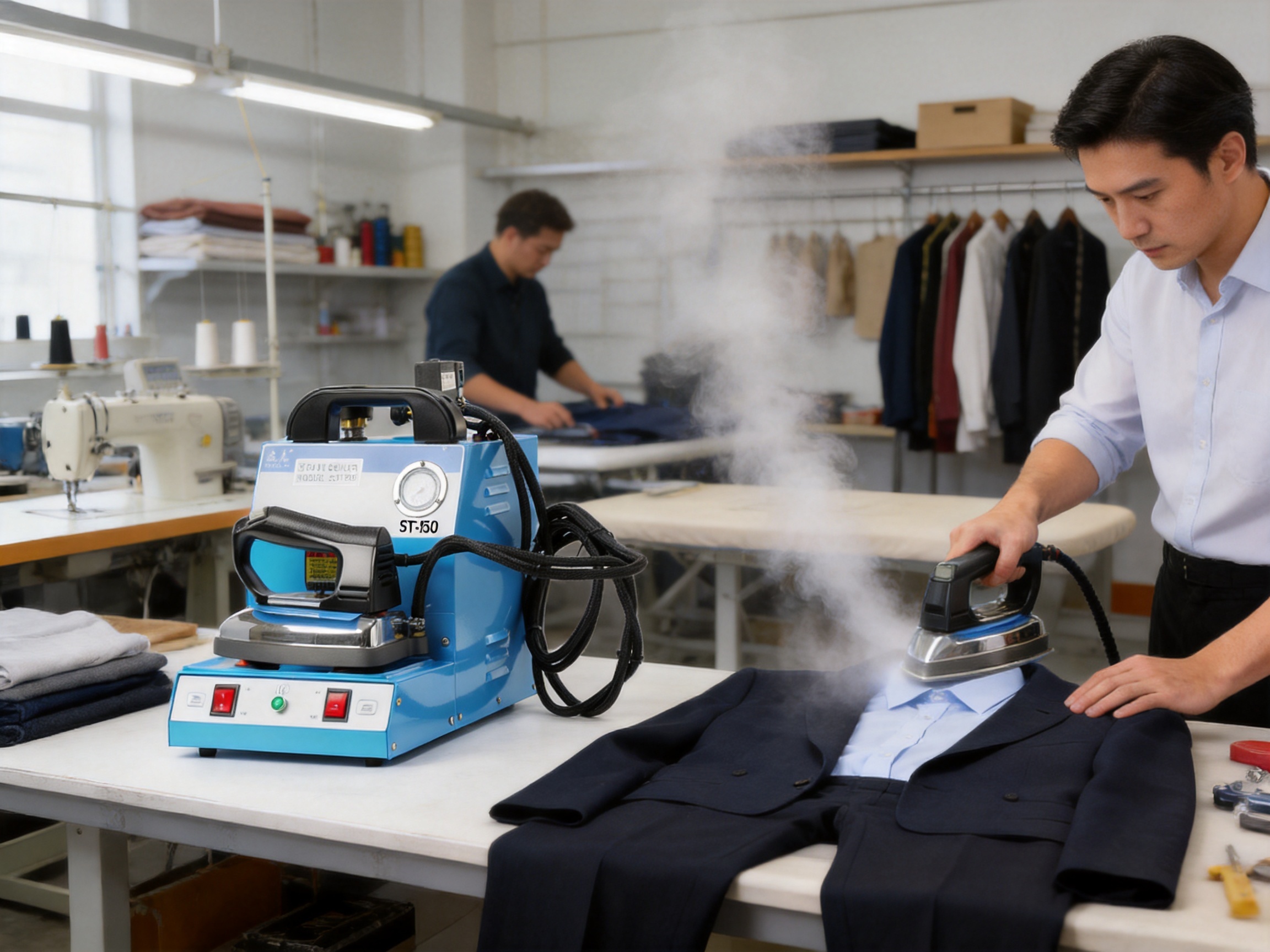
Garment production frequently requires steam for intermediate pressing, final finishing, shaping, and presentation. The ST-750 can support pressing stations where operators need a consistent source of dry steam in a relatively small area.
It may be suitable for shirts, trousers, jackets, uniforms, dresses, workwear, school clothing, and other products. The operator should adjust the steaming technique according to fabric type, color, construction, and care requirements.
Tailors and alteration businesses often work with different garments throughout the day. A compact steam boiler can help finish hems, reshape garments after alteration, open seams, and improve the presentation of completed work.
Because the equipment is relatively portable, it can be placed close to the alteration or fitting area. This reduces the need to transport garments across a busy shop and allows steam to be used as part of the final quality-check process.
Uniform services and commercial laundries may need steam for finishing garments after washing and drying. The ST-750 can support smaller pressing operations, hotel uniform rooms, restaurant workwear services, and local laundry businesses.
For high-volume operations, buyers should compare required throughput with the capacity of the ST-750 and determine whether several units or a larger boiler system would be more appropriate.
Steam can assist with the treatment and shaping of certain textile products and upholstery materials. A controlled steam supply may help relax wrinkles, refresh surfaces, or support finishing work. Material compatibility must always be assessed before steaming, since some fabrics, coatings, adhesives, and delicate surfaces may not tolerate heat or moisture.
Dry steam can be used in selected cleaning and maintenance processes where high-temperature vapor is preferred over large quantities of liquid water. Possible environments include workshops, service departments, hospitality facilities, and specialist cleaning operations.
The ST-750 should be used only for applications compatible with its design. Users should not assume that a garment steam boiler replaces a dedicated high-pressure cleaning machine, sterilizer, or regulated medical device.
Vocational schools, tailoring academies, and equipment distributors may use the ST-750 for demonstrations and training. Its visible pressure gauge and liquid level alarm help students understand basic boiler operation, while its compact size simplifies classroom placement.
The ST-750 is produced by Jinyun Shengda Sewing Equipment Co., Ltd., a company established in 2003 in Huzhen Town, Lishui City, Zhejiang Province, China. The company specializes in the research, development, and production of electric irons, steam irons, hanging irons, spray guns, small steam machines, heat transfer machines, steam boilers, vacuum tables, and accessories.
This product range provides an important manufacturing advantage. Rather than focusing on a single isolated item, the company works across connected categories of ironing and garment equipment. Knowledge gained from electric heating, steam delivery, pressure control, fabric finishing, and workstation design can support the development of related products.
The company’s stated research and development, management, and sales teams work together to improve products and serve customers. This cross-functional approach can help manufacturers identify practical market requirements, coordinate product changes, prepare documentation, and respond to distributor feedback.
The company also owns several product brands, including Silver Star, Platinum Dragon, Tingshun, Jiasheng, Shengtai, and Jiangxin. These brands reflect the company’s involvement in multiple equipment segments and markets.
Independent research and development allows a manufacturer to improve product structure, heating systems, steam performance, controls, safety features, packaging, and usability according to customer requirements. For a steam boiler such as the ST-750, development work may involve balancing water capacity, heating power, pressure stability, portability, and ease of maintenance.
Research and development is especially important for equipment used repeatedly in professional environments. Minor design weaknesses can become significant problems when a machine operates for many hours or is handled by multiple users. Continuous product improvement helps address these practical concerns.
Since its establishment in 2003, the company has accumulated experience in the ironing equipment field. Long-term industry involvement can support better understanding of distributor expectations, replacement parts, packaging requirements, export procedures, and application-specific product needs.
Experience does not remove the need for inspection and verification, but it provides a useful foundation for developing equipment intended for professional customers rather than occasional household use.
A broad product range can benefit customers that are building complete garment finishing workstations. The same supplier may be able to provide steam boilers, irons, vacuum tables, spray guns, heat transfer machines, and accessories. This can simplify sourcing, communication, replacement purchasing, and equipment matching.
For distributors, a broad catalog can also support market segmentation. Customers with different budgets and production volumes may be offered compact, medium-capacity, or more specialized solutions while maintaining a relationship with one manufacturer.
The company states that its products follow national and industry standards, including GB4706.1-2005 and GB4706.2-2007. It also states that its products have passed CCC and CQC certifications. Buyers should request current certification documents and confirm that the specific ST-750 configuration being purchased is covered by the applicable documentation.
Standards-oriented production is important for electrical and heating equipment. A professional steam boiler must be designed with attention to insulation, wiring, grounding, heating components, pressure-related risks, water-level conditions, enclosure construction, and operating instructions.
Certification information should be considered together with the destination market’s requirements. Different countries and regions may require specific electrical markings, plugs, testing reports, language labels, import documentation, or conformity procedures. The supplier and importer should confirm these details before shipment.
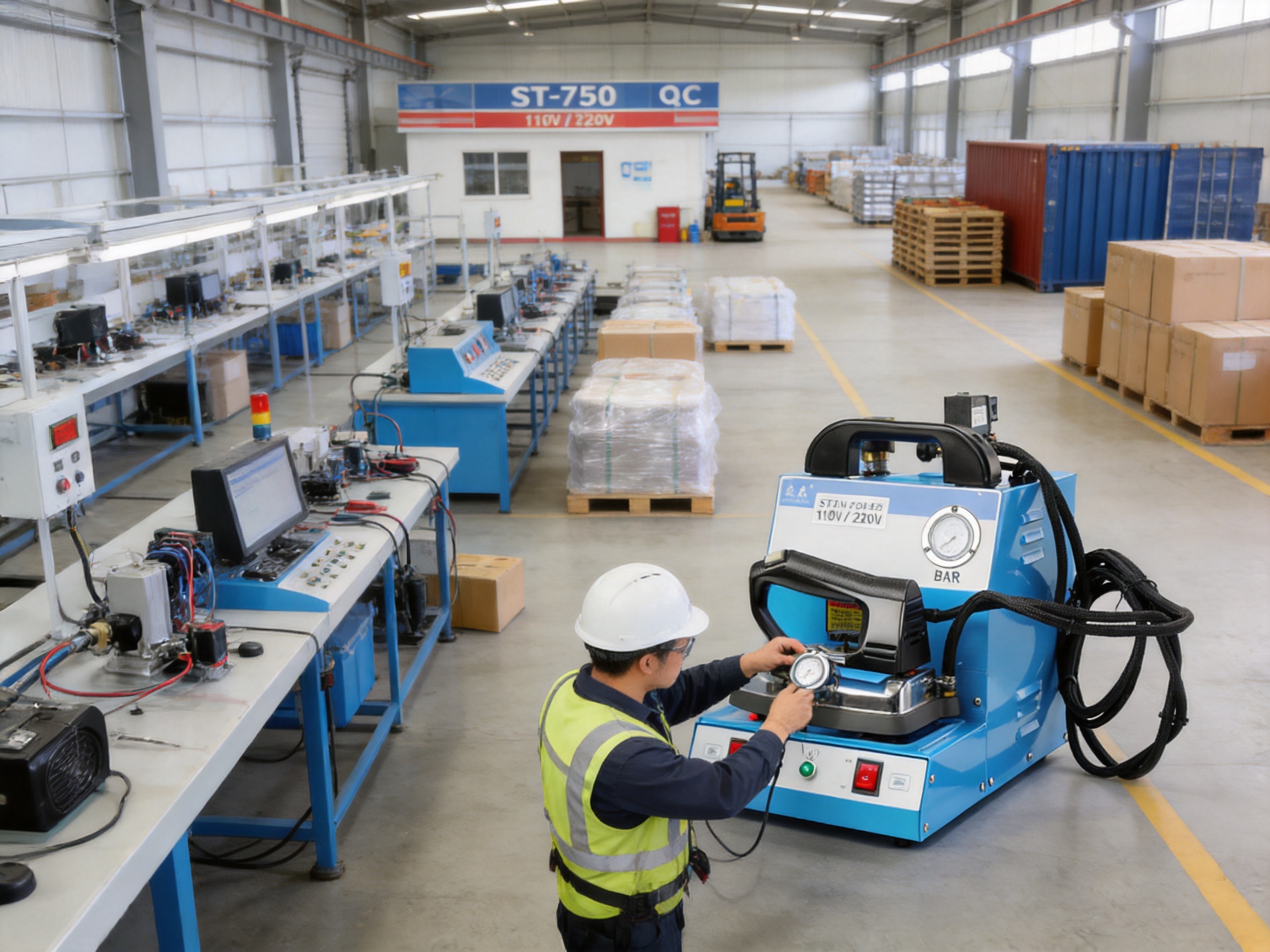
Quality is also influenced by process control. Consistent assembly, correct component selection, electrical inspection, functional testing, packaging protection, and traceability all contribute to reliable product delivery. Buyers may request information about factory inspection procedures, sample approval, quality-control checkpoints, and after-sales support.
Although detailed internal factory procedures are not specified in the available product information, a responsible manufacturing process for this type of equipment should include several key stages.
The boiler tank, heating elements, electrical components, pressure gauge, alarm system, switches, wiring, insulation, and external housing must be selected for compatibility with the intended operating conditions. Materials should be appropriate for heat, moisture, pressure, and repeated use.
Correct assembly is necessary for stable heating and safe steam delivery. Connections must be properly secured, electrical wiring must be routed safely, and seals must be fitted correctly. The relationship between the water tank, heating system, steam outlet, pressure gauge, and alarm should be checked during assembly.
Electrical equipment should undergo suitable tests for insulation, grounding, continuity, power operation, and abnormal conditions according to the applicable production and certification procedures. These checks help identify faults before the product is packed and shipped.
Functional testing should verify that the boiler heats correctly, produces steam, displays pressure, and activates the liquid level alarm under the intended conditions. Testing may also include checking the iron’s heating performance and confirming that controls respond appropriately.
Steam equipment may be exposed to vibration, impact, moisture, and repeated handling during transportation. Proper packaging should protect the boiler body, gauge, iron, electrical connections, and accessories. The listed packing size provides a reference for logistics planning, warehouse storage, and container loading.
Customers with special shipping requirements should discuss carton labels, export packaging, palletization, spare parts, manuals, and inspection arrangements with the manufacturer before placing an order.
The ST-750 should be installed and operated according to the supplier’s instructions. Place the unit on a stable, level, heat-resistant surface with sufficient ventilation and clearance for operation, inspection, and maintenance.
Before connecting the machine, verify that the voltage shown on the product matches the local power supply. Use a suitable grounded electrical outlet and avoid overloaded circuits. Electrical installation should be performed by a qualified person where required by local regulations.
Fill the water tank with suitable water as recommended by the supplier. Water quality can influence scale formation, heating efficiency, and component life. If the local water supply is hard, ask the manufacturer whether filtered, softened, or otherwise treated water is recommended.
Do not overfill the tank. Allow the machine to complete its heating and pressure-building process before beginning work. Monitor the pressure gauge and respond to any unusual indication, noise, smell, leakage, or alarm condition.
Keep the iron, hose, steam outlet, and surrounding work area away from combustible materials. Steam can cause burns, and heated surfaces may remain hot after the machine is switched off. Operators should wear suitable protective clothing where appropriate and keep inexperienced users away from the equipment during operation.
Never open, dismantle, or repair a pressurized or energized boiler. Switch off the power, allow the equipment to cool, release pressure according to the instructions, and use trained service personnel for repairs.
Regular maintenance helps preserve steam quality, heating efficiency, and operational safety. The exact maintenance schedule should be based on the manufacturer’s instructions, working hours, water quality, and application.
Mineral deposits can accumulate inside water-heating equipment. Scale may reduce heating efficiency, restrict passages, affect sensors, or shorten component life. Use the recommended water and follow the supplier’s cleaning and descaling procedure.
Check that the pressure gauge is readable and that its indication behaves normally during operation. A damaged, fogged, stuck, or inconsistent gauge should be inspected by qualified service personnel before continued use.
The liquid level alarm should be checked according to the recommended service procedure. If the alarm does not activate as expected, discontinue use until the cause has been identified and corrected.
Inspect the steam hose, connectors, iron handle, soleplate, cable, plug, and control components. Replace damaged or worn parts with approved components. Do not use equipment with exposed wiring, leaking connections, cracked insulation, or damaged steam fittings.
Keep the equipment exterior, ventilation openings, controls, and surrounding floor clean and dry. Dust, lint, spilled water, and textile fibers can interfere with safe operation and may increase the chance of accidental slips or electrical contamination.
Efficiency is not limited to electrical power consumption. It also includes how effectively the operator, water, workspace, and production time are used. The ST-750 supports workflow efficiency through its 4-liter tank, continuous steam design, compact layout, and operating indicators.
A larger tank can reduce interruptions caused by refilling. Continuous dry steam can reduce repeated passes over a garment and limit the need to wait for excess moisture to evaporate. A pressure gauge can help operators understand when the machine is ready, while the liquid level alarm can reduce the risk of operating without sufficient water.
Efficiency also depends on correct technique. Operators should use the appropriate amount of steam, select the right temperature and contact method for each fabric, and avoid unnecessary steaming. Regular cleaning and proper water management help maintain heating performance over time.
Businesses should assess the complete workflow when comparing equipment. A machine with a slightly higher purchase price may offer better practical value if it reduces refilling, improves finishing consistency, supports more applications, and requires less workspace.
Before ordering the ST-750, buyers should identify the intended application, expected daily operating hours, required voltage, available workspace, water quality, preferred accessories, and local compliance requirements.
Distributors should confirm packaging details, minimum order quantities, lead times, spare parts availability, instruction manuals, warranty terms, branding options, and after-sales procedures. If the product is intended for a specific national market, the importer should verify electrical standards, plug type, labeling, language, customs documentation, and certification needs.
End users should consider whether one ST-750 unit can meet their expected workload or whether several units would provide better flexibility. Businesses with very high steam demand may require a larger boiler system, while small workshops may benefit from the ST-750’s compact design.
Buyers should also consider the complete workstation. The boiler may be paired with an iron, vacuum table, spray gun, heat transfer machine, or other accessory depending on the production process. Matching equipment correctly can improve operator comfort and finishing quality.
The company states that it provides customization and OEM services. These capabilities may be relevant to importers, distributors, retail brands, project suppliers, and professional equipment dealers that require specific packaging, labeling, product identification, or market presentation.
Customization should be discussed in detail before production. Potential topics include brand labels, carton artwork, instruction manuals, electrical plugs, color requirements, accessory combinations, spare parts, product markings, and certification documentation.
OEM cooperation is most successful when technical requirements are documented clearly. Buyers should provide target-market information, expected production quantities, quality standards, packaging specifications, and approval procedures. Samples should be evaluated before mass production, particularly when electrical configurations or accessories differ from the standard product.
A manufacturer with its own research and development and production capabilities may be better positioned to coordinate such changes than a trading company with limited control over the factory. Nevertheless, all customization claims should be confirmed through written specifications, approved samples, and commercial agreements.
The company reports that its products are distributed in China and exported to Southeast Asia, Central Asia, South America, Africa, and other regions. International experience can help a manufacturer understand differences in voltage, transportation, climate, customer expectations, and distribution channels.
Professional service is important for steam equipment because customers may need guidance on installation, water treatment, operation, replacement parts, and troubleshooting. A supplier that can provide product information and technical communication can help reduce the time required to resolve issues.
For international buyers, communication should cover product manuals, spare parts, packaging, warranty handling, repair procedures, and the responsibilities of the manufacturer, distributor, and end user. Clear communication is especially important for heating and pressure-related equipment.
The ST-750 is designed to generate continuous dry steam for professional and commercial applications. It is particularly suitable for garment pressing, tailoring, textile finishing, commercial laundry support, uniform services, selected cleaning tasks, and other applications that require a compact steam source.
The water capacity is 4 liters. This capacity helps reduce the frequency of refilling compared with smaller steam generators, although actual operating time depends on steam demand and working conditions.
The listed voltage options are 220V and 110V. Buyers should select the correct configuration for the destination market and confirm the plug and electrical requirements before ordering.
The boiler power is 1600W. The listed iron power is 900W. These ratings support the product’s intended steam-generation and garment-finishing functions.
The built-in pressure gauge provides a visible indication of internal steam pressure. It helps operators monitor the operating condition of the boiler and identify unusual pressure behavior that may require attention.
The liquid level alarm warns the user when the water level is too low. It supports safer operation by drawing attention to a condition that could affect heating performance and equipment protection.
Its compact format, 4-liter tank, integrated ironing capability, and portability make it suitable for consideration by small tailoring shops and alteration businesses. The buyer should compare the expected workload with the machine’s capacity before purchase.
It may be used in environments where professional steam performance is desired, but it is primarily positioned as commercial and industrial ironing equipment. Household users should consider the space, electrical requirements, safety procedures, and maintenance responsibilities before purchasing.
No. Dry steam generally refers to steam with reduced liquid-water content compared with wet steam. The product is designed to provide steam without unwanted water droplets in normal operation, but users should still follow correct filling, heating, maintenance, and operating procedures.
Maintenance should include suitable water use, scale control, inspection of the gauge and alarm, examination of the steam hose and iron, cleaning of the work area, and professional servicing when required. Always follow the supplier’s specific instructions.
The company states that it provides customization and OEM services. Buyers should confirm available options, minimum quantities, lead times, packaging requirements, technical changes, and approval procedures before placing an order.
The provided information lists 220V and 110V versions. Other details, such as frequency, plug type, cable specifications, and market-specific configurations, should be confirmed with the manufacturer.
The listed packing size is 480 x 305 x 450 millimeters. This measurement is useful for shipping, storage, warehouse planning, and transport calculations.
The ST-750 is a compact steam boiler intended for professional and commercial applications. It may not replace a large centralized system in a high-volume factory. Buyers should compare steam demand, operating hours, number of workstations, and required pressure before selecting equipment.
Buyers should confirm voltage, plug type, accessories, packaging, manuals, certification documents, warranty terms, spare parts, delivery schedule, and any OEM requirements. Product specifications should be approved in writing before mass shipment.
The ST-750 Steam Boiler offers a practical combination of capacity, portability, steam quality, monitoring, and integrated ironing support. Its 4-liter water tank reduces interruptions, while the 1600W boiler supports continuous dry steam generation. The pressure gauge improves operating visibility, and the liquid level alarm adds an important layer of water-level awareness.
Its main competitive strength is balance. The product is more capable than a small domestic steamer but more compact and flexible than a large fixed boiler installation. This makes it relevant to tailoring shops, garment workshops, uniform departments, commercial laundries, training centers, and other businesses that need dependable steam without a large infrastructure investment.
The manufacturer strengthens the product offering through experience in related ironing and garment equipment, independent research and development, a broad product portfolio, OEM and customization capabilities, international distribution experience, and a stated commitment to applicable standards and certifications.
As with any heating and steam equipment, correct selection, installation, operation, water management, maintenance, and safety training are essential. Buyers should verify the final configuration and compliance documents for their market. When matched with the correct workload, the ST-750 can provide an efficient and space-conscious steam solution for professional fabric care and related applications.
1. Product specification sheet for the ST-750 Steam Boiler, including model, voltage, power, water capacity, packing size, pressure gauge, liquid level alarm, and dry steam characteristics.
2. Manufacturer-provided company information for Jinyun Shengda Sewing Equipment Co., Ltd., including company history, product categories, research and development capabilities, OEM services, export markets, and certifications.
3. General principles of steam-generator operation, water-level management, pressure monitoring, electrical safety, and routine maintenance for commercial heating equipment.
4. General garment-care and textile-finishing practices concerning steam application, fabric sensitivity, moisture control, pressing technique, and professional workflow organization.
5. General quality-control considerations for electrical appliances, including component inspection, insulation testing, grounding verification, functional testing, packaging protection, and market-specific conformity review.
 +86-578-3158872 / +86-578-3158958
 jyshengda@163.com / caroying@jy-shengda.com
 No. 8 Nanyi Rd, Huzhen Industrial Park, Zhejiang, China
Copyright © Jinyun Shengda Sewing Equipment Co., Ltd. All Rights Reserved.
Ironing Press Machine Equipment Factory
 English
 中文简体
 русский
 عربى