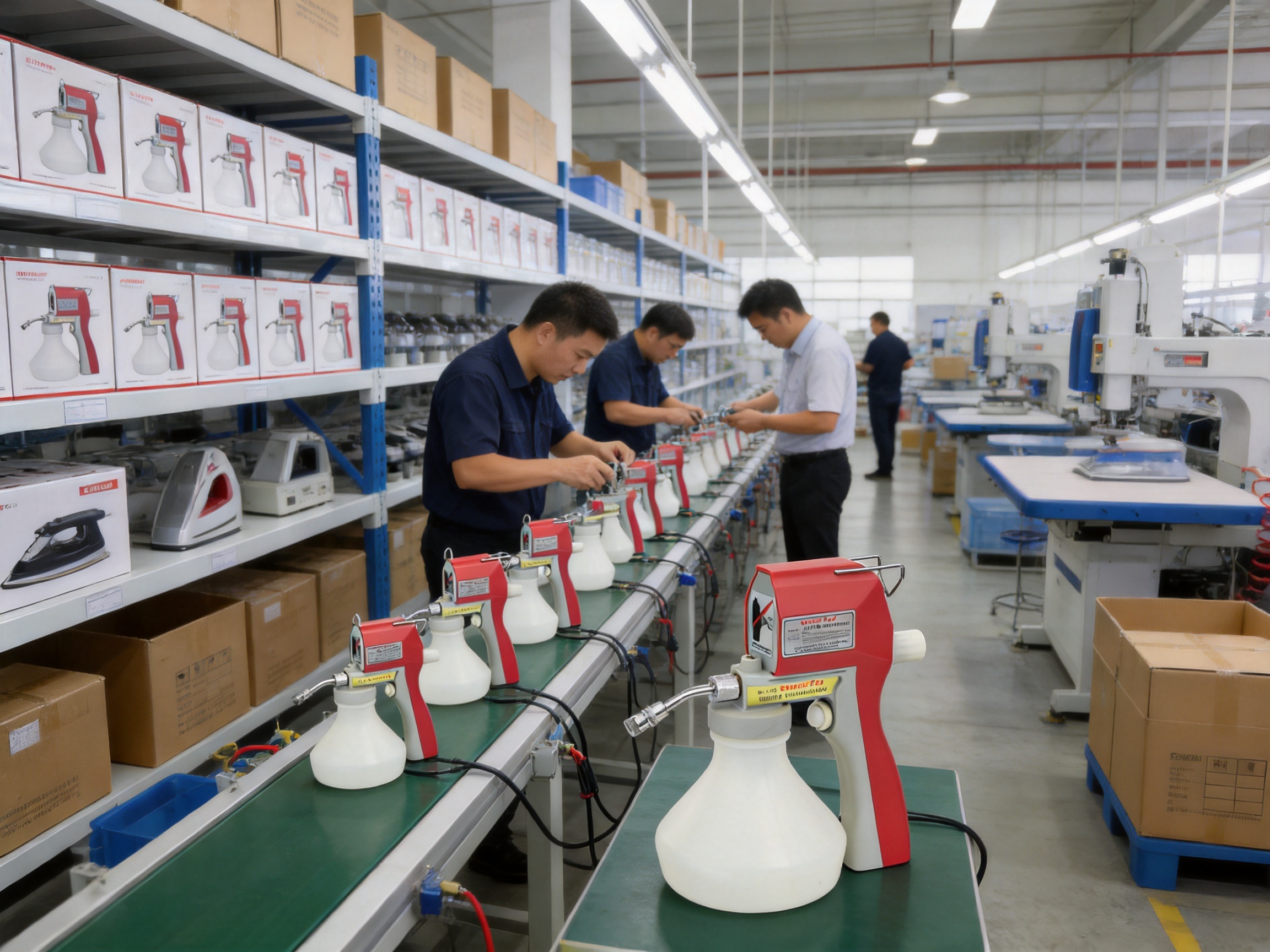
In textile, garment, printing, dyeing, advertising, and related production environments, cleaning performance can directly influence product quality, operating efficiency, and customer satisfaction. Stains, dust, excess dye, printing residue, and other contaminants may appear during manufacturing, handling, storage, or finishing. When these problems must be addressed quickly and accurately, a professional spray gun can provide a practical solution that is faster, more controlled, and more convenient than manual cleaning methods.
The ST-120 Spray Gun is designed to meet these requirements with a compact structure, a lightweight body, stable operation, and effective cleaning power. Operating at 220V with a 40W motor and a 0.65-liter tank, it is suitable for users who need a portable cleaning tool that can be used for extended periods without excessive fatigue. Its ergonomic structure supports comfortable handling, while its optional angled nozzles enable users to direct the spray toward difficult or confined areas.
More than a simple cleaning device, the ST-120 represents a balanced combination of usability, functional performance, durability, and manufacturing experience. It is intended for professional environments in which consistent results, straightforward maintenance, and dependable operation are essential. Its design allows operators to perform targeted cleaning work while maintaining better control over spray direction and intensity.
This article examines the ST-120 Spray Gun in detail, including its operating specifications, application value, competitive advantages, design features, quality considerations, manufacturing strengths, and suitability for different industries.
Cleaning is often treated as a secondary task in industrial production, but it can have a significant effect on the final appearance and usability of a product. In garment manufacturing, a small mark on fabric may affect the presentation of a finished item. In textile processing, unwanted particles or stains may reduce the perceived quality of the material. In printing and advertising production, ink residue and surface contamination may compromise visual clarity. A reliable spray gun helps operators respond to these issues efficiently.
Traditional cleaning methods may require cloths, brushes, manual applicators, or larger machines. These methods can be effective in certain circumstances, but they may not always provide the same balance of speed, precision, and portability. Manual application can consume considerable time, especially when many items require treatment. Large cleaning equipment may offer strong output but can be inconvenient when the work involves small areas, individual garments, or hard-to-reach surfaces.
A compact spray gun fills this practical gap. It can deliver a cleaning solution in a controlled manner, allowing the operator to focus on specific areas rather than treating an entire surface unnecessarily. This selective approach can reduce waste, improve working speed, and support more consistent results.
The ST-120 is particularly suitable for businesses that need equipment capable of moving between workstations or departments. Its 1.0-kilogram weight makes it easier to carry and position than many heavier industrial tools. The compact form also supports convenient storage when the spray gun is not in use.
The ST-120 Spray Gun is an electrically powered cleaning tool intended for a variety of professional applications. It is suitable for industries such as knitting, dyeing, apparel, advertising, and printing, where targeted cleaning may be required during production or finishing.
The product combines a 220V power supply with a 40W motor. This configuration provides a practical operating balance for a compact tool: sufficient power for effective cleaning while maintaining a relatively small and manageable body. The 50Hz frequency specification corresponds to common electrical standards in many industrial and commercial environments.
A 0.65-liter tank provides a useful operating capacity without making the product excessively heavy. The tank is large enough for routine cleaning tasks while remaining compatible with the product’s portable design. The 1.0-kilogram total weight further supports easy handling, particularly when operators must work continuously or move frequently between pieces of material.
| Item | Specification | Practical Benefit |
|---|---|---|
| Product | ST-120 Spray Gun | Professional cleaning tool for targeted applications |
| Voltage | 220V | Suitable for compatible commercial and industrial electrical systems |
| Power | 40W | Supports effective spray operation in a compact structure |
| Frequency | 50Hz | Compatible with common power environments |
| Weight | 1.0kg | Reduces fatigue and improves portability |
| Tank Capacity | 0.65L | Provides practical fluid capacity for routine work |
| Nozzle Options | Optional angled nozzles | Improves access to corners and hard-to-reach areas |
These specifications show that the ST-120 is designed for practical daily use rather than unnecessary complexity. Its value comes from the way its components work together: an appropriate electrical configuration, a portable weight, an accessible tank size, and adjustable application options.
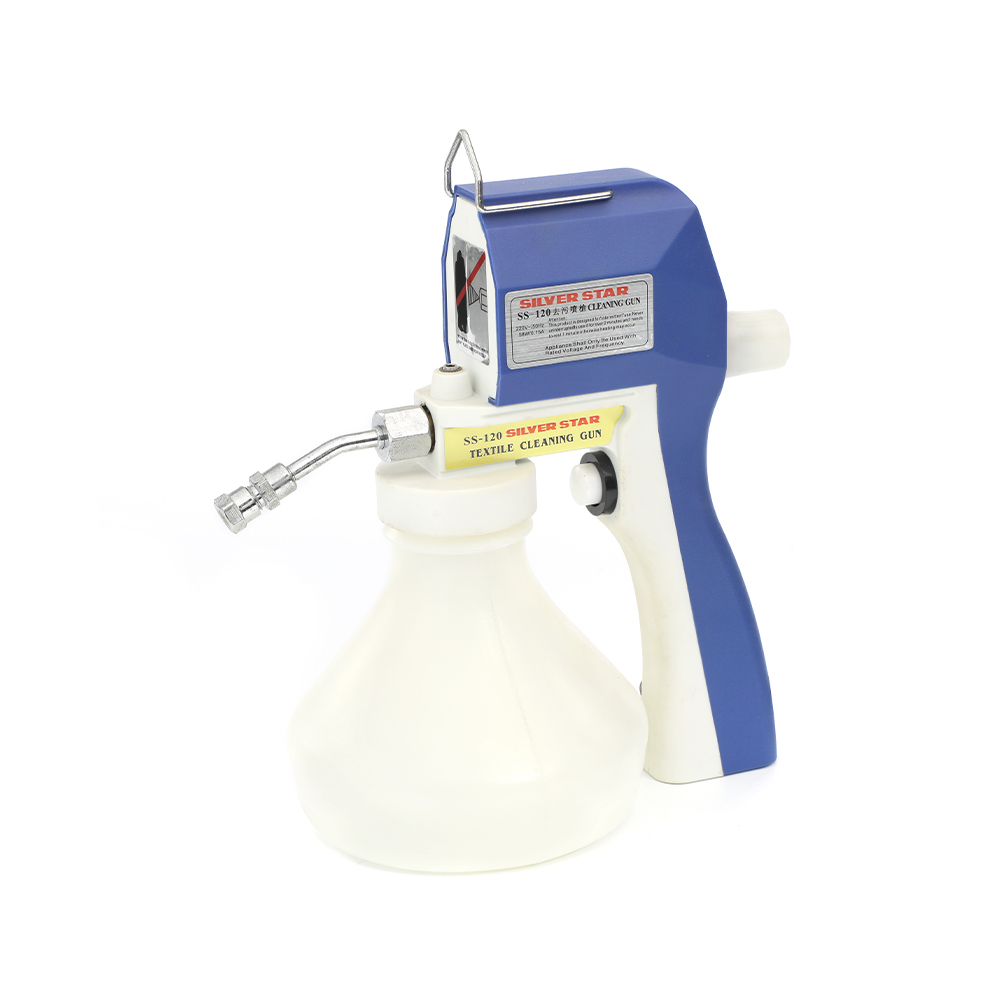
ST-120 Spray Gun
One of the most important advantages of the ST-120 is its lightweight construction. At approximately 1.0 kilogram, the spray gun can be carried and operated with less physical effort than heavier equipment. This is particularly valuable in garment and textile environments, where workers may perform repeated cleaning operations throughout a shift.
Excessive tool weight can cause discomfort in the hand, wrist, arm, and shoulder. Over time, fatigue may reduce accuracy and slow the pace of work. A lighter device makes it easier for the operator to maintain a stable position and direct the spray precisely. This can support more uniform treatment of stains and reduce the likelihood of accidental overspray.
Portability is another practical benefit. The ST-120 can be moved between production areas, inspection stations, finishing departments, and service locations without requiring special transport equipment. It can also be stored in a relatively small space, which is helpful for workshops that need to maintain an organized work environment.
The lightweight design does not eliminate the need for proper operating technique. Operators should still hold the tool securely, use suitable cleaning solutions, and follow workplace safety procedures. However, the reduced weight makes correct handling easier and more comfortable during ordinary operation.
The ST-120 includes an ergonomic structure intended to reduce strain during use. A comfortable grip can help users maintain control while applying cleaning fluid to a specific area. The shape of the handle and the overall balance of the tool contribute to a more natural operating posture.
Ergonomics are especially important when the spray gun is used for repeated spot-cleaning tasks. An operator may need to work on many garments, fabric panels, printed pieces, or advertising materials in succession. A tool that is easy to hold can help maintain consistent performance throughout the work period.
Comfort also has a quality benefit. When operators are less fatigued, they are more likely to control the spray carefully and inspect results accurately. This supports both productivity and finished-product appearance.
The ST-120 is engineered to provide strong cleaning capability in a compact format. Its spray action helps distribute cleaning fluid over the selected area, assisting in the removal of dirt, stains, and other unwanted residues. The operator can focus treatment where it is needed instead of applying fluid broadly across the entire product.
Targeted cleaning is valuable in the apparel industry, where fabrics may require spot treatment before pressing, packaging, or final inspection. It is also useful in textile processing, where localized marks can appear during knitting, dyeing, sewing, or handling. In printing and advertising, surfaces may require cleaning after production or before presentation to a customer.
Cleaning performance depends on several factors, including the type of contaminant, the material being treated, the selected cleaning solution, spray distance, spray intensity, and operator technique. The ST-120 provides a practical tool for managing these factors because its controls and nozzle options allow the user to adapt the application to the task.
A controlled spray pattern helps prevent excessive application of cleaning fluid. Over-saturation can create additional drying time, affect delicate materials, or spread a stain beyond its original location. By maintaining a stable spray pattern, the ST-120 assists users in applying fluid evenly and carefully.
The stable spray pattern is also valuable for repeatability. When the same type of cleaning task must be performed many times, consistent output allows operators to develop a reliable working method. This can improve process uniformity across different shifts and production batches.
Although the ST-120 is compact, its effectiveness is not limited to small household tasks. Its intended industrial applications demonstrate that a lightweight device can still deliver meaningful value when it is designed around practical production requirements.
Different cleaning tasks require different spray directions. Straight access may be suitable for an exposed surface, but a seam, corner, fold, recessed area, or difficult angle may require the spray to approach from another direction. The ST-120 addresses this need through optional angled nozzles.
Angled nozzles improve versatility by helping the operator reach areas that may otherwise be inconvenient to treat. In garment production, they may be useful around seams, collars, cuffs, pockets, or layered sections. In textile and printing applications, they can help direct cleaning fluid toward edges and recessed surfaces.
The availability of nozzle options also allows businesses to configure the equipment according to their specific work. A company focusing on apparel finishing may have different requirements from a printing workshop or advertising-material producer. Optional components make the spray gun more adaptable without requiring separate equipment for every application.
Hard-to-reach areas are often where dirt or residue remains after general cleaning. An angled nozzle can improve access while allowing the operator to maintain a comfortable wrist position. This reduces the need to twist the hand or reposition the entire workpiece unnecessarily.
Better access can improve both speed and precision. Instead of spending additional time trying to align a straight nozzle, the operator can use an appropriate angle to direct the spray more efficiently. This is a meaningful advantage in production environments where many pieces must be processed.
Optional nozzles also support more specialized work. When a business handles a wide range of products, flexibility can be more valuable than a single fixed configuration. The ST-120 provides a practical foundation that can be adapted to different cleaning requirements.
Consistency is a central requirement for professional cleaning equipment. A spray gun that produces irregular output can cause uneven treatment, oversaturation in some areas, or insufficient coverage in others. The ST-120 is designed to maintain a stable spray pattern, supporting more uniform application.
A stable spray pattern benefits the operator in several ways. First, it makes the tool easier to control. Second, it supports repeatable cleaning procedures. Third, it helps reduce the risk of wasting cleaning solution. Finally, it contributes to a more predictable finished appearance.
Stable performance is especially important when the spray gun is used alongside other finishing equipment. For example, a garment may be cleaned before pressing, folding, inspection, or packaging. Consistent spot treatment helps ensure that subsequent processes begin with a more uniform product condition.
Reliability also improves confidence. When operators can depend on the spray gun to perform steadily, they can concentrate on identifying stains, selecting an appropriate treatment method, and checking the result. They do not need to compensate constantly for unexpected changes in spray behavior.
Predictable performance can contribute to higher productivity even when the individual cleaning task is relatively small. Reducing repeated attempts, unnecessary adjustments, and uneven applications saves time across an entire production day.
For supervisors and production managers, consistent equipment performance can also simplify training. New operators can learn a repeatable process more easily when the tool responds in a stable manner. Experienced workers can maintain their preferred technique without continually adapting to equipment variation.
The result is a more organized cleaning workflow that supports quality control and efficient labor use.
The ST-120 features intuitive controls that allow users to adjust spray intensity according to the requirements of the task. Different fabrics, surfaces, and contaminants may require different levels of application. Adjustable control gives operators the ability to use a gentler setting for delicate work or a stronger application when more cleaning power is needed.
Simple controls are valuable in industrial environments because equipment must be understood quickly and used confidently. Complicated interfaces can slow down production and increase the possibility of incorrect operation. The ST-120 is designed with a practical operating approach that supports straightforward adjustment.
Control over spray intensity also helps reduce fluid waste. Applying only the amount required for a specific task can lower consumption and help keep the work area cleaner. It may also reduce drying time, depending on the material and cleaning solution used.
Operators should always test cleaning solutions and application settings on an inconspicuous area when working with unfamiliar materials. The spray gun provides control, but the correct setting must be selected according to the material, stain, and process requirements.
Maintenance is an important consideration when selecting production equipment. A tool that is difficult to clean may gradually lose performance, develop blockages, or become less reliable. The ST-120 is designed to allow straightforward maintenance and cleaning of the unit itself.
After use, operators can follow appropriate procedures to inspect the tank, nozzle, and fluid path. Removing residue promptly helps maintain smooth operation and reduces the possibility of buildup. The ability to disassemble and clean the relevant components makes routine care more manageable.
Easy maintenance offers several economic benefits. It can reduce downtime, extend the useful life of the equipment, and limit the need for avoidable repairs. In a busy production environment, the time saved through simple maintenance procedures can be significant.
Before maintenance, the spray gun should be disconnected from the power supply and handled according to applicable safety procedures. Any remaining liquid should be removed or managed appropriately. The tank and nozzle should be checked for residue, and the exterior should be wiped with a suitable cloth.
Users should avoid using incompatible chemicals or aggressive cleaning methods that may damage components. Cleaning solutions should be selected based on the material being treated and the equipment instructions supplied for the product. If the spray pattern changes unexpectedly, the nozzle and fluid path should be inspected.
Regular inspection can identify loose parts, wear, or contamination before these issues affect production. A simple maintenance schedule can therefore protect both equipment reliability and work quality.
The ST-120 offers several advantages when compared with basic manual application methods. A cloth or brush may be suitable for isolated tasks, but manual methods can produce uneven pressure and inconsistent distribution of cleaning fluid. The spray gun provides a more controlled approach that can be repeated across multiple products.
Compared with larger cleaning machines, the ST-120 provides greater portability and easier access to individual items or localized areas. Large systems may be appropriate for high-volume or fully automated operations, but they can be less convenient for spot cleaning, small-batch work, and flexible production environments.
Compared with low-quality general-purpose sprayers, the ST-120 is designed specifically with professional cleaning applications in mind. Its ergonomic structure, stable spray pattern, optional angled nozzles, and practical maintenance design reflect the requirements of textile, apparel, printing, and related industries.
The strongest competitive advantage is not simply one specification. It is the balance between performance, portability, adaptability, and usability. A product may have a high output but be too heavy for prolonged operation. Another may be inexpensive but lack stable performance or reliable construction. The ST-120 is positioned as a balanced solution for businesses that need dependable daily equipment without excessive complexity.
| Evaluation Area | ST-120 Advantage | Value to the User |
|---|---|---|
| Portability | Approximately 1.0kg | Easy movement between workstations and reduced fatigue |
| Application Flexibility | Optional angled nozzles | Improved access to corners, seams, and recessed areas |
| Cleaning Control | Adjustable spray intensity | Better adaptation to different materials and stains |
| Consistency | Stable spray pattern | More uniform treatment and repeatable results |
| Maintenance | Accessible cleaning and disassembly | Lower maintenance burden and reduced downtime |
| Application Range | Suitable for several industries | One tool can support diverse production requirements |
These advantages make the ST-120 a practical choice for companies that value flexible equipment and efficient workflows. It is not limited to a single type of textile or one specific cleaning process. Instead, it can support a range of professional tasks when used with suitable cleaning materials and proper operating techniques.
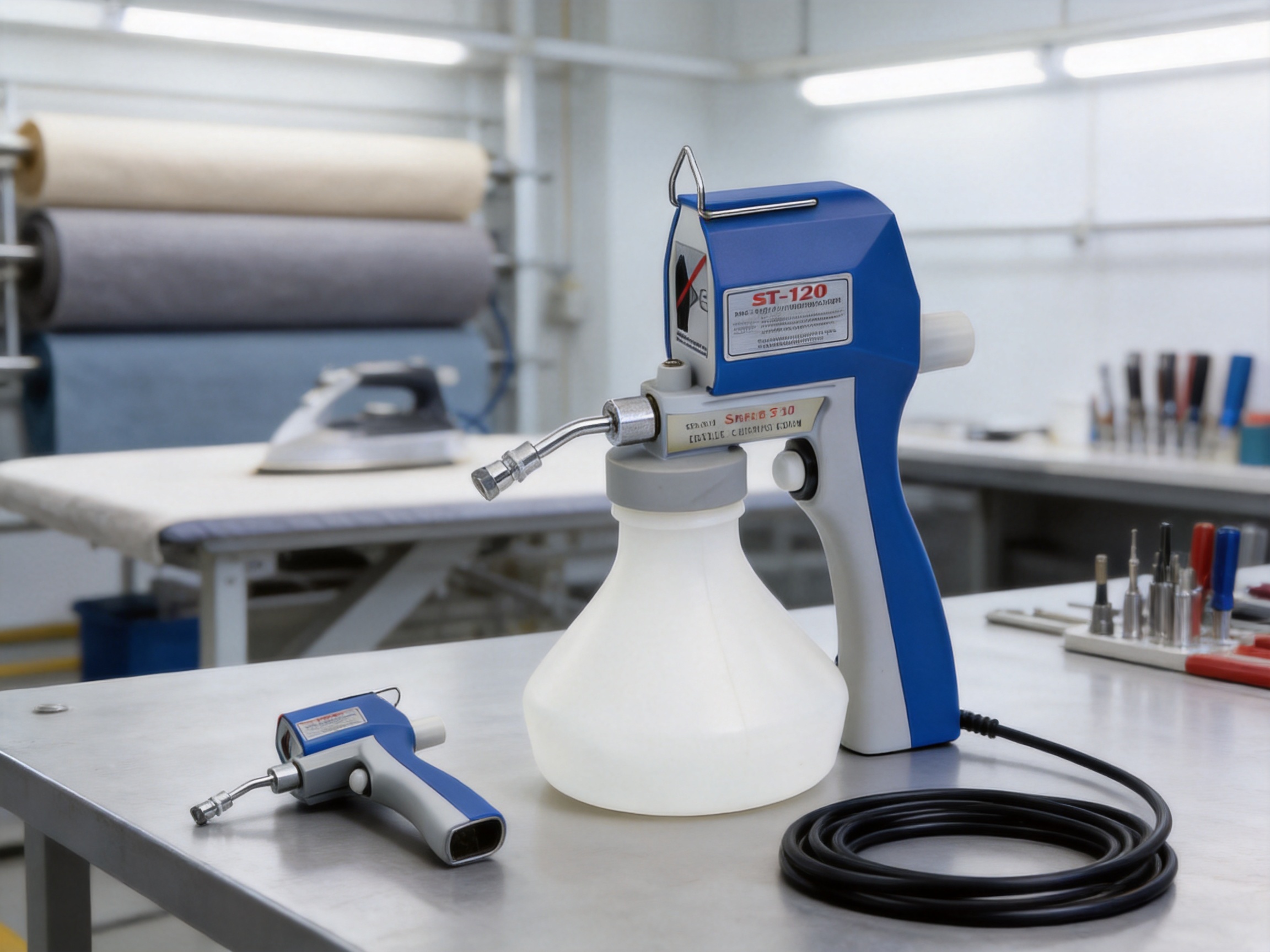
Garment production often involves multiple stages at which marks or residues may occur. Fabric may be affected during cutting, sewing, handling, pressing, labeling, or transportation. Before a garment reaches final inspection or packaging, small stains may need to be treated quickly.
The ST-120 can be used as a spot-cleaning tool in production and finishing departments. Its lightweight design makes it convenient for operators who work on individual garments or batches of clothing. The adjustable spray intensity allows the user to select a suitable application level based on the fabric and stain.
Angled nozzles may be useful for areas such as sleeves, collars, pockets, seams, and layered sections. These locations can be difficult to reach with a straight applicator, especially when the garment must remain in a particular position. The ST-120 enables more flexible access while supporting operator comfort.
In garment quality control, rapid cleaning can help prevent otherwise acceptable products from being delayed or rejected because of minor surface contamination. Of course, the suitability of any cleaning process should be confirmed for the specific fabric and dye. However, the spray gun provides an efficient tool for controlled treatment when the process is appropriate.
Knitting and dyeing operations require attention to material appearance and surface condition. Fibers, dust, dye marks, and handling residues may affect the visual quality of textile products. A portable spray gun can assist workers with localized cleaning during inspection and finishing.
In dyeing-related environments, careful control is important because different materials and colors may react differently to cleaning solutions. The ST-120 supports measured application, allowing the operator to focus on a defined area rather than applying fluid indiscriminately.
The product’s stable spray pattern is useful for repeat work. When an operator must treat similar textile materials repeatedly, consistent spray behavior can support a more uniform procedure. Its portability also enables use near inspection tables, finishing lines, or other designated work areas.
Because textile materials vary considerably, users should establish suitable operating procedures for each fabric type. These procedures may include testing, controlling spray distance, selecting an appropriate solution, and allowing sufficient drying time.
Advertising and printing businesses work with a wide range of materials, including printed fabric, display surfaces, paper-based products, boards, and other presentation materials. Dust, ink residue, adhesive traces, or handling marks may reduce the visual impact of a finished product.
The ST-120 can help users address localized contamination before delivery, installation, or display. Its compact size makes it suitable for workshops where materials may vary in size and shape. The operator can move around a workpiece and direct the spray toward the affected area.
Optional angled nozzles can be especially useful when cleaning the edges or recessed portions of display items. A stable spray pattern helps minimize uneven application, which is important when appearance is a primary quality criterion.
Printing and advertising materials may be sensitive to moisture, solvents, or friction. Operators should therefore verify compatibility before cleaning and use the lowest effective spray intensity. The equipment provides the means for controlled application, while process knowledge determines the correct cleaning method.
The ST-120 is produced by Jinyun Shengda Sewing Equipment Co., Ltd., a Chinese manufacturer established in 2003. The company is located in Huzhen Town, Lishui City, Zhejiang Province, an area positioned near Lishui, Jinhua, and Taizhou. This location provides access to transportation networks, industrial resources, and information channels that support manufacturing and distribution.
The company specializes in the independent research, development, and production of ironing and garment equipment. Its product range includes electric irons, steam irons, hanging irons, spray guns, small steam machines, heat transfer machines, steam boilers, vacuum tables, and related accessories.
This broad product scope is an important manufacturing strength. A company that develops multiple types of garment and textile equipment can gain practical insight into the needs of production lines, finishing departments, repair workshops, distributors, and end users. Knowledge gained from one equipment category can support improvements in another.
For a spray gun manufacturer, experience with steam equipment, ironing systems, vacuum tables, and heat transfer machines can contribute to a better understanding of fabric handling, garment finishing, operator ergonomics, heat and moisture management, and production workflow integration.
The company emphasizes independent research and development. This approach allows product improvements to be guided by actual market requirements rather than relying only on standard designs. Product structure, usability, material selection, and performance can be evaluated and refined through internal development activities.
Independent development also supports customization and OEM services. Different markets may require changes in electrical specifications, packaging, accessories, labeling, or operating configurations. A manufacturer with its own research and production capabilities is better positioned to coordinate these requirements.
For customers, this can provide a more direct communication process. Instead of working through multiple unrelated suppliers, buyers can discuss product requirements with a manufacturer familiar with the equipment’s design and production details.
The company’s research and development, management, and sales teams work together to provide equipment and professional service. Cooperation across these functions can improve communication between customer feedback and product improvement.
Sales teams can communicate market demand and user concerns to development and production personnel. Manufacturing teams can provide accurate technical information for sales support. Management can coordinate quality, delivery, and service requirements. This integrated structure helps create a more consistent customer experience.
Reliable equipment depends on more than appearance. Electrical safety, structural strength, component consistency, assembly accuracy, and functional testing all contribute to long-term performance. The company states that it follows national and industry standards, including GB4706.1-2005 and GB4706.2-2007.
The company’s products have also passed CCC and CQC certifications. These certifications provide evidence that applicable products have been evaluated within recognized Chinese conformity and quality systems. Buyers should confirm the specific certification status and documentation applicable to the exact model, configuration, and destination market.
Standards awareness is important for professional buyers because equipment is often used in environments where electrical safety and operational reliability are essential. A manufacturer that pays attention to relevant standards demonstrates a more systematic approach to product development and production.
Quality management should cover the entire process, from incoming materials and component inspection to assembly, testing, packaging, and shipment. Consistency at each stage helps ensure that the finished product performs as expected in actual use.
A durable spray gun requires appropriate materials for its body, tank, nozzle, handle, electrical components, and internal fluid path. Components should be selected according to their intended operating conditions and compatibility with approved cleaning solutions.
Assembly quality is equally important. Correct alignment, secure connections, proper electrical installation, and accurate fitting of functional components can influence spray stability and product service life. Careful assembly also contributes to user safety and easier maintenance.
While no equipment should be considered maintenance-free, robust construction and proper assembly can reduce the likelihood of frequent failures. This supports a lower total cost of ownership over the working life of the product.
The company has established distribution channels in China and has received positive feedback from overseas customers. Its products are exported to Southeast Asia, Central Asia, South America, Africa, and other regions.
International experience can strengthen a manufacturer’s ability to manage different customer expectations, packaging requirements, electrical environments, documentation needs, and shipping arrangements. It also exposes the company to diverse operating conditions and application practices.
The company identifies customization, OEM services, reliable quality, diverse products, competitive costs, professional service, and convenient shipment as key advantages. These strengths are relevant to importers, distributors, wholesalers, and industrial users seeking a long-term equipment supplier.
For overseas buyers, supplier capability should be evaluated not only by the product itself but also by communication, order coordination, spare-part support, packaging, lead time, documentation, and after-sales service. A manufacturer with a broad product portfolio may be able to consolidate purchases and simplify supply-chain management.
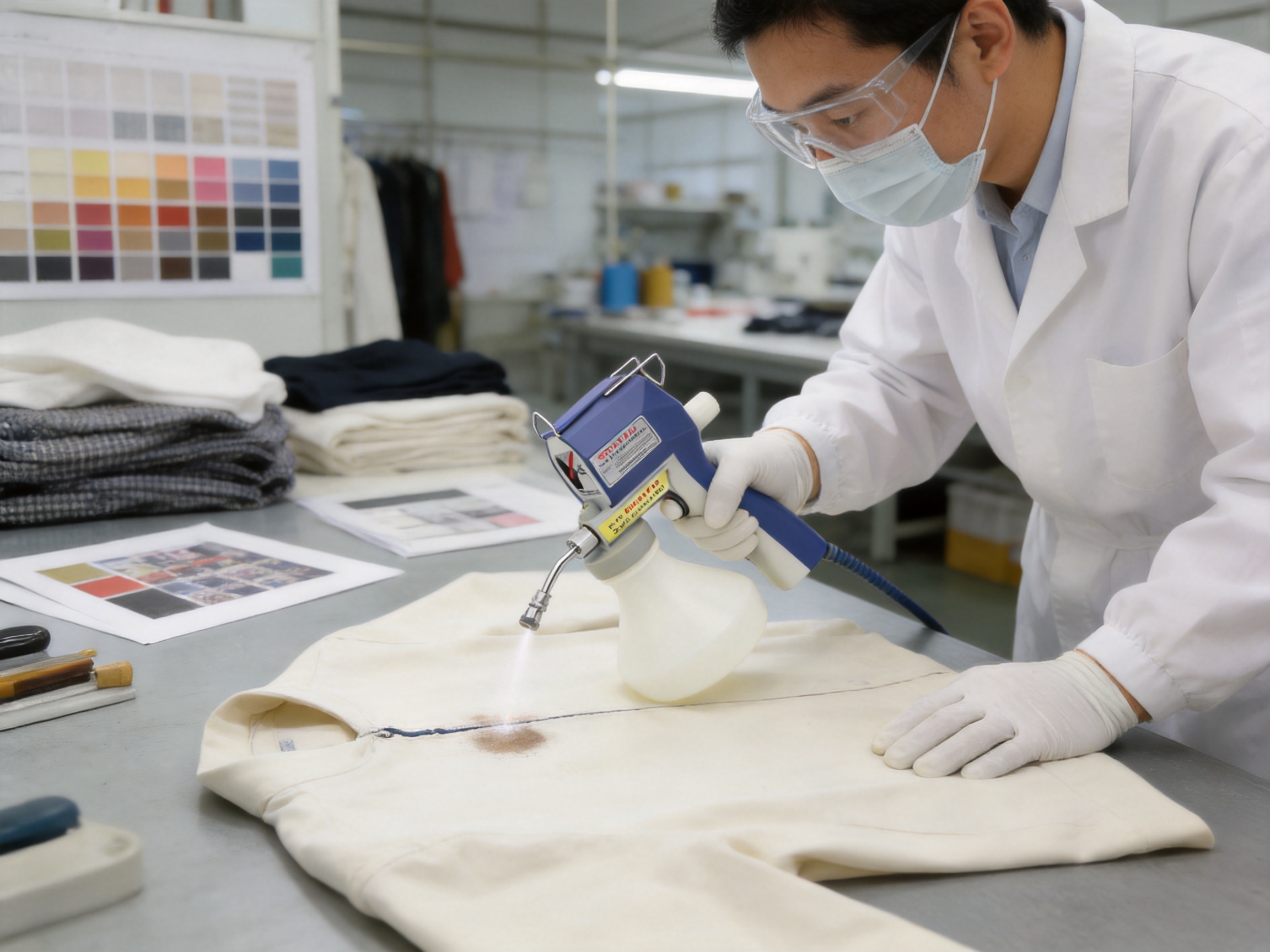
Different customers may need different versions of the same equipment. Requirements may involve voltage, frequency, plug type, packaging, logo placement, product labeling, color, accessories, or documentation. The company’s OEM and customization capabilities can support such business arrangements, subject to technical and order requirements.
Customization is particularly valuable for distributors that want to develop a consistent product range. A distributor may require coordinated packaging across several categories, including irons, spray guns, steam boilers, vacuum tables, and accessories. Working with a manufacturer that produces multiple categories can make this coordination more efficient.
OEM cooperation also allows customers to align equipment with regional market expectations. However, customization should always preserve essential safety and performance requirements. Any changes to electrical components, fluid-contact materials, or operating configuration should be reviewed carefully.
Before using the ST-120, operators should read the product documentation and confirm that the electrical supply matches the rated requirement of 220V and 50Hz. The work area should be clean, dry, adequately ventilated, and organized to prevent accidental contact with electrical components or moving personnel.
The tank should be filled only with a suitable cleaning solution and should not be overfilled. The operator should check that the nozzle is installed correctly and that the spray path is unobstructed. Electrical connections should be secure, and the tool should not be used if the power cord, plug, tank, or housing shows signs of damage.
During operation, users should direct the spray away from the body and other people. Protective equipment should be selected according to the cleaning solution being used. Adequate ventilation is important when products may generate vapors or aerosols.
After use, the spray gun should be switched off and disconnected before maintenance or cleaning. Remaining fluid should be handled according to the solution supplier’s recommendations and local environmental procedures.
These precautions are not unique to the ST-120; they are standard principles for responsible use of electrically powered cleaning equipment. Correct operation protects the user, the product, and the work environment.
Small workshops can benefit from the ST-120 because it does not require a large installation area. Its portable structure allows one tool to support several workstations or product types. The reasonable tank capacity and simple controls make it suitable for businesses that need flexible equipment without a complex system.
Medium-sized manufacturers may use the spray gun as part of a quality-control or finishing process. Multiple units can be assigned to different departments, or one unit can be shared according to production schedules. The stable spray pattern and easy maintenance support a standardized working method.
Larger factories and distributors may value the product as one component in a broader equipment portfolio. Because the manufacturer also supplies steam equipment, irons, boilers, vacuum tables, heat transfer machines, and accessories, buyers may be able to source complementary products from the same supplier.
The correct purchasing quantity depends on production volume, workstation layout, cleaning frequency, and the number of operators. Buyers should also consider spare accessories, maintenance materials, and training requirements when planning procurement.
Purchase price is only one part of equipment value. A lower-priced product may become expensive if it causes frequent downtime, consumes excessive cleaning fluid, requires difficult maintenance, or must be replaced quickly. Conversely, a product with a practical design and reliable operation may provide better value throughout its service life.
The ST-120 supports cost efficiency through several characteristics. Its lightweight structure can reduce operator fatigue and help maintain productivity. Its targeted spray application may reduce unnecessary fluid use. Its stable performance can limit repeated treatment. Its accessible maintenance design can reduce avoidable service interruptions.
Durability is another important factor. The spray gun is built from quality materials and intended for regular use in demanding work environments. A durable tool can reduce the frequency of replacement and contribute to more predictable operating costs.
Businesses should evaluate the product according to their own cleaning volume and working conditions. The best choice is the one that delivers the required performance while fitting the company’s production process, maintenance capability, and budget.
The ST-120 competes effectively by delivering a well-rounded set of advantages rather than relying on a single feature. Its 1.0-kilogram weight supports portability. Its 40W power rating provides a practical operating foundation. Its 0.65-liter tank balances capacity and manageability. Its optional angled nozzles increase application flexibility. Its ergonomic structure supports user comfort, while its stable spray pattern contributes to repeatable results.
Many professional users do not need the largest or most complicated cleaning machine. They need a tool that can be picked up quickly, operated comfortably, cleaned easily, and relied upon throughout daily production. The ST-120 is aligned with these practical requirements.
Its suitability for multiple industries also gives it a competitive advantage. A garment factory, textile workshop, printing business, advertising producer, or dyeing-related operation can adapt the product to its own cleaning workflow. This broad application range can improve equipment utilization and reduce the need to purchase several specialized tools.
The manufacturer’s experience in garment and textile equipment further strengthens the product’s position. A supplier that understands ironing, steaming, vacuum finishing, heat transfer, and related processes can better recognize the operational needs surrounding a spray gun.
The ST-120 is mainly used for targeted cleaning in industries such as knitting, dyeing, apparel, advertising, and printing. It can help remove dirt, stains, and other residues from suitable fabrics or surfaces when used with an appropriate cleaning solution.
The product is rated at 220V, 40W, and 50Hz. Users should confirm that their electrical supply and plug configuration are compatible before operation.
The spray gun weighs approximately 1.0 kilogram. This lightweight design improves portability and helps reduce fatigue during repeated or extended use.
The tank capacity is 0.65 liters. This provides practical fluid capacity for routine professional cleaning while helping keep the tool compact and manageable.
The ST-120 is available with optional angled nozzles. These nozzles help users direct the spray toward corners, seams, recessed areas, and other difficult-to-reach locations.
The product includes user-friendly controls that allow adjustment of spray intensity. The operator can select a suitable level according to the material, stain, cleaning solution, and required result.
Typical applications include knitting, dyeing, garment production, apparel finishing, advertising production, and printing. It may also be used in other professional cleaning tasks where controlled spray application is appropriate.
Its lightweight body and ergonomic design are intended to improve comfort during extended operation. Operators should still use proper posture, take appropriate breaks, and follow workplace safety procedures.
The tank, nozzle, and relevant fluid pathways should be cleaned after use according to the operating instructions. The unit should be disconnected from power before maintenance, and users should inspect it regularly for residue, damage, or loose components.
Users should not assume that every chemical is compatible with the spray gun or the material being treated. Cleaning solutions should be selected according to the equipment instructions, supplier recommendations, and the surface or fabric requirements. A small test area is recommended for unfamiliar materials.
The ST-120 combines electrical operation, stable spray performance, adjustable intensity, ergonomic handling, optional angled nozzles, and professional application suitability. These features provide greater control and repeatability than many basic manual methods.
The manufacturer identifies OEM and customization as part of its service capabilities. Specific requirements, such as packaging, labeling, electrical configuration, accessories, or branding, should be discussed and confirmed before placing an order.
The company produces electric irons, steam irons, hanging irons, spray guns, small steam machines, heat transfer machines, steam boilers, vacuum tables, and related accessories. This broad range supports customers seeking complementary garment and textile equipment.
Jinyun Shengda Sewing Equipment Co., Ltd. is located at No. 8 Nanyi Road, Huzhen Industrial Park, Zhejiang, China. The company was established in 2003 and serves domestic and international markets.
Buyers should confirm voltage, frequency, plug requirements, nozzle configuration, packaging, delivery schedule, applicable certifications, warranty terms, spare parts, cleaning-solution compatibility, and after-sales support. They should also clarify any OEM or customization requirements in writing.
The ST-120 Spray Gun is a practical professional cleaning tool designed for industries where targeted treatment, portability, and consistent operation are important. Its lightweight 1.0-kilogram construction helps reduce operator fatigue, while the ergonomic structure supports comfortable handling during repeated work.
With a 220V power supply, 40W motor, 50Hz frequency, and 0.65-liter tank, the product offers a balanced configuration for routine industrial and commercial applications. Its strong cleaning capability, stable spray pattern, adjustable controls, optional angled nozzles, and straightforward maintenance make it adaptable to different production environments.
Compared with less specialized cleaning methods, the ST-120 provides better control, more flexible access, and greater repeatability. Its suitability for knitting, dyeing, apparel, advertising, and printing allows businesses to use one compact tool across multiple tasks.
The manufacturer strengthens the product’s value through experience in independent research and development, a broad garment-equipment portfolio, quality and standards awareness, OEM capability, export experience, and professional service. These strengths support buyers who are looking not only for a product but also for a dependable long-term equipment partner.
For companies seeking an efficient, portable, and versatile spray gun for professional cleaning applications, the ST-120 offers a strong combination of functional performance, user comfort, maintainability, and manufacturing support.
1. Product specification sheet for the ST-120 Spray Gun, including voltage, power, frequency, weight, tank capacity, nozzle options, and application information.
2. Manufacturer company profile for Jinyun Shengda Sewing Equipment Co., Ltd., including company history, product categories, research and development activities, export markets, and service capabilities.
3. General principles of ergonomic equipment design for repetitive industrial operations and handheld tool use.
4. General guidance for maintenance and safe operation of electrically powered spray and cleaning equipment.
5. GB4706.1-2005, General Safety Requirements for Household and Similar Electrical Appliances.
6. GB4706.2-2007, Applicable Safety Requirements for Electrical Appliances Used for Heating and Similar Purposes.
7. General quality-control principles for textile, garment, printing, advertising, and finishing equipment.
 +86-578-3158872 / +86-578-3158958
 jyshengda@163.com / caroying@jy-shengda.com
 No. 8 Nanyi Rd, Huzhen Industrial Park, Zhejiang, China
Copyright © Jinyun Shengda Sewing Equipment Co., Ltd. All Rights Reserved.
Ironing Press Machine Equipment Factory
 English
 中文简体
 русский
 عربى