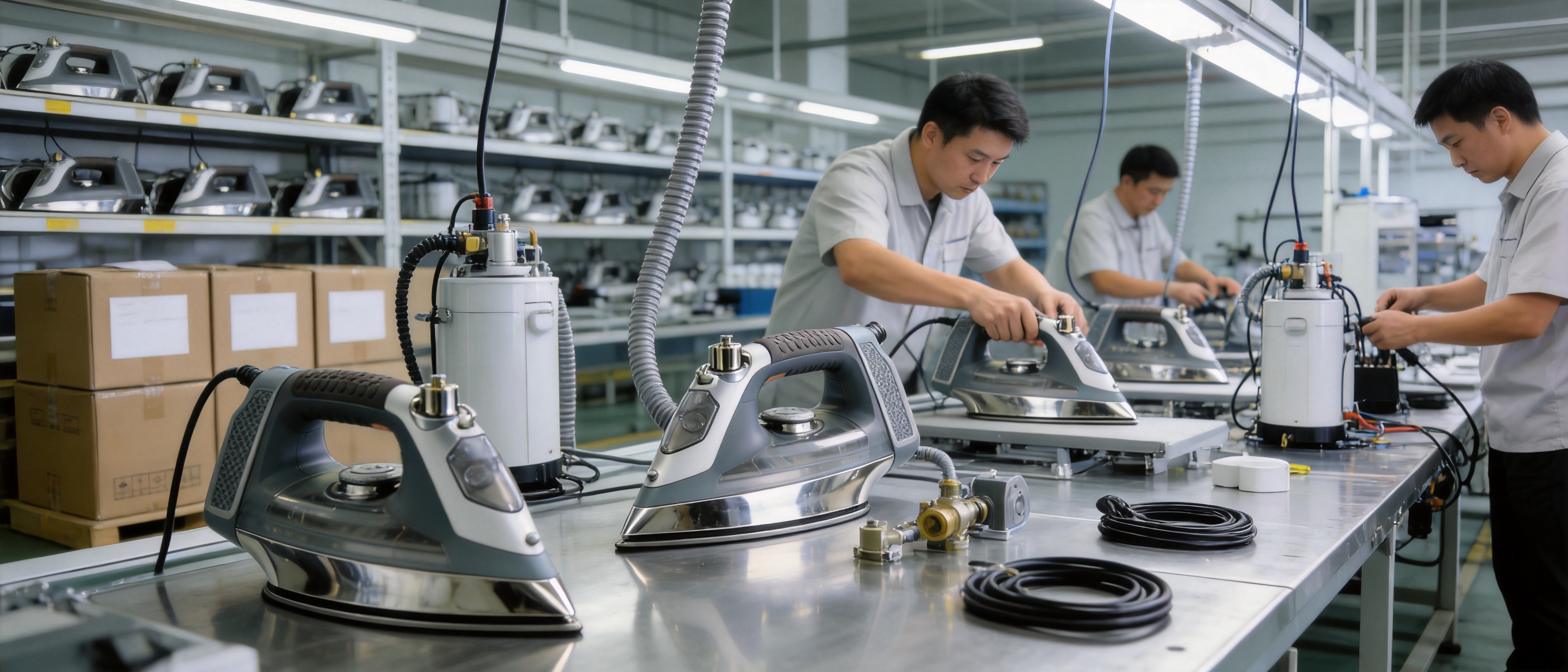
In professional garment care, the quality of an iron directly influences productivity, finish quality, fabric safety, and operator comfort. A dependable all steam iron must do more than produce heat. It must deliver controlled steam, glide smoothly across different textiles, remain comfortable during repeated use, and withstand the demanding conditions of a commercial workplace. The ST-3PC (BS-3PC) All Steam Iron is designed around these practical requirements, combining a full stainless steel soleplate, an ergonomic handle, a durable steam valve, an adjustable steam system, and a protective outer cover.
This combination makes the iron suitable for a broad range of applications, including garment factories, tailoring workshops, laundry facilities, hotels, uniform departments, clothing retailers, alteration shops, and demanding home users. Instead of focusing on a single fabric type or a limited ironing task, the product is built as a versatile steam tool for everyday wrinkle removal and finishing work.
The iron is manufactured by Jinyun Shengda Sewing Equipment Co., Ltd., a Chinese producer specializing in ironing equipment and related machinery. The company develops and produces electric irons, steam irons, hanging irons, spray guns, small steam machines, heat transfer machines, steam boilers, vacuum tables, and accessories. Its wider product portfolio gives the ST-3PC a useful position within a complete garment-finishing system rather than as an isolated appliance.
For buyers comparing professional ironing equipment, the most important question is not simply whether an iron becomes hot. The more meaningful questions are whether it can maintain consistent performance, whether its construction supports long service, whether its controls are easy to use, and whether the manufacturer can provide dependable production and service support. The ST-3PC is designed to answer these requirements through practical construction and a focus on maintainability.
An all steam iron is designed to use steam as a central part of the ironing process. Heat relaxes fabric fibers, while moisture helps soften creases and allows the soleplate to pass more effectively over the material. This combination is particularly useful when garments have deep wrinkles, layered sections, shaped areas, seams, collars, cuffs, pleats, or heavier textiles that are difficult to finish with dry heat alone.
In a professional environment, steam also supports a more consistent finishing process. Operators can apply the amount of moisture required for a particular material, then use the heated soleplate to smooth the surface. When steam output is adjustable, the user has greater control over delicate fabrics and can apply stronger steam to thicker textiles when necessary.
The ST-3PC is intended for this flexible working method. Its adjustable steam flow allows the operator to adapt the ironing process to different fabrics and garment structures. Delicate materials may require lower or more carefully controlled steam output, while curtains, upholstery, workwear, and other heavier textiles may benefit from a stronger flow. This adaptability reduces the need to use separate irons for different applications.
The term “all steam” also reflects the product’s suitability for continuous steam-related work rather than occasional household touch-ups alone. In a workshop or laundry setting, the iron may be handled repeatedly throughout the day. Therefore, the durability of the steam valve, comfort of the handle, and smoothness of the soleplate become important contributors to overall productivity.
The ST-3PC uses a full stainless steel soleplate. This is one of the most important construction features because the soleplate is the part of the iron that comes into direct contact with fabric. Stainless steel is valued for its strength, corrosion resistance, and ability to provide a smooth working surface when properly manufactured and maintained.
A stainless steel soleplate can support smooth movement across many fabric types. Reduced friction helps the operator move the iron with less effort, which is especially valuable during long working sessions. A smooth glide also makes it easier to follow garment contours and finish details such as lapels, sleeve edges, collars, and pleats.
Another benefit is the potential for even heat distribution across the ironing surface. Consistent heat helps reduce the risk of localized cold or excessively hot areas. For professional users, uniform heating is important because uneven performance can lead to repeated passes, inconsistent results, or unnecessary concern when working with sensitive fabrics.
Compared with lower-grade soleplate materials, a full stainless steel surface offers a strong balance between durability and working performance. It is less vulnerable to ordinary wear than many softer surfaces, and it can maintain a professional appearance when cleaned correctly. This makes it suitable for environments where the iron is used frequently and expected to remain reliable over time.
The outer cover of the ST-3PC contributes both to appearance and protection. It shields internal components from dust, incidental contact, and general wear associated with handling and storage. In a busy production environment, equipment may be moved between workstations or placed near fabric fibers, packaging materials, and other sources of debris. A well-designed cover helps protect the internal structure under these conditions.
The cover also gives the iron a streamlined and professional appearance. While appearance is not a substitute for performance, a clean and orderly workstation can support better organization and reinforce the professional image of a tailoring shop, laundry service, clothing factory, or hotel operation.
From a maintenance perspective, the cover is part of the product’s protective strategy. Internal components that are better shielded may be less exposed to dust accumulation and accidental impact. This does not eliminate the need for routine cleaning or inspection, but it can support longer-lasting operation when combined with correct use and regular care.
Operators often underestimate the importance of the handle until they work with an iron for several hours. Repetitive gripping, lifting, pressing, and directional movement can create strain in the hand, wrist, and forearm. The ST-3PC addresses this concern through a specially designed handle intended to provide a secure and comfortable grip.
The handle is shaped for control and maneuverability. A stable grip allows users to guide the soleplate accurately around difficult areas, including collars, cuffs, pleats, buttons, pockets, and curved garment sections. A comfortable handle can also reduce the force required to maintain control, helping the operator work more efficiently.
The handle material is selected to provide a soft yet secure contact surface. Its non-slip characteristics support steadier operation, particularly when the user is moving quickly between garments or working with steam. Better grip control is also helpful when applying different levels of pressure to fabrics with different thicknesses.
Ergonomics are a competitive advantage because they influence the total cost of ownership in ways that are not always visible in a product photograph. A comfortable tool may help reduce operator fatigue, support more consistent finishing, and improve the experience of workers who use the equipment daily. For commercial buyers, these practical benefits can be as important as the initial purchase price.
The steam valve is a critical internal component. It controls the release of steam and directly affects the consistency of the ironing process. If a valve performs poorly, the iron may deliver irregular steam, require additional passes, or become more difficult to control. The ST-3PC uses a durable steam valve designed for long-term use and consistent steam production.
Reliable valve performance supports efficient wrinkle removal. When steam is delivered in a stable and controllable manner, the operator can work with greater confidence and adjust the process according to the fabric. This is especially important in professional settings where different garments may be processed consecutively.
A durable valve can also reduce maintenance demands. No mechanical component is maintenance-free, and the working life of any steam system depends on water quality, operating conditions, cleaning, and correct handling. However, a valve designed with long-term use in mind provides a stronger foundation for dependable service than a component intended only for light or occasional operation.
Different fabrics respond differently to heat and moisture. A lightweight or delicate textile may require controlled steam, while a thick fabric may need a more substantial flow to relax its fibers. The ST-3PC includes a back pressure valve and adjustable steam settings that allow users to regulate the output.
This feature improves versatility. Instead of applying the same steam intensity to every garment, the operator can adapt the iron to the material and the specific crease. This helps prevent unnecessary saturation and gives the user a more precise working method.
Adjustable steam is also useful when working with household and commercial textiles beyond standard garments. Curtains, upholstery, uniforms, workwear, linens, and other thick materials may require a different approach from shirts, dresses, or lightweight fashion fabrics. One adjustable iron can therefore support a wider range of tasks.
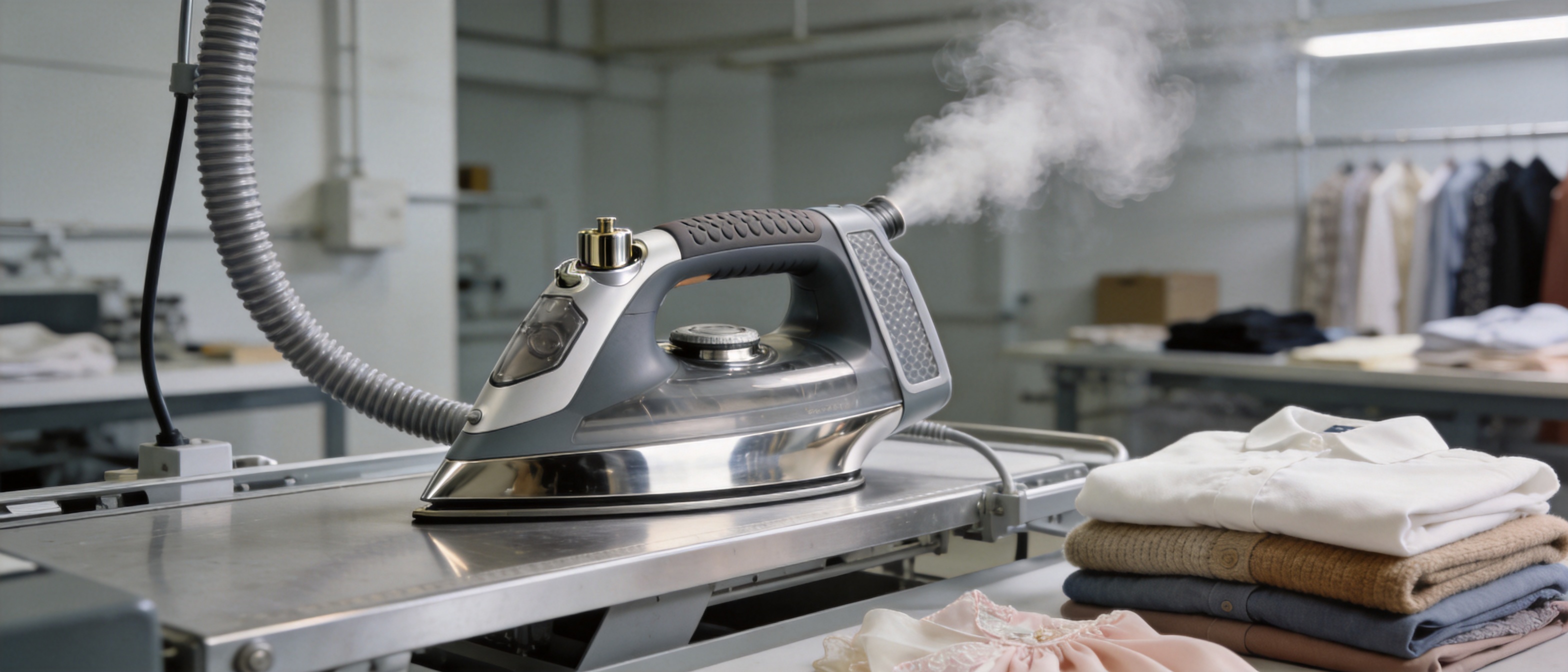
Many basic irons are designed primarily for occasional use. They may provide heat but offer limited control over steam, less durable working surfaces, or handles that become uncomfortable during extended operation. For users who iron only a few items per week, these compromises may seem acceptable. For professional users, they can create inefficiencies that accumulate throughout the working day.
The ST-3PC is differentiated by the relationship between its features. Its stainless steel soleplate supports smooth movement, its handle supports control, its valve supports steam consistency, and its adjustable output supports fabric versatility. These elements work together rather than functioning as unrelated specifications.
A second advantage is the emphasis on practical durability. The product is not presented as a disposable consumer tool. Its protective cover, stainless steel contact surface, durable valve, and professional-oriented design make it more appropriate for users who expect repeated operation and long-term equipment value.
A third advantage is flexibility. Some ironing systems are optimized for a narrow task, such as light household garments or a particular industrial finishing operation. The ST-3PC can be used across many fabric categories and work environments. This may help businesses reduce the number of different irons required for routine operations.
A fourth advantage is operator usability. An iron that is technically powerful but difficult to hold can reduce productivity. The ergonomic handle and adjustable steam control are intended to make the product easier to operate with precision. When several employees use the same equipment, straightforward handling can also help create a more consistent workflow.
These advantages should be considered alongside the buyer’s specific requirements. The correct steam supply, electrical configuration, water quality, work surface, ventilation, and safety procedures should always be confirmed before installation. Product performance depends not only on the iron itself but also on the surrounding equipment and operating practices.
Garment factories often need reliable finishing tools for sample development, quality inspection, pressing after sewing, and final presentation. The ST-3PC can support these stages by helping operators remove creases, shape garments, and improve the appearance of finished products.
In a production environment, the ability to adjust steam is particularly useful. Different styles may involve cotton, blended fabrics, synthetic materials, wool-like textiles, linings, and layered construction. Operators can select an appropriate steam level instead of relying on one fixed output for every product.
The stainless steel soleplate is also useful for repeated movement across seams and panels. A smooth soleplate can help the operator complete finishing work with fewer interruptions, provided that it is kept clean and used according to the fabric manufacturer’s recommendations.
Tailors and alteration specialists often work on individual garments that require precision. A collar may need reshaping, a sleeve may need careful pressing, or a hem may need to be flattened without leaving unwanted marks. The ST-3PC’s controlled steam and comfortable handle support this type of detailed work.
In an alteration shop, the iron may be used on garments made from many different materials. The adjustable steam feature gives the operator more flexibility when moving from a delicate dress to a heavier jacket or from a lightweight blouse to structured workwear.
Laundry facilities and hotel uniform departments require equipment that can handle frequent use. The ST-3PC’s durable valve and stainless steel soleplate are relevant to these conditions because both components support repeated ironing and finishing operations.
For hotel operations, presentation is important. Staff uniforms, table linens, guest garments, curtains, and other textiles may need to look clean and well finished. The ability to control steam makes the iron suitable for a range of textile categories, while the protective cover contributes to a professional equipment appearance.
Although the product is suitable for commercial environments, experienced home users may also appreciate its professional construction. Individuals who sew, operate small clothing businesses, restore vintage garments, or care for large quantities of clothing may need more capability than a conventional household iron provides.
Home users should assess available steam connections, electrical requirements, workspace, and safety conditions before choosing professional-style equipment. When those conditions are appropriate, the ST-3PC can provide a more durable and adaptable solution for demanding domestic applications.
The quality of an ironing tool depends on more than the final assembly stage. It is influenced by product design, material selection, component compatibility, quality inspection, process control, and after-sales support. Jinyun Shengda Sewing Equipment Co., Ltd. has built its business around the independent research, development, and production of ironing equipment and related machinery.
The company was established in 2003 and is located in Huzhen Town, Lishui City, Zhejiang Province, China. Its location is positioned near the junction of Lishui, Jinhua, and Taizhou, providing access to transportation routes, industrial resources, and information channels. These conditions can support purchasing, production coordination, shipment, and communication with domestic and overseas customers.
Its product range includes electric irons, steam irons, hanging irons, spray guns, small steam machines, heat transfer machines, steam boilers, vacuum tables, and accessories. This broad specialization is significant because many of these products are used within the same garment-finishing workflow. Experience with boilers, vacuum tables, and steam-related accessories can help the manufacturer understand how an iron operates as part of a wider system.
The company’s research and development, management, and sales teams work together to improve products and respond to customer requirements. This type of internal coordination is important for manufacturers serving different markets because customers may require variations in electrical configuration, packaging, accessories, labeling, or application support.
Independent research and development allows a manufacturer to improve product structures based on practical use rather than relying only on standardized or generic designs. For the ST-3PC, the stated product advantages show attention to the outer cover, soleplate, handle, steam valve, and steam adjustment system.
These areas reflect the main contact points between the operator, the garment, and the steam supply. Improving them can influence usability, durability, maintenance, and finishing results. Product development that considers these relationships is more valuable than simply adding features without addressing daily operating needs.
Research and development also supports customization and OEM services. Buyers with established distribution networks may need specific branding, packaging, market documentation, or configuration requirements. A manufacturer with product development capabilities is generally better positioned to discuss such needs than a company focused only on trading standard products.
The company states that it follows national and industry standards, including GB4706.1-2005 and GB4706.2-2007. It also states that its products have passed CCC and CQC certifications. These standards and certifications provide an important framework for electrical safety and product conformity.
Certification does not replace correct installation, safe operation, or routine inspection. However, it gives buyers a reference point when evaluating the manufacturer’s quality system and market readiness. Importers and commercial users should still confirm the certification status of the exact model, the applicable electrical version, and the documentation required in their destination market.
Professional ironing equipment requires careful control of several production stages. Metal parts must be shaped and finished accurately. The soleplate must provide a consistent working surface. Handles and covers must fit securely. Steam valves and related components must be assembled in a way that supports reliable operation. Electrical parts must be checked for safety and compatibility.
Quality control is therefore not limited to visual inspection. It may include dimensional checks, assembly verification, electrical safety testing, steam-path inspection, functional testing, and packaging review. A systematic approach helps identify problems before products are shipped to customers.
For buyers, it is reasonable to request information about inspection procedures, test records, spare parts, operating instructions, warranty terms, and shipment protection. These questions help confirm that the product is supported as a complete commercial tool rather than sold as an unsupported component.
| Item | Information |
|---|---|
| Product | ST-3PC (BS-3PC) All Steam Iron |
| Product category | All Steam Iron |
| Primary working surface | Full stainless steel soleplate |
| Steam control | Adjustable steam flow with back pressure valve |
| Handle design | Ergonomically designed handle with a secure, comfortable grip |
| Steam valve | Durable valve intended for consistent long-term steam production |
| Outer construction | Protective and functional cover |
| Typical applications | Garment factories, tailoring shops, laundries, hotels, clothing retailers, upholstery work, and demanding home use |
| Manufacturer specialization | Irons, steam equipment, boilers, vacuum tables, heat transfer machines, spray guns, and accessories |
| Service capabilities | Product development, customization, OEM support, shipment coordination, and professional service |
Productivity in ironing is determined by more than the number of garments processed per hour. It also includes the quality of the finish, the number of repeated passes, the ease of correcting mistakes, and the comfort of the operator. The ST-3PC addresses these factors through a balanced set of features.
A smooth stainless steel soleplate can help the operator move across a garment efficiently. When the soleplate glides well, less effort may be required to cover large areas. The operator can also transition more easily between flat sections and shaped details.
Adjustable steam helps reduce unnecessary rework. If the steam output is appropriate for the material, wrinkles may be released more effectively. Excess moisture can be avoided on fabrics that do not require it, while thicker materials can receive the additional steam needed for effective relaxation.
The ergonomic handle supports repeated movement. Reduced discomfort can help operators maintain a consistent rhythm, particularly during long shifts. Better control may also contribute to more precise results around seams, edges, and shaped garment areas.
The durable steam valve supports continuity. In a busy setting, interruptions caused by unstable steam output can affect production schedules. A valve designed for long-term use is therefore an important part of the product’s productivity value.
Even durable equipment requires proper care. Users should follow the operating instructions supplied with the product and ensure that the iron is connected to a compatible steam source and electrical supply. The working area should be organized so that steam lines, cables, garments, and other equipment do not create unnecessary hazards.
The stainless steel soleplate should be kept clean and free from residues. Any buildup can affect glide and may transfer to fabric. Cleaning should be performed only with methods suitable for the surface and with the iron disconnected or safely placed according to the manufacturer’s instructions.
Steam system maintenance is also important. Water quality can influence deposits and internal cleanliness. Where applicable, users should follow recommended procedures for water treatment, draining, inspection, and descaling. The correct procedure depends on the connected steam system and should not be improvised.
The steam valve, hose connections, and electrical cable should be inspected regularly for signs of wear, leakage, looseness, or damage. Problems should be addressed by qualified personnel. Operators should not attempt unsafe repairs while the equipment is hot, energized, or under pressure.
At the end of a work period, the iron should be stored in a stable and secure position. The cover and handle should be protected from impacts, and the soleplate should not be placed directly on unsuitable surfaces. Good storage habits can reduce accidental damage and help preserve the equipment’s working condition.
Distributors should evaluate both the product and the manufacturer. Important questions include the available electrical configurations, minimum order quantities, packaging method, replacement parts, technical documents, warranty policy, lead time, and export experience. These details affect how easily the product can be introduced into a new market.
Commercial end users should assess their daily workload, fabric range, steam source, worktable arrangement, and operator requirements. The product is most valuable when its features match the real workflow. For example, a tailoring shop may place greater importance on control and precision, while a laundry may focus more heavily on durability and repeated use.
Buyers should also consider the complete workstation. An all steam iron may perform best when paired with a suitable steam boiler, vacuum table, hose, electrical protection, and appropriate ventilation. The manufacturer’s broader product portfolio may make it easier to source compatible equipment from one experienced supplier.
Customization and OEM services can be valuable for importers and established brands. Packaging, labels, manuals, product identification, and market-specific requirements should be discussed clearly before production. Written specifications help reduce misunderstandings and support consistent repeat orders.
A manufacturer specializing in ironing equipment develops knowledge that extends beyond a single product. Steam behavior, heat transfer, operator movement, garment construction, worktable design, and equipment maintenance are all connected. Experience across these categories can support more practical product decisions.
Jinyun Shengda Sewing Equipment Co., Ltd. has operated in this field since 2003 and serves customers in China and overseas markets. Its products are reported to be exported to Southeast Asia, Central Asia, South America, Africa, and other regions. This international reach indicates experience in serving different commercial environments and distribution channels, although buyers should confirm the specific requirements for their own market.
The company also owns several product brands, including Silver Star, Platinum Dragon, Tingshun, Jiasheng, Shengtai, and Jiangxin. For business customers, this portfolio demonstrates a broader presence in the ironing equipment sector. However, the principal value of the ST-3PC remains its construction, performance, compatibility, and service support rather than brand names alone.
Stable distribution channels and overseas customer feedback can help a manufacturer identify common usage issues and improve product quality. Continuous product improvement is especially important for steam equipment because users operate under different water conditions, work intensities, climate conditions, and maintenance practices.
For lightweight garments, users should begin with a moderate or carefully controlled steam setting and test the effect on an inconspicuous area when appropriate. The iron should be moved smoothly rather than held stationary for too long. Fabric care instructions should always be considered.
For thicker garments and textiles, additional steam may help relax fibers before the soleplate passes over the area. Operators should work systematically, moving from larger sections to detailed areas. Seams and layered sections may require different pressure and movement from flat panels.
For collars, cuffs, pleats, and shaped areas, the ergonomic handle can help the operator change direction and maintain control. Short, deliberate movements are often more effective than excessive pressure. Steam should be adjusted to the textile and the desired finish.
For curtains and upholstery, users should consider the material, lining, backing, and colorfastness before applying steam. The iron should not be used in a way that could damage adhesives, coatings, foam, or sensitive decorative surfaces. Professional testing is recommended for unfamiliar materials.
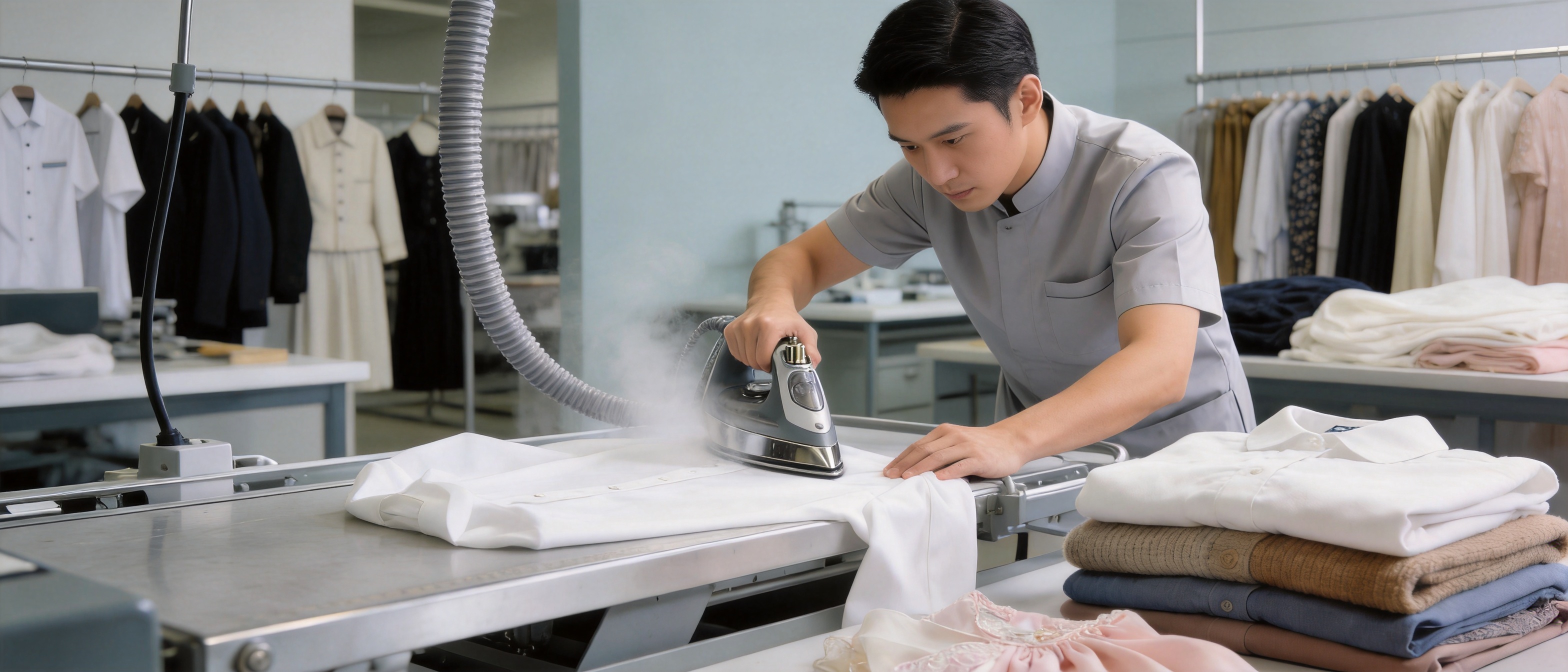
The ST-3PC is designed for steam-based ironing and garment finishing. It can be used in garment factories, tailoring workshops, laundries, hotels, clothing retailers, alteration shops, and demanding home applications.
The full stainless steel soleplate provides a durable, corrosion-resistant working surface that is designed to glide smoothly over fabrics and distribute heat evenly. It is suitable for repeated use when maintained correctly.
Yes. The product includes adjustable steam settings and a back pressure valve, allowing users to regulate steam flow for different fabrics and applications.
A comfortable, secure handle supports control and may reduce hand and wrist fatigue during prolonged use. It also helps the operator maneuver around collars, cuffs, seams, pleats, and other detailed areas.
The adjustable steam system makes the iron suitable for a broad range of materials, including thicker textiles such as curtains, upholstery, and workwear. The correct setting should be selected according to the fabric and the intended finish.
It can be used for a variety of fabrics when the operator selects an appropriate steam level, temperature, movement, and pressure. Fabric care instructions and a preliminary test should be followed for sensitive materials.
The product has an elegant and functional outer cover designed to shield internal components from dust and general wear while providing a streamlined appearance.
The manufacturer produces electric irons, steam irons, hanging irons, spray guns, small steam machines, heat transfer machines, steam boilers, vacuum tables, and related accessories.
The company identifies customization and OEM services among its business advantages. Buyers should discuss branding, packaging, technical requirements, labeling, and production quantities directly with the manufacturer.
The company states that it follows standards including GB4706.1-2005 and GB4706.2-2007 and that its products have passed CCC and CQC certifications. Buyers should confirm the certification documents and applicability for the exact model and destination market.
Buyers should confirm the electrical configuration, steam requirements, accessories, packaging, instruction materials, replacement parts, warranty conditions, delivery schedule, and any market-specific compliance requirements.
The ST-3PC (BS-3PC) All Steam Iron is built around the practical requirements of efficient and comfortable garment finishing. Its full stainless steel soleplate supports smooth movement and durability. Its protective cover helps shield internal components. Its ergonomic handle promotes control during extended use. Its durable steam valve supports consistent operation, while adjustable steam flow allows the user to work with different fabrics and textile applications.
These characteristics give the product meaningful advantages over basic irons that offer limited steam control, less durable contact surfaces, or less attention to operator comfort. The product is especially suitable for businesses that need a versatile iron capable of supporting repeated daily work.
The manufacturer strengthens the product offering through experience in research, development, production, quality management, OEM support, and a broad portfolio of complementary equipment. Its specialization in steam boilers, vacuum tables, heat transfer machines, spray guns, and accessories can help customers plan a more complete ironing and garment-finishing system.
For professional users, the best equipment decision is one that balances performance, durability, comfort, maintenance, compatibility, and service. The ST-3PC is designed with this balance in mind, making it a practical choice for garment care operations that require dependable steam control and a durable working tool.
1. Jinyun Shengda Sewing Equipment Co., Ltd. Product information for the ST-3PC (BS-3PC) All Steam Iron.
2. Jinyun Shengda Sewing Equipment Co., Ltd. Company profile and product category information.
3. GB4706.1-2005. Household and Similar Electrical Appliances—Safety—General Requirements.
4. GB4706.2-2007. Safety Requirements for Electric Irons and Similar Appliances.
5. General principles of textile care, steam ironing, fabric handling, and professional garment finishing.
6. General guidance on occupational ergonomics, repetitive tool use, and workstation safety in garment production.
 +86-578-3158872 / +86-578-3158958
 jyshengda@163.com / caroying@jy-shengda.com
 No. 8 Nanyi Rd, Huzhen Industrial Park, Zhejiang, China
Copyright © Jinyun Shengda Sewing Equipment Co., Ltd. All Rights Reserved.
Ironing Press Machine Equipment Factory
 English
 中文简体
 русский
 عربى