
Garment factories do not use the same pressing setup for every production stage. Shirt bodies, shaped panels, collars, cuffs, and smaller finishing jobs can require different operator access and fabric control. For buyers planning a new workstation, the layout of the ironing surface deserves the same attention as heating power and vacuum performance. A U Shape Vacuum Ironing Table can fit production areas where operators need to approach garments from several directions while keeping the equipment footprint manageable.
Jinyun County Shengda Sewing Equipment Co., Ltd. manufactures ironing equipment in Zhejiang, China. Established in 2003, the company combines product development, production, sales, and service. Its range includes vacuum tables, electric irons, steam equipment, spray guns, and heat transfer machines.
The working shape affects how an operator places and turns a garment. A conventional flat table provides a front-facing workstation, while a U-shaped surface gives the operator access around more of the work area. This can be useful when pressing shaped garments or sections that need repeated repositioning.
Shengda’s ST-Q3 U Shape Vacuum Ironing Table has a 400 × 1200 mm table size. Its compact dimensions can suit workstations where floor space is limited. Buyers should compare the table dimensions with the products handled at the workstation rather than selecting equipment from motor power alone.
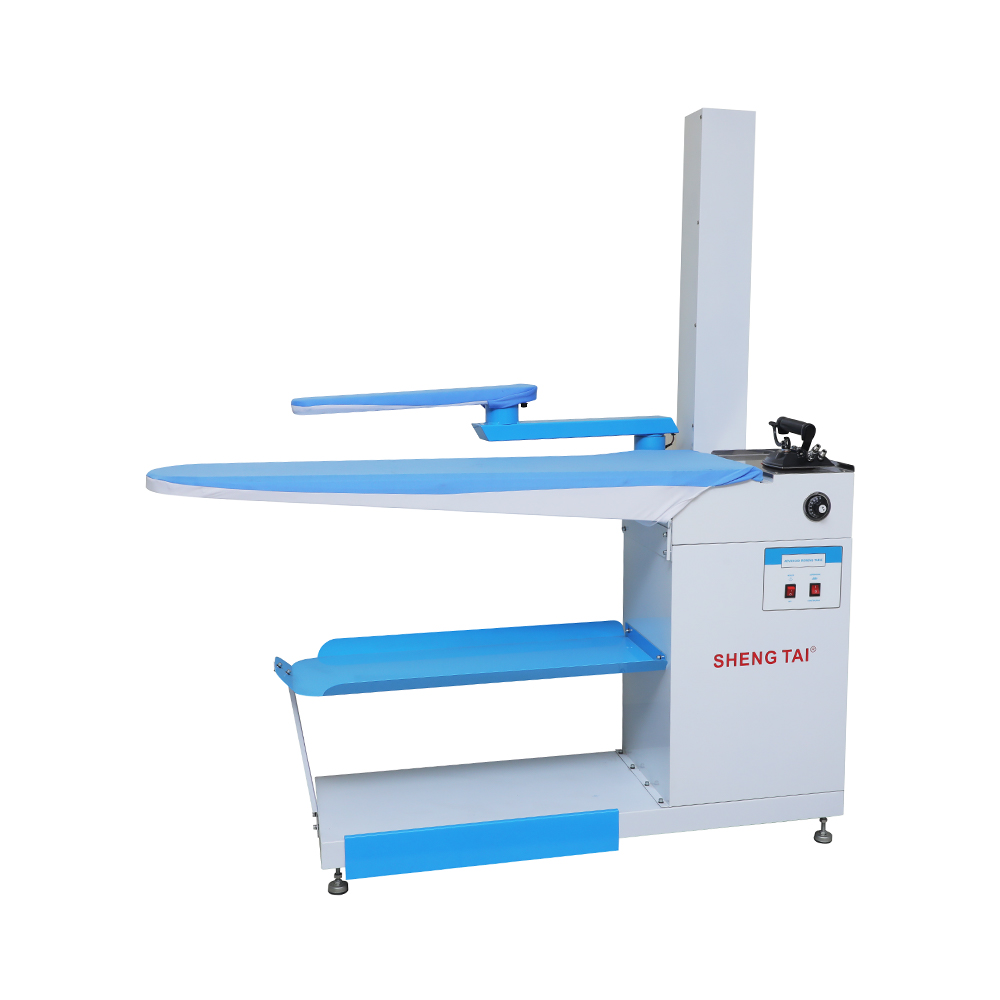
A vacuum system helps hold fabric against the working surface during pressing. For production teams, the practical concern is movement: fabric that shifts during ironing may require the operator to stop and reposition it. A vacuum ironing table provides suction beneath the work surface to support stable handling.
The ST-Q3 uses a 750W vacuum motor and has a listed vacuum pressure of at least 150Pa. It also has 1350W tabletop heating and 400W arm heating. These specifications give procurement teams measurable points for comparing equipment configurations.
When evaluating a U Shape Vacuum Ironing Table, buyers should check vacuum pressure together with motor power, table size, heating arrangement, and the fabric types used in production.
|
Purchasing Factor |
U Shape Vacuum Ironing Table |
Standard Flat Vacuum Table |
Larger Pressing Equipment |
|
Operator access |
Around the U-shaped work area |
Mainly front-facing |
Often fixed loading |
|
Shaped garment work |
Useful for collars, cuffs, panels, curves |
General surface pressing |
Depends on tooling |
|
Floor-space planning |
400 × 1200 mm ST-Q3 format |
Varies by model |
Usually needs more layout space |
|
Fabric control |
Vacuum supports stable positioning |
Vacuum supports stable positioning |
May use pressing fixtures |
|
Purchasing priority |
Layout, suction, heating, electrical supply |
Surface size and vacuum |
Capacity, tooling, cycle needs |
The comparison shows why a U Shape Vacuum Ironing Table should be evaluated as part of the garment finishing workflow, rather than as an isolated piece of equipment.
Heating specifications matter when the machine will operate repeatedly during a production shift. The ST-Q3 uses a 220V power supply, with 1350W tabletop heating and 400W arm heating. Its vacuum motor is listed at 2800 r/min.
For overseas procurement, electrical configuration should be confirmed before the purchase order is released. Buyers should specify the required voltage and local electrical requirements, along with table dimensions and heating functions.
Shengda also offers vacuum ironing table configurations with built-in steam generators and other table sizes, giving distributors and garment-equipment buyers several configurations to compare.
For a U Shape Vacuum Ironing Table, procurement teams can place these items on the technical checklist:
These points help turn a general product request into a defined technical specification when comparing manufacturer quotations.
Shengda reports that 90% of its parts are made in-house, supporting control over component production and assembly. The company has more than 300 employees and more than 70 management and technical personnel, according to its company information. Its manufacturing range covers several categories of garment and textile equipment, giving B2B buyers an option to source related machines from the same manufacturer.
For buyers sourcing a U Shape Vacuum Ironing Table for distribution or garment production, supplier discussions can cover model selection, electrical requirements, table configuration, production quantities, and application-specific requirements before an order is finalized.
The ST-Q3 combines a 400 × 1200 mm work surface, 750W vacuum motor, ≥150Pa vacuum pressure, 1350W tabletop heating, and 400W arm heating in a compact workstation format.
 +86-578-3158872 / +86-578-3158958
 jyshengda@163.com / caroying@jy-shengda.com
 No. 8 Nanyi Rd, Huzhen Industrial Park, Zhejiang, China
Copyright © Jinyun Shengda Sewing Equipment Co., Ltd. All Rights Reserved.
Ironing Press Machine Equipment Factory
 English
 中文简体
中文简体 русский
 عربى
عربى