
A stain rarely covers an entire garment or bolt of fabric — it sits in one spot, surrounded by material that is already clean and does not need to be touched. That distinction is what shapes the design of a fabric stain remover gun more than raw cleaning power does: the tool has to concentrate its effect exactly where a mark is, without soaking or disturbing the surrounding fabric.
Re-cleaning an entire garment or fabric roll to remove one localized mark wastes water, cleaning solution, and processing time, and can introduce its own problems if repeated wetting affects dye or finish. A fabric stain remover gun addresses this through a precision nozzle designed to concentrate spray on a small, specific area, leaving the surrounding material untouched. This matters most in the textile and garment industries, where a knitted fabric or finished garment may have picked up a single contaminant spot during handling rather than uniform soiling.
The cleaning action behind a fabric stain remover gun comes from high-pressure spray rather than heat or steam, using mechanical force from the pressurized stream to lift dirt, ink, or dye residue out of the fabric weave. Pressure is generally adjustable, letting the same tool run at lower settings for delicate knits and higher settings for more robust woven materials where a gentler spray would not fully clear a stubborn mark. This pressure-based approach is distinct from steam-based finishing tools used elsewhere in garment production, which rely on heat and moisture rather than mechanical force to do their work.
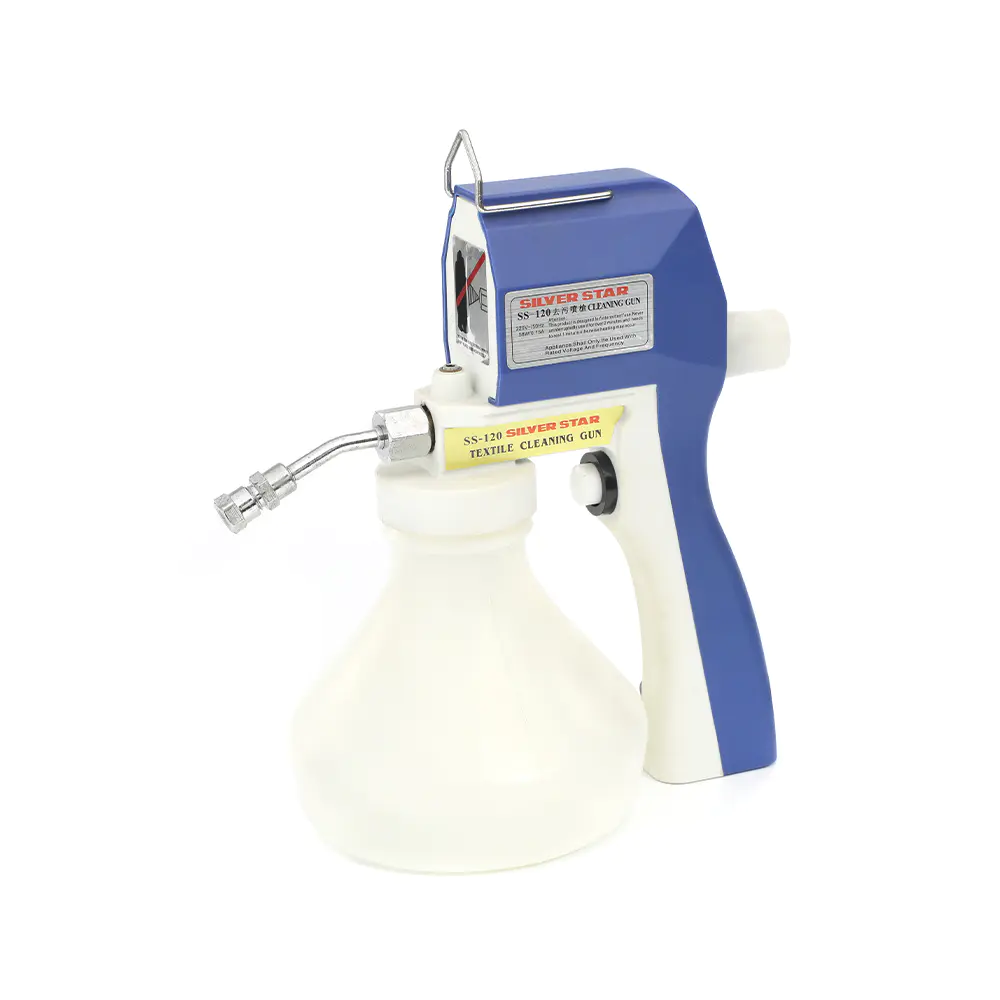
A fabric stain remover gun shows up at more than one stage of textile and garment manufacturing. Before fabric is cut and sewn, it can clear contaminants picked up during handling or storage, giving cutting and sewing operations a clean starting material. After garments are finished, the same tool addresses residual marks from production — thread oil, dust, or handling marks — before packaging. In the printing and dyeing industry, it is also used to clear ink or dye stains from printed fabric surfaces, and in advertising and signage production, a similar cleaning step keeps printed banners and posters free of contamination before and after printing.
Because a fabric stain remover gun is used alongside cleaning solutions and sometimes mild chemical agents, corrosion resistance in its wetted components matters as much as spray performance. Repeated exposure to cleaning fluids can degrade lower-grade metals over time, which is why components in continuous industrial use are generally built from corrosion-resistant materials rather than standard-grade metal that would need more frequent replacement.
Because knitted fabrics, woven textiles, and finished garments respond differently to mechanical spray force, adjustable pressure settings let a single fabric stain remover gun serve multiple material types without needing a separate tool for each. Lighter, more delicate fabrics generally call for reduced pressure to avoid distorting the weave, while heavier materials can tolerate — and often require — higher pressure to fully clear an embedded mark.
For textile and garment manufacturers sourcing this equipment, useful comparison points include adjustable pressure range relative to the fabric types in production, nozzle precision for targeted versus broader cleaning, ergonomic grip and weight for operators using the tool through repeated shifts, and corrosion resistance given the cleaning solutions the tool will be exposed to. Jinyun County Shengda Sewing Equipment Co., Ltd., based in Huzhen Town, Lishui City, Zhejiang, produces its ST-170 and ST-120 spray gun models for this type of high-pressure fabric cleaning within its broader garment-finishing equipment range. For buyers standardizing equipment across multiple production lines, a single fabric stain remover gun model covering both pre- and post-production cleaning stages can simplify training and spare-parts sourcing compared with running different tools for each stage.
 +86-578-3158872 / +86-578-3158958
 jyshengda@163.com / caroying@jy-shengda.com
 No. 8 Nanyi Rd, Huzhen Industrial Park, Zhejiang, China
Copyright © Jinyun Shengda Sewing Equipment Co., Ltd. All Rights Reserved.
Ironing Press Machine Equipment Factory
 English
 中文简体
中文简体 русский
 عربى
عربى