
Heat transfer production depends on several variables working together: temperature, dwell time, pressure, substrate, and transfer material. When an apparel manufacturer moves from occasional customization to repeated production, controlling these variables becomes a purchasing concern. A Pneumatic Heat Transfer Machine provides a mechanical pressing system for applications where consistent pressure is required across repeated transfer cycles.
Jinyun County Shengda Sewing Equipment Co., Ltd. offers pneumatic single- and double-station heat transfer equipment for textile printing and bonding applications. Its ST-15 1515-2030 model is listed with a 15 × 15 cm work table, 220V voltage, 0.75kW power, 50–300°C temperature range, and 1–60 second time setting.
Pressure is one of the variables buyers need to control when evaluating transfer equipment. Manual pressure can vary between operators, particularly during repeated production. A pneumatic system uses compressed air to apply the pressing force, giving the machine a defined operating mechanism.
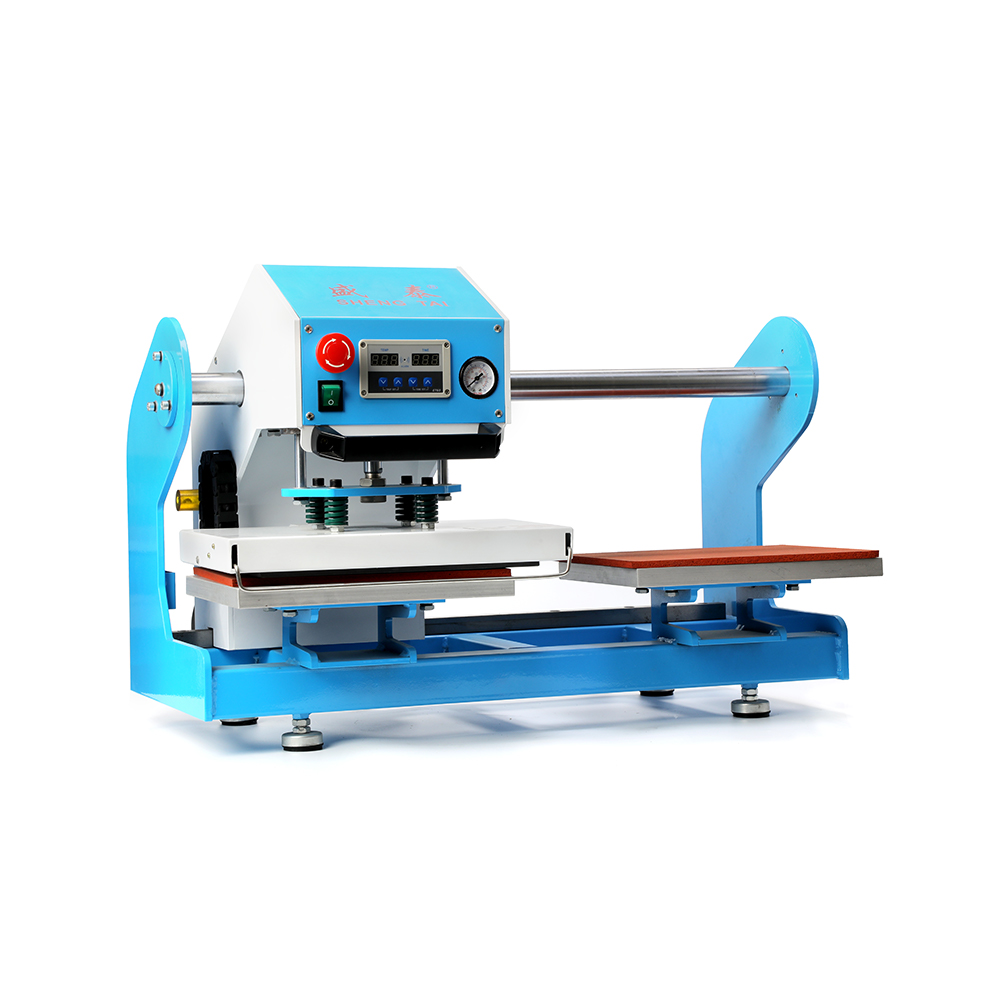
The Pneumatic Heat Transfer Machine format is therefore relevant to production environments where repeatability matters. It can support textile decoration, garment customization, fabric bonding, and related applications listed for Shengda's equipment.
The actual transfer process still depends on the transfer film, adhesive system, substrate, temperature, dwell time, and pressure requirements. Buyers should establish the process parameters for their own materials before selecting the machine.
Station configuration becomes important when production volume increases. A single-station machine requires the operator to complete one loading and pressing cycle before moving to the next workpiece. A double-station configuration can separate loading and pressing activities between two work areas.
|
Production Situation |
Single Station |
Double Station |
|
Small custom orders |
Suitable for changing jobs |
May provide additional capacity |
|
Repeated garment logos |
Simple workstation arrangement |
Supports a more continuous workflow |
|
Operator movement |
One active work position |
Two work positions |
|
Space planning |
More compact |
Requires more operating clearance |
|
Production expansion |
Suitable for smaller output |
Provides a different workflow option |
For procurement teams, the choice should follow the expected production process rather than the station count alone.
The ST-15 model provides a listed temperature range of 50–300°C and a 1–60 second time-delay setting. These controls give operators defined parameters for heat-transfer work.
A Pneumatic Heat Transfer Machine should still be selected according to the actual transfer system. A temperature range that covers one application does not automatically make the same setting suitable for every film or fabric. Buyers should test the intended transfer materials and establish production parameters before confirming a larger order.
The machine's listed 220V power supply and 0.75kW power rating should also be checked against the electrical requirements of the destination market.
Heat transfer equipment is used for more than printing graphics on finished clothing. Shengda lists textile printing, fabric bonding, and customized textiles among the applications of its pneumatic model.
For garment manufacturers, the machine can be considered where logos, graphics, labels, or other transferred elements form part of the production process. For textile distributors, the same equipment category may serve customers involved in customization or fabric bonding.
This wider application range can be relevant to importers building a machinery portfolio around textile processing rather than selling equipment for one narrow product type.
Shengda has specialized in ironing and related equipment since 2003. The company integrates design, development, production, sales, and service, and reports more than 300 employees, including more than 70 management and technical personnel. It also states that 90% of its parts are made in-house.
For buyers sourcing a Pneumatic Heat Transfer Machine, these manufacturing details provide useful points for supplier discussions. Procurement teams can ask about component sourcing, assembly procedures, spare parts, electrical configuration, packaging, and production quantities before finalizing an order.
Shengda's heat-transfer range includes single-station, double-station, pneumatic, electromagnetic, pull-out, and other configurations. This gives distributors several equipment formats to compare when serving customers with different production requirements.
A clear request for quotation should identify the intended material, transfer process, required working area, expected production volume, electrical specification, and preferred station configuration.
For a Pneumatic Heat Transfer Machine, buyers should also clarify the target temperature range, dwell time requirements, pressure requirements, available compressed-air conditions, machine footprint, and packaging expectations.
The ST-15 model provides a concrete reference point with its 15 × 15 cm work table, 50–300°C temperature range, 1–60 second timing range, 220V voltage, and 0.75kW power.
These specifications can be used as a starting point for technical discussions rather than treated as universal requirements for every heat-transfer application.
 +86-578-3158872 / +86-578-3158958
 jyshengda@163.com / caroying@jy-shengda.com
 No. 8 Nanyi Rd, Huzhen Industrial Park, Zhejiang, China
Copyright © Jinyun Shengda Sewing Equipment Co., Ltd. All Rights Reserved.
Ironing Press Machine Equipment Factory
 English
 中文简体
 русский
 عربى
