
A Transfer Press can serve several different production tasks, from applying graphics to garments to bonding textile layers. For B2B buyers, the machine should therefore be selected around the intended transfer process rather than purchased only by size or heating power. A Transfer Press needs to match the material, transfer method, pressure requirement, working area, and production volume of the application.
Shengda manufactures heat-transfer equipment for textile and fabric applications. Its product range includes single-station, double-station, pneumatic, electromagnetic, pull-out, and other heat-transfer configurations.
The substrate has a direct effect on equipment selection. Cotton, linen, synthetic textiles, heavier fabrics, and bonded textile layers can require different temperature and pressure settings.
Shengda's heat-transfer equipment is described for applications including fabric bonding and transferring designs or text to materials such as cotton, linen, and fiber. The company's equipment uses adjustable pressure and digital time control on relevant models.
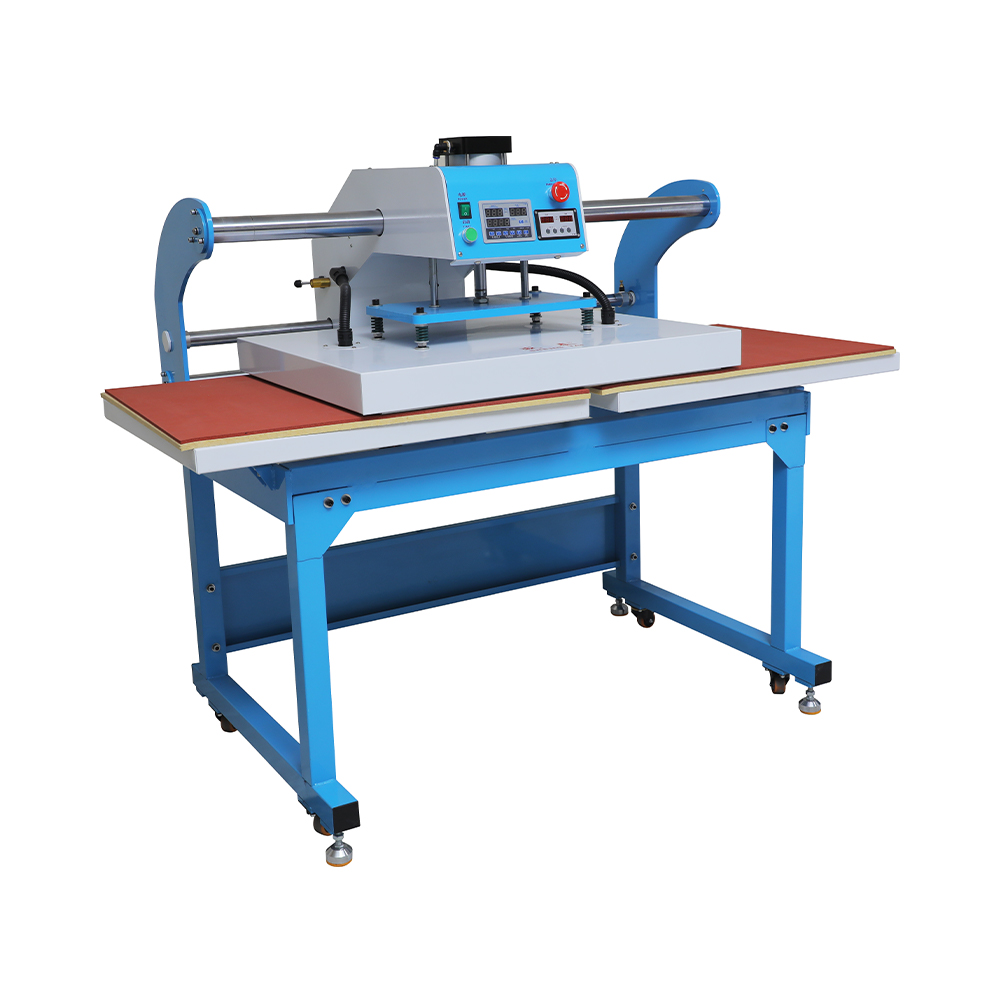
When purchasing a Transfer Press, buyers should provide the supplier with the materials they intend to process. A supplier can then determine which machine configuration is appropriate for the required working conditions.
This approach is more practical than choosing equipment only from a catalog photograph because two machines with similar external dimensions may serve different production workflows.
The working area determines what products can be processed in one cycle. A small work table can suit logos, labels, and small textile components, while larger products may require a larger platen.
The ST-15 model listed by Shengda has a 15 × 15 cm work table, 220V voltage, 0.75kW power, a 50–300°C temperature range, and a 1–60 second time setting.
A Transfer Press should therefore be evaluated against the actual transfer size rather than the finished product size alone. A T-shirt, for example, may require only a small working area when the intended graphic is limited to a chest logo.
Different machine structures can support different workflows.
|
Requirement |
Single-Station Press |
Double-Station Press |
Pneumatic Press |
|
Small customized orders |
Practical for varied jobs |
Useful when more output is needed |
Suitable where controlled pressure is required |
|
Operator workflow |
One working position |
Alternating work positions |
Pneumatic pressing cycle |
|
Space requirement |
Relatively compact |
Needs additional station clearance |
Depends on model |
|
Pressure operation |
Model dependent |
Model dependent |
Pneumatic force application |
|
Typical purchasing focus |
Simplicity and work area |
Workflow and output |
Pressure consistency and air supply |
This comparison gives procurement teams a way to connect machine configuration with production conditions.
A Transfer Press does not produce consistent results through temperature alone. Heat, dwell time, pressure, transfer material, and substrate interact during the application process.
Shengda's heat-transfer equipment includes digital time control, adjustable pressure, and temperature control on applicable models. Its product information also describes silicone mats designed for temperatures up to 200°C on the general heat-transfer machine range.
Buyers should confirm the actual operating limits of the selected model and the transfer materials being used. Production testing is also useful when a new transfer film, adhesive, or fabric is introduced.
Jinyun County Shengda Sewing Equipment Co., Ltd. was established in 2003 and focuses on ironing and related equipment. The company integrates product design, development, production, sales, and service. It reports more than 300 employees and more than 70 management and technical personnel.
Shengda also states that 90% of its parts are self-made. For overseas equipment buyers, this provides a useful point for supplier evaluation alongside assembly capability, spare-part arrangements, production planning, and quality control procedures.
The manufacturer produces several heat-transfer machine configurations, so buyers can discuss whether a standard model or another configuration fits the intended process.
Before requesting a quotation for a Transfer Press, buyers should prepare a technical specification covering:
A clear specification gives the manufacturer enough information to recommend an appropriate model and prepare a quotation based on actual production needs.
A Transfer Press can operate as a standalone workstation or as part of a larger textile production process. In garment manufacturing, it may follow sewing and printing preparation stages. In customization operations, it can form the main transfer workstation for applying logos, graphics, labels, or other decorative elements.
Shengda's broader equipment portfolio includes ironing equipment, vacuum tables, steam equipment, and heat-transfer machinery. For distributors, this range can support sourcing programs that cover several stages of garment preparation and finishing from one manufacturing supplier.
The final machine choice should follow the transfer material, working dimensions, production volume, pressure method, and electrical requirements established by the buyer before ordering.
 +86-578-3158872 / +86-578-3158958
 jyshengda@163.com / caroying@jy-shengda.com
 No. 8 Nanyi Rd, Huzhen Industrial Park, Zhejiang, China
Copyright © Jinyun Shengda Sewing Equipment Co., Ltd. All Rights Reserved.
Ironing Press Machine Equipment Factory
 English
 中文简体
 русский
 عربى
