
People usually notice an iron only when something goes wrong.
A shiny mark appears on dark fabric, a seam refuses to flatten properly, or delicate material develops slight scorching after pressing. Inside garment workshops, these problems are rarely blamed on temperature alone. In many cases, the issue comes from unstable heat distribution during continuous operation.
That is one reason industrial electro iron systems are designed very differently from ordinary household models.
In clothing production environments, pressing equipment may operate for hours without interruption. Under those conditions, maintaining consistent heat becomes far more important than simply reaching a high temperature quickly.
Actually, experienced operators often care more about temperature stability than maximum heat.
Different textiles absorb heat at very different speeds.
A lightweight polyester lining responds almost immediately when touched by an electro iron, while thicker cotton or wool fabrics require more gradual heat penetration before wrinkles relax properly.
The problem is that industrial pressing rarely deals with only one material type during a work shift.
Factories may continuously process:
If the iron temperature fluctuates too aggressively, operators constantly need to adjust pressing rhythm to avoid damaging sensitive areas.
Actually, some fabrics become permanently glossy from excessive surface pressure long before visible burning appears.
A household iron typically rests between uses.
Inside production workshops, an electro iron may contact fabric continuously for long periods throughout the day. Under these conditions, the heating plate loses surface temperature repeatedly during operation.
If heat recovery becomes too slow, the pressing quality changes from one garment section to the next.
This may lead to:
Factories therefore pay close attention to heating element response speed instead of focusing only on peak temperature numbers.
Actually, stable recovery performance often improves productivity more than simply increasing total heat output.
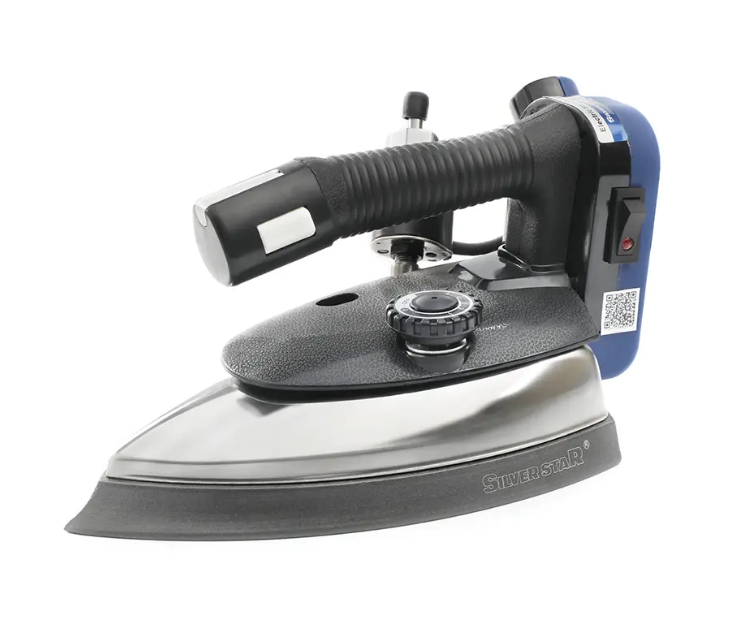
In many garment environments, an electro iron works together with steam rather than dry heat alone.
Steam softens fibers temporarily, allowing seams and wrinkles to relax more evenly during pressing. However, unstable steam release creates another set of problems.
Too much moisture may leave water marks or cause delayed fabric deformation after cooling. Too little steam reduces pressing efficiency, especially on thicker materials.
Operators therefore monitor:
Actually, professional pressing often depends more on moisture management than raw temperature itself.
One interesting challenge with industrial electro iron operation is that dark fabrics reveal mistakes much more clearly than lighter materials.
Excessive pressure or unstable heating may create reflective shine marks on black or navy garments even when the material technically remains undamaged. Synthetic blends are especially sensitive because surface fibers flatten easily under concentrated heat.
This becomes a major concern in:
Actually, experienced press operators often adjust contact timing instinctively based on how certain fabrics reflect light during pressing.
The heating system inside an electro iron is only part of the equation.
The soleplate material itself strongly affects how heat spreads across the fabric surface. Uneven heat zones create inconsistent pressing results, especially during large-area garment finishing.
Different soleplate structures influence:
Actually, some pressing defects blamed on operator technique originate from uneven heat transfer across worn soleplates.
That is why industrial equipment maintenance often includes checking surface flatness and coating condition regularly.
Industrial pressing equipment operates under much harsher conditions than residential appliances.
An electro iron inside a garment factory may experience constant heating cycles, repeated movement, steam exposure, and prolonged operating hours every day. Over time, internal heating components gradually change performance characteristics.
Temperature instability sometimes begins subtly.
Operators may first notice:
Actually, many pressing quality problems appear gradually before complete equipment failure becomes obvious.
To someone outside the apparel industry, an electro iron may seem like a simple heating tool.
Inside garment production, however, pressing quality directly affects fabric appearance, seam shape, and final product presentation. Small temperature variation becomes highly visible once hundreds of garments move through the same production line every day.
The difficult part is not generating heat.
It is maintaining controlled, repeatable heat behavior across different fabrics, different operators, and long continuous working hours without damaging the material being pressed.
 +86-578-3158872 / +86-578-3158958
 jyshengda@163.com / caroying@jy-shengda.com
 No. 8 Nanyi Rd, Huzhen Industrial Park, Zhejiang, China
Copyright © Jinyun Shengda Sewing Equipment Co., Ltd. All Rights Reserved.
Ironing Press Machine Equipment Factory
 English
 中文简体
中文简体 русский
 عربى
عربى