
A shirt may look perfectly flat immediately after ironing.
Several minutes later, slight wrinkles begin returning around seams, pockets, cuffs, or folded areas. Inside garment factories and laundry rooms, this situation is extremely common, especially when operators focus only on surface heat without controlling moisture and cooling conditions properly.
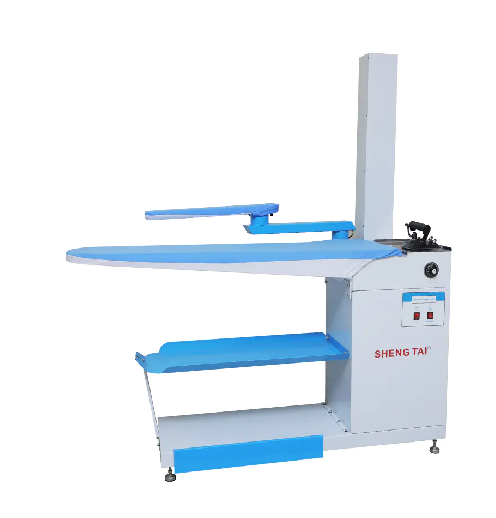
That is one reason a vacuum steam table became an important part of professional garment finishing rather than just an accessory below the iron.
In many pressing processes, the wrinkle does not truly disappear during ironing.
The fabric fibers are only temporarily reshaped until moisture and heat stabilize again.
Actually, some wrinkles return not because the pressing failed, but because the fabric never cooled correctly afterward.
Steam Softens Fibers Only Temporarily
When steam reaches fabric during pressing, the fibers become more flexible for a short period.
An iron alone may flatten the surface visually, but inside the material structure, the fibers still contain heat and moisture. Without proper stabilization, the shape gradually changes again as the garment cools naturally.
A vacuum steam table helps remove that remaining heat and moisture much faster after pressing.
This becomes especially important with:
Actually, some fabrics appear smooth while still internally unstable for several minutes after steaming.
Residual Moisture Causes Shape Recovery
One major reason wrinkles return is trapped moisture.
During pressing, steam enters the fabric layers quickly. If that moisture cannot leave efficiently afterward, the fibers slowly relax back toward their previous shape once the garment hangs naturally.
A vacuum steam table creates airflow beneath the garment surface to extract moisture during the finishing process.
Without proper suction, fabrics may develop:
Actually, operators sometimes mistake moisture retention for poor ironing technique when the real issue comes from incomplete drying.
Cooling Speed Changes Fabric Stability
Heat alone does not permanently fix garment shape.
Inside professional pressing systems, cooling speed strongly influences how well the fibers maintain their finished structure. A vacuum steam table helps accelerate cooling immediately after steam application, allowing the material to stabilize faster.
This matters because warm fabric remains flexible even after the iron leaves the surface.
If cooling happens too slowly, movement during handling may reshape the garment again before the fibers fully settle.
This becomes particularly noticeable in:
Actually, professional garment finishing often depends more on controlled cooling than on pressing pressure itself.
Heavy Fabrics Hold Heat Much Longer
Not every textile reacts the same way during pressing.
Dense fabrics store more internal heat and moisture after steaming, which increases the chance of wrinkle recovery later. A vacuum steam table becomes especially useful for thicker materials because suction helps pull heat from deeper inside the fabric layers.
This is common in:
Actually, heavy garments may feel dry on the surface while still holding significant internal moisture underneath.
Seams And Stitching Areas Recover Faster
Flat fabric surfaces usually respond well to pressing.
Seams behave differently because multiple fabric layers, thread tension, and stitching density all resist reshaping during ironing. Without proper airflow support, these thicker areas cool unevenly after steaming.
A vacuum steam table helps stabilize those problem zones by removing moisture more evenly across different fabric thicknesses.
Otherwise, seam areas may gradually:
Actually, experienced garment finishers often spend more time controlling seam behavior than flattening the visible fabric surface itself.
Continuous Production Requires Faster Stabilization
Inside factories, garments move rapidly through finishing lines.
Without a vacuum steam table, operators may need to wait longer between pressing stages to allow garments to cool naturally. This slows production and increases the risk of shape distortion during handling.
Vacuum systems help improve workflow because the fabric stabilizes more quickly after pressing.
This becomes valuable in:
Actually, vacuum tables improve consistency as much as they improve pressing speed.
Professional Pressing Depends On Moisture Control
To many people, ironing appears mainly about applying heat to remove wrinkles.
Inside garment finishing, however, moisture management often matters even more than temperature itself. A vacuum steam table works not only as a support surface, but as part of the fabric stabilization process after steaming.
The difficult part is not flattening the garment temporarily.
It is keeping the fabric structure stable after heat, steam, and handling conditions continue changing during cooling.
 +86-578-3158872 / +86-578-3158958
 jyshengda@163.com / caroying@jy-shengda.com
 No. 8 Nanyi Rd, Huzhen Industrial Park, Zhejiang, China
Copyright © Jinyun Shengda Sewing Equipment Co., Ltd. All Rights Reserved.
Ironing Press Machine Equipment Factory
 English
 中文简体
中文简体 русский
 عربى
عربى