
In garment finishing rooms, removing a small stain is sometimes harder than cleaning the entire piece of clothing.
The stain itself may disappear completely, yet a faint ring, discoloration area, or drying mark remains visible afterward. On dark fabrics especially, these water marks often become more obvious under lighting than the original stain.
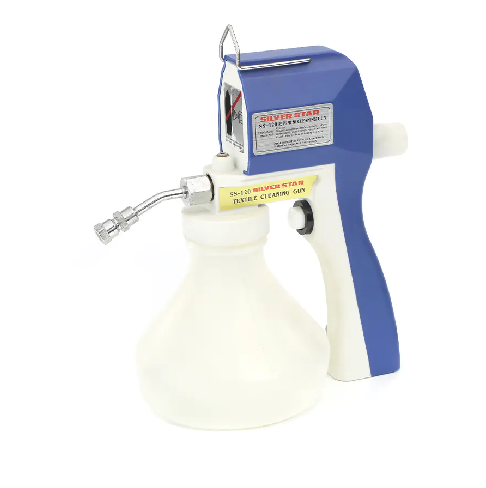
That is one reason a Fabric Stain Remover Gun requires more operator control than many people expect.
Inside textile processing, local stain treatment changes moisture balance, fiber direction, and chemical distribution within a very small fabric area. If those conditions are not controlled carefully, the surrounding surface dries unevenly after cleaning.
Actually, many water marks appear only after the garment looks fully dry.
Localized Wetting Changes Fabric Reflection
One challenge with a Fabric Stain Remover Gun is that it treats only a limited area instead of washing the entire garment evenly.
When moisture concentrates on one section, the fibers react differently compared with the surrounding dry fabric. During drying, the treated zone may shrink or settle slightly unevenly, changing how light reflects from the surface.
This becomes especially noticeable on:
Actually, some “water stains” are not chemical stains at all — they are changes in surface reflection caused by uneven fiber positioning.
Drying Speed Affects Final Appearance
After using a Fabric Stain Remover Gun, moisture does not evaporate uniformly across the treated area.
The outer edge of the wet zone often dries more slowly than the center because dissolved residue gradually moves outward during evaporation. This creates the familiar ring-shaped water mark many garment finishers try to avoid.
Several factors influence this process:
Actually, fast drying is not always better. Uneven evaporation sometimes makes the mark more visible instead of reducing it.
Spray Pressure Can Disturb Fabric Structure
A Fabric Stain Remover Gun relies on compressed air or liquid pressure to target stains quickly.
If spray force becomes too aggressive, delicate fibers may shift direction during treatment. Once the fabric dries, the disturbed area reflects light differently from surrounding sections even when no visible residue remains.
This happens frequently with:
Actually, experienced operators often adjust spray angle instinctively depending on how sensitive the fabric texture feels.
Chemical Residue Sometimes Stays Invisible
Not all spotting chemicals evaporate completely after cleaning.
When using a Fabric Stain Remover Gun, small amounts of dissolved detergent or cleaning agent may remain inside the fibers if rinsing becomes insufficient. The garment may initially appear normal until the residue dries fully and changes the surface color slightly.
This becomes more obvious under strong lighting or on darker fabrics.
Over time, leftover residue may cause:
Actually, some water marks blamed on moisture are partly caused by cleaning chemistry remaining inside the textile.
Heat Can Make Water Marks Worse
Many operators use steam or heated airflow after applying a Fabric Stain Remover Gun to speed up drying.
The problem is that excessive heat sometimes locks uneven moisture patterns into the fabric structure before the fibers stabilize naturally. Once this happens, the water mark may become much harder to remove afterward.
This is especially risky with:
Actually, professional spot cleaning often requires balancing temperature carefully instead of simply drying the area as fast as possible.
Fabric Density Changes Moisture Movement
Different textiles absorb cleaning fluid very differently.
A thick wool garment treated with a Fabric Stain Remover Gun holds moisture much longer beneath the surface compared with lightweight polyester or cotton blends. As internal moisture migrates outward during drying, the surface tension across the fabric changes gradually.
This sometimes creates visible drying borders even after the stain itself disappears completely.
Actually, two garments cleaned with the same technique may show completely different results simply because the fabric structure handles moisture differently.
Spot Cleaning Requires Moisture Control
To people outside garment processing, local stain removal may seem simple.
Inside professional finishing environments, however, a Fabric Stain Remover Gun affects not only the stain itself, but also the moisture balance and fiber structure around the treated area.
The difficult part is not dissolving the stain.
It is preventing the surrounding fabric from drying unevenly after cleaning, which changes how the fibers absorb moisture, reflect light, and settle back into shape.
 +86-578-3158872 / +86-578-3158958
 jyshengda@163.com / caroying@jy-shengda.com
 No. 8 Nanyi Rd, Huzhen Industrial Park, Zhejiang, China
Copyright © Jinyun Shengda Sewing Equipment Co., Ltd. All Rights Reserved.
Ironing Press Machine Equipment Factory
 English
 中文简体
中文简体 русский
 عربى
عربى