
A garment may look smooth immediately after pressing, yet certain areas suddenly reflect light more strongly than the surrounding fabric.
On dark trousers, jackets, or uniforms, these shiny patches often appear around seams, pockets, cuffs, and pleated sections. In garment factories, this problem is commonly called “shine marks,” and once they become visible, removing them completely is often difficult.
Interestingly, excessive temperature is not always the main reason.
In many cases, an electric iron creates fabric shine because pressure, moisture, and fiber structure interact incorrectly during pressing.
Actually, some fabrics become glossy even at relatively safe temperatures if surface pressure remains too concentrated.
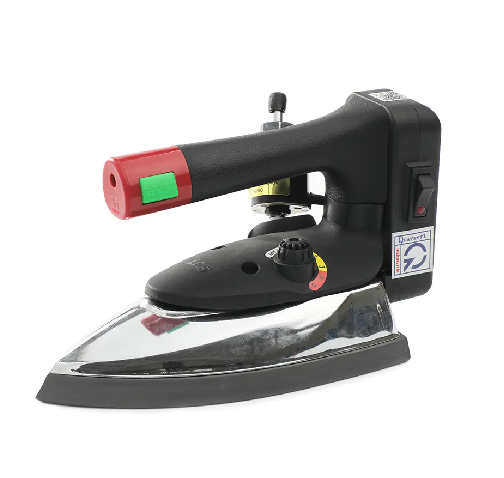
Synthetic Fibers React Faster To PressureF
One reason an electric iron leaves shine marks more easily on certain garments is that synthetic fibers soften differently from natural materials.
Polyester and blended fabrics respond quickly to both heat and compression. During pressing, the surface fibers flatten under pressure and begin reflecting light in a more uniform direction. The fabric technically remains intact, but visually it develops a polished appearance.
This becomes especially noticeable on:
Actually, the shine often comes from altered surface texture rather than direct burning damage.
Excessive Pressure Changes Fiber Direction
Many operators focus only on temperature settings while ignoring pressing force.
An electric iron applying strong pressure repeatedly across the same area compresses the fabric surface gradually. Once the upper fibers lose their natural texture, light reflects more sharply from the flattened section.
This commonly appears around:
Actually, some shine marks develop because operators hold the iron stationary for too long instead of moving pressure evenly across the surface.
Steam Balance Influences Surface Appearance
Steam plays a major role during professional pressing.
With an electric iron , controlled steam helps soften fibers temporarily so wrinkles relax without requiring excessive mechanical pressure. However, insufficient steam often forces operators to compensate by pressing harder against the fabric.
That increases the risk of surface polishing.
On the other hand, excessive moisture may also create uneven fiber settling after drying.
Factories therefore monitor:
Actually, experienced press operators often judge fabric behavior by touch and reflection rather than relying only on machine settings.
Dark Fabrics Reveal Shine More Clearly
Shine marks appear on many textiles, but dark garments expose the problem much faster.
A slightly polished section created by an electric iron reflects surrounding light differently from untreated fabric. On black or navy materials, even small surface texture changes become highly visible under factory lighting or sunlight.
This is one reason formal garment manufacturers pay special attention during finishing operations involving:
Actually, the fabric may feel completely normal by touch while the shine remains visually obvious from certain angles.
Worn Soleplates Increase Localized Heat
The condition of the iron itself strongly affects pressing quality.
An older electric iron with scratches, residue buildup, or uneven soleplate wear may transfer heat inconsistently across the fabric surface. Certain sections become hotter or create additional friction during movement.
Over time, this increases the chance of:
Actually, some pressing defects blamed on operator technique are partially caused by soleplate condition itself.
That is why professional garment workshops regularly clean and inspect pressing surfaces.
Fiber Density Changes Shine Behavior
Not all fabrics react identically under an electric iron .
Loosely woven textiles sometimes recover their surface texture naturally after steaming, while tightly woven synthetic materials hold compressed fiber patterns much longer. Dense fabrics also trap heat differently inside the material structure.
This explains why some garments become shiny surprisingly quickly while others tolerate repeated pressing without visible changes.
Actually, fabric structure often influences shine risk more directly than thickness alone.
Professional Pressing Requires Surface Control
To many people, ironing simply means removing wrinkles.
Inside garment production environments, however, an electric iron also changes how fibers sit, reflect light, and recover after heat exposure. The final appearance depends not only on temperature, but also on pressure balance, steam control, and fabric structure.
The difficult part is not flattening the garment.
It is removing wrinkles while keeping the original surface texture looking natural under different lighting conditions after pressing is complete.
 +86-578-3158872 / +86-578-3158958
 jyshengda@163.com / caroying@jy-shengda.com
 No. 8 Nanyi Rd, Huzhen Industrial Park, Zhejiang, China
Copyright © Jinyun Shengda Sewing Equipment Co., Ltd. All Rights Reserved.
Ironing Press Machine Equipment Factory
 English
 中文简体
中文简体 русский
 عربى
عربى