The ST-5060 Hydraulic Upper and Lower Heating Single-Station Heat Transfer Machine is designed for textile businesses that require dependable pressure, controlled heat, and repeatable production results. Combining a hydraulic pressing system with independently heated upper and lower plates, the machine supports a broad range of heat transfer and fabric processing applications. It is suitable for garment decoration, fabric bonding, sublimation transfer, solvent-based ink transfer, flocking, and puff printing.
Modern textile production requires more than a simple heated press. Operators need accurate temperature management, consistent pressure, reliable cycle timing, and a working surface that can withstand repeated exposure to heat. The ST-5060 addresses these requirements through a coordinated design that brings together hydraulic force, dual-sided heating, digital controls, electronic timing, and a durable silicone base.
The machine is particularly useful for companies working with cotton, linen, synthetic fibers, and blended fabrics. Its low-temperature operating capability also helps processors handle materials that may be sensitive to excessive heat. By supporting different fabric types and printing techniques, it can serve garment manufacturers, custom apparel workshops, textile decorators, promotional product producers, and fabric-processing businesses.
In addition to its technical design, the ST-5060 benefits from the manufacturing experience of Jinyun Shengda Sewing Equipment Co., Ltd. The company develops and produces ironing and textile equipment, including electric irons, steam irons, hanging irons, spray guns, small steam machines, heat transfer machines, steam boilers, vacuum tables, and related accessories. Its experience across several equipment categories supports practical product development and helps the company offer equipment solutions for different production environments.
This article examines the ST-5060 in detail, including its operating principle, principal advantages, applications, controls, maintenance considerations, manufacturing strengths, and position compared with more basic heat transfer equipment.
The ST-5060 is a hydraulic, single-station heat transfer machine with upper and lower heating. Its basic function is to apply a controlled combination of heat and pressure to transfer a design, bond textile layers, or create a special surface effect on fabric. Unlike a basic single-sided press, the ST-5060 heats both the upper and lower surfaces of the working area. This arrangement helps heat penetrate the material more evenly and can improve the consistency of the final result.
The hydraulic mechanism supplies pressing force through a controlled system rather than relying only on manual mechanical leverage. This makes the pressing action more consistent from one production cycle to the next. Uniform pressure is especially important when transferring large designs, working with layered materials, or processing fabrics that require an even application across the entire pressing area.
The machine is identified as a single-station model, meaning that it concentrates production activity on one working position. This arrangement is appropriate for businesses that need a compact and focused production unit without the complexity of a multi-station system. A single station can also simplify operator training, workflow planning, and routine maintenance.
The ST-5060 is intended for colorful sublimation and solvent-based ink designs and can process a variety of textile materials. Its application range extends beyond conventional flat transfers. The machine also supports flocking and puff printing, enabling users to create tactile, raised, or textured decorative effects.
Its design combines production flexibility with control. Rather than requiring a separate machine for every type of transfer, the ST-5060 can accommodate multiple processes when the appropriate temperature, pressure, and time settings are selected for the material and transfer medium.
Heat transfer printing depends on the interaction of three principal variables: temperature, pressure, and time. Each variable affects the quality of the finished design. Insufficient heat may prevent the transfer medium from bonding correctly. Excessive heat may damage a fabric or distort a printed design. Insufficient pressure may result in incomplete adhesion, while excessive pressure may affect the texture or appearance of the material. An unsuitable cycle time can produce inconsistent results even when the temperature and pressure are correct.
The ST-5060 is designed to coordinate these variables through its hydraulic pressing system, dual heating plates, digital temperature control, and electronic timer. The operator places the textile and transfer material in the working position, selects the required settings, and starts the pressing cycle. The upper and lower plates provide heat while the hydraulic system applies pressure. Once the programmed time has elapsed, the electronic control system signals the end of the cycle.
Because heat is supplied from both sides, the material can receive more comprehensive thermal coverage than it would on a single-sided machine. This may be valuable when working with thicker textiles, layered fabric assemblies, or processes that require more uniform heat penetration.
The hydraulic action also helps the machine maintain a stable relationship between the pressing surfaces. When pressure is evenly distributed, the transfer material is less likely to receive different levels of force in different areas. This contributes to cleaner edges, more consistent adhesion, and a lower risk of visible irregularities caused by uneven contact.
Operators should always establish process settings according to the transfer medium, fabric composition, design size, and production requirements. The machine provides control and repeatability, but each material combination may require its own tested operating parameters.
The hydraulic system is one of the most important differences between the ST-5060 and simpler manual heat presses. Hydraulic pressing distributes force across the working area and helps maintain stable pressure during the transfer cycle. This is valuable when the design covers a substantial part of the garment or when the material contains multiple layers.
Consistent pressure supports consistent bonding. If one section of a transfer receives less pressure than another, the result may include weak adhesion, incomplete color development, uneven texture, or visible defects. The hydraulic mechanism helps reduce these variations by applying force in a more controlled manner.
Hydraulic operation can also reduce the physical effort required from the operator. In a manual press, repeated closing and locking may cause fatigue, particularly during extended production. A hydraulic system provides a more manageable workflow and helps the operator concentrate on positioning, inspection, and quality control.
Compared with basic hand-operated equipment, hydraulic pressing is especially advantageous for businesses that handle regular production quantities. It can help create a more standardized process, making it easier to repeat successful settings across multiple orders.
The ST-5060 uses heated upper and lower plates rather than relying only on heat from the top. Dual-sided heating creates a more comprehensive heating environment around the textile and transfer material. This is useful for applications in which heat must move through a fabric assembly or reach adhesive layers from both directions.
Two-sided heating can improve the efficiency of the transfer process by reducing uneven temperature distribution. It may also help shorten the time needed to bring the material to an effective processing condition, depending on the fabric thickness and transfer method.
For fabric bonding, upper and lower heating can be particularly useful because both surfaces of the layered material participate in the heating process. For special printing techniques, the arrangement can help maintain a more uniform thermal condition across the working area.
The dual-heating design gives the ST-5060 an advantage over conventional single-heated presses in applications that involve thicker or layered materials. It also provides greater process flexibility for users who work with different types of textile products.
The machine is capable of efficient operation at lower temperatures. This is important for fabrics that may shrink, discolor, deform, or otherwise suffer damage when exposed to excessive heat. Delicate textiles and certain synthetic blends can require careful thermal control, and low-temperature capability expands the range of materials that can be processed.
Lower-temperature processing may also be beneficial when working with specialized transfer media or fabrics with surface finishes that are sensitive to heat. By allowing the operator to select an appropriate temperature rather than using unnecessarily high heat, the machine supports a more careful production approach.
Low-temperature operation does not mean that every material can be processed under identical conditions. Instead, it gives the operator more control and allows the process to be adapted to the requirements of each fabric and transfer system. Testing remains important, particularly when introducing a new textile or transfer film.
The digital display and intelligent temperature controller make the machine easier to operate. Operators can monitor the selected temperature and adjust the settings according to the process requirements. Clear controls can reduce the time needed to set up a job and support more consistent production between operators.
Digital control is also valuable for documenting production procedures. Once a suitable temperature and cycle have been established for a particular fabric and transfer material, the settings can be recorded as part of an internal work instruction. This helps reduce dependence on individual operator experience and supports repeatable manufacturing.
An accessible control system is important in both small and larger workshops. Experienced operators can make accurate adjustments, while new operators can learn the basic operating sequence more quickly. A straightforward interface also reduces the possibility of accidental changes during production.
The electronic timer regulates the length of the heat transfer cycle. When the programmed time has elapsed, the machine signals the operator. This helps prevent overexposure and underexposure to heat.
Timing accuracy is essential because the same temperature can produce different results depending on how long it is applied. A cycle that is too short may leave the transfer incompletely bonded. A cycle that is too long may affect the fabric, transfer layer, or visual quality of the design. Electronic time control helps bring greater consistency to this part of the process.
The timer also reduces the need for constant manual observation. Operators can prepare the next item, inspect a completed product, or organize materials while the current cycle is running, provided that appropriate workplace safety procedures are followed.
The bottom plate is equipped with a high-temperature-resistant silicone pad. According to the supplied product information, the silicone base can withstand temperatures of up to 200°C without deforming. This contributes to long-term durability and helps the machine maintain a stable working surface.
A silicone pad also supports even contact between the textile and the heated plate. Its resilient surface can help accommodate minor differences in fabric thickness and improve the uniformity of pressure across the transfer area. It may also help protect the lower plate and provide a suitable surface for different garment and fabric configurations.
Because the silicone pad is exposed to repeated heat and pressure, it should be inspected regularly. Operators should keep it clean, avoid placing sharp objects on it, and replace it if it becomes permanently compressed, torn, contaminated, or uneven.
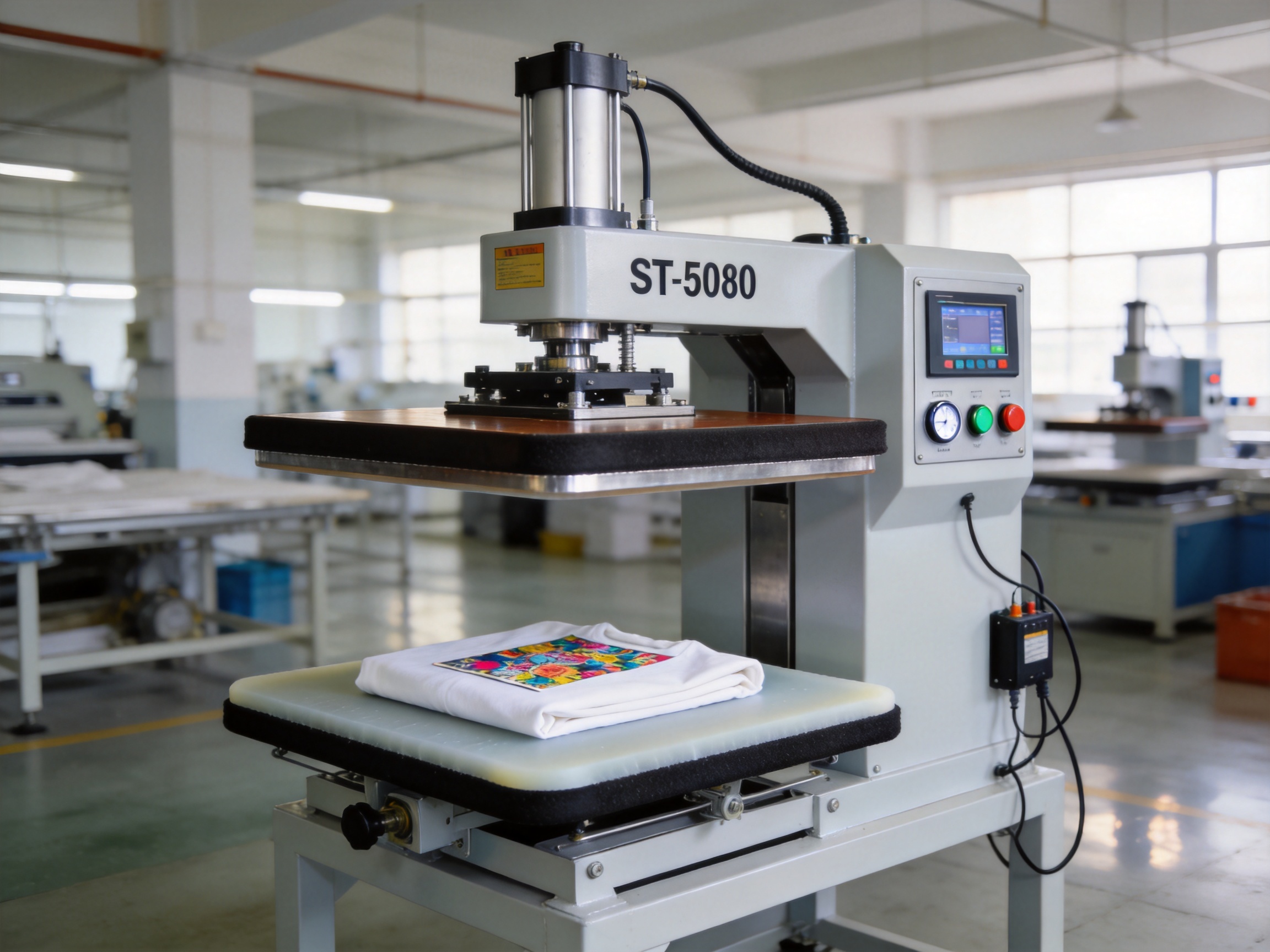
The ST-5060 is well suited to garment printing for products such as T-shirts, hoodies, workwear, uniforms, sports clothing, and other apparel. Its hydraulic pressure helps ensure that the design is pressed evenly onto the garment, while dual-sided heating supports comprehensive heat coverage.
Garment decorators can use the machine for colorful designs produced with sublimation or solvent-based ink systems, subject to the compatibility of the transfer materials and fabric. Cotton, linen, synthetic fibers, and blends may be processed when suitable settings are selected.
The single-station format can be useful for small and medium production workshops, custom apparel businesses, sampling departments, and manufacturers that need a flexible machine for varied orders. It can handle individual garments and short production runs while also supporting repeat work when settings have been standardized.
Fabric bonding involves joining two or more textile layers with the help of heat-activated adhesives or related materials. The ST-5060 can support this application by combining controlled pressure with heating from both sides.
Even pressure is important in fabric bonding because the adhesive must spread or activate consistently across the intended area. Uneven contact can result in weak points, lifting edges, or differences in flexibility. The hydraulic system helps maintain uniform force, while the heated plates support the activation of the bonding material.
Potential applications include layered textile components, decorative fabric assemblies, labels, patches, and other products that require a stable connection between materials. The correct adhesive and process settings must be selected according to the fabrics and the intended use of the finished product.
Puff printing creates a raised, three-dimensional effect on a textile surface. This effect gives printed garments a distinctive appearance and tactile quality. The ST-5060 supports puff printing by providing controlled heat, pressure, and timing.
Because puff effects depend on the behavior of the printing or transfer material, process control is particularly important. Excessive heat, unsuitable pressure, or an incorrect cycle time may affect the height, shape, or uniformity of the raised design. The machine’s digital controls and electronic timer help operators establish repeatable conditions.
Puff printing can increase the visual value of custom garments, fashion products, promotional apparel, and special-edition textile items. It is one example of how the ST-5060 can support decorative techniques beyond conventional flat transfers.
The machine can also be used for flocking and other special fabric-processing techniques. Flocking produces a soft or velvety surface effect, while related processes can create changes in texture or relief.
These applications benefit from even pressure because the decorative material must be properly fixed to the textile. The upper and lower heating system can also help provide a more stable thermal environment. As with all specialized processes, users should verify compatibility between the fabric, adhesive, transfer medium, and machine settings before beginning production.
The ST-5060 is designed to support the transfer of colorful sublimation and solvent-based ink designs. These methods allow businesses to produce detailed graphics, branding elements, decorative patterns, names, numbers, and customized artwork.
Sublimation applications are commonly associated with suitable synthetic textiles, while solvent-based ink transfers may be used with different material systems depending on the transfer construction. The machine’s broad temperature-control capability allows the operator to adapt the process more carefully to the selected transfer medium.
High-quality results depend on more than the press alone. Artwork preparation, ink quality, transfer-paper selection, fabric preparation, alignment, temperature, pressure, and time all influence the final product. The ST-5060 provides a stable processing platform for these variables.
Businesses evaluating heat transfer machinery often compare a hydraulic dual-heating system with a basic manual, single-heated press. Each machine type may have a place in the market, but the ST-5060 offers several practical advantages for users who require broader capability and more repeatable production.
| Evaluation Area | ST-5060 Hydraulic Dual-Heating Machine | Basic Manual Single-Heating Press |
|---|---|---|
| Pressure application | Hydraulic pressure supports even force distribution | Manual force may vary between cycles and operators |
| Heating arrangement | Upper and lower heating plates provide two-sided heat coverage | Usually relies on a single heated surface |
| Temperature control | Digital display and intelligent temperature controller | May provide less precise or less visible adjustment |
| Cycle timing | Electronic timer helps standardize processing time | Timing may depend more heavily on manual observation |
| Fabric range | Suitable for various fabrics, including cotton, linen, and synthetics | May be more limited by heating and pressure consistency |
| Special applications | Supports transfer printing, fabric bonding, flocking, and puff printing | May be intended mainly for basic flat transfers |
| Operator workload | Hydraulic operation can reduce repetitive manual pressing effort | Repeated manual closing may increase fatigue |
| Production consistency | Designed for repeatable pressure, heat, and time control | Results may vary more according to operator technique |
The comparison does not mean that every basic press is unsuitable. Manual machines may be useful for occasional work, very small businesses, or applications with limited requirements. However, when a company needs more consistent production, a broader range of textile applications, or reduced operator effort, the ST-5060 offers a stronger technical platform.
The combination of hydraulic pressing and dual-sided heating is particularly significant. A machine with only one of these features may improve one part of the process, but the ST-5060 integrates both systems. Digital controls and electronic timing further strengthen its suitability for repeat production.
Jinyun Shengda Sewing Equipment Co., Ltd. was established in 2003 and is located in Huzhen Town, Lishui City, Zhejiang Province, China. The company specializes in research, development, and production across several categories of textile and garment equipment.
Its product range includes electric irons, steam irons, hanging irons, spray guns, small steam machines, heat transfer machines, steam boilers, vacuum tables, and accessories. This range gives the company a broad understanding of garment finishing, pressing, steaming, and textile production requirements.
Experience across related product categories can support better equipment integration. For example, a company that manufactures both heat transfer machines and steam equipment can better understand how pressing, moisture, temperature, and garment finishing interact in a complete production environment.
The company emphasizes independent research and development. This capability allows product designs to be improved in response to customer requirements, manufacturing experience, and changing textile applications.
For the ST-5060, research and development is reflected in the combination of hydraulic pressing, upper and lower heating, digital temperature management, electronic timing, and a high-temperature-resistant silicone base. These features address common production needs: even pressure, heat consistency, process repeatability, durability, and operational convenience.
Independent development also supports adaptation. Different markets may require different electrical configurations, operating practices, packaging arrangements, or accessory combinations. A manufacturer with its own development and production capabilities is better positioned to discuss such requirements and provide suitable solutions.
The company states that it follows national and industry standards, including GB4706.1-2005 and GB4706.2-2007. Its products have also passed CCC and CQC certifications. These standards and certifications indicate a structured approach to electrical product safety and quality control.
Compliance is important for equipment used in commercial workshops because the machine must operate in an environment where heat, electricity, pressure, and repetitive production are present. Customers should confirm the specific certification documentation and electrical configuration applicable to the model and destination market before purchase.
A quality-oriented manufacturing process should include material selection, component inspection, assembly control, electrical testing, functional testing, and final inspection. For a hydraulic heat transfer machine, attention should also be paid to the alignment of the plates, hydraulic operation, temperature control, timer function, silicone pad condition, and protective features.
The company’s research and development, management, and sales teams work closely together. This type of coordination can improve communication between product design and customer service. Technical feedback from customers can be transferred to the development team, while product information can be communicated more accurately to distributors and end users.
Close coordination is especially valuable for machinery because customers often need more than a product catalogue. They may require guidance on application suitability, installation, operation, spare parts, packaging, export documentation, or after-sales support. A manufacturer with connected internal teams can respond more efficiently to these practical needs.
The company offers customization and OEM services. These capabilities may benefit distributors, importers, textile equipment dealers, and businesses that require private-label products or market-specific configurations.
Customization can involve branding, packaging, documentation, electrical requirements, accessories, or other agreed technical details. Any modification should be confirmed in writing before production, including the effect on delivery time, certification, warranty, and maintenance requirements.
OEM capability also demonstrates that the manufacturer is prepared to work according to defined customer specifications. This can be valuable for businesses developing a complete product range or seeking consistent equipment from a long-term manufacturing partner.
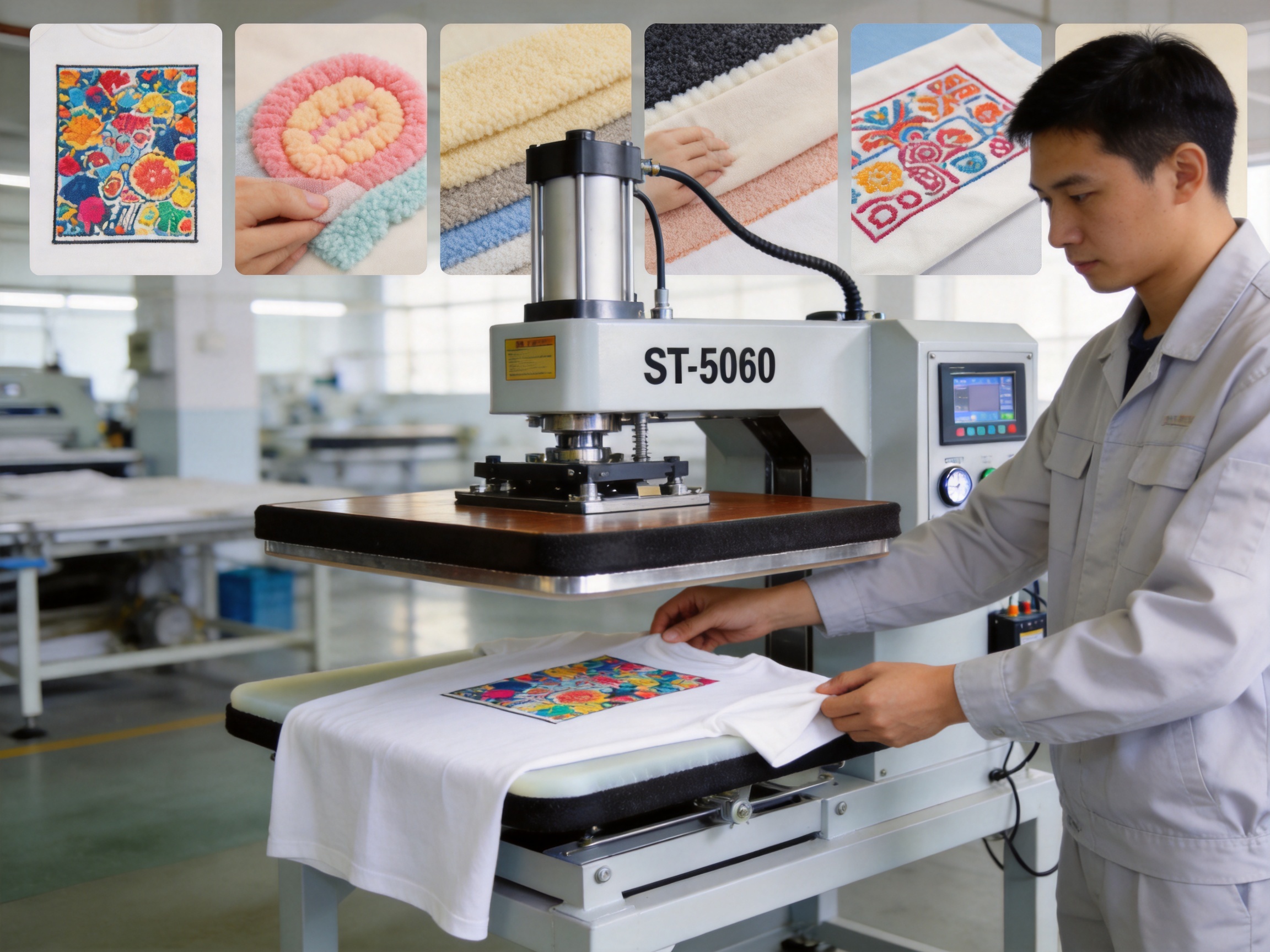
Before operating the machine, the fabric should be clean, dry, and free from wrinkles, oil, dust, and loose fibers in the transfer area. Garments should be checked for seams, zippers, buttons, pockets, or other raised features that may affect contact with the pressing plates.
The transfer design should also be inspected for correct size, orientation, color, and placement. For repeated orders, the company should prepare positioning templates or work instructions to reduce variation between garments.
The operator should determine the appropriate temperature, pressure, and cycle time for the selected material combination. These settings should be based on the transfer-medium supplier’s instructions, fabric characteristics, and trial results.
The digital display allows the operator to set and monitor temperature, while the hydraulic system provides controlled pressure. The electronic timer helps define the duration of the cycle. When a new material is introduced, a test piece should be processed before full production begins.
The textile is placed on the silicone base, and the transfer material is positioned on the intended area. Correct alignment is essential, especially for logos, names, numbers, and centered artwork. The operator should verify that the material is flat and that no unwanted folds are trapped beneath the transfer.
Once the material is positioned, the machine applies the selected heat and hydraulic pressure. The upper and lower heating plates provide thermal coverage, while the silicone base supports contact and heat distribution. The operator should avoid touching heated surfaces and should follow all applicable safety procedures.
After the electronic timer indicates that the cycle is complete, the product can be removed according to the requirements of the transfer material. Some transfers may require hot peeling, warm peeling, or cold peeling, so the operator should follow the relevant technical instructions.
The finished item should be inspected for adhesion, edge definition, color, texture, placement, and surface defects. Any irregularities should be recorded so that temperature, pressure, time, alignment, or material preparation can be reviewed.
Quality control should begin before pressing and continue through final inspection. The machine can provide stable operating conditions, but consistent results also depend on the quality of the fabric and transfer materials.
Temperature should be checked periodically to ensure that the displayed setting corresponds to the actual process requirement. The heating plates should be kept clean and free from residue. Contamination can affect contact, transfer appearance, and the service life of the working surfaces.
Pressure consistency should also be monitored. Unusual hydraulic noise, slow movement, leakage, unstable pressing, or visible misalignment should be investigated promptly. Continuing to operate a machine with a suspected hydraulic or structural problem may result in poor production quality or create a safety risk.
The silicone base should remain level and resilient. If it becomes permanently indented, damaged, or uneven, the contact conditions may change. Replacing a worn pad can help protect production quality and reduce stress on the press.
Production records can improve quality management. A record may include fabric type, transfer material, temperature, pressure setting, cycle time, operator, date, and inspection result. These records help identify successful parameters and make troubleshooting more systematic.
Routine maintenance helps preserve the performance of the ST-5060. The machine should be cleaned according to the manufacturer’s instructions, with particular attention to the heated surfaces, silicone base, control area, and surrounding workspace.
Before maintenance or inspection, the machine should be switched off and isolated from its power source where appropriate. Heated components must be allowed to cool before cleaning or handling. Operators should not attempt to repair electrical or hydraulic systems unless they are properly qualified.
The hydraulic system should be inspected for signs of leakage, unusual pressure behavior, or damaged components. Electrical cables, switches, controllers, and connections should be checked for visible damage. Any fault affecting temperature, timing, pressure, or machine movement should be reported and resolved before regular production resumes.
The work area should be kept clear of unnecessary materials. Heat-resistant gloves or other appropriate protective equipment may be required depending on the process. Operators should receive instruction on hot surfaces, pinch points, emergency procedures, and correct loading and unloading methods.
Safety is also supported by good workflow design. Materials should be stored so that the operator does not need to reach across heated surfaces. Finished products should be placed in a designated cooling area, and transfer films or papers should be organized to prevent mix-ups.
The ST-5060 can serve several types of textile businesses because its capabilities are not restricted to a single decoration method. A small custom apparel studio can use it for personalized garments and short runs. A promotional product supplier can apply logos and graphics to clothing. A garment factory can use it for branding, patches, or fabric bonding. A textile sampling department can use the machine to test designs and materials before larger production.
Its single-station configuration can be advantageous where floor space is limited or where production volumes do not justify a larger multi-station system. At the same time, hydraulic pressure, dual heating, and controlled timing provide features that can support a more professional production standard than a simple entry-level press.
Businesses can also benefit from the machine’s process versatility. Instead of purchasing separate basic machines for flat transfers, bonding, and selected special effects, they may be able to consolidate several related operations on one flexible platform. The exact suitability depends on the materials and production volume, but the broad application range can simplify equipment planning.
Before purchasing the ST-5060, customers should review the intended applications, fabric types, transfer materials, expected production volume, available electrical supply, workspace, ventilation, operator skills, and service requirements.
The buyer should confirm the working-area dimensions, electrical specifications, hydraulic requirements, temperature range, control functions, delivery configuration, and included accessories with the supplier. These details are important because machine configurations may vary according to market and customer requirements.
Training should be included in the implementation plan. Operators need to understand material preparation, setting selection, loading and unloading, safe operation, quality inspection, and basic maintenance. Written work instructions are useful for maintaining consistency when several people operate the machine.
Businesses should also plan for replacement consumables and service components. The silicone pad is a working component that may eventually require replacement. Transfer materials, protective sheets, cleaning supplies, and other process items should be managed as part of the production system.
When buying from an overseas manufacturer, customers should also clarify packaging, shipment terms, documentation, warranty coverage, technical support, spare parts availability, and communication procedures. These factors can be as important as the machine’s basic specifications when calculating long-term operating value.
Jinyun Shengda Sewing Equipment Co., Ltd. operates from No. 8 Nanyi Road, Huzhen Industrial Park, Zhejiang, China. The company’s location benefits from access to transportation and information channels at the junction of Lishui, Jinhua, and Taizhou.
The manufacturer supplies products to China and overseas markets. Its export regions include Southeast Asia, Central Asia, South America, Africa, and other areas. International distribution experience can help the company understand the documentation, packaging, communication, and service expectations associated with export orders.
The company owns several brands, including Silver Star, Platinum Dragon, Tingshun, Jiasheng, Shengtai, and Jiangxin. Its broad product portfolio and established distribution channels indicate experience in serving different market segments and customer requirements.
The company identifies several business advantages: customization and OEM services, reliable quality, diverse products, competitive costs, professional service, and convenient shipment. These strengths are relevant to buyers seeking not only a machine but also a long-term equipment supplier.
Customers can contact the company through jyshengda@163.com or caroying@jy-shengda.com. Telephone communication is available at +86-578-3158872, and the fax number is +86-578-3158958.
Efficient heat transfer depends on applying the required heat for the required time rather than using excessive settings. The ST-5060’s digital temperature control and electronic timer can support more disciplined operation. By standardizing settings, businesses may reduce rejected products, unnecessary reprocessing, and material waste.
Dual-sided heating may also contribute to efficient heat penetration in certain applications. When both sides of a material assembly receive heat, the process may achieve the required condition more effectively than a single-sided approach, depending on fabric thickness and transfer construction.
Operational efficiency is not determined by the machine alone. Proper maintenance, accurate positioning, good material storage, operator training, and systematic quality control all contribute to efficient production. A reliable press becomes more valuable when it is integrated into a well-organized workflow.
Reducing production defects is one of the most practical forms of resource efficiency. Consistent pressure, temperature, and time can help prevent failed transfers and reduce the amount of fabric, transfer material, labor, and energy consumed by rework.
The ST-5060 offers a combination of features designed for dependable and flexible textile processing. Its hydraulic system provides controlled pressure and helps reduce variation between production cycles. Upper and lower heating plates provide comprehensive heat coverage and support applications involving layered or thicker materials.
The low-temperature operating capability expands the range of fabrics that can be processed. Digital temperature control makes settings easier to monitor, while electronic time control helps standardize cycle duration. The high-temperature-resistant silicone base supports durable operation and contributes to stable heat and pressure distribution.
Compared with a basic manual single-heated press, the ST-5060 can provide better process control, lower operator effort, broader application potential, and more repeatable results. It supports garment printing, fabric bonding, sublimation transfers, solvent-based ink transfers, flocking, and puff printing.
Its value is further strengthened by the manufacturer’s independent research and development, broad product expertise, manufacturing experience, quality orientation, certification background, customization services, OEM capability, and export experience.
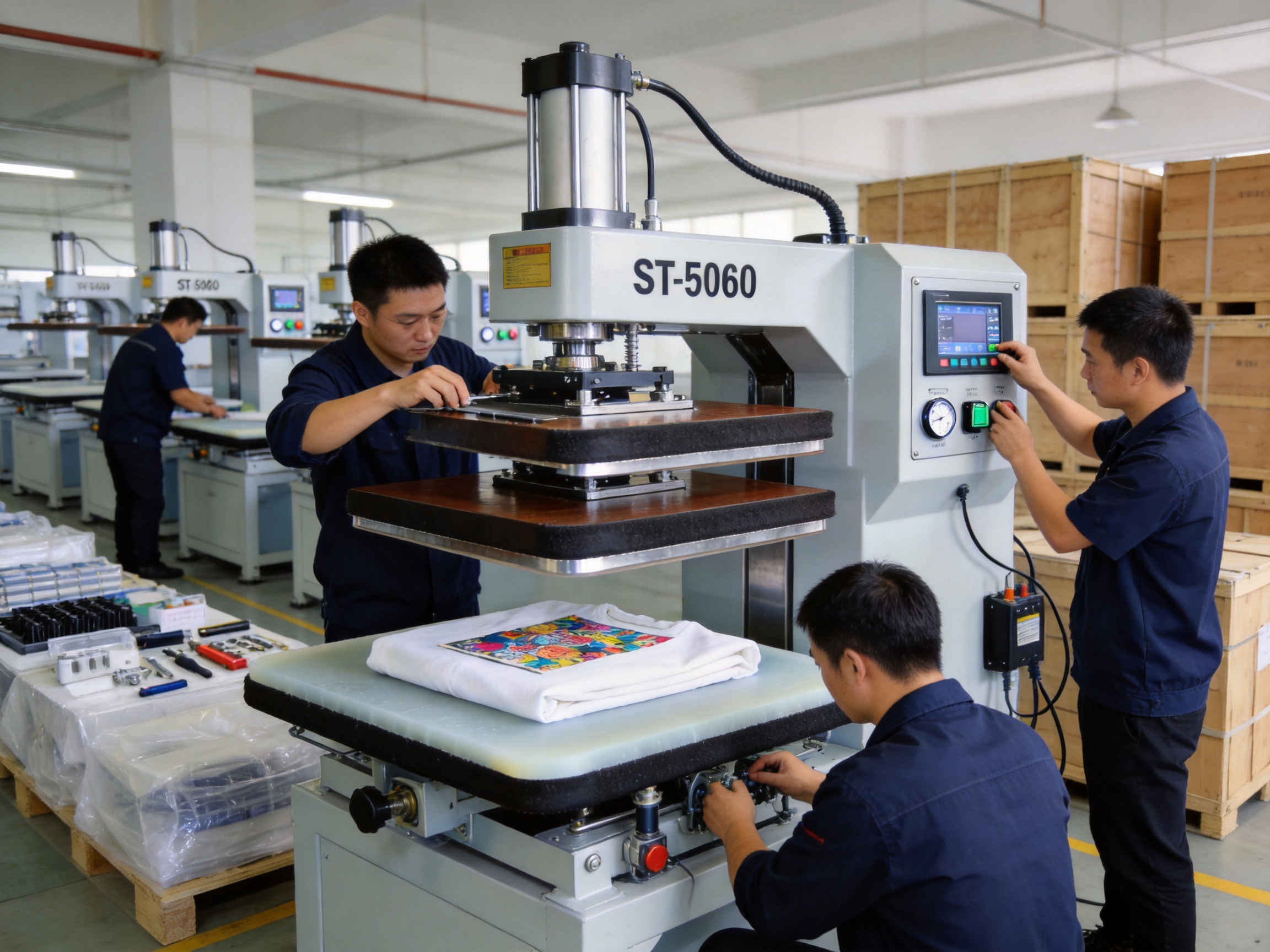
The ST-5060 is used for heat transfer printing, garment decoration, fabric bonding, sublimation transfer, solvent-based ink transfer, flocking, and puff printing. It can process materials such as cotton, linen, synthetic fibers, and suitable blends.
Upper and lower heating provides heat from both sides of the material. This can improve heat coverage, support more uniform penetration, and benefit applications involving layered or thicker textiles.
Hydraulic pressing helps distribute pressure evenly across the working area. It can improve transfer consistency, reduce operator effort, and provide more repeatable results than manual pressing methods.
The machine can operate efficiently at lower temperatures, which may make it suitable for certain heat-sensitive fabrics. The correct temperature, pressure, and time must always be established through material testing and supplier recommendations.
Yes. The machine supports puff printing, which creates a raised three-dimensional effect. Accurate temperature, pressure, and timing are important for maintaining a consistent puff appearance.
The electronic timer controls the duration of each transfer cycle and signals the operator when the selected time has elapsed. This helps reduce underexposure and overexposure to heat.
The silicone base provides a durable, heat-resistant working surface. According to the supplied information, it can withstand temperatures up to 200°C without deforming and helps support stable contact and heat distribution.
Its single-station design can suit small and medium textile workshops, custom apparel businesses, sampling departments, and other operations that need flexible production without a multi-station system.
Buyers should confirm working-area dimensions, electrical requirements, temperature and pressure capabilities, included accessories, delivery terms, certification documentation, warranty conditions, spare parts, and technical support.
Yes. The company offers customization and OEM services. Specific requirements should be discussed and confirmed before production, including branding, packaging, electrical configuration, documentation, and delivery arrangements.
Jinyun Shengda Sewing Equipment Co., Ltd. is located at No. 8 Nanyi Road, Huzhen Industrial Park, Zhejiang, China.
Customers can contact the company by email at jyshengda@163.com or caroying@jy-shengda.com. The telephone number is +86-578-3158872, and the fax number is +86-578-3158958.
The ST-5060 Hydraulic Upper and Lower Heating Single-Station Heat Transfer Machine is a versatile textile-processing solution for businesses that require consistent pressure, controlled temperature, accurate timing, and broad application capability. Its hydraulic system helps deliver even pressing force, while dual heating plates improve thermal coverage from both sides of the material.
The machine is suitable for garment printing, fabric bonding, sublimation, solvent-based ink transfer, flocking, and puff printing. Its ability to operate at lower temperatures makes it useful for a wider variety of fabrics, while its digital display, intelligent temperature controller, electronic timer, and durable silicone base support practical day-to-day operation.
Beyond the product itself, the manufacturer offers the advantages of independent research and development, experience across multiple textile equipment categories, established production capabilities, certification awareness, customization, OEM services, professional support, and international distribution experience.
For textile manufacturers, garment decorators, promotional product suppliers, and custom apparel businesses, the ST-5060 provides a balanced combination of flexibility, repeatability, and operational control. When correctly installed, maintained, and operated according to suitable material parameters, it can become a dependable part of a modern heat transfer production line.
1. Product information supplied for the ST-5060 Hydraulic Upper and Lower Heating Single-Station Heat Transfer Machine.
2. Company profile and manufacturing information supplied by Jinyun Shengda Sewing Equipment Co., Ltd.
3. General technical principles of textile heat transfer printing, including the relationship between temperature, pressure, and time.
4. General textile production guidance concerning fabric preparation, transfer-material compatibility, quality inspection, and equipment maintenance.
5. GB4706.1-2005, Safety of Household and Similar Electrical Appliances—General Requirements.
6. GB4706.2-2007, Safety Requirements for Household and Similar Electrical Appliances—Particular Requirements.
7. General industrial practices for hydraulic press operation, thermal-process safety, electrical inspection, and garment finishing.
 +86-578-3158872 / +86-578-3158958
 jyshengda@163.com / caroying@jy-shengda.com
 No. 8 Nanyi Rd, Huzhen Industrial Park, Zhejiang, China
Copyright © Jinyun Shengda Sewing Equipment Co., Ltd. All Rights Reserved.
Ironing Press Machine Equipment Factory
 English
 中文简体
 русский
 عربى