In professional garment manufacturing, the quality of the final pressing process can determine how a finished product looks, feels, and performs. Even a well-cut and carefully sewn garment may lose its commercial appeal if seams are poorly defined, fabrics remain wrinkled, or delicate areas are difficult to finish. A reliable vacuum ironing table provides the stable working surface, controlled heat, and fabric support required to achieve a consistent result.
The ST-Q3-G 400x1200mm Vacuum Ironing Table is designed for tailoring workshops, garment factories, alteration businesses, apparel sampling rooms, and other professional applications that require accurate and repeatable pressing. Its integrated heating and vacuum systems create a controlled finishing environment, while the heated tabletop and heated arm help operators work efficiently across different garment sections.
With a 4KW heating pipe, a 750W vacuum motor, a vacuum pressure of at least 150Pa, a 1350W heated tabletop, and a 400W heated arm, the unit combines several important functions in one compact workstation. Its 400x1200mm table size provides a useful work area without demanding the floor space associated with larger industrial installations. A built-in illumination system further improves visibility during detailed operations.
This article examines the product’s design, operating advantages, applications, technical specifications, manufacturing strengths, and suitability for different users. It also explains how the equipment can support quality control, workplace efficiency, and professional garment presentation.

ST-Q3-G 400x1200mm Vacuum Ironing Table
Garment finishing is more than simply removing visible wrinkles. It includes shaping panels, opening seams, setting collars and cuffs, improving edge definition, preparing garments for inspection, and creating a clean appearance before packaging or retail display. These operations require a surface that can manage heat, moisture, pressure, and fabric movement at the same time.
A conventional ironing board may be sufficient for occasional household use, but professional production places greater demands on equipment. Operators may work for many hours, handle different materials, and process garments with complex shapes. A basic board often lacks integrated suction, dedicated heating, stable construction, and the ergonomic features necessary for continuous production.
A vacuum ironing table addresses these limitations by drawing air through the work surface. This suction helps hold fabric in position, remove excess moisture, and support more controlled shaping. The result can be a cleaner seam line and a more stable garment surface during pressing. For tailoring and high-end apparel work, these functions are particularly valuable because small finishing imperfections can affect the perceived quality of the entire garment.
The ST-Q3-G combines vacuum support with multiple heating elements. The heated tabletop helps maintain a consistent working temperature under the garment, while the heated arm provides additional support for sleeves, narrow sections, and shaped areas. The heating pipe contributes to the system’s heat generation, helping the equipment reach the operating condition needed for professional pressing work.
Because the functions are integrated into one workstation, the operator does not need to move repeatedly between separate heating, pressing, and positioning stations. This can reduce unnecessary handling and make the finishing process more organized. In a production environment, improved workflow may contribute to more consistent output and easier operator training.
The ST-Q3-G is a 400x1200mm vacuum ironing table developed for precision garment finishing. Its dimensions provide a long, practical working surface for garments, panels, seams, and fabric sections while maintaining a relatively compact footprint. This balance is useful for workshops where available floor space must be managed carefully.
The product includes a high-power heating pipe rated at 4KW. This component supports the machine’s heating performance and helps establish an effective working environment for pressing. The tabletop itself includes 1350W of heating power, helping the work surface maintain useful heat during operation rather than relying only on an external iron.
A 400W heated arm extends the table’s practical flexibility. Sleeves, trouser legs, shoulder areas, narrow seams, and other difficult sections can be positioned over the arm for more controlled finishing. This is especially useful for tailored garments and products where a flat surface alone cannot provide the correct shape.
The 750W vacuum motor generates suction through the work surface. The stated vacuum pressure is at least 150Pa. By helping secure fabric and draw away moisture, the vacuum function supports precise positioning and more predictable pressing results. Operators can work with greater control when materials are less likely to shift during ironing.
The table operates on a 220V power supply and features a rotational speed of 2800r/min. These specifications are important for buyers assessing electrical compatibility and operating performance. Before installation, users should confirm that the local power system, wiring, protective devices, and workplace regulations are suitable for the equipment.
An integrated illumination system improves visibility over the working area. Good lighting is important when checking seam alignment, fabric grain, edge quality, surface marks, and small construction details. In a busy workshop, built-in illumination can also reduce dependence on uneven ambient lighting.
| Item | Specification |
|---|---|
| Product type | Vacuum ironing table |
| Model | ST-Q3-G |
| Heating pipe power | 4KW |
| Vacuum motor power | 750W |
| Vacuum pressure | At least 150Pa |
| Tabletop heating power | 1350W |
| Arm heating power | 400W |
| Power supply | 220V |
| Rotational speed | 2800r/min |
| Table size | 400x1200mm |
| Illumination | Integrated lighting system |
One of the main advantages of the ST-Q3-G is its integrated heating configuration. Instead of treating the ironing surface as a passive board, the product adds 1350W of tabletop heating and 400W of arm heating. This supports more stable contact between the work surface and the garment.
Consistent heat can be useful when opening seams, shaping garment sections, and preparing materials for subsequent operations. The heated surface helps reduce the temperature difference that may occur when a garment is placed on a cold board. It also supports a more predictable relationship between the iron, fabric, and underlying table.
The 4KW heating pipe provides substantial heating capacity for a professional workstation. In comparison with basic tables that depend solely on the external iron, this configuration gives the operator more control over the overall working environment. The iron remains important, but the table contributes actively to the finishing process.
Heat management must always be matched to the material being processed. Different fabrics have different temperature tolerances, moisture requirements, and pressure sensitivities. Operators should follow the fabric manufacturer’s recommendations and conduct a test on a concealed area when working with unfamiliar materials.
Fabric movement is a common source of inconsistency during garment pressing. Lightweight textiles, slippery materials, bias-cut sections, and multilayer assemblies may shift when pressure is applied. The vacuum function helps stabilize the garment against the table surface.
The 750W vacuum motor and stated vacuum pressure of at least 150Pa provide the suction force needed for professional table operation. The air movement can also help remove moisture from the pressing area. When moisture and heat are managed correctly, seams may settle more effectively and the fabric can be shaped with greater control.
Vacuum support is especially useful for operations that require accurate positioning. An operator can place a seam, edge, or panel in the desired location and apply the iron with less concern that the material will slide away from the reference point. This can improve repeatability across multiple garments.
Compared with a non-vacuum board, a vacuum table may also help reduce the amount of manual holding required. The operator can focus more closely on the iron and the garment shape instead of constantly repositioning the fabric. This may support better ergonomics and a smoother production rhythm.
A flat table is useful for broad panels, but many garment areas are curved, narrow, or difficult to access. Sleeves, cuffs, trouser legs, shoulder sections, and fitted garment components often require a more specialized support surface.
The ST-Q3-G includes a 400W heated arm to address these requirements. The arm allows the operator to position smaller or tubular sections more naturally. Heating at the arm can help maintain a more consistent working condition when the garment is moved away from the main tabletop.
This feature may reduce the need to stretch or flatten shaped garments excessively. Excessive flattening can affect the intended form of a garment, especially in tailored or structured products. A shaped support helps the operator preserve construction details while still applying controlled heat and pressure.
The 400x1200mm table size offers a useful combination of length and compactness. A 1200mm length provides room for many garment sections and fabric panels, while the 400mm width keeps the table suitable for workshops with limited space.
Compact equipment can be valuable for sample rooms, tailoring shops, repair businesses, educational facilities, and smaller production lines. It may also be appropriate when a company wants to add a specialized pressing station without redesigning the entire workshop.
At the same time, buyers should evaluate the table size against their actual product range. Large upholstery pieces, oversized curtains, or very broad industrial textiles may require a larger specialized surface. For apparel, tailoring, alterations, and detailed garment finishing, the stated dimensions provide a practical working area.
Accurate finishing depends on what the operator can see. Loose threads, seam distortion, shine marks, puckering, uneven edges, and small stains may be difficult to identify under weak or inconsistent lighting.
The ST-Q3-G includes an illumination system positioned as part of the workstation design. This helps create a clearer view of the working area and can support more detailed inspection during pressing. Better visibility is particularly useful for dark fabrics, fine materials, complex seam structures, and quality-control checks.
Integrated lighting can also contribute to a more organized workstation. Rather than depending entirely on a separate lamp that may cast shadows or occupy valuable table space, the operator has lighting incorporated into the equipment configuration.
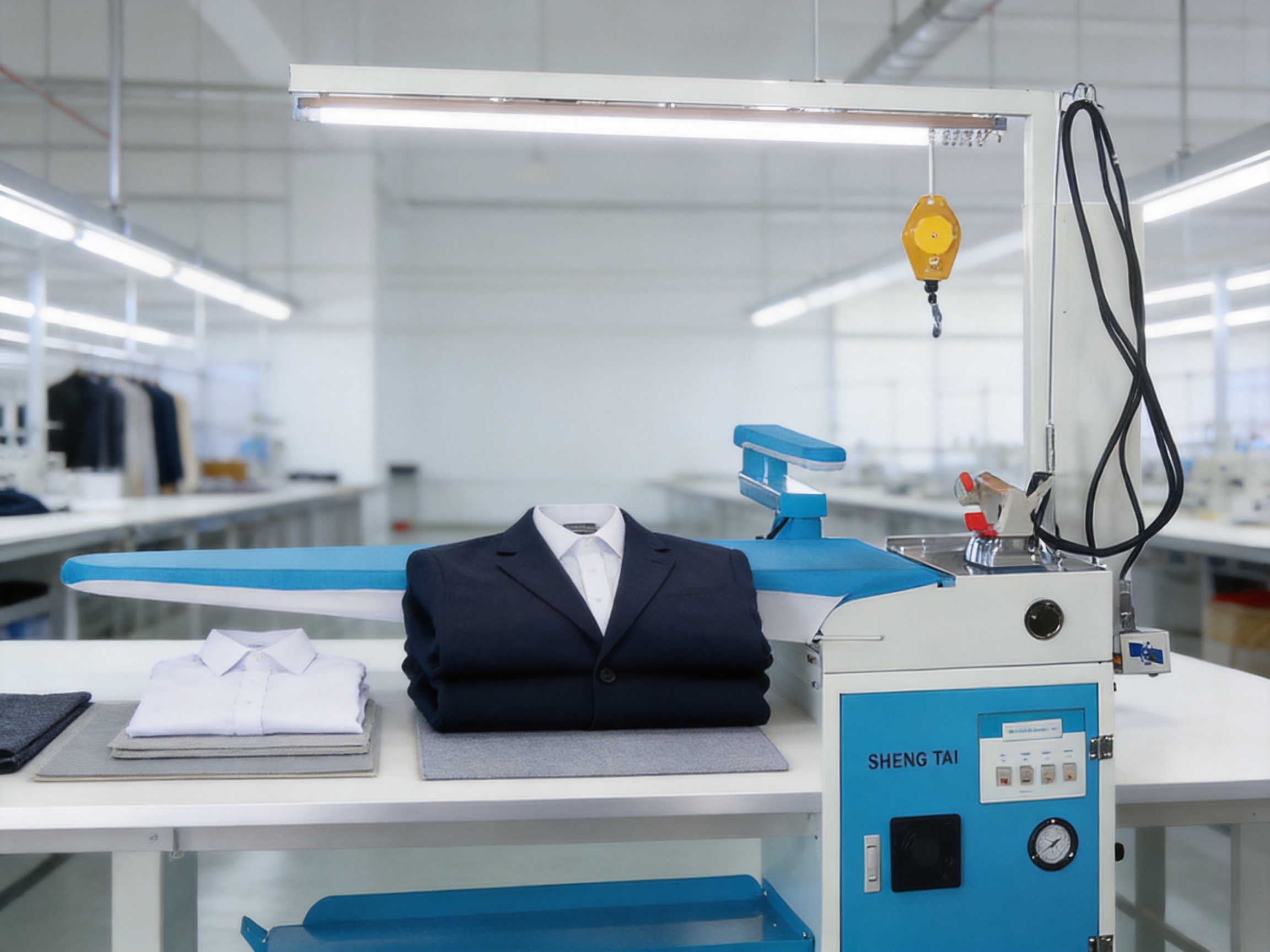
Purchasers comparing vacuum ironing tables should look beyond the name of the product and examine how the complete system supports daily work. The ST-Q3-G offers several functional advantages over basic ironing boards and less integrated tables.
A basic ironing board provides a place to lay fabric, but it may not provide active heating or vacuum support. The ST-Q3-G contributes to the pressing process through a heated tabletop, heated arm, and vacuum motor. This makes the workstation more active and more closely aligned with professional finishing requirements.
Professional garment production depends on repeatability. One successful pressing result is not enough; the same standard must be maintained across a batch. Integrated heating and suction help establish more consistent working conditions from one garment to the next.
Repeatability does not come from the machine alone. It also depends on operator training, fabric knowledge, maintenance, and correct temperature selection. However, a well-equipped workstation gives operators a stronger foundation for following standardized procedures.
The combination of a flat heated tabletop and heated arm allows the operator to address both broad and shaped sections. This is more flexible than a single flat surface. It can reduce the need to use improvised supports or transfer garments between multiple stations.
Some industrial pressing systems are designed for very large production environments and may require considerable space. The 400x1200mm configuration is more suitable for users who need professional features in a compact format. This can be an advantage for small and medium-sized factories, tailoring businesses, and specialized finishing departments.
High-end apparel and bespoke tailoring require careful control because the value of the product is closely connected to its appearance and finish. A visible seam distortion or poorly shaped sleeve may be unacceptable even if the garment is technically complete.
The ST-Q3-G’s vacuum support, heated arm, tabletop heating, and illumination system are suited to work where detail matters. These functions allow operators to pay closer attention to shape, surface quality, and construction lines.
Bespoke tailoring involves individual fitting, detailed construction, and careful finishing. Garments often include shaped panels, canvassed areas, complex lapels, curved seams, and carefully formed sleeves. A vacuum ironing table can support the pressing stages needed to refine these details.
The heated arm is especially useful when working with sleeves and narrow sections. The operator can position a sleeve or trouser leg over the arm and apply controlled pressing without forcing the component completely flat. This supports the dimensional character of tailored clothing.
Luxury and premium apparel manufacturers often require consistent presentation across a production batch. The finished garment must meet visual expectations at inspection, photography, packaging, and retail display stages.
The ST-Q3-G can be used for seam opening, final shaping, collar and cuff finishing, sleeve preparation, and appearance correction. The integrated illumination system helps operators inspect the surface during the finishing process.
Alteration businesses handle a wide variety of garments and materials. Work may include trouser adjustments, sleeve changes, waist alterations, repairs, and reshaping. Because each job can differ from the previous one, flexible equipment is important.
The combination of a compact footprint and professional functions makes the ST-Q3-G suitable for many alteration environments. It provides more capability than a household ironing board while remaining appropriate for a workshop where space and workflow are closely managed.
Sample rooms need to move quickly between different designs, fabrics, and construction methods. Pressing is often required throughout pattern development and prototype evaluation, not only at the end of production.
A controlled pressing station helps pattern makers, sample machinists, and product developers assess how seams, edges, and fabric behavior respond to heat and moisture. The vacuum function can also help stabilize delicate samples during repeated adjustments.
In a factory, the vacuum ironing table can function as a dedicated station within a broader finishing line. It may be assigned to a particular operation, such as sleeve finishing, seam opening, final garment preparation, or quality correction.
The equipment’s electrical and space requirements should be reviewed during line planning. Proper ventilation, safe cable routing, operator access, and maintenance clearance are important parts of installation planning.
Educational facilities teaching fashion design, tailoring, garment technology, or industrial sewing can use professional equipment to help students develop correct working habits. Training on a vacuum ironing table introduces learners to the relationship between heat, pressure, moisture, suction, and fabric structure.
Students can also learn why pressing is considered a construction process rather than a final cosmetic step. Correct pressing at each stage can improve accuracy and reduce the need for corrective work later.
The product is manufactured by Jinyun Shengda Sewing Equipment Co., Ltd., a Chinese producer with experience in sewing and ironing equipment. The company was established in 2003 and is located in Huzhen Town, Lishui City, Zhejiang Province.
The company focuses on independent research, development, and production. Its product range includes electric irons, steam irons, hanging irons, spray guns, small steam machines, heat transfer machines, steam boilers, vacuum tables, and related accessories. This broad product scope gives the manufacturer experience across several connected areas of garment equipment.
A manufacturer that develops multiple categories within the same industry can better understand the complete workflow surrounding pressing and finishing. Vacuum tables, steam boilers, irons, spray guns, and accessories are not isolated products in a professional workshop. They often operate as parts of one production system.
Independent research and development supports product improvement over time. In equipment manufacturing, development work may include refining heating arrangements, improving operating convenience, adjusting structural components, evaluating electrical systems, and responding to customer requirements.
The company’s stated commitment to independent research and development indicates an approach focused on building and improving its own product capabilities. This is important for buyers who need equipment that can be adapted to changing market expectations or specific application requirements.
The company’s portfolio covers steam generation, pressing, ironing, heat transfer, spraying, and vacuum support. This category experience may help customers source complementary equipment from a single manufacturer rather than coordinating with several unrelated suppliers.
For distributors and garment factories, a broader product range can simplify communication, product matching, spare-parts planning, and technical discussions. It can also make it easier to develop a consistent equipment package for a workshop or production line.
The company identifies customization and OEM services among its advantages. These services can be relevant to importers, distributors, brand owners, and industrial users who require particular labeling, packaging, configuration, or product coordination.
Customization should be discussed in detail before an order is placed. Buyers should clarify minimum order quantities, available options, electrical requirements, packaging, documentation, testing procedures, and delivery schedules. Clear technical communication helps ensure that the supplied product matches the intended application.
The company states that it follows national and industry standards, including GB4706.1-2005 and GB4706.2-2007. It also states that its products have passed CCC and CQC certifications. Buyers should request current certification documents and confirm that the specific model and production version are covered by the applicable documentation.
Standards and certifications are important because ironing equipment combines electricity, heat, moving components, and, in some systems, steam or vacuum. Responsible manufacturing requires attention to insulation, grounding, component selection, protective measures, assembly quality, and product testing.
The company reports stable distribution channels in China and exports to Southeast Asia, Central Asia, South America, Africa, and other regions. International experience can be valuable because overseas customers often require additional attention to power compatibility, documentation, packaging, shipping arrangements, and after-sales communication.
Export buyers should still confirm all destination-specific requirements before purchase. Electrical standards, plug types, labeling rules, certification requirements, and customs documentation can vary by country.
The factory is located in Huzhen Industrial Park, Zhejiang, China, at No. 8 Nanyi Road. The company describes its location as being near the junction of Lishui, Jinhua, and Taizhou, with convenient transportation and information channels.
For international customers, logistics planning should include product dimensions, packing dimensions, gross weight, container loading, shipping terms, insurance, customs documents, and destination delivery. A manufacturer’s location within an industrial region may support coordination with component suppliers, freight providers, and related equipment businesses.
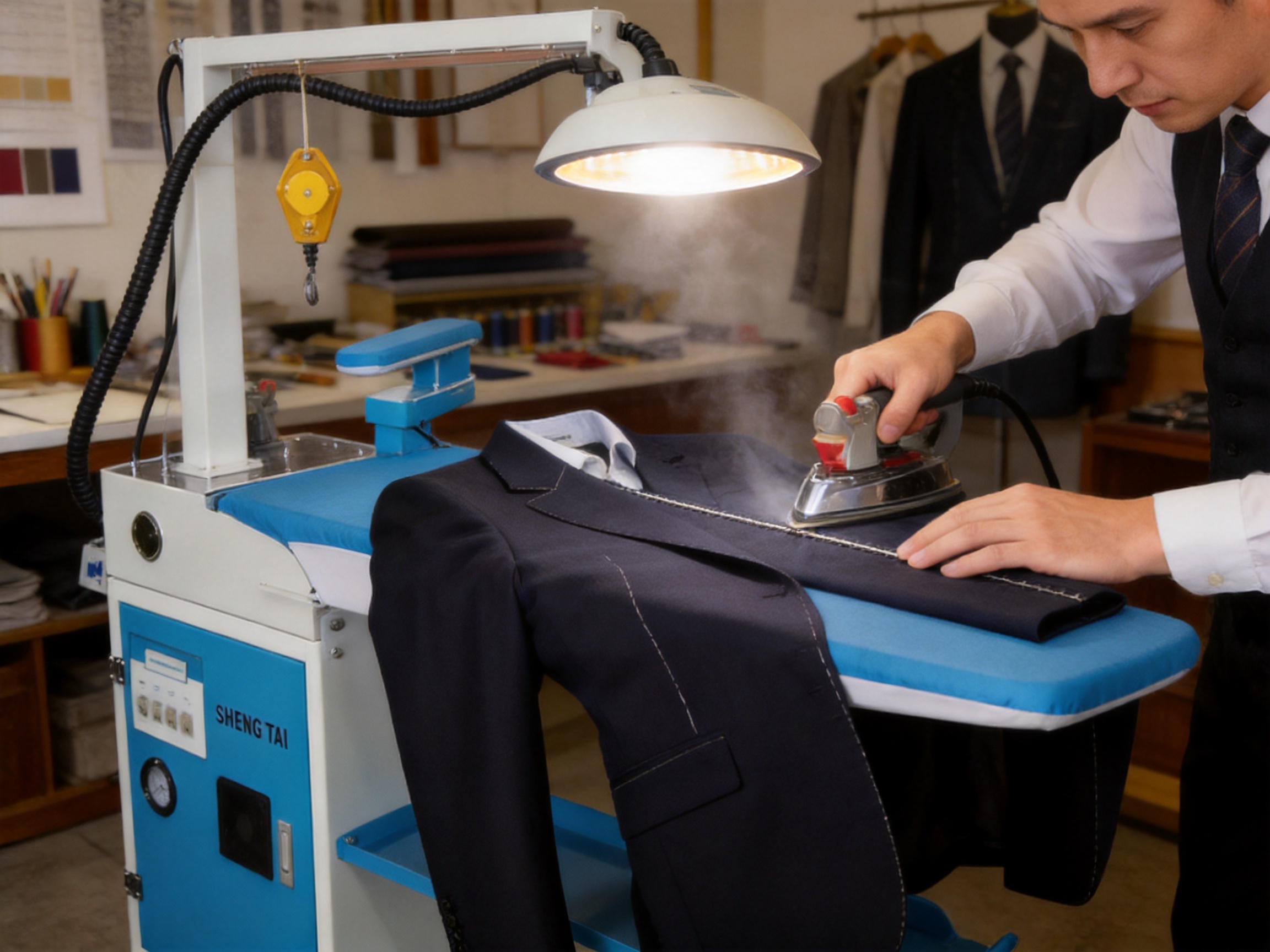
Although specific internal production procedures may vary, professional vacuum ironing table manufacturing generally requires coordination between mechanical fabrication, heating-system assembly, electrical installation, vacuum-system integration, surface finishing, and final testing.
The table structure must support repeated operator use and withstand the heat associated with pressing. Dimensional accuracy is important because the tabletop, arm, and associated components need to work together as a stable workstation.
Manufacturing attention should be given to frame alignment, surface flatness, component fit, fastening, and access for future maintenance. A stable structure helps reduce unwanted movement during pressing and contributes to operator confidence.
The 4KW heating pipe, 1350W tabletop heating system, and 400W arm heating system must be integrated in a manner that supports practical heat distribution. Electrical connections, insulation, temperature control, and protective components are important considerations during assembly.
Heat should be distributed in a controlled way rather than concentrated in isolated areas. Uneven heating may cause inconsistent pressing results or create unnecessary stress on fabrics. Proper testing helps identify abnormal temperature behavior before the product reaches the customer.
The vacuum motor, air channels, table surface, and filtration or maintenance access points form the suction system. Effective assembly requires attention to airflow paths and sealing. The stated 750W motor and vacuum pressure specification provide a basis for performance evaluation.
During use, the vacuum surface may collect lint, loose fibers, and dust. A practical design should allow operators to inspect and clean relevant areas. Regular maintenance helps preserve airflow and reduces the risk of performance decline.
Because the equipment operates at 220V and includes several powered systems, electrical assembly and testing are central to manufacturing quality. Wiring should be organized, protected, and appropriate for the connected loads. Grounding and protective devices should be checked according to applicable requirements.
Final inspection may include power-on testing, heating checks, vacuum checks, lighting checks, rotational-speed verification where applicable, and visual inspection of the finished unit. Buyers can request information about factory testing and quality-control procedures when evaluating suppliers.
A professional finishing machine should arrive ready for safe installation and commissioning. Final inspection can help confirm that the table surface, arm, controls, lighting, electrical connections, and external finishes meet the intended standard.
Packaging is equally important for export products. The unit should be protected against impact, moisture, abrasion, and movement during transportation. International buyers should confirm whether installation instructions, operating manuals, spare parts, and electrical accessories are included.
A machine’s value is measured not only by its specifications but also by how it affects daily work. The ST-Q3-G is designed as an integrated workstation, which can help operators develop a clear and repeatable pressing sequence.
An operator may begin by positioning the garment section on the heated table or arm. The vacuum can then be activated to stabilize the material. After selecting a suitable iron temperature and pressing method, the operator can refine the seam, edge, or shaped section while using the illumination system for visual inspection.
This workflow can reduce repeated repositioning and improve the transition between pressing and checking. If an area does not meet the required standard, it can be corrected immediately rather than being discovered later during final inspection.
For production managers, a dedicated workstation also makes process standardization easier. Work instructions can specify garment orientation, vacuum use, pressing sequence, temperature range, inspection points, and quality acceptance criteria.
For operators, ergonomics should be considered carefully. The table should be installed at a comfortable working height, with adequate access around the unit. Operators should avoid unnecessary twisting, excessive reaching, or prolonged contact with hot surfaces.
Regular maintenance helps preserve the performance and service life of a vacuum ironing table. Before cleaning or inspection, the machine should be switched off, disconnected from the power supply where appropriate, and allowed to cool.
The work surface and arm should be kept clean and free from accumulated fibers, adhesive residue, oil, and other contaminants. Foreign material can affect fabric appearance and may restrict airflow through the vacuum surface.
Operators should inspect the cover and surface condition regularly. A worn or damaged cover may reduce pressing quality and should be replaced according to the manufacturer’s recommendations.
Lint and dust can gradually affect the vacuum path. Cleaning schedules should reflect the type and volume of garments processed. High-shedding materials may require more frequent attention than clean, tightly woven fabrics.
If suction appears weaker than normal, the operator should check for blocked openings, dirty filters, loose connections, or other maintenance issues. Continuing to operate a restricted system may place unnecessary strain on the motor.
Unusual odors, unexpected noise, unstable heating, damaged cables, or visible electrical defects should be treated as warning signs. The equipment should be taken out of service until it has been inspected by a qualified person.
Users should avoid unauthorized modifications to heating, vacuum, or electrical components. Replacement parts should be suitable for the model and installed according to approved procedures.
Training should cover startup and shutdown procedures, temperature selection, vacuum operation, garment positioning, fabric testing, emergency response, and routine cleaning. New operators should be supervised until they demonstrate safe and consistent use.
Particular care is required when handling heat-sensitive fabrics, synthetic materials, coated textiles, dark fabrics, and garments with decorative components. A suitable pressing cloth or lower-temperature method may be required depending on the material.
Before purchasing the ST-Q3-G, buyers should match the equipment to their application, electrical environment, production volume, and available workspace. The 400x1200mm dimensions should be compared with the size of the garments and panels that will be processed.
Buyers should verify the power supply and confirm whether the 220V configuration matches the destination facility. They should also ask about plug type, frequency, total connected load, circuit protection, and installation recommendations.
It is useful to request product drawings, packing information, operation manuals, spare-part lists, warranty conditions, and recommended maintenance procedures. For importers, documentation should be confirmed before shipment rather than after the product arrives.
Distributors may also evaluate the product’s market position. A compact professional vacuum table can appeal to tailoring shops, garment factories, alteration businesses, fashion schools, and small production units. Its combination of heating, vacuum, illumination, and arm support offers several selling points within one product.
For larger buyers, supplier evaluation should include factory capability, production lead time, quality-control procedures, certification records, packaging standards, communication quality, and after-sales support. A competitive price is valuable, but long-term reliability and service can have an equally important effect on total ownership cost.
The ST-Q3-G is not limited to simple wrinkle removal. Its features support the broader objective of controlled garment presentation. The heated tabletop contributes to a stable pressing environment. The vacuum motor helps hold fabric in place. The heated arm supports shaped components. The illumination system supports visual inspection.
These functions work together to address common challenges in professional finishing. They can help operators achieve cleaner lines, more stable positioning, improved visibility, and a more organized workflow. The equipment is especially appropriate where garment appearance is closely linked to product value.
Its compact size also makes it adaptable. A workshop may use it as its primary pressing station, while a factory may assign it to a specialized operation. A distributor may present it as a professional upgrade for customers moving beyond basic boards and household equipment.
The company’s wider product range strengthens the equipment’s position as part of a complete garment-equipment portfolio. Customers who require irons, steam equipment, spray guns, heat transfer machines, boilers, or accessories may be able to coordinate their sourcing through the same manufacturer.
The ST-Q3-G is designed for professional garment finishing, including tailoring, apparel production, alterations, sample development, seam pressing, shaped-section finishing, and final garment preparation.
The table size is 400x1200mm. This provides a useful working length while maintaining a relatively compact footprint for professional workshops and production areas.
The heating pipe power is 4KW. The product also includes 1350W tabletop heating and 400W arm heating.
The vacuum motor is rated at 750W. The stated vacuum pressure is at least 150Pa.
The vacuum function helps hold fabric against the work surface, reduce movement during pressing, and assist with moisture removal. It supports more controlled positioning and repeatable finishing.
The heated arm provides support for sleeves, cuffs, trouser legs, narrow seams, shoulder areas, and other shaped or difficult-to-reach garment sections. It allows these areas to be finished without relying only on a flat tabletop.
Yes. The product includes an integrated illumination system to improve visibility during pressing and detailed quality inspection.
The stated power supply is 220V. Buyers should confirm the local voltage, frequency, plug configuration, circuit capacity, and applicable electrical requirements before installation.
Bespoke tailors, high-end apparel manufacturers, garment factories, alteration shops, sample rooms, fashion schools, repair businesses, and professional finishing departments can all benefit from the equipment.
Its 400x1200mm table size makes it suitable for many small and medium-sized workshops that need professional functions but have limited floor space. Buyers should still confirm that the working area matches their garment sizes and production needs.
Buyers should check electrical compatibility, table dimensions, total power requirements, certification documents, installation instructions, packing details, warranty terms, spare parts, delivery conditions, and after-sales support.
The manufacturer identifies customization and OEM services among its capabilities. Specific options, minimum order quantities, packaging, labeling, technical changes, and delivery conditions should be confirmed directly for each project.
Operators should keep the work surface clean, remove lint and debris, inspect airflow openings, follow filter-cleaning recommendations, and arrange qualified service if suction becomes weak or irregular.
No single pressing method is suitable for every fabric. Operators should follow material-care instructions, select an appropriate temperature and pressure, and test unfamiliar or sensitive materials before production use.
The supplier has operated since 2003, focuses on research, development, and production, offers a broad range of ironing and garment equipment, provides OEM and customization services, and reports experience with domestic distribution and international export markets.
The ST-Q3-G 400x1200mm Vacuum Ironing Table is a professional workstation designed to bring greater control and consistency to garment finishing. Its 4KW heating pipe, 750W vacuum motor, stated vacuum pressure of at least 150Pa, 1350W heated tabletop, and 400W heated arm provide a strong combination of functions for precision pressing.
The product’s compact dimensions make it practical for a wide range of workplaces, from bespoke tailoring studios and alteration shops to apparel factories and sample rooms. The heated arm extends its usefulness beyond flat garment sections, while the integrated illumination system supports visibility and inspection.
Compared with basic ironing boards or less integrated equipment, the ST-Q3-G provides active heating, fabric stabilization, shaped-section support, and a more organized professional workflow. These capabilities can help businesses improve finish quality, reduce avoidable repositioning, and establish more repeatable operating procedures.
The manufacturer strengthens the product offering through experience in ironing equipment, steam systems, vacuum tables, heat transfer machines, accessories, research and development, OEM services, and international distribution. Its stated adherence to relevant standards and certifications provides an additional point for buyers to verify during supplier evaluation.
For customers seeking a compact but capable vacuum ironing table, the ST-Q3-G offers a balanced solution for precision garment finishing. Correct installation, suitable operator training, routine maintenance, and fabric-specific pressing practices will help users obtain the best long-term value from the equipment.
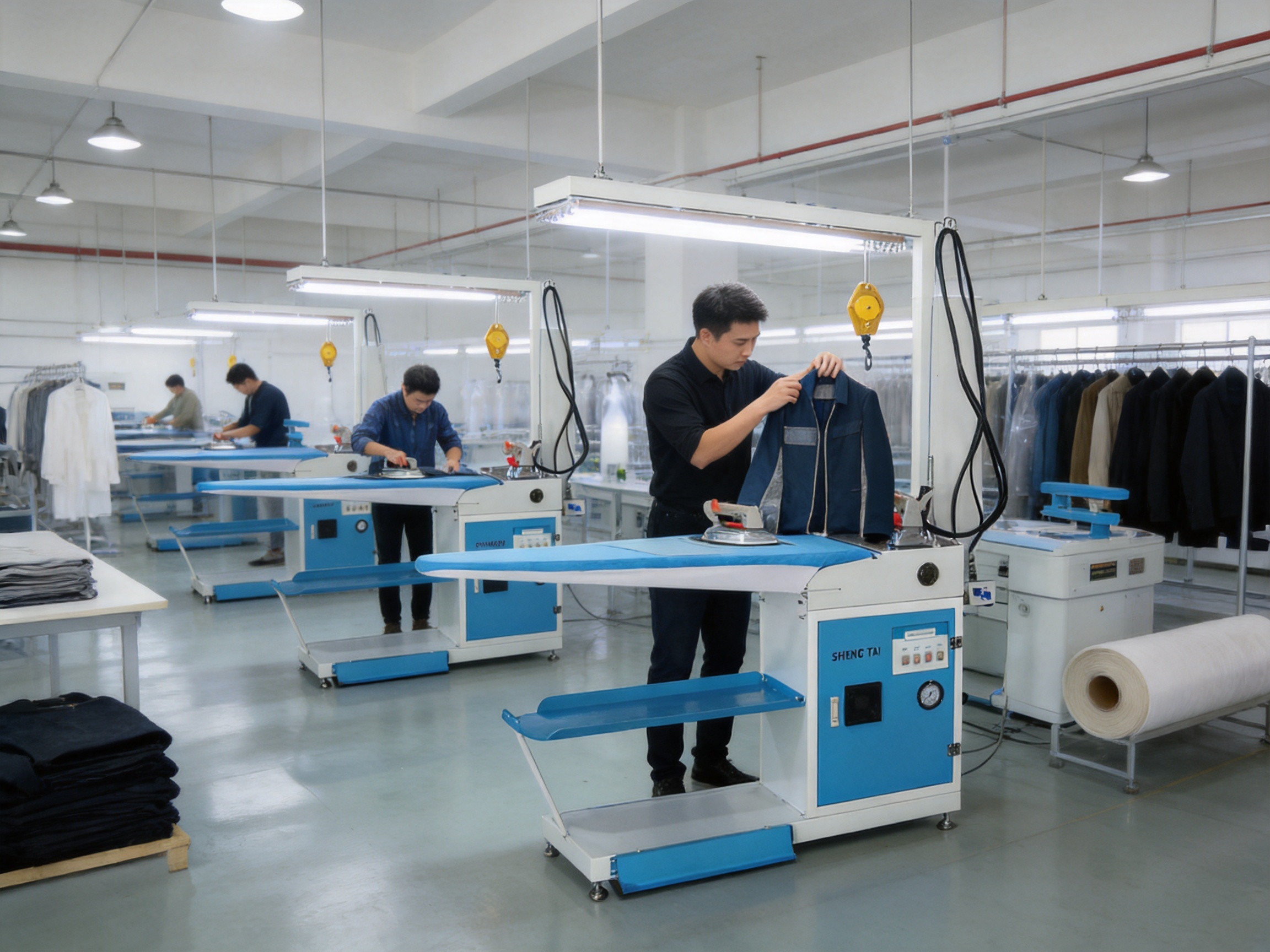
1. Product technical information for the ST-Q3-G 400x1200mm Vacuum Ironing Table, including heating, vacuum, power supply, speed, and dimensional specifications.
2. Manufacturer company information concerning product development, manufacturing categories, OEM services, export markets, and company history.
3. General professional garment-finishing practices concerning heat, pressure, moisture control, vacuum support, seam opening, and shaped-section pressing.
4. GB4706.1-2005, General Requirements for Safety of Household and Similar Electrical Appliances.
5. GB4706.2-2007, Applicable Safety Requirements for Electric Irons and Similar Appliances.
6. General workplace guidance for electrical safety, equipment maintenance, operator training, fabric testing, and thermal-process control.
 +86-578-3158872 / +86-578-3158958
 jyshengda@163.com / caroying@jy-shengda.com
 No. 8 Nanyi Rd, Huzhen Industrial Park, Zhejiang, China
Copyright © Jinyun Shengda Sewing Equipment Co., Ltd. All Rights Reserved.
Ironing Press Machine Equipment Factory
 English
 中文简体
 русский
 عربى