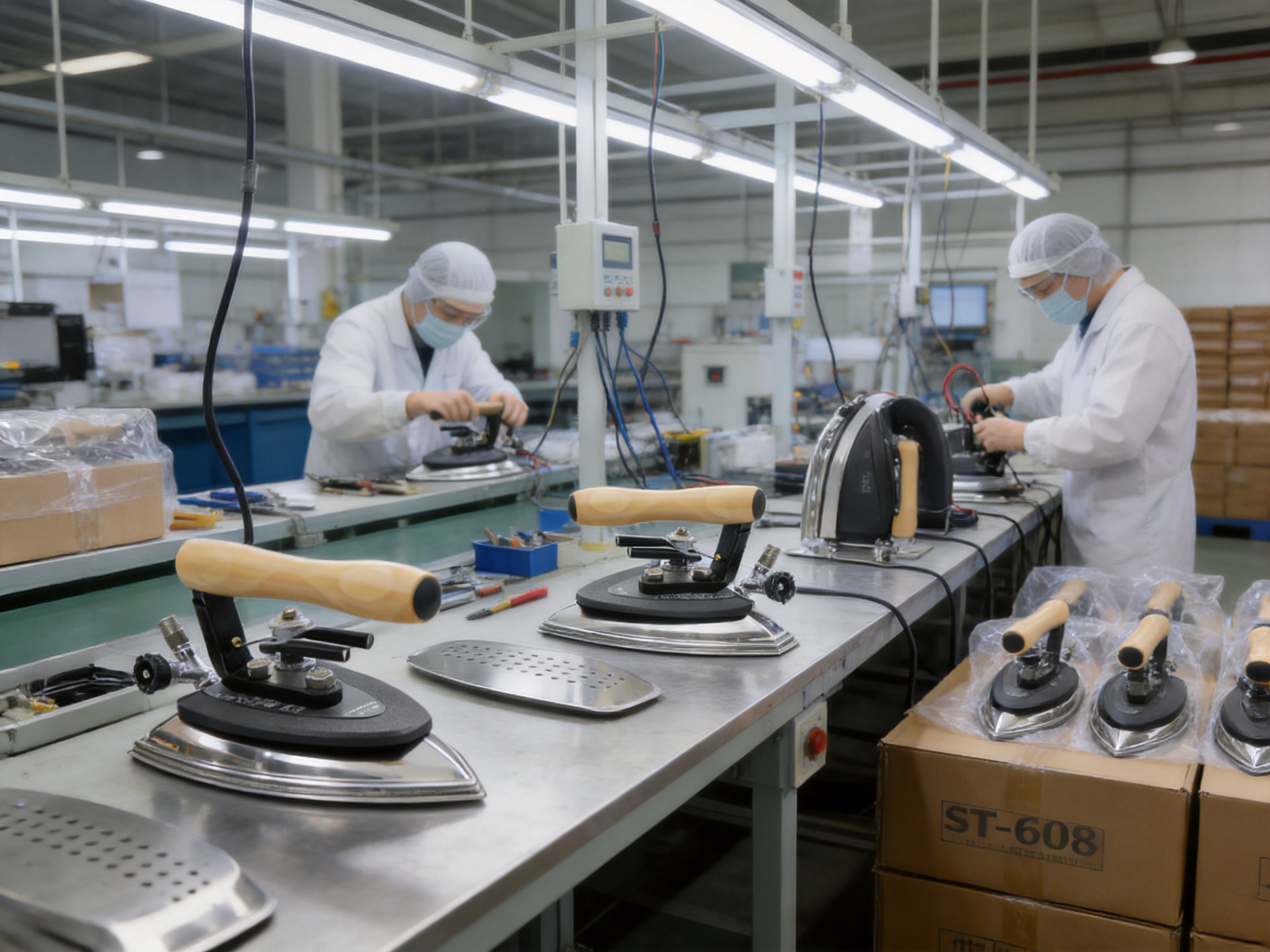
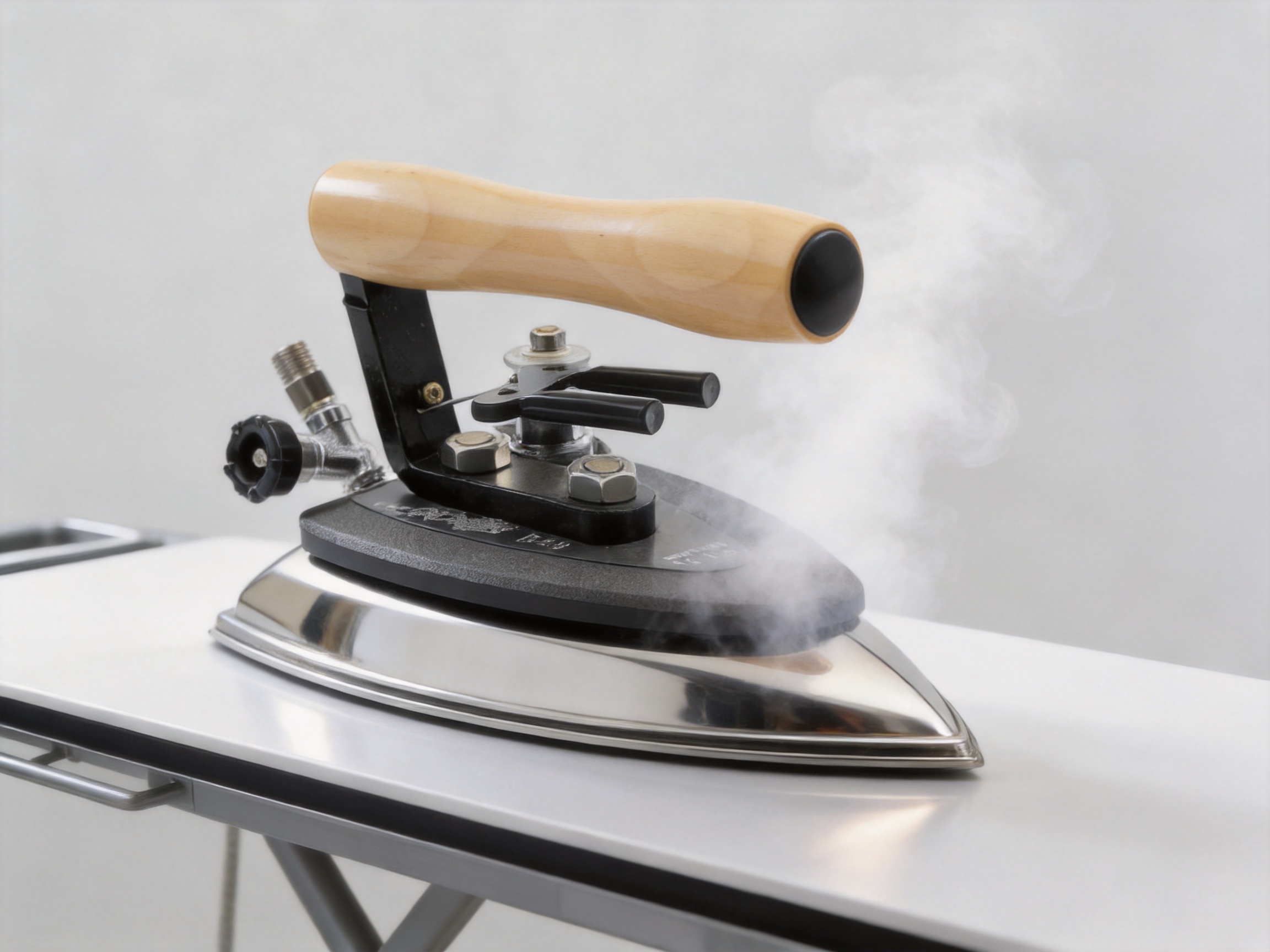
The ST-608 All Steam Iron is designed for users who expect more from a steam iron than basic wrinkle removal. It combines an elegant exterior, a durable stainless-steel soleplate, controlled steam distribution, a powerful heating system, and an ergonomically designed handle. Together, these features create a practical ironing solution for homes, garment workshops, tailoring businesses, laundries, hospitality operations, and other environments where consistent finishing quality matters.
Unlike ordinary dry irons that depend primarily on direct heat and pressure, an all-steam iron uses moisture and heat to relax fabric fibers before the soleplate passes over the material. This process can make wrinkle removal faster and more effective, particularly when working with heavier textiles, layered garments, formal clothing, uniforms, and fabrics that tend to crease easily. The ST-608 is developed around this principle, providing users with a balanced combination of steam control, surface durability, ease of movement, and attractive styling.
The product is manufactured by Jinyun Shengda Sewing Equipment Co., Ltd., an established Chinese producer of ironing equipment and related machinery. The company has specialized in electric irons, steam irons, hanging irons, spray guns, small steam machines, heat transfer machines, steam boilers, vacuum tables, and accessories since 2003. Its product range and manufacturing experience allow the ST-608 to benefit from a broader understanding of professional garment-care systems rather than being designed as an isolated household appliance.
This article examines the ST-608 All Steam Iron in detail. It explains its construction, operating advantages, competitive strengths, practical applications, manufacturing background, quality approach, maintenance considerations, and suitability for different users. It also includes a product comparison table, frequently asked questions, and reference notes for readers evaluating steam ironing equipment.
The ST-608 All Steam Iron is a compact, hand-operated steam iron intended to deliver reliable fabric finishing through the combined use of heat, pressure, and steam. Its design places particular emphasis on four user priorities: comfortable handling, durable contact with the fabric, efficient wrinkle removal, and an appearance suitable for modern home or professional environments.
The iron uses a stainless-steel soleplate. This component is the main working surface that contacts garments, and its material selection has a direct influence on glide, heat transfer, service life, and maintenance. Stainless steel is widely valued for its resistance to corrosion, wear, and discoloration. When properly maintained, it provides a smooth and stable ironing surface that can continue to perform effectively over extended periods.
The product also features a specially designed handle. A handle may appear to be a simple component, but it strongly affects the operator’s comfort and control. During a short ironing task, nearly any handle may seem adequate. During extended work, however, an unsuitable grip can contribute to hand fatigue, wrist tension, and reduced precision. The ST-608 handle is shaped to provide a secure, comfortable grip and to support controlled movement across different types of fabric.
Its external cover is described as a sleek P, H, and T cover. This cover contributes to the iron’s visual identity while also supporting a compact overall form. The result is a product that can fit naturally into a household laundry area, tailoring station, garment workshop, or commercial ironing workspace without appearing unnecessarily bulky.
Steam control is another important feature. The operator can adjust or manage the steam output according to fabric type, wrinkle severity, and the desired finishing result. This flexibility is valuable because different materials require different levels of moisture. Light fabrics may require gentle steam, while thicker textiles and stubborn creases may benefit from stronger steam penetration.

ST-608 All Steam Iron
Fabric wrinkles develop when fibers are compressed, folded, stored, washed, or exposed to changes in moisture. Heat can soften the fibers, but heat alone is not always sufficient to restore a smooth appearance. Steam adds moisture, helping the fibers relax so that the soleplate and the operator’s pressure can reshape the surface more efficiently.
An all-steam iron is particularly useful when garments need a clean, professional appearance. Shirts, trousers, jackets, uniforms, dresses, table linens, curtains, and other textile products can benefit from controlled steam. Steam may also help the operator reduce the number of passes required over a garment, which can improve productivity and reduce unnecessary effort.
The ST-608 supports this approach through a combination of powerful heating and adjustable steam control. A heating system that reaches working temperature efficiently helps reduce waiting time between tasks. Consistent temperature control is equally important because uneven or unstable heating can create inconsistent results across a garment.
Steam must also be distributed in a controlled manner. Excessive steam can leave fabric too damp, while insufficient steam may fail to relax deeper wrinkles. The ST-608 is designed to provide precision in steam release, allowing users to adapt the ironing process instead of relying on a single fixed setting.
Compared with a basic dry iron, the ST-608 can offer a more versatile approach to garment finishing. Compared with larger commercial pressing equipment, it provides a more compact and maneuverable format. This balance makes it suitable for users who need steam performance but do not require the footprint or operating method of a complete industrial pressing station.
The ST-608 has an elegant exterior that combines functional construction with a refined appearance. The P, H, and T cover gives the iron a distinctive visual finish and helps it integrate with modern household appliances and professional workspaces.
A pleasing design is not merely a decorative benefit. Product appearance can influence user confidence, particularly when the iron is displayed in a customer-facing environment such as a boutique, hotel laundry, tailoring shop, or clothing-care counter. A well-finished housing suggests attention to detail and can support a more professional presentation.
The compact shape also contributes to practical storage. Users can place the iron in a laundry room, workshop cabinet, equipment area, or service station without requiring the space associated with larger pressing machinery. At the same time, the shape is designed to preserve the necessary working components, including the soleplate, heating structure, steam passages, and handle.
The stainless-steel soleplate is one of the ST-608’s most important competitive features. The soleplate must transfer heat efficiently, move smoothly over fabric, resist repeated contact, and remain stable during regular use. Stainless steel provides a strong foundation for these requirements.
Its smooth surface helps reduce friction between the iron and the garment. Lower friction allows the operator to guide the iron more easily and may reduce the physical effort needed to complete a task. This is especially useful when ironing large garments, multiple layers, bedding, uniforms, or commercial textile products.
Stainless steel is also resistant to rust and general wear when cared for correctly. In a steam iron, resistance to corrosion is important because water and moisture are part of normal operation. A durable soleplate can help the product maintain a consistent ironing experience over a longer service period.
The material also supports even heat distribution. Stable heat across the working surface helps reduce the possibility of needing repeated passes over the same area. A more uniform soleplate temperature can contribute to a smooth finish and allow the user to work with greater confidence.
The specially designed handle is intended to provide a comfortable and secure grip. Its importance becomes increasingly clear during extended ironing sessions, where the user repeatedly lifts, guides, turns, and repositions the product.
An ergonomic handle should allow the operator to maintain control without excessive gripping force. A secure grip is important when working around seams, collars, cuffs, pleats, pockets, and other detailed garment areas. Good control also helps the user apply the appropriate amount of pressure without making unnecessary movements.
The ST-608’s handle is developed with comfort in mind. Its shape helps support the hand and wrist, while the product’s balanced design assists maneuverability. Reduced strain may be especially beneficial for tailoring professionals, laundry workers, clothing manufacturers, costume departments, and other users who iron for several hours during a working day.
Different textiles respond differently to heat and moisture. Cotton and linen may require more steam to relax firm wrinkles, while synthetic or delicate fabrics may need a gentler approach. The ST-608’s steam control allows users to adjust the output to suit the material and the condition of the garment.
Controlled steam can improve precision. Instead of releasing the same volume of moisture continuously, the operator can choose when additional steam is needed. This is useful for working on stubborn creases, shaping garments, preparing seams, and improving the finish of formal clothing.
Steam control also supports more economical operation. When the maximum output is not required, the user can select a lower setting and avoid unnecessary steam consumption. The exact operating procedure should follow the product’s instructions and the requirements of the connected steam system, where applicable.
Efficient heating is essential for productive ironing. A slow-heating iron can interrupt workflow, while inconsistent temperature can make it difficult to achieve an even finish. The ST-608 is equipped with a powerful heating system intended to support quick heat-up and stable temperature control.
Quick heat-up can be valuable in domestic settings, where users often want to iron one or two garments without a long preparation period. It is equally useful in professional environments, where waiting time can accumulate across many tasks.
Consistent temperature helps the operator establish a predictable working routine. Once the appropriate setting is selected, the iron should provide stable performance across the garment, subject to correct operation, fabric suitability, and maintenance. Predictability is an important advantage over low-quality products that may produce uneven heating or require repeated adjustment.
The market includes many low-cost steam irons, but price alone does not determine total value. A product that appears inexpensive may create higher long-term costs if it wears quickly, feels uncomfortable, heats unevenly, or requires frequent replacement. The ST-608 is positioned around durability, usability, and dependable performance rather than only an initial low purchase price.
One competitive advantage is the use of stainless steel for the soleplate. Some entry-level products may use materials or surface treatments that are more vulnerable to scratches, coating damage, or loss of glide. A stainless-steel working surface offers a robust alternative and may be better suited to frequent use.
A second advantage is the combination of steam control and powerful heating. A basic iron may provide only limited steam adjustment or may produce steam inconsistently when the heating system cannot maintain the required temperature. The ST-608 is designed as an integrated system in which heat and steam work together.
A third advantage is the ergonomic handle. In many products, exterior design is prioritized while hand comfort receives less attention. The ST-608 gives the handle a clear functional role, supporting secure operation, control, and reduced fatigue.
A fourth advantage is its balance between compactness and professional usefulness. Large industrial presses can be highly productive but may require considerable floor space and specialized installation. A small domestic iron may be convenient but insufficient for demanding work. The ST-608 occupies a practical middle position for users who need greater steam capability and durability in a portable hand-iron format.
A fifth advantage is the manufacturing experience behind the product line. Shengda produces not only irons but also steam boilers, vacuum tables, spray guns, heat transfer machines, and other garment-care equipment. This broader product knowledge can support a more complete understanding of steam generation, ironing surfaces, fabric handling, and workflow integration.
| Feature | Value to the User | Practical Benefit |
|---|---|---|
| All-steam ironing design | Combines heat, moisture, and pressure | Supports efficient wrinkle removal across many fabrics |
| Stainless-steel soleplate | Durable, smooth, and corrosion-resistant working surface | Provides reliable glide and long-term service potential |
| Specially designed handle | Comfortable and secure grip | Improves control and helps reduce hand fatigue |
| Steam control system | Adjustable steam release | Allows adaptation to fabric type and wrinkle severity |
| Powerful heating system | Quick heat-up and stable working temperature | Supports consistent results and efficient workflow |
| Compact exterior | Space-efficient appliance format | Suitable for homes, workshops, shops, and service areas |
| Elegant P, H, and T cover | Refined product appearance | Complements modern laundry and professional environments |
| Manufacturer product range | Experience across related ironing equipment | Supports equipment matching, customization, and OEM cooperation |
For household users, the ST-608 can support regular garment care, including shirts, trousers, dresses, uniforms, jackets, and household linens. Its compact form makes it practical for laundry rooms where space is limited. The stainless-steel soleplate can move smoothly across fabrics, while the steam function helps deal with wrinkles that are difficult to remove with a dry iron.
The product’s appearance is also suitable for home use. Many households prefer appliances that are not only functional but also visually compatible with the surrounding interior. The ST-608’s cover and compact design help it appear refined rather than purely industrial.
Tailors and alteration professionals need precision as well as speed. They may press seams, shape collars, open hems, smooth sleeves, prepare garments for fitting, and complete final finishing before delivery. Steam control can assist with these detailed tasks, while the ergonomic handle supports frequent handling.
The iron can be used alongside a suitable ironing board, vacuum table, steam boiler, or other workshop equipment. In a tailoring environment, the ability to control steam and move the iron accurately is often more valuable than simply having the highest possible heating output.
Garment factories and small production workshops often require finishing equipment at different stages of production. The ST-608 may be used for sample preparation, seam pressing, quality correction, final garment finishing, or small-batch production.
Its stainless-steel soleplate is appropriate for repeated contact with textiles, provided that operators follow correct procedures and keep the surface clean. Its compact structure also allows it to be used at stations where a larger press would not be practical.
Hotels, guesthouses, and serviced apartments may need reliable ironing equipment for uniforms, linens, curtains, guest garments, and housekeeping operations. A durable steam iron can support both routine laundry work and occasional garment-care requests.
The ST-608 can also be useful where a clean, professional presentation is important. Its design is suitable for service areas and can provide an effective solution without the installation demands of a complete industrial finishing line.
Schools, hospitals, restaurants, theaters, event companies, and security organizations may maintain uniforms or costumes that require frequent finishing. These garments often include structured areas, seams, badges, pleats, and layered sections.
The ST-608’s controllable steam and maneuverable handle can help operators work around these details. The user should always test the selected heat and steam setting on an inconspicuous area when dealing with unfamiliar fabrics, printed surfaces, decorative materials, or heat-sensitive components.
The ST-608 is supported by the manufacturing background of Jinyun Shengda Sewing Equipment Co., Ltd. The company was established in 2003 and is located in Huzhen Town, Lishui City, Zhejiang Province, China. Its location at the junction of Lishui, Jinhua, and Taizhou provides access to transportation routes, industrial resources, suppliers, and communication networks.
Shengda specializes in independent research, development, and production. This is important because product performance depends on more than assembly. It involves product structure, material selection, heating design, steam pathways, handle ergonomics, electrical safety, process control, and quality verification.
The company’s product range includes electric irons, steam irons, hanging irons, spray guns, small steam machines, heat transfer machines, steam boilers, vacuum tables, and accessories. These categories are closely related to garment production and finishing. Experience across the full equipment spectrum can help the manufacturer understand how a hand iron operates within a larger textile workflow.
The company owns several product brands, including Silver Star, Platinum Dragon, Tingshun, Jiasheng, Shengtai, and Jiangxin. This portfolio indicates experience in serving different market segments and developing products for varied customer requirements. The ST-608 benefits from a manufacturer that is familiar with both consumer-oriented and professional ironing applications.
Independent research and development gives a manufacturer greater control over product improvement. Instead of relying entirely on external designs, the company can evaluate user feedback, identify recurring performance requirements, and make changes to structure, materials, appearance, or operating features.
For an all-steam iron, research and development may involve improving heat transfer, optimizing steam distribution, refining the soleplate shape, adjusting handle geometry, strengthening the housing, and improving the overall balance of the unit. These improvements can be introduced progressively as the manufacturer gains more experience from production and market use.
Shengda states that its research and development, management, and sales teams work closely together. Such cooperation can help connect technical design with real customer needs. Sales teams receive feedback from distributors and end users, management coordinates resources and quality objectives, and technical teams translate practical requirements into product improvements.
An integrated production capability can improve consistency between product design and finished goods. When a manufacturer controls or closely manages key production stages, it can establish clearer standards for components, assembly, testing, packaging, and shipment.
For the ST-608, relevant production considerations may include soleplate finishing, heating-component installation, steam-channel assembly, handle attachment, cover fitting, electrical connection, and final functional inspection. Each stage affects the reliability of the finished product.
Integrated capability also supports customization and OEM services. Different customers may require changes in appearance, labeling, packaging, electrical specifications, accessory combinations, or market documentation. A manufacturer with its own product development and production resources is generally better positioned to coordinate such projects than a trading company with no direct manufacturing control.
Shengda follows national and industry standards, including GB4706.1-2005 and GB4706.2-2007, as stated in the supplied company information. These standards relate to the safety requirements of household and similar electrical appliances and electric irons. The company also states that its products have passed CCC and CQC certifications.
Compliance with recognized standards is significant for importers, distributors, retailers, and professional users. It provides a framework for evaluating electrical safety, construction, insulation, heating behavior, and other essential product considerations. Buyers should confirm the certification scope, current validity, applicable model, and destination-market requirements before placing an order.
Quality is also connected to process discipline. A product may use good materials, but inconsistent assembly or incomplete inspection can undermine performance. For this reason, reliable manufacturing should include clear component requirements, controlled assembly procedures, functional testing, electrical safety checks, appearance inspection, and appropriate packaging.
The company has established distribution channels in China and receives feedback from overseas customers. Its products are mainly exported to Southeast Asia, Central Asia, South America, Africa, and other regions. International market experience can help a manufacturer understand different operating environments, electrical requirements, shipping conditions, distributor expectations, and after-sales concerns.
Export capability is especially relevant for buyers seeking OEM or wholesale cooperation. International customers generally require more than a product sample. They may need stable production, export packaging, documentation, communication support, delivery coordination, and repeat-order consistency.
A high-quality steam iron depends on a sequence of controlled manufacturing operations. Although specific factory procedures may vary, the following stages illustrate the areas that are important when producing equipment such as the ST-608.
Materials must be selected according to their role in the product. The soleplate requires a material that can tolerate repeated heating, movement, and contact with fabric. The housing needs appropriate heat resistance, dimensional stability, and surface quality. The handle must provide mechanical strength and a comfortable user interface.
Material selection also affects product life and user perception. A soleplate that remains smooth, a cover that retains its appearance, and a handle that feels secure all contribute to the perceived quality of the product.
The stainless-steel soleplate must be formed, finished, and inspected carefully. Its shape influences how the iron moves around collars, seams, buttons, edges, and narrow garment sections. Its surface finish influences glide and the likelihood of snagging or marking fabrics.
Quality inspection should check for visible defects, rough areas, scratches, deformation, and irregularities that could interfere with ironing. The soleplate must also be correctly integrated with the heating assembly so that heat can spread evenly across the working surface.
The heating system must be positioned securely and connected correctly. Its performance affects warm-up speed, temperature stability, and energy use. Electrical connections require particular attention because safe insulation, secure terminals, and correct assembly are essential to appliance reliability.
Functional tests can confirm whether the iron reaches its working range, maintains an appropriate temperature, and responds correctly to control settings. Proper testing helps identify defects before the product is packaged and shipped.
Steam must travel through the product in a controlled and predictable way. The steam path, control mechanism, seals, and outlet arrangement all influence the final result. Poorly controlled steam may lead to uneven output, leakage, or unnecessary moisture.
Assembly inspection should confirm that steam-related components are fitted correctly and that the control system operates smoothly. Testing should evaluate steam release under normal operating conditions and verify that the product performs according to its intended design.
The handle must be firmly connected to the main body while preserving user comfort. It should not feel loose, unstable, or poorly balanced. The cover must also be fitted evenly, with a clean appearance and no sharp or inconvenient edges.
Because users interact with the handle and cover throughout the product’s life, these parts influence both safety and satisfaction. A carefully finished exterior is therefore part of the manufacturing process rather than an optional cosmetic detail.
Before shipment, completed units should undergo visual and functional checks. These may include inspection of the soleplate, handle, cover, controls, electrical components, steam operation, temperature behavior, labeling, and general appearance.
Packaging must protect the product during handling and transportation. Export shipments may experience vibration, stacking pressure, humidity changes, and repeated loading or unloading. Appropriate internal protection and clear documentation can reduce the risk of transit damage.
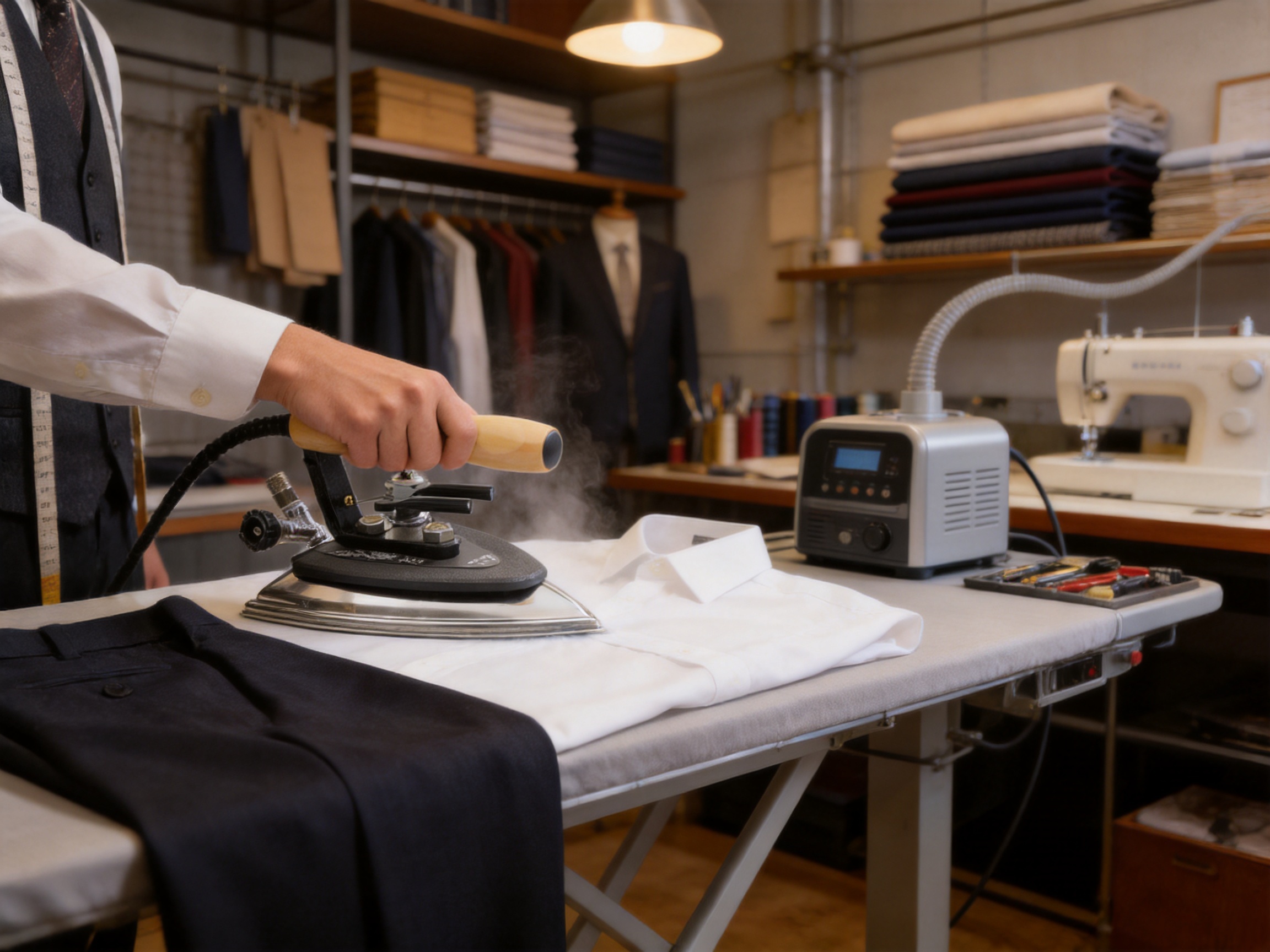
Correct operation is essential for achieving the best performance from any steam iron. Before use, the operator should review the product instructions, confirm that the electrical supply is compatible, and prepare a stable ironing surface. If the unit is connected to an external steam source or boiler, the connection should be made according to the applicable instructions and safety procedures.
The garment should be checked for its recommended ironing temperature and steam suitability. Labels, printed decorations, coated surfaces, synthetic fibers, and delicate materials may require special care. When the fabric is unfamiliar, testing a small hidden area is a sensible precaution.
The operator should select a suitable heat and steam level rather than automatically using the highest setting. Begin with a moderate setting and increase it only when necessary. This approach can help protect sensitive fabrics and reduce unnecessary moisture consumption.
Move the iron smoothly across the fabric. Excessive pressure is not always necessary, particularly when heat and steam are working effectively. For seams and structured areas, use controlled movements and avoid trapping moisture under layered fabric for longer than necessary.
At the end of operation, switch off the iron, disconnect it when appropriate, and allow it to cool safely. Do not store the unit while it remains hot or wet. The operating area should be kept clear of children, combustible materials, and unnecessary obstructions.
Regular maintenance supports the long-term performance of the ST-608. The soleplate should be kept clean and free from adhesive residue, melted fibers, starch buildup, and other contaminants. Any cleaning procedure should follow the manufacturer’s recommendations and avoid abrasive materials that could damage the surface.
Water quality can affect steam equipment. Mineral deposits may accumulate in steam passages or related components when hard water is used repeatedly. Users should follow the specified water and cleaning guidance. If a separate boiler or steam generator is used, that equipment should also be maintained according to its own service requirements.
The power cord, plug, housing, handle, controls, and steam connections should be inspected periodically. Signs of damage, overheating, loose parts, unusual odor, leakage, or irregular heating should be treated seriously. The product should be removed from service until it has been checked by a qualified person.
Good handling practices can extend service life. The iron should not be dropped, dragged by its cord, placed on an unstable surface, or stored where the soleplate can be scratched. Operators should also avoid using unsuitable chemicals or unapproved accessories.
Maintenance is one area where the ST-608 can offer value over disposable or poorly constructed alternatives. A product built with durable materials and supported by an experienced manufacturer is more suitable for planned care and long-term use. Buyers should nevertheless establish a maintenance schedule that reflects operating frequency and working conditions.
For wholesalers, distributors, garment-equipment dealers, and commercial users, product value includes more than technical features. It also involves supply reliability, product consistency, communication, packaging, service, and the ability to support different market requirements.
Shengda identifies customization and OEM services among its advantages. This can be useful for buyers who want their own labels, packaging formats, market-specific configurations, or coordinated product ranges. OEM cooperation should be discussed in detail, including minimum order quantities, approved artwork, sample procedures, quality standards, inspection arrangements, lead times, and warranty terms.
The manufacturer’s diverse product portfolio may also help buyers source related equipment from one supplier. A customer purchasing the ST-608 may also require steam boilers, vacuum tables, spray guns, heat transfer machines, or accessories. A broader product range can simplify procurement and make it easier to design a compatible ironing solution.
Competitive cost is another stated company advantage. Cost should be evaluated together with durability, expected service life, replacement frequency, operating efficiency, and after-sales support. A reliable iron that remains usable over a longer period may provide better total value than a cheaper unit that requires early replacement.
Professional service and convenient shipment are also important for international purchasers. Buyers should request complete commercial and technical information, confirm destination-market electrical requirements, and establish a clear process for order confirmation, inspection, transport, and after-sales communication.
The ST-608 can be considered as part of a larger ironing system. Household users may pair it with a stable ironing board and suitable storage arrangement. Tailoring shops may use it with a vacuum table or compact steam source. Larger operations may integrate it with a steam boiler, garment finishing station, or other specialized equipment.
The correct configuration depends on workload, garment types, available space, power supply, steam requirements, operator skill, and budget. A hand iron provides flexibility and close control, while a vacuum table can help stabilize garments and manage moisture. A boiler may support sustained steam production for professional operations, but it also introduces additional installation and maintenance requirements.
Buyers should consider the complete workflow rather than selecting equipment based on one feature alone. The best solution is the one that provides suitable output, manageable operating costs, safe working conditions, acceptable comfort, and reliable support.
Steam irons combine electricity, heat, moisture, and pressure, so responsible operation is essential. Operators should use the product only for its intended purpose and should not modify electrical or steam components without authorization.
The work area should be dry where electrical connections are located, even though steam is used during ironing. Cords should be positioned so that they do not create tripping hazards or come into contact with hot surfaces. The iron should be placed on a suitable rest when not actively in use.
Users should avoid directing steam toward the body or other people. Steam can cause serious burns even when it appears less intense than visible boiling water. Appropriate protective practices are particularly important in professional environments where multiple operators may work close together.
Training also affects product performance. Operators who understand fabric labels, temperature settings, steam control, garment positioning, and safe shutdown procedures are more likely to achieve consistent results and avoid damage.
The stated compliance with GB4706.1-2005 and GB4706.2-2007, together with CCC and CQC certifications, provides an important basis for evaluation. However, purchasers should always verify the documents relevant to the specific model, order, voltage, destination country, and current regulatory requirements.
The ST-608 All Steam Iron offers a combination of features that address both everyday convenience and professional performance. Its stainless-steel soleplate provides durability and smooth movement. Its handle supports comfort and control. Its steam system allows flexible operation, while its powerful heating design supports quick preparation and consistent results.
Its compact form gives it an advantage in environments where workspace is limited. At the same time, its construction and steam capability make it more suitable for demanding use than many basic household irons. This makes the product relevant to a broad range of users, from individual consumers to tailoring shops and commercial garment-care operations.
The product is also supported by a manufacturer with more than two decades of experience in ironing and sewing equipment. Shengda’s independent research and development, integrated product range, export experience, OEM capability, and stated commitment to quality provide additional reasons for buyers to evaluate the ST-608 as part of a long-term equipment strategy.
For customers who value both appearance and performance, the product’s elegant P, H, and T cover adds a further benefit. The iron looks refined without sacrificing the practical requirements of steam ironing, durable materials, and ergonomic handling.
The ST-608 is an all-steam iron designed for wrinkle removal and garment finishing. It combines a heated stainless-steel soleplate with controlled steam output and an ergonomic handle.
The stainless-steel soleplate provides a smooth, durable working surface with resistance to rust and general wear. It also supports stable heat transfer and easy movement across fabrics when properly maintained.
Yes. Its compact shape, attractive exterior, comfortable handle, and steam-control function make it suitable for household laundry. It can also be used in professional environments that require a portable hand-ironing solution.
Yes. The ST-608 can support seam pressing, sample preparation, garment finishing, alterations, and other tailoring tasks. Its controlled steam and maneuverable handle are useful when working around detailed garment areas.
Steam control allows the operator to adapt moisture output to different fabrics and wrinkle conditions. Light materials may need less steam, while heavier or more deeply wrinkled fabrics may require additional moisture.
A powerful heating system can reduce warm-up time and support consistent working temperature. This may help users complete ironing tasks more efficiently, although actual performance depends on operating conditions, fabric type, and correct settings.
The handle affects comfort, stability, and precision. The ST-608 handle is specially designed to provide a secure grip and help reduce strain during extended ironing sessions.
It may be used as part of a broader ironing setup that includes a suitable board, vacuum table, steam boiler, or accessories. The correct combination depends on the user’s workload, steam source, workspace, and operating requirements.
The iron is intended for a wide range of fabrics, but users should always follow garment-care labels and select appropriate temperature and steam settings. Delicate, coated, printed, or unfamiliar materials should be tested carefully before full treatment.
Keep the soleplate clean and remove residue using only approved methods. Avoid abrasive cleaners, sharp tools, and rough surfaces that could scratch or damage the stainless steel. Follow the manufacturer’s instructions for cleaning and storage.
International buyers should confirm voltage, frequency, plug configuration, certification requirements, packaging, minimum order quantity, delivery terms, warranty conditions, spare parts, and destination-market documentation. They should also verify whether the selected model matches local regulations.
The company identifies customization and OEM services among its business advantages. Specific requirements, including branding, packaging, configuration, quantity, sampling, and delivery schedules, should be confirmed directly during the purchasing process.
The company produces electric irons, steam irons, hanging irons, spray guns, small steam machines, heat transfer machines, steam boilers, vacuum tables, and related accessories. This range can support customers seeking multiple types of garment-care equipment.
The supplied company information states that its products follow standards including GB4706.1-2005 and GB4706.2-2007 and have passed CCC and CQC certifications. Buyers should request and verify current documentation for the exact model and destination market.
Its value comes from the combination of a durable stainless-steel soleplate, ergonomic handle, controlled steam, powerful heating, compact design, and manufacturing experience. Buyers should evaluate expected service life, comfort, performance consistency, and support rather than comparing purchase price alone.
The ST-608 All Steam Iron is a versatile garment-finishing tool built around durability, control, comfort, and attractive design. Its stainless-steel soleplate supports smooth movement and long-term wear resistance. Its specially designed handle improves grip and maneuverability. Its adjustable steam control allows users to adapt the ironing process to different fabrics, while its powerful heating system supports quick heat-up and stable performance.
These features give the ST-608 advantages over simple dry irons and basic steam models. It is compact enough for home use and small workspaces, yet capable of supporting the repeated demands of tailoring, garment production, hospitality, uniform care, and commercial laundry applications.
The product’s strengths are reinforced by the manufacturing capabilities of Jinyun Shengda Sewing Equipment Co., Ltd. Since 2003, the company has developed and produced a broad range of ironing and sewing-related equipment. Its independent research and development, product diversity, OEM and customization services, stated quality certifications, export experience, and focus on customer satisfaction provide a strong foundation for domestic and international cooperation.
For users seeking a reliable balance between professional steam performance and convenient hand operation, the ST-608 is a practical candidate. With correct operation, suitable fabric settings, regular cleaning, and responsible maintenance, it can provide an efficient and comfortable ironing experience for both everyday garments and demanding finishing tasks.
1. Product information supplied for the ST-608 All Steam Iron, including design, soleplate, handle, heating, steam-control, and application details.
2. Company profile information supplied for Jinyun Shengda Sewing Equipment Co., Ltd., including company history, product categories, export regions, OEM capability, and manufacturing strengths.
3. GB4706.1-2005, Safety of Household and Similar Electrical Appliances: General Requirements.
4. GB4706.2-2007, Safety of Household and Similar Electrical Appliances: Particular Requirements for Electric Irons.
5. General textile-care principles concerning the use of heat, moisture, pressure, garment labels, and fabric-sensitive ironing practices.
6. General quality-management considerations for electric appliance assembly, functional inspection, electrical safety testing, packaging, and export preparation.
 +86-578-3158872 / +86-578-3158958
 jyshengda@163.com / caroying@jy-shengda.com
 No. 8 Nanyi Rd, Huzhen Industrial Park, Zhejiang, China
Copyright © Jinyun Shengda Sewing Equipment Co., Ltd. All Rights Reserved.
Ironing Press Machine Equipment Factory
 English
 中文简体
 русский
 عربى