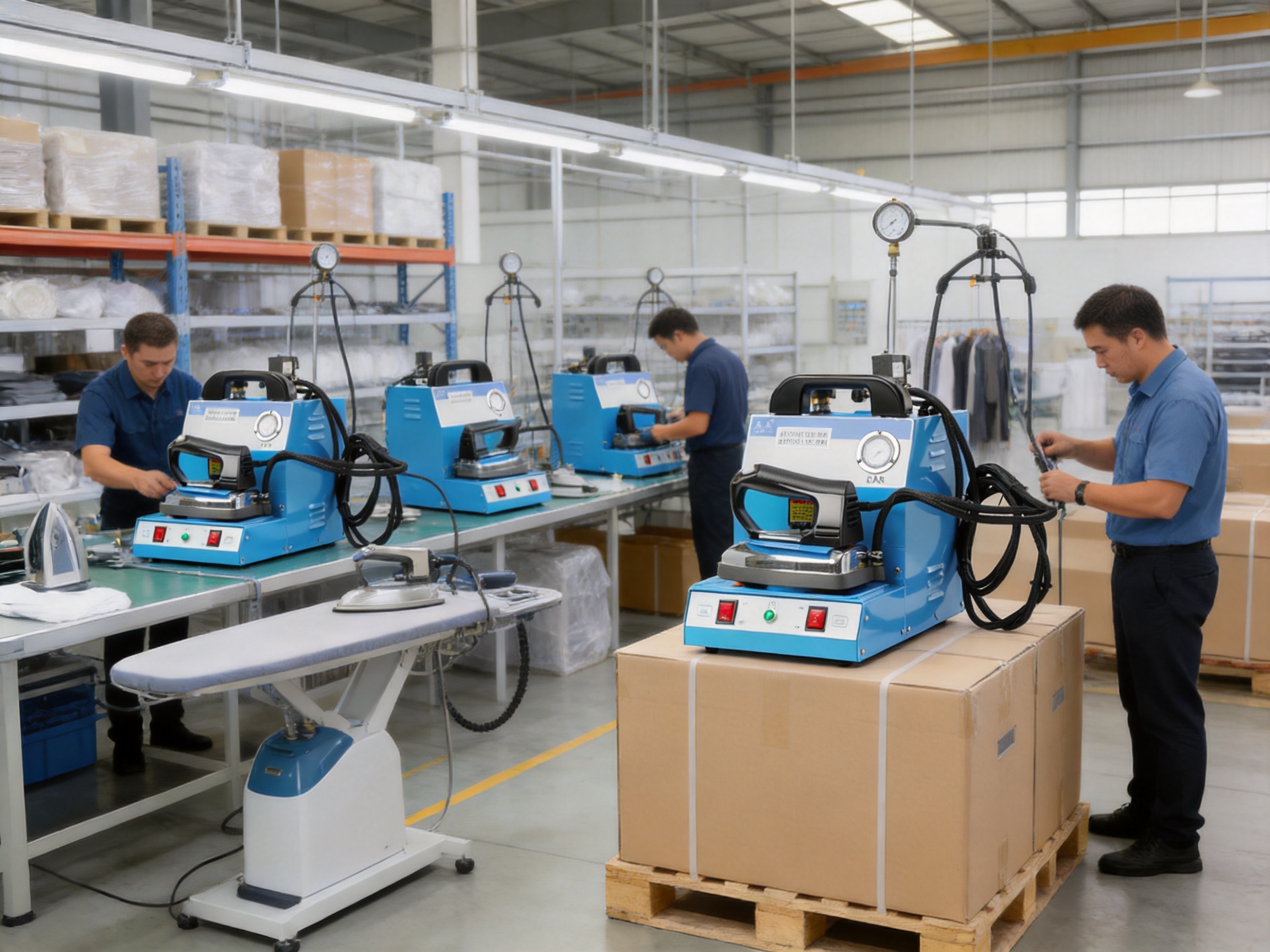
The ST-750 Steam Boiler is a compact, portable steam-generation system designed for professional ironing, garment finishing, textile processing, cleaning, sterilization, and other applications that require a dependable supply of dry steam. With a 4-liter water capacity, 1,600-watt boiler, 900-watt iron connection, pressure gauge, and liquid level alarm, the unit combines practical operating capacity with a space-saving design.
For businesses that need reliable steam without installing a large fixed boiler system, the ST-750 provides a useful balance between performance, mobility, safety, and operating convenience. Its design is especially suitable for garment factories, tailoring shops, laundry businesses, dry-cleaning facilities, uniform suppliers, hotels, alteration studios, and commercial workrooms.
The machine is produced by Jinyun Shengda Sewing Equipment Co., Ltd., a Chinese manufacturer specializing in electric irons, steam irons, hanging irons, spray guns, small steam machines, heat transfer machines, steam boilers, vacuum tables, and related accessories. The company has developed its product range through independent research, manufacturing experience, quality control, and continuous improvement in response to professional users’ needs.
Unlike a basic domestic steam appliance, the ST-750 is configured as a work-oriented steam system. It is intended to provide a stable steam source for repeated operations rather than occasional household use. The combination of a relatively large water tank, pressure monitoring, low-water protection, and compatibility with professional ironing equipment makes it a practical choice for users who value continuity and controlled steam delivery.

ST-750 Steam Boiler
The ST-750 is designed to generate steam efficiently from a compact body. Its 4-liter water tank helps extend the working period between refills, while the 1,600-watt boiler heating system supports the production of continuous steam for a wide variety of tasks. The connected iron has a rated power of 900 watts, allowing the boiler and ironing tool to work together as an integrated professional system.
The unit is available for 220-volt or 110-volt electrical environments, depending on the configuration required by the customer. This voltage flexibility supports use in different markets and helps distributors select a suitable model for regional power standards.
| Model | ST-750 |
| Product type | Steam boiler for professional and commercial applications |
| Available voltage | 220V / 110V |
| Boiler power | 1600W |
| Iron power | 900W |
| Water capacity | 4L |
| Packing size | 480 × 305 × 450 mm |
| Main monitoring device | Built-in pressure gauge |
| Primary safety alert | Liquid level alarm |
| Steam characteristic | Continuous dry steam output |
The product’s operating concept is straightforward. Water is placed into the boiler tank, the heating system raises the water temperature, and steam is generated for connection to a professional iron or another suitable steam tool. The pressure gauge allows the operator to observe internal steam pressure, while the liquid level alarm provides an alert when the water level becomes too low.
This simple operating structure is one of the machine’s strengths. Operators can understand the basic functions quickly, and routine use does not require complicated programming or advanced technical training. The system is suitable for work environments where equipment needs to be effective, accessible, and easy to integrate into daily production.
Steam quality has a direct influence on ironing results, fabric handling, and operational efficiency. Steam containing excessive water droplets may leave damp areas on garments, create uneven finishing, slow down production, or increase the time required before products can be folded and packed. For delicate materials, excess moisture may also affect the appearance of the fabric or complicate quality inspection.
The ST-750 is designed to deliver continuous dry steam without water droplets under appropriate operating conditions. Dry steam supports controlled fabric relaxation and helps operators remove wrinkles more efficiently. It can also improve consistency when multiple garments or textile panels must be processed in succession.
In garment production, steam is used to soften fibers, reshape collars and seams, press sleeves, remove creases, and improve the final appearance of finished products. In tailoring and alteration work, controlled steam helps operators achieve professional results in a small workspace. In laundry and hospitality applications, steam can support garment finishing and presentation before items are returned to customers or placed into service.
Dry steam is also valuable in applications where cleanliness and controlled moisture are important. It may be used for selected cleaning, fabric treatment, or preparation operations, provided that the particular process, material, and workplace safety requirements are appropriate. The machine should always be operated according to the instructions and limitations established by the manufacturer and the application environment.
The 4-liter water tank is one of the most practical features of the ST-750. Compared with small steam generators that require frequent refilling, the larger tank supports longer operating intervals. This is especially useful in busy workrooms where operators cannot stop repeatedly to replenish water.
Reduced refilling frequency can improve workflow in several ways. Operators can complete more garments or textile pieces during a working cycle, interruptions are reduced, and the steam supply can remain more consistent throughout the task. For commercial users, even small reductions in interruption time may contribute to better labor utilization and smoother production planning.
A larger tank also gives the operator more flexibility when organizing work. The machine can be prepared before a production period begins, allowing the user to concentrate on ironing, pressing, or finishing instead of monitoring the water supply constantly. This convenience is valuable in tailoring shops, garment workshops, school uniform operations, hotel laundries, and other settings with repeated daily use.
Water quality remains important. Users should follow the manufacturer’s recommendations regarding suitable water, tank cleaning, and mineral control. Proper water management can help reduce deposits and support stable heating performance over the service life of the equipment.
The ST-750 is designed to provide useful steam output without the footprint of a large industrial boiler installation. Its packing size is 480 × 305 × 450 millimeters, which makes transportation, storage, and delivery more convenient. The compact form is particularly advantageous for businesses with limited floor space.
A portable steam boiler can be moved between workstations or transported to a different operating location when necessary. This is beneficial for mobile garment services, small production rooms, temporary workshops, training centers, and businesses that change their layout frequently.
Portability also provides an advantage during installation. A compact machine is easier to position near an ironing table, vacuum table, finishing station, or garment preparation area. It does not require the same level of building modification that may be associated with a large fixed steam system. This can help small businesses begin professional operations with a manageable equipment investment.
Compact does not mean that the machine is intended only for light use. The ST-750 is configured for professional work, with a 1,600-watt boiler, 4-liter tank, pressure gauge, and liquid level alarm. Its design aims to combine useful operating capability with the convenience of a smaller machine.
Continuous steam production is important in any process where the operator performs repeated work. Stop-and-start steam delivery can make it difficult to maintain a consistent rhythm, particularly when processing a large order or working with garments that require several pressing stages.
The ST-750 is designed to maintain a continuous dry steam supply during normal operation. This supports a more predictable workflow and reduces the need to wait repeatedly for steam to become available. Operators can move from one garment section to another with greater continuity, improving the overall working experience.
Continuous operation also supports quality consistency. When the steam source behaves predictably, operators can develop a stable working method for different fabrics and garment types. This can reduce variation between products and make it easier to train new staff members.
The pressure gauge gives the operator a direct visual indication of internal steam pressure. Rather than relying only on sound, heat, or irregular steam flow, the user can monitor the gauge as part of normal operation.
Pressure information helps the operator understand whether the machine has reached a suitable operating condition and whether the system is maintaining pressure during use. It also supports more controlled operation because the user can recognize abnormal readings and respond appropriately.
For production managers and maintenance personnel, a gauge can assist with basic equipment observation. Changes in pressure behavior may indicate the need for inspection, cleaning, or professional service. The gauge is not a replacement for scheduled maintenance, but it gives users an important piece of operating information in real time.
The liquid level alarm is an important protection feature. It alerts the operator when the water level becomes too low, helping prevent the boiler from continuing to operate without sufficient water.
Low-water operation can place unnecessary stress on heating components and may lead to reduced performance or equipment damage. By providing an audible or visual warning, depending on the configuration, the alarm helps the user take timely action. The operator can stop or replenish the water supply before the condition becomes more serious.
This feature is especially useful in busy work environments where the machine may be used for long periods. Operators can become focused on garments and production tasks, so an automatic warning provides an additional layer of awareness. It also supports safer operating habits for new users who may not yet know how quickly the water level changes during different workloads.
The ST-750 specifications include a 900-watt iron power rating. This indicates that the boiler is designed to operate as part of a professional steam-ironing system rather than as an isolated heat source.
An integrated boiler and iron arrangement can simplify equipment selection. Buyers do not necessarily need to assemble a steam source and ironing tool from unrelated suppliers. A coordinated system can make installation more straightforward and help ensure that the power requirements are understood before purchase.
The professional iron can be used for pressing garments, smoothing seams, shaping fabric, refining details, and improving presentation. Depending on the connected equipment and operating method, the system may support a wide range of garment and textile tasks.
Users should select an appropriate ironing surface and workplace layout. A suitable ironing board, vacuum table, or heat-resistant work surface can complement the steam boiler and improve the final result. Shengda’s broader product range includes vacuum tables and other ironing equipment, allowing distributors and customers to consider a coordinated workstation configuration.
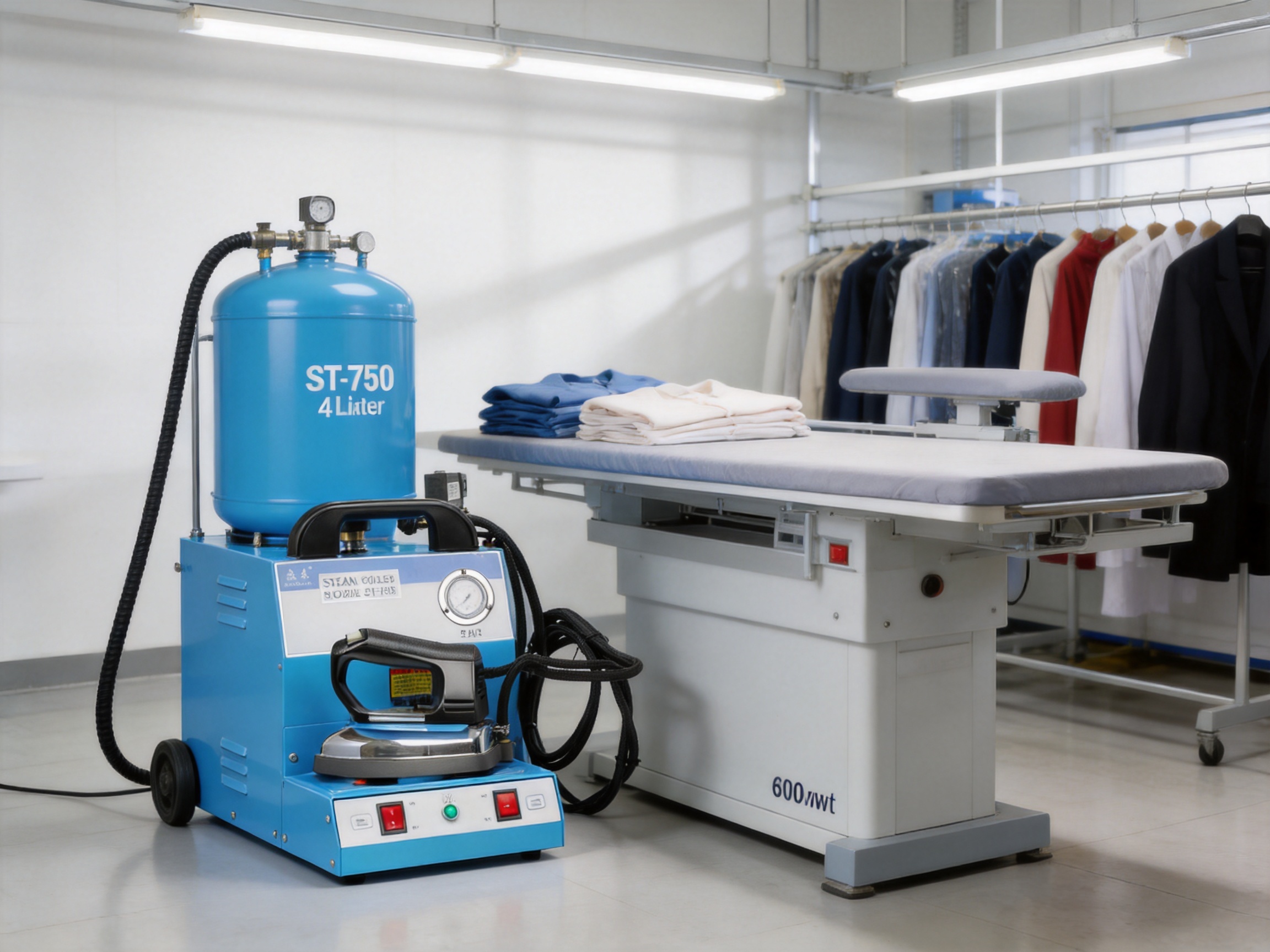
The market includes many small steam appliances intended for household or occasional use. While these products may be suitable for limited tasks, they are not always designed for the repetition, control, and workflow requirements of commercial ironing. The ST-750 offers several advantages for professional users who need more than occasional wrinkle removal.
A 4-liter water tank provides a longer operating interval than many compact consumer steam devices. This can reduce interruptions and make the machine more suitable for batch processing. Businesses handling multiple garments or textile products can benefit from a system that is prepared for repeated use.
The pressure gauge provides information that is not always available on simple steam appliances. Operators can monitor the system more intentionally and identify unusual conditions earlier. This is useful for work environments where reliable output matters.
The ST-750 is intended to work with professional ironing equipment and commercial processes. Its design is more closely aligned with garment finishing, tailoring, laundry, and industrial textile work than with occasional household use.
The liquid level alarm helps protect the boiler from low-water operation. This feature is particularly valuable in production environments, where operators may work continuously and may not have time to inspect the water level manually at frequent intervals.
Large centralized boiler systems can provide substantial steam capacity, but they may require dedicated space, piping, installation work, and higher initial investment. The ST-750 offers a more accessible alternative for small and medium-sized users who require professional steam but do not need a large permanent plant.
It is important to recognize that the ST-750 is not intended to replace every industrial boiler. Large factories with extensive production lines may require centralized steam infrastructure. However, for smaller operations, independent workstations, and businesses seeking flexible capacity, the ST-750 can provide an efficient and practical solution.
Garment factories use steam during several stages of production. Operators may press seams, shape collars, prepare sleeves, smooth finished garments, and correct wrinkles created during sewing, transportation, or packaging.
The ST-750 can serve as a steam source for individual pressing stations or smaller production areas. Its compact structure allows it to be positioned near the work area, while the water capacity supports repeated operations during a production shift.
Tailors and alteration specialists often work with different fabrics and garment structures throughout the day. They need equipment that can respond quickly to individual jobs without occupying excessive space.
The ST-750 provides a professional steam source for reshaping garments, refining hems, setting seams, and preparing clothing for customer delivery. Its portable design also allows a shop to adjust the workstation layout as business requirements change.
Steam finishing is an important part of presenting cleaned garments. After washing or dry cleaning, garments may require pressing and shaping before they are returned to customers.
A stable steam source can help improve the appearance of shirts, jackets, trousers, uniforms, dresses, and other clothing. The 4-liter tank is useful for businesses that process a steady volume of garments and need to reduce interruptions caused by frequent refilling.
Hotels, resorts, restaurants, and event facilities may use steam equipment for uniforms, table textiles, curtains, guest garments, and other fabric items. A compact boiler can be installed in a laundry room, housekeeping area, or dedicated garment preparation space.
The ST-750 may be useful where the operation needs professional steam but does not justify a large centralized system. Its mobility and manageable size are convenient for facilities with limited technical space.
Uniform suppliers often need to prepare garments before delivery. Steam finishing can help remove storage creases, improve the appearance of embroidered or printed garments, and present completed orders in a professional condition.
The boiler can support order preparation for schools, hospitals, security companies, factories, offices, restaurants, and other organizations that purchase uniforms in quantity.
Design studios, sample rooms, and small textile workshops frequently require steam for prototypes and limited production batches. The compact ST-750 can provide a dedicated steam source without taking up the space required by a large factory installation.
Designers and technicians can use steam to examine how fabrics respond to heat and moisture, refine garment shapes, and prepare samples for review. As with all textile processes, operators should test new materials carefully and follow suitable temperature and moisture practices.
Dry steam can be useful in selected cleaning and preparation procedures where controlled heat and moisture are appropriate. Potential examples include certain fabric-care tasks and equipment preparation operations.
Application suitability depends on the material, surface, temperature tolerance, and workplace requirements. Users should not assume that every surface or process is suitable for steam. Testing and professional operating procedures are essential.
The performance of a steam boiler depends not only on its product specifications but also on the capabilities of the manufacturer behind it. Jinyun Shengda Sewing Equipment Co., Ltd. was established in 2003 in Zhejiang Province, China. The company is located in Huzhen Town, Lishui City, near the junction of Lishui, Jinhua, and Taizhou.
This location provides access to transportation networks, industrial resources, component suppliers, labor, and regional manufacturing expertise. Convenient logistics can support the movement of raw materials, finished products, spare parts, and export orders.
Shengda emphasizes independent research, development, and production. This approach allows the company to study customer requirements and incorporate practical improvements into its product range.
For steam boilers and ironing equipment, research and development may involve heating performance, steam stability, water management, electrical safety, component matching, ergonomics, portability, and ease of maintenance. A manufacturer that works across related product categories can also evaluate how boilers, irons, vacuum tables, spray guns, and accessories perform as part of a wider workstation.
Independent development supports product continuity. It gives the manufacturer greater control over design adjustments, specification updates, and customer-specific requirements. It can also make it easier to provide OEM or customized products for distributors and commercial buyers.
The company manufactures several categories of ironing and garment-care equipment, including electric irons, steam irons, hanging irons, spray guns, small steam machines, heat transfer machines, steam boilers, vacuum tables, and accessories.
This broad portfolio is valuable for customers that want to source multiple related products from one manufacturer. A distributor may be able to build a product range around garment finishing, while an industrial buyer can evaluate compatible equipment for a complete workstation.
Product specialization across several categories also gives the company an opportunity to understand the working conditions of garment factories, tailoring shops, laundries, and textile businesses. Knowledge gained from one product category can support improvements in another.
Shengda reports that its research and development, management, and sales teams work closely together. This type of internal coordination can improve communication between market requirements and manufacturing decisions.
Sales teams often receive direct information from distributors and end users. Research and development personnel can use this information to identify areas for product improvement, while management teams can coordinate production, quality, and delivery requirements.
For international customers, communication is especially important. Buyers may require specific voltage configurations, packaging arrangements, labeling, documentation, spare parts, or OEM details. A coordinated organization is better positioned to clarify these requirements before production.
The company states that its products follow applicable national and industry standards, including GB4706.1-2005 and GB4706.2-2007. It also reports that its products have passed CCC and CQC certifications.
Standards and certifications provide a structured basis for evaluating electrical safety, product construction, testing, and compliance. For buyers, these credentials can support supplier assessment and market-entry planning. Certification requirements may vary by country, so importers should confirm the specific documentation and conformity requirements applicable in their destination market.
Customization and OEM services are identified as company strengths. This is useful for importers, wholesalers, distributors, and established brands that need equipment under a private label or with market-specific specifications.
Potential customization areas may include product labeling, packaging, voltage selection, documentation, color, accessories, and order configuration. The exact scope depends on order quantity, technical feasibility, and agreement between the buyer and manufacturer.
OEM cooperation requires clear communication. Buyers should provide complete specifications, target-market requirements, packaging expectations, inspection standards, and delivery schedules. The manufacturer and buyer should also confirm sample approval procedures before mass production.
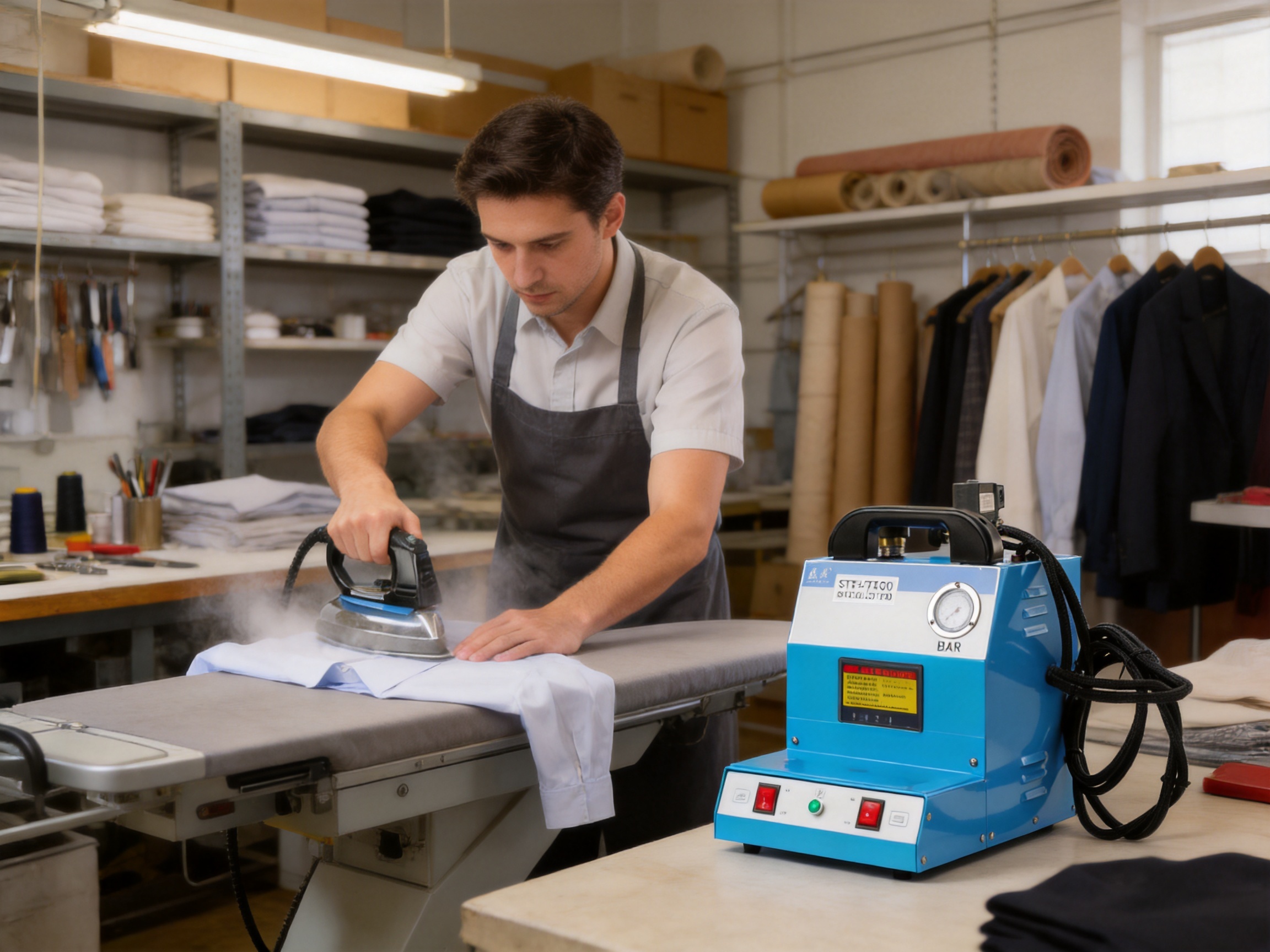
A reliable steam boiler requires more than a heating element and a water tank. The complete system includes electrical components, wiring, controls, heating surfaces, pressure-related parts, seals, connectors, housing materials, alarms, and user interfaces. Each component must be selected and assembled with attention to compatibility and safety.
During manufacturing, quality control should cover incoming materials, component inspection, assembly accuracy, electrical connections, tank integrity, heating behavior, pressure indication, alarm operation, and final product performance. Proper testing helps reduce the risk of defects reaching customers.
For equipment used in commercial environments, consistency is particularly important. Buyers often need multiple units that behave similarly, use common replacement parts, and fit the same operating procedures. A structured manufacturing process helps support repeatability across production batches.
Packaging is another important consideration. The ST-750 has a packing size of 480 × 305 × 450 millimeters, so packaging must protect the boiler, gauge, connections, and other components during transportation. Appropriate internal protection, secure positioning, moisture control, and clear handling instructions can help reduce transit-related damage.
Export-oriented manufacturing also requires attention to documentation. Commercial buyers may need product specifications, packing lists, invoices, certificates, user instructions, spare-parts information, and inspection records. Clear documentation supports customs clearance, distributor training, after-sales service, and end-user confidence.
The ST-750 should be installed on a stable, level, heat-resistant surface with adequate space around the unit. The operating area should be clean, dry, ventilated, and organized so that hoses, electrical cables, and garment materials do not create trip or contact hazards.
Before use, the operator should confirm that the voltage matches the machine configuration and the local power supply. Electrical connections should be made in accordance with applicable regulations. If the buyer is uncertain about the installation, a qualified technician should be consulted.
Water should be added according to the manufacturer’s instructions. The tank should not be overfilled, and the operator should avoid using unsuitable liquids or additives unless specifically approved. Water quality has a direct influence on mineral deposits, heating performance, and maintenance requirements.
The operator should allow the boiler to reach the appropriate working condition before beginning full production. The pressure gauge can be observed during warm-up and operation. If the liquid level alarm activates, the user should follow the recommended procedure rather than continuing to operate the machine without sufficient water.
Steam hoses and iron connections should be inspected regularly. Damaged insulation, loose fittings, leaks, unusual odors, abnormal noise, or irregular pressure readings should be treated as reasons to stop operation and arrange an inspection.
Regular maintenance supports safe and reliable operation. The exact maintenance schedule depends on water quality, daily working hours, operating environment, and the manufacturer’s instructions. However, several general practices are important.
Mineral deposits may accumulate inside a boiler over time, particularly when hard water is used. Deposits can reduce heating efficiency and affect steam production. The water tank should be cleaned according to the recommended procedure and interval.
Power cables, plugs, switches, terminals, and visible wiring should be checked for damage or looseness. Electrical inspection should be carried out by qualified personnel when internal access is required.
The pressure gauge should remain readable and respond appropriately during operation. The liquid level alarm should also be checked as part of routine service. If either device behaves abnormally, the machine should be removed from service until it has been inspected.
Hoses, couplings, seals, and iron connections should be examined for wear, leakage, or heat damage. Replacing worn parts before failure can reduce downtime and protect operators from exposure to hot steam.
Repairs involving pressure systems, heating components, electrical controls, or internal safety devices should be handled by qualified technicians. Unauthorized modifications may create safety risks and may affect warranty or certification status.
The ST-750 can help control operating costs through its combination of water capacity, steam continuity, compact construction, and relatively simple operation. A 4-liter tank reduces the frequency of refill-related interruptions, while the 1,600-watt boiler provides the heating capacity required for professional steam work.
Efficiency should be evaluated across the complete workflow rather than by electrical power alone. A machine that produces consistent steam may reduce rework, shorten finishing time, and help operators complete more garments during a working period. Reliable equipment can also reduce the indirect costs associated with delays, inconsistent quality, and frequent service calls.
The compact design may reduce installation and space costs compared with a large fixed boiler. Smaller businesses can establish a professional pressing station without dedicating an entire technical room to steam generation.
Cost of ownership also depends on correct maintenance. Using suitable water, cleaning the tank, preventing scale buildup, and replacing worn components can help preserve performance. Operators should be trained to respond to alarms and abnormal conditions promptly.
Buyers should confirm whether the 110-volt or 220-volt version is appropriate for the intended market. Voltage requirements should be verified before ordering because an incorrect configuration can prevent safe operation.
The customer should also evaluate the planned workload. The ST-750 is suitable for many commercial and small industrial applications, but extremely large production lines may require multiple units or a centralized boiler. Workload, number of operators, daily operating hours, garment types, and available space should all be considered.
Compatibility with the ironing station is another important factor. Buyers should confirm the required hose connections, iron configuration, table arrangement, accessories, and replacement parts. A complete workstation should be designed so that the operator can work comfortably without excessive bending, stretching, or movement.
Distributors should discuss packaging, labeling, documentation, warranty, spare parts, inspection, and after-sales service with the manufacturer before placing an order. Clear expectations at the purchasing stage can reduce misunderstandings later.
Purchasing from an experienced manufacturer can provide advantages beyond the initial product transaction. A company with a long operating history and a focused product portfolio is more likely to understand recurring service issues, customer expectations, component availability, and market differences.
Jinyun Shengda Sewing Equipment Co., Ltd. has operated since 2003 and has built its business around ironing and garment-care equipment. Its experience includes product development, manufacturing, domestic distribution, export activity, and cooperation with customers in Southeast Asia, Central Asia, South America, Africa, and other regions.
The company’s stated strengths include reliable quality, diverse products, competitive costs, professional service, customization, OEM support, and convenient shipment. These capabilities can be important for wholesalers and importers that need a stable supply rather than a one-time purchase.
The company also owns several product brands, including Silver Star, Platinum Dragon, Tingshun, Jiasheng, Shengtai, and Jiangxin. This brand experience reflects its participation in multiple market segments and its ability to manage product lines for different customer groups.
For a buyer evaluating suppliers, the most important factors should include documented specifications, product samples, factory communication, quality procedures, certification records, delivery performance, spare-parts support, and the ability to respond to technical questions. The ST-750 is strengthened by the broader manufacturing structure behind it.
| User type | Primary need | How the ST-750 can help |
| Tailoring shop | Professional pressing in limited space | Compact size, portable construction, and integrated steam ironing capability |
| Garment workshop | Repeated pressing and finishing | 4-liter tank and continuous dry steam for improved workflow |
| Laundry business | Finishing multiple garments | Reduced refill frequency and controlled steam output |
| Hotel laundry | Uniform and textile presentation | Professional steam generation without a large fixed boiler |
| Uniform supplier | Preparing garments for delivery | Steam-assisted wrinkle removal and final appearance improvement |
| Distributor | Reliable commercial product supply | OEM, customization, export support, and related product categories |
The ST-750 is designed for professional and commercial steam applications, especially garment ironing, textile finishing, tailoring, laundry work, uniform preparation, and selected cleaning or preparation tasks that are suitable for dry steam.
The water capacity is 4 liters. This capacity supports longer operation between refills than many smaller steam devices, helping reduce interruptions during repeated work.
The boiler power is 1,600 watts. The connected iron has a rated power of 900 watts.
Yes. The stated voltage options are 220V and 110V. Buyers should select the correct configuration for the destination market and confirm the specification before ordering.
The ST-750 is designed to provide continuous dry steam without water droplets under suitable operating conditions. Dry steam is useful for controlled garment pressing and textile finishing.
The built-in pressure gauge allows the operator to observe the internal steam pressure. It provides useful operating information and can help identify unusual pressure behavior that may require inspection.
The liquid level alarm alerts the operator when the water level is too low. The user should follow the recommended operating procedure and replenish the water or stop the machine as appropriate.
Yes. Its compact and portable design makes it suitable for tailoring shops, alteration businesses, and other workrooms with limited space. The 4-liter tank also supports repeated daily use.
It depends on the workload. The ST-750 is suitable for many small and medium-sized professional applications, but large factories with extensive production lines may need multiple units or a centralized steam system with greater capacity.
Maintenance may include tank cleaning, scale control, inspection of electrical connections, checking the pressure gauge and liquid level alarm, examining steam hoses, and replacing worn components. The manufacturer’s instructions should determine the exact maintenance schedule.
The company states that it provides customization and OEM services. Buyers should discuss labeling, packaging, voltage, documentation, accessories, minimum order quantities, and technical requirements before production.
Buyers should confirm voltage, product configuration, intended workload, accessories, packaging, certifications, warranty terms, spare parts, delivery schedule, and destination-market requirements.
The stated packing size is 480 × 305 × 450 millimeters. Buyers should consider this measurement when planning shipping, storage, and delivery arrangements.
Jinyun Shengda Sewing Equipment Co., Ltd. is located at No. 8 Nanyi Road, Huzhen Industrial Park, Zhejiang, China. The company’s operations are based in Huzhen Town, Lishui City, Zhejiang Province.
The ST-750 Steam Boiler is a practical solution for businesses that need dependable dry steam in a compact and portable format. Its 4-liter water capacity, 1,600-watt boiler, 900-watt iron connection, built-in pressure gauge, and liquid level alarm provide a balanced combination of capacity, visibility, convenience, and operational protection.
Its advantages are especially relevant to garment factories, tailoring shops, laundries, hotels, uniform suppliers, textile workshops, and other commercial users that need more continuity and control than a basic household steam appliance can provide. The machine can support professional ironing and finishing without requiring the space and infrastructure of a large centralized boiler system.
The product is also supported by the manufacturing capabilities of Jinyun Shengda Sewing Equipment Co., Ltd. With experience dating from 2003, independent research and development, a broad ironing-equipment portfolio, OEM capability, export experience, and stated compliance with national and industry standards, the company is positioned to serve both individual equipment buyers and international distribution partners.
When properly installed, operated, maintained, and matched to the intended workload, the ST-750 can contribute to consistent steam performance, smoother production, reduced interruptions, and improved garment presentation. For users seeking a professional steam source that combines mobility with practical capacity, it represents a versatile option for modern ironing and textile-care operations.
1. Product specification sheet for the ST-750 Steam Boiler, including voltage, boiler power, iron power, water capacity, and packing dimensions.
2. Manufacturer-provided product information concerning dry steam production, pressure monitoring, liquid level warning, portability, and commercial applications.
3. Company profile of Jinyun Shengda Sewing Equipment Co., Ltd., including manufacturing history, product categories, research and development, OEM services, export markets, and quality commitments.
4. General principles of professional garment pressing, steam finishing, textile handling, and commercial ironing-workstation design.
5. General electrical safety and equipment-maintenance practices for commercial steam-generation and garment-finishing machinery.
6. GB4706.1-2005, General Requirements for Safety of Household and Similar Electrical Appliances.
7. GB4706.2-2007, Applicable Safety Requirements for Electric Irons and Similar Garment-Care Appliances.
 +86-578-3158872 / +86-578-3158958
 jyshengda@163.com / caroying@jy-shengda.com
 No. 8 Nanyi Rd, Huzhen Industrial Park, Zhejiang, China
Copyright © Jinyun Shengda Sewing Equipment Co., Ltd. All Rights Reserved.
Ironing Press Machine Equipment Factory
 English
 中文简体
 русский
 عربى