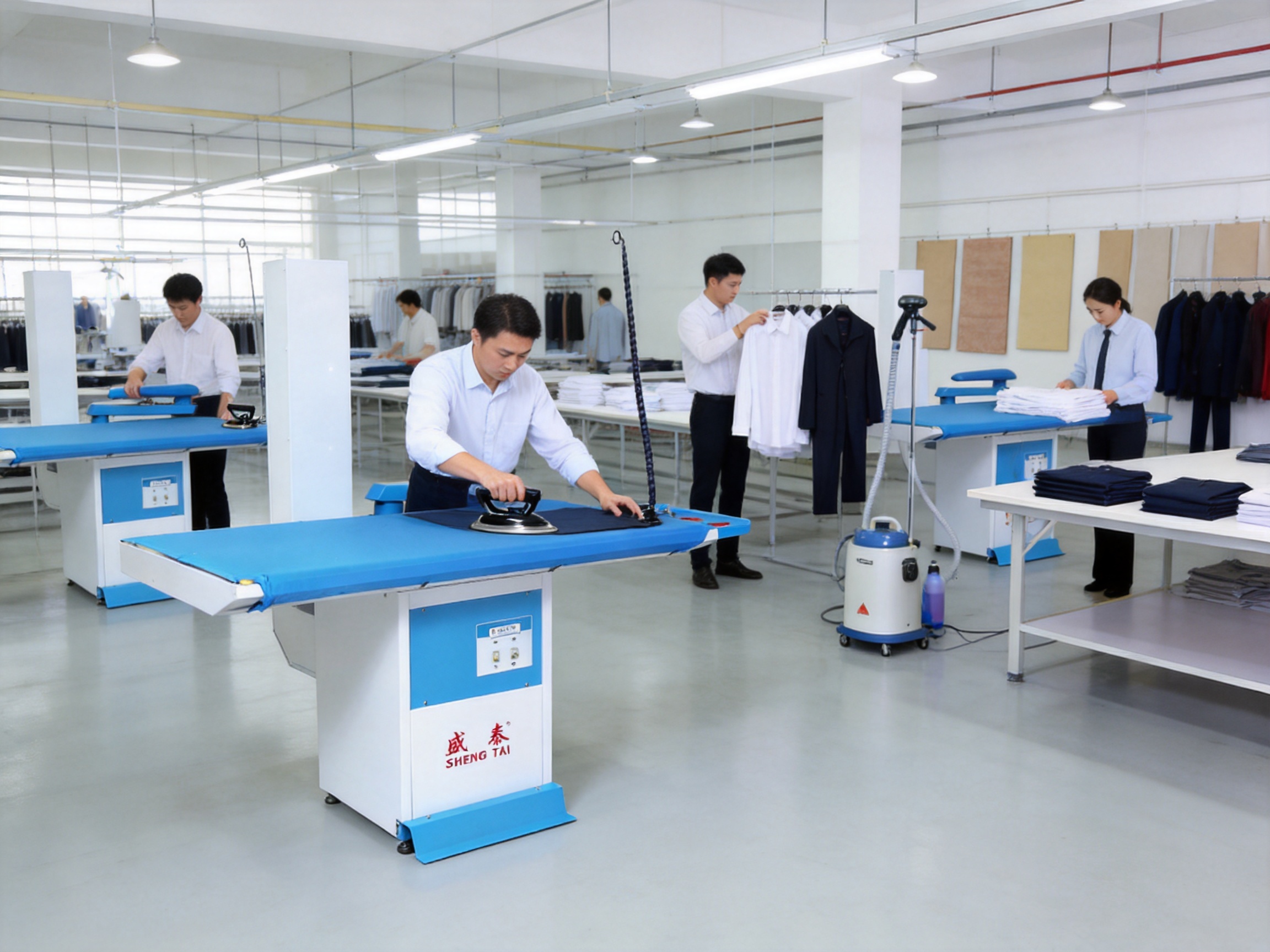
Modern garment production, tailoring, laundry services, hospitality operations, uniform suppliers, and clothing-care businesses all depend on reliable finishing equipment. Even when a garment has been cut and sewn accurately, its final appearance is strongly influenced by the quality of the ironing process. Wrinkles, loose fabric, uneven seams, and unstable work surfaces can reduce productivity and affect the perceived value of finished clothing. The ST-B1 Vacuum Ironing Table is designed to address these challenges by combining a stable ironing platform, powerful vacuum support, optional heating functions, and a practical structure suitable for different working environments.
Unlike a basic passive ironing board, the ST-B1 actively supports the operator during garment finishing. Its vacuum function helps hold fabric against the tabletop, reducing movement while the iron is being used. This allows the operator to concentrate on shaping, pressing, and refining the garment instead of repeatedly repositioning the material. The result is a more controlled process, improved consistency, and a more comfortable working experience.
The table is available with several tabletop dimensions, including 800 x 1,200 millimeters, 800 x 1,500 millimeters, and 900 x 1,800 millimeters. These options allow users to select a configuration that matches their available workspace, garment sizes, production volume, and preferred operating method. Optional tabletop heating and arm heating functions further expand the equipment’s flexibility for professional applications.
Manufactured by Jinyun Shengda Sewing Equipment Co., Ltd., the ST-B1 reflects the company’s experience in the development and production of electric irons, steam irons, spray guns, steam equipment, heat transfer machines, steam boilers, vacuum tables, and related accessories. The company emphasizes independent research and development, product improvement, manufacturing quality, customization, OEM service, and international distribution.
Ironing is not simply the act of passing a heated iron over fabric. Professional finishing requires the fabric to be positioned correctly, held securely, exposed to suitable heat and pressure, and handled in a way that protects its structure. A conventional board may provide a surface, but it does not necessarily prevent fabric from shifting. This becomes especially inconvenient when working with lightweight materials, large garment panels, curved sections, layered seams, or fabrics that must be aligned accurately.
A vacuum ironing table creates suction through the working surface. When the vacuum motor is activated, air is drawn through the table, helping the fabric remain in contact with the surface. This support can reduce sliding, bunching, and unwanted movement. The operator can then guide the iron with greater precision and apply pressure more consistently.
For commercial users, the vacuum function can also reduce unnecessary handling. Without suction, an operator may need to stop frequently to pull the fabric taut, adjust the garment, or correct a fold that has moved during pressing. Each interruption adds time to the process. On a vacuum table, the fabric is supported while the operator works, helping create a more continuous workflow.
The benefits are not limited to speed. A stable fabric position contributes to better shaping and a more uniform finish. Seams can be opened more accurately, edges can be aligned more consistently, and surface wrinkles can be removed without repeatedly disturbing the garment. For businesses that process many garments every day, these small improvements can have a significant cumulative effect.
The ST-B1 is designed around a practical combination of vacuum power, optional heating functions, dependable electrical operation, and multiple size choices. The following table summarizes the main technical information supplied for the product.
| Item | Specification |
|---|---|
| Product type | Vacuum ironing table |
| Vacuum motor power | 750 W |
| Vacuum pressure | At least 150 Pa |
| Tabletop heating power | 1,000 W, optional |
| Arm heating power | 3,500 W, optional |
| Power supply | 220 V |
| Motor rotational speed | 1,400 revolutions per minute |
| Available table sizes | 800 x 1,200 mm; 800 x 1,500 mm; 900 x 1,800 mm |
The 750 W vacuum motor provides the primary suction function. A vacuum pressure of at least 150 Pa supports the positioning of garments during ironing. The optional 1,000 W tabletop heating function can help maintain a suitable working temperature across the table surface, while the optional 3,500 W arm heating function is intended for configurations requiring additional heated pressing support.
The 220 V power supply makes the table suitable for electrical systems using this voltage. Buyers should confirm local electrical standards, plug configuration, grounding requirements, and installation conditions before ordering. Technical specifications may also need to be matched with the selected tabletop size and optional functions.
The most important difference between the ST-B1 and a basic ironing board is the active vacuum system. A standard board depends mainly on the operator’s hands to keep fabric in position. This can be adequate for occasional household use, but it is less efficient for repeated professional work. The ST-B1 helps secure the fabric through suction, giving the operator a more stable working surface.
Active stabilization is particularly useful when handling large pieces of fabric or garments that have broad panels. It can also help when pressing delicate materials that easily move under the iron. Instead of gripping or pulling the garment continuously, the operator can guide it more gently while the vacuum assists with positioning.
The three available tabletop sizes provide more flexibility than a one-size-fits-all board. The 800 x 1,200 millimeter version can be suitable where space is limited or where the main work involves smaller garments and components. The 800 x 1,500 millimeter version offers a broader working area for general professional use. The 900 x 1,800 millimeter option provides additional coverage for larger garments, long panels, and high-volume operations.
Choosing the correct size can reduce the need to fold or reposition clothing. A larger table may improve workflow for coats, dresses, trousers, uniforms, bedding, and other large textile products. A more compact model may be easier to install in a small workshop, tailoring room, laundry area, or retail back room.
Many basic ironing boards provide only a passive surface. The ST-B1 can be supplied with optional tabletop heating and arm heating functions. These options allow the table to be configured according to the user’s process requirements, available utilities, and desired level of finishing performance.
Tabletop heating can support more stable thermal conditions beneath the garment. This may assist moisture management and help the operator achieve consistent results when working with steam or heat-sensitive materials. Arm heating can provide an additional heated area for specific pressing tasks, such as sleeves, narrow sections, shaped garments, or operations requiring a specialized support surface.
Optional functions also give buyers a way to control investment. A user who does not require integrated heating can select a simpler configuration, while a production facility with more demanding finishing standards can specify additional equipment at the time of purchase.
Productivity is influenced not only by machine speed but also by the number of movements required for each garment. The ST-B1 can reduce repeated fabric adjustments, repositioning, and manual holding. Over the course of a full workday, this can help reduce wasted time and make the process more predictable.
A smoother workflow is valuable for both individual operators and larger production teams. Tailors can spend more time on accurate shaping. Laundry operators can process garments with fewer interruptions. Uniform manufacturers can maintain more consistent finishing across batches. Clothing workshops can increase output without relying solely on faster manual work.
A garment is more likely to receive a consistent finish when it remains stable throughout the ironing process. The vacuum function helps prevent the fabric from shifting as pressure is applied. This can support cleaner seam opening, more accurate edge work, and a smoother overall appearance.
Consistency is especially important when several operators work on the same production line. A supportive table reduces dependence on individual hand strength and personal technique. Although operator training remains essential, the equipment provides a more repeatable foundation for the work.
Garment finishing often involves standing for extended periods, repeatedly moving the arms, leaning over the work surface, and applying controlled pressure. Poor equipment design can contribute to back, shoulder, wrist, and arm fatigue. The ST-B1 is intended to provide a practical working height and a stable surface that can help reduce unnecessary strain.
An ergonomic ironing station should allow the operator to keep the shoulders relaxed, maintain a relatively neutral wrist position, and move the iron without excessive reaching. The choice of table size also affects comfort. A surface that is too small may force the operator to reposition garments repeatedly, while a surface that is too large may require excessive reaching. Selecting the appropriate model is therefore important for both productivity and user comfort.
The vacuum function can further support ergonomics by reducing the need to hold fabric manually. Instead of using one hand to stretch or stabilize the garment while the other hand operates the iron, the operator can work with greater freedom. This can be particularly helpful when performing detailed pressing or when handling garments that require careful alignment.
Comfort also influences quality. An operator who experiences less fatigue is more likely to maintain attention, pressure control, and accuracy during a long shift. By supporting the operator rather than merely providing a flat surface, the ST-B1 contributes to a more sustainable work process.
The vacuum system is the central functional feature of the ST-B1. The 750 W motor creates airflow through the table, while the perforated or air-permeable working surface allows suction to act on the garment. This holds the material against the table and helps maintain a flatter, more stable position.
Vacuum support can be useful for several types of textile operations. During seam opening, it helps keep the fabric aligned. During surface pressing, it can reduce bubbling and movement. When shaping collars, cuffs, pockets, or hems, it supports precise placement. When removing moisture after steam application, airflow through the garment can assist the drying and setting process.
The stated vacuum pressure of at least 150 Pa provides the suction performance specified for the product. Actual results may depend on fabric thickness, garment construction, table covering condition, ambient conditions, and the way the material is positioned. Operators should use appropriate settings and procedures for different fabrics, especially delicate or highly elastic textiles.
Vacuum operation should be integrated with correct ironing technique. Suction does not replace suitable temperature control, steam management, or fabric knowledge. Instead, it gives the operator an additional method of controlling the garment. The best results are achieved when vacuum, heat, pressure, and movement are used together.
Different fabrics respond differently to heat, moisture, pressure, and airflow. Cotton and linen may require strong heat and steam to release wrinkles. Wool and blended fabrics may need controlled temperature and careful shaping. Synthetic materials may require lower temperatures to prevent shine, deformation, or melting. Silk and other delicate fabrics must be handled with special attention to heat and pressure.
The vacuum system helps keep these materials stable, but operators should still follow fabric-care recommendations and test uncertain materials in an inconspicuous area. For delicate fabrics, a lower suction setting or a protective cloth may be appropriate where the operating configuration allows adjustment. The product information describes adjustable suction as a feature intended to support different fabric types and help prevent damage.
When steam is used during ironing, moisture must be managed carefully. Excessive moisture can slow production and leave the garment damp after pressing. Vacuum airflow can help draw air through the textile and assist with moisture removal. This may help the garment cool and set more quickly after pressing.
Faster drying can be valuable in commercial laundries and garment factories, where finished items may need to be inspected, folded, packed, or transferred to the next operation. Efficient moisture management can also reduce the risk of marks caused by leaving a damp garment in an unsuitable position.
The ST-B1 can be configured with optional tabletop heating power of 1,000 W. A heated tabletop can provide additional control during pressing and may help maintain a consistent working environment. It can be particularly helpful when the operator works with steam, moisture, thick fabrics, or garments that need to be set after shaping.
The optional arm heating power is listed as 3,500 W. A heated arm or auxiliary pressing section can help the operator manage narrow or shaped areas that are difficult to press on a broad flat surface. Sleeves, shoulder sections, trouser legs, collars, and other contoured parts may benefit from an appropriate auxiliary support.
These heating options should be selected according to the actual production process. A small tailoring workshop may prefer the vacuum function without additional heating. A professional finishing department may require both tabletop and arm heating. Purchasing the right configuration from the beginning can prevent later modification costs and ensure that the equipment matches the intended workload.
Users should also consider electrical capacity, ventilation, heat-resistant coverings, operator training, and maintenance procedures when using heated options. Heating components should be operated according to the manufacturer’s instructions, and power should be disconnected before inspection or servicing.

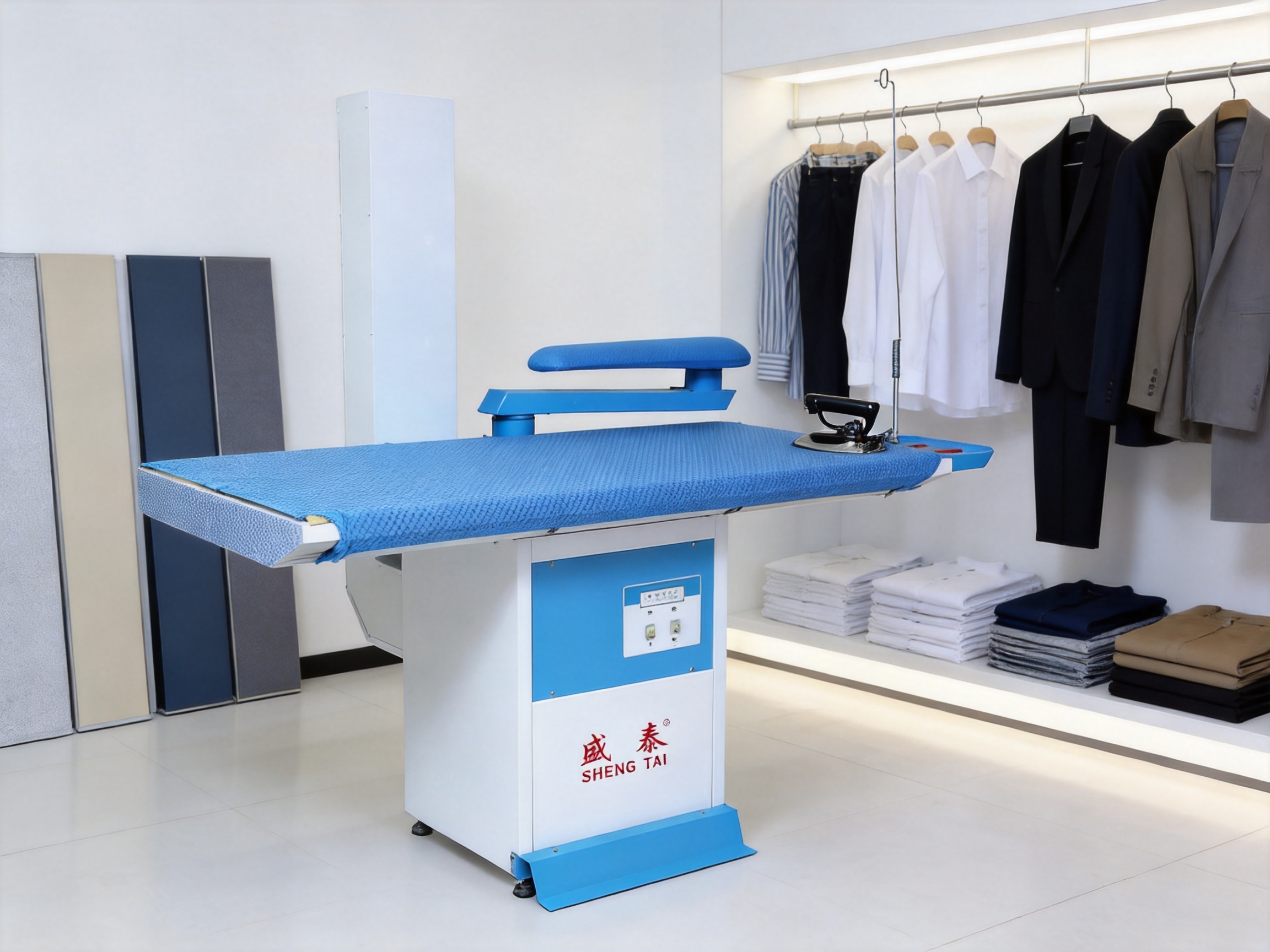
ST-B1 Vacuum Ironing Table
The 800 x 1,200 millimeter version is a practical choice for smaller workshops, tailoring rooms, alteration services, and facilities where floor space is limited. It provides an active vacuum working surface while maintaining a relatively compact footprint. It may be suitable for shirts, trousers, skirts, children’s clothing, garment components, and routine repair work.
This size can also serve as a secondary workstation in a larger production facility. For example, it may be used for detail pressing, inspection corrections, or small-batch orders while larger tables handle broad garment panels.
The 800 x 1,500 millimeter version offers a balanced combination of working area and space efficiency. It is suitable for general garment production, laundry operations, uniform finishing, and professional tailoring. The additional length allows the operator to place more of a garment on the surface before repositioning it.
For many users, this size can provide a versatile middle option. It is large enough for a wide range of garments but may still fit comfortably into a standard workshop layout. It is especially useful where both daily production and varied garment sizes must be accommodated.
The 900 x 1,800 millimeter version is intended for users who require a larger working area. It can be useful for coats, dresses, uniforms, long textile panels, bedding, curtains, and other products that are inconvenient to handle on a small board.
A larger surface can reduce folding and repositioning. It may also help operators maintain the correct alignment of long seams and edges. However, buyers should confirm that the available floor space, operator movement area, electrical installation, and ventilation are sufficient for the selected model.
Professional ironing equipment must withstand repeated heating, pressure, movement, vacuum operation, and daily handling. The ST-B1 is described as having a durable construction made from materials selected for regular use and resistance to wear. Its stable base is intended to reduce wobbling during operation.
Stability is an important safety and quality factor. If a table moves while the operator is pressing, the iron may not follow the intended path, and the garment may shift. An unstable base can also increase the risk of accidental contact with hot surfaces. A solid structure gives the operator greater confidence and supports more accurate work.
Durability also depends on correct installation and maintenance. The table should be placed on a level floor, electrical connections should be completed correctly, and moving or heated components should not be overloaded. Covers, filters, suction passages, and working surfaces should be checked according to the operating environment.
In busy commercial settings, equipment downtime can affect delivery schedules and labor planning. A durable design, accessible components, and a practical maintenance structure can help reduce interruptions. The ST-B1 is described as having components that are accessible for repairs or adjustments, supporting easier servicing when required.
Regular maintenance helps preserve vacuum performance, heating efficiency, safety, and finish quality. The smooth working surface of the ST-B1 is designed for quick cleaning. Lint, fibers, dust, and residues can accumulate during garment processing, so routine surface cleaning is important.
Operators should keep the tabletop covering clean and in good condition. A worn or blocked covering may reduce airflow and affect suction distribution. If the covering becomes damaged, contaminated, or excessively compressed, it should be inspected and replaced or serviced as appropriate.
The vacuum system should be kept free from excessive lint accumulation. Depending on the operating environment, filters, air passages, and motor areas may require periodic cleaning. A restricted airflow path can reduce vacuum performance and place additional load on the motor.
Heating elements and electrical connections should be inspected by qualified personnel. Before cleaning or servicing, the equipment should be switched off and disconnected from the power supply. Operators should never attempt electrical repairs without suitable training and authorization.
Good maintenance practice includes recording service activities, reporting unusual noise or vibration, checking the condition of power cables, and ensuring that switches and controls operate correctly. Early attention to small issues can prevent more expensive failures and help extend the useful life of the machine.
The ST-B1 is produced by a company with a product range covering multiple categories of ironing and garment-processing equipment. This broader manufacturing background is important because a vacuum ironing table does not operate in isolation. Its effectiveness may depend on compatibility with irons, steam boilers, spray guns, heat transfer equipment, and other finishing tools.
Jinyun Shengda Sewing Equipment Co., Ltd. was established in 2003 in Zhejiang, China. The company specializes in independent research, development, and production of electric irons, steam irons, hanging irons, spray guns, small steam machines, heat transfer machines, steam boilers, vacuum tables, and accessories. This product concentration gives the manufacturer practical knowledge of the working conditions faced by garment factories, laundries, tailoring businesses, and professional clothing-care operators.
Independent research and development allows the company to improve product structures based on market requirements and customer feedback. Instead of treating each product as an isolated item, a manufacturer with experience across related categories can consider the entire finishing process. This supports more practical decisions regarding vacuum performance, heating options, electrical configuration, operator usability, and equipment compatibility.
The company states that its research and development, management, and sales teams work closely together. Such cooperation can improve communication between product designers, production personnel, quality teams, and customers. It can also support customization and OEM projects, where buyers may require specific configurations, labeling, packaging, electrical arrangements, or market-oriented adjustments.
Quality in ironing equipment involves more than appearance. It includes electrical safety, motor reliability, heating consistency, structural stability, control performance, surface durability, and serviceability. A machine may look well finished but still perform poorly if its vacuum system is weak or its heating is uneven. The manufacturing process must therefore consider both visible and functional quality.
The company reports that its products follow national and industry standards, including GB4706.1-2005 and GB4706.2-2007. It also states that its products have passed CCC and CQC certifications. Buyers should confirm the certification scope and documentation for the specific ST-B1 configuration being purchased, especially when ordering optional electrical functions or equipment for export markets.
Standards and certifications provide a framework for safety and quality control, but proper installation and operation remain essential. The equipment should be used within its rated electrical requirements, and operators should receive appropriate training. Buyers should also maintain records of technical documentation, inspection, and service.
Different customers may have different requirements for tabletop dimensions, heating options, voltage, packaging, controls, accessories, and branding. The company’s stated customization and OEM capabilities can be valuable for distributors, importers, garment-equipment suppliers, and larger industrial users.
Customization should be discussed before production begins. Buyers may need to provide information about local voltage, frequency, plug type, operating environment, intended fabric categories, production volume, shipping requirements, and installation limitations. Clear technical communication helps ensure that the delivered equipment is suitable for its actual use.
Tailoring shops often need to move between different garments and different fabric types in a short period. The ST-B1 gives these businesses a stable vacuum surface without requiring a large industrial finishing line. Its available sizes allow the shop to select a model that fits the workspace while still providing professional support.
Alteration services can benefit from precise positioning when adjusting hems, sleeves, waistbands, lapels, and seams. Because the garment is held more securely, the operator can focus on the specific section being corrected. This can improve the appearance of completed alterations and reduce rework.
Laundries process garments in large quantities and often operate under time pressure. Vacuum support can help operators work more quickly while achieving a consistent finish. The optional heating functions may be useful where moisture removal and rapid garment turnover are important.
The table can be integrated into a broader workflow that includes washing, drying, inspection, ironing, folding, and packing. Its stable construction and accessible maintenance points support continued use in a busy environment, provided that cleaning and servicing are performed regularly.
Garment factories require consistency across batches and operators. The ST-B1 can support pressing operations before final inspection, packaging, or shipment. It may be used for sample development, production finishing, seam opening, shaping, and correction work.
The larger table sizes may help factories handle long garment sections with fewer repositioning steps. The vacuum system also supports accurate alignment, which can be important for structured garments and products with visible seams or design lines.
Uniform suppliers often process shirts, jackets, trousers, skirts, coats, and other garments with repeated specifications. A stable, repeatable ironing station can help maintain consistency across large orders. The optional arm heating function may also assist with sleeves and shaped sections commonly found in uniforms.
Hotels, hospitals, schools, and other institutions may operate internal laundry and garment-care departments. These users require equipment that is practical, reliable, and easy to maintain. The ST-B1 can support the finishing of uniforms, linens, staff clothing, curtains, and other textile products, depending on the selected size and workflow.
A productive ironing process begins before the iron touches the fabric. Garments should be inspected, shaken out, and positioned correctly. Labels, buttons, zippers, and decorative components should be considered before heat and pressure are applied. The ST-B1 can then be used to stabilize the garment and support the sequence of pressing operations.
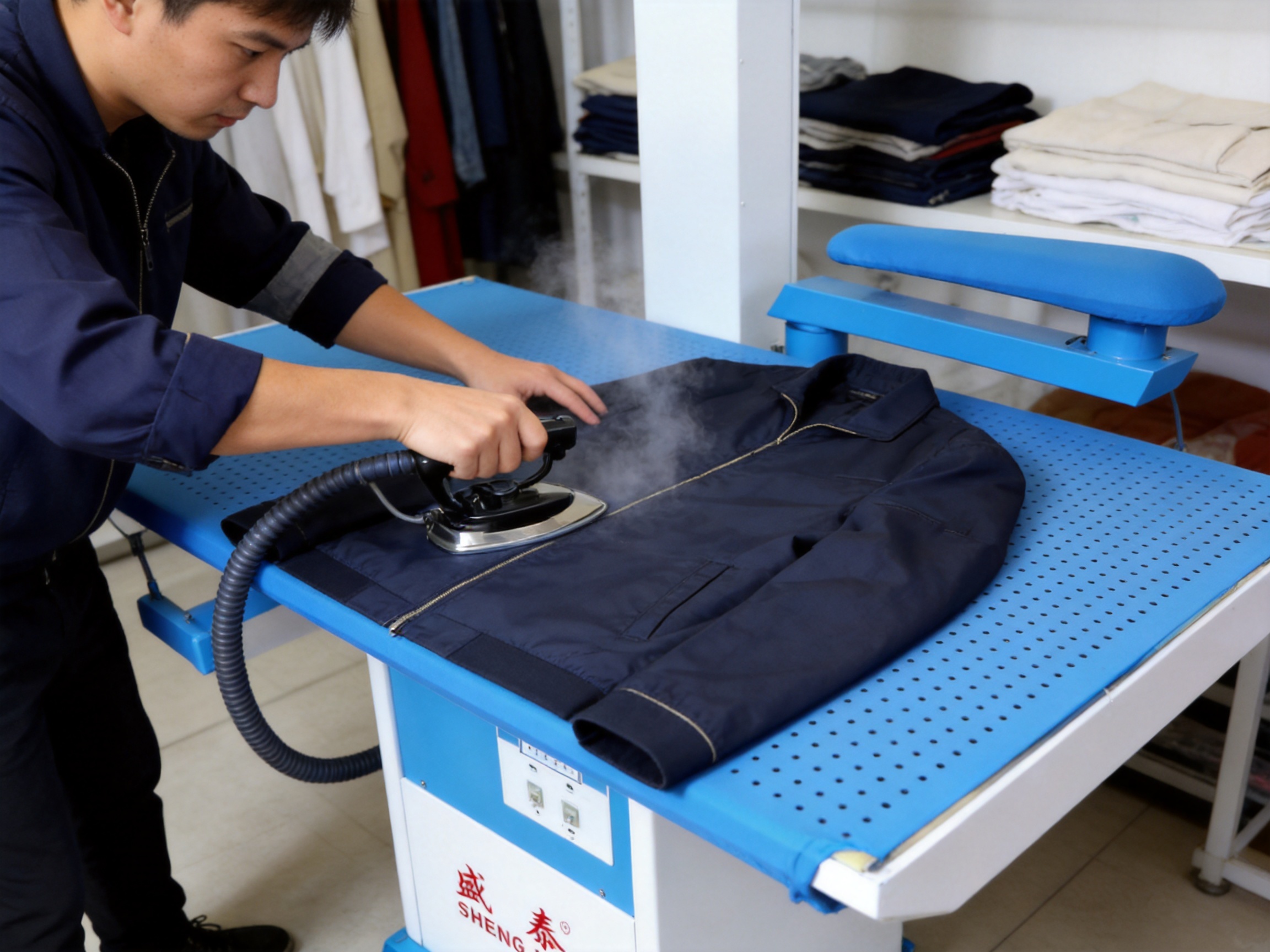
For a typical garment, the operator may begin with internal seams, then press larger panels, followed by collars, cuffs, hems, sleeves, and final visible surfaces. The vacuum function helps keep the garment in place during each stage. When steam is used, suction can assist with moisture management and help the fabric settle after pressing.
After pressing, the garment should be allowed to cool and set in an appropriate position. The operator can then inspect the garment for remaining wrinkles, shine, distortion, water marks, or uneven seams. A stable finishing table makes correction work easier because the item can be placed in a controlled position again.
This workflow supports quality control as well as speed. Operators are less likely to overlook defects when the garment is easier to handle and remains stable. Managers can also establish standardized procedures for different garment categories, helping new employees learn the process more quickly.
Before installation, the buyer should confirm the table dimensions, access route, floor condition, electrical supply, ventilation, and operator clearance. The machine should be positioned so that the operator can move around the table safely and handle garments without obstruction.
The power supply is specified as 220 V. The facility should have a suitable electrical circuit with proper protection and grounding. If optional heating functions are selected, the electrical load may be higher than that of the vacuum motor alone. Installation should therefore be reviewed by qualified electrical personnel.
The table should be leveled before use. A level position helps maintain stability and supports consistent fabric placement. The operator should also check that the vacuum system functions correctly and that the tabletop covering is installed properly.
During operation, the user should select suitable heat, steam, suction, and pressure settings for the textile being processed. The iron should not be left unattended on the garment or table covering. Hot surfaces should be treated as potential burn hazards, and the work area should be kept free from flammable materials.
Operators should be trained to recognize fabric limitations. A vacuum table improves control, but it cannot eliminate the risk of damage caused by excessive heat, unsuitable steam, prolonged pressure, or incorrect handling. Test pressing is recommended for unfamiliar materials.
Electrical safety is essential because the ST-B1 combines a motor with optional heating systems. Power cables, plugs, switches, and connections should be inspected periodically. Damaged electrical components should be replaced or repaired by qualified professionals.
Users should disconnect the equipment before cleaning, maintenance, or inspection. Water and cleaning liquids should not be allowed to enter electrical components or the motor. The table should be used in a dry, appropriately ventilated work area unless the manufacturer provides specific instructions for another environment.
Operators should wear suitable work clothing and avoid loose sleeves or accessories that could interfere with the ironing process. The work area should have enough lighting to identify wrinkles, stains, seam distortion, and surface damage.
When the working day is complete, the iron and heating functions should be switched off. The vacuum motor should also be turned off according to the operating procedure. The table should be left clean, dry, and ready for the next use.
Daily maintenance can include wiping the tabletop, removing lint, checking the condition of the cover, and observing whether suction is even across the surface. Operators should report unusual sounds, excessive vibration, burning smells, or reduced vacuum performance immediately.
Weekly or periodic maintenance may include inspecting air passages, checking fasteners, examining power cords, and cleaning accessible areas around the vacuum motor. The exact schedule should reflect the operating environment. A laundry processing dusty or lint-heavy materials may need more frequent cleaning than a small tailoring shop.
Qualified technicians should inspect electrical and heating systems at suitable intervals. If optional heating functions are installed, their controls and connections should be examined as part of the maintenance program. Service records can help identify recurring problems and support better preventive maintenance.
The tabletop cover is a working component rather than a purely decorative accessory. It affects contact, airflow, cleanliness, and pressing performance. If the cover becomes damaged or blocked, replacing it can restore performance and protect the table surface.
When purchasing the ST-B1, buyers should first define the main application. The correct tabletop size depends on the garments or textile products being processed, the number of operators, and the available floor area. A distributor may need to stock more than one size to serve different customer groups.
The buyer should also decide whether optional tabletop heating and arm heating are required. A full configuration may be appropriate for industrial production, while a basic vacuum configuration may be sufficient for tailoring and alterations. Electrical requirements should be confirmed before the order is finalized.
Questions about packaging, delivery, spare parts, operating manuals, warranty terms, installation guidance, and after-sales service should be discussed with the supplier. For export orders, buyers should verify customs documentation, local certification requirements, voltage compatibility, and shipping protection.
Because the manufacturer offers a wider range of garment-finishing products, customers may also consider whether the table should be purchased as part of a coordinated equipment solution. Compatibility with steam boilers, irons, spray guns, and other accessories can simplify procurement and create a more unified service relationship.
Purchasing a vacuum ironing table is not only a decision about motor power or tabletop size. It is also a decision about product development experience, manufacturing capability, quality management, technical support, and long-term supply reliability. A manufacturer that has operated in the ironing-equipment field for many years is more likely to understand the practical problems faced by garment professionals.
Jinyun Shengda Sewing Equipment Co., Ltd. has been engaged in this field since 2003 and serves both domestic and overseas customers. Its product range covers many stages of garment finishing, from irons and steam equipment to vacuum tables and accessories. This specialization supports a deeper understanding of heat transfer, steam management, suction, operator handling, electrical design, and workshop requirements.
The company reports that its products are exported to Southeast Asia, Central Asia, South America, Africa, and other regions. International experience can help a manufacturer understand differences in customer expectations, packaging, documentation, electrical systems, and market applications. It can also support more effective communication with distributors and OEM buyers.
Customization, competitive costs, product variety, professional service, and convenient shipment are identified as company strengths. These factors can be important for wholesalers and project buyers who need more than a single machine. They may require repeat supply, coordinated accessories, spare parts, private labeling, or technical assistance for multiple installations.
Equipment efficiency should be evaluated over its complete working life rather than only by initial purchase price. A vacuum ironing table can contribute to efficiency by reducing repeated handling and helping operators finish garments more consistently. Improved productivity may reduce labor time per garment and lower the amount of rework required.
Optional heating functions should be selected carefully. Heating can provide valuable process benefits, but it also increases energy consumption and electrical requirements. Buyers should compare the expected production benefits with the operating conditions of the facility. In some applications, the vacuum function alone may provide the best balance of performance and energy use.
Durable construction and maintainable components can also reduce long-term cost. Equipment that remains stable, can be cleaned effectively, and allows accessible servicing may deliver better value than a lower-cost product that requires frequent replacement or extended downtime.
Responsible operation includes turning off heating and vacuum functions when they are not needed, maintaining airflow paths, and replacing worn covers or components before performance deteriorates. These practices can improve efficiency while extending equipment life.
Before ordering, buyers can use the following checklist:
1. Confirm the required tabletop size: 800 x 1,200 millimeters, 800 x 1,500 millimeters, or 900 x 1,800 millimeters.
2. Determine whether optional 1,000 W tabletop heating is required.
3. Determine whether optional 3,500 W arm heating is required.
4. Confirm that the facility has a suitable 220 V power supply and adequate electrical capacity.
5. Measure the installation area and allow sufficient space for operator movement.
6. Identify the main garment types and fabric categories to be processed.
7. Confirm compatibility with existing irons, steam boilers, and other finishing equipment.
8. Request operating instructions, maintenance guidance, spare-parts information, and certification documentation.
9. Discuss packaging, shipping, installation, warranty, and after-sales support.
10. Establish an operator training and preventive-maintenance plan before production begins.
The ST-B1 is designed to provide a stable, vacuum-supported surface for garment ironing and professional textile finishing. Its suction function helps hold fabric in position while the operator removes wrinkles, opens seams, shapes garments, and completes final pressing work.
The vacuum draws air through the table surface and helps keep the garment in place. This reduces fabric movement, minimizes repeated repositioning, and allows the operator to work with greater control and consistency.
The available sizes are 800 x 1,200 millimeters, 800 x 1,500 millimeters, and 900 x 1,800 millimeters. The appropriate choice depends on garment size, workspace, production volume, and the type of pressing work required.
Tabletop heating is listed as an optional function with a power rating of 1,000 W. Buyers should specify whether this option is required when placing an order.
Yes. Arm heating is listed as an optional function with a power rating of 3,500 W. It can be considered for applications involving sleeves, shaped garment sections, or other specialized pressing operations.
The vacuum motor power is 750 W, and the specified vacuum pressure is at least 150 Pa.
Yes. The 900 x 1,800 millimeter version provides the largest working area and may be suitable for coats, dresses, uniforms, curtains, bedding, and other large textile products. The 800 x 1,500 millimeter model can also support many general professional applications.
It can be used for different fabric categories when the correct heat, steam, pressure, and suction procedures are followed. Delicate fabrics should be tested carefully, and operators should use suitable temperature settings and protective methods.
Potential users include tailoring shops, alteration services, commercial laundries, clothing factories, uniform suppliers, hotels, hospitals, textile workshops, and institutional garment-care departments.
The listed power supply is 220 V. Buyers should verify local electrical requirements and ensure that the selected configuration, especially configurations with heating options, is supported by an appropriate circuit.
The table is designed for practical maintenance. The smooth surface can be cleaned quickly, and components are described as accessible for repairs or adjustments. Regular cleaning of the tabletop, cover, vacuum passages, and surrounding areas is recommended.
The manufacturer produces irons, steam equipment, spray guns, heat transfer machines, steam boilers, vacuum tables, and accessories. This experience across related products can support coordinated procurement, equipment compatibility, customization, and technical communication.
The company states that it provides customization and OEM services. Buyers should discuss specific requirements such as dimensions, electrical configuration, heating options, packaging, labeling, and accessories before production.
Users should check floor level, table clearance, electrical capacity, ventilation, operator access, power connections, and the condition of the tabletop covering. Installation and electrical work should be performed according to the manufacturer’s instructions and applicable local requirements.
The ST-B1 Vacuum Ironing Table provides a professional solution for businesses that need more control, consistency, and efficiency than a basic ironing board can offer. Its 750 W vacuum motor and specified suction performance help stabilize garments during pressing, while the available tabletop sizes allow the equipment to adapt to different workshops and production requirements.
The optional 1,000 W tabletop heating and 3,500 W arm heating functions give buyers additional flexibility. Users can select a configuration that matches their process instead of paying for functions they do not need. The stable construction, ergonomic working concept, accessible maintenance points, and smooth surface further support daily professional use.
Compared with passive ironing surfaces, the ST-B1 can reduce fabric movement, repeated repositioning, operator fatigue, and finish inconsistency. These advantages are relevant to tailoring shops, laundries, clothing manufacturers, uniform suppliers, hotels, hospitals, and other organizations that depend on reliable garment finishing.
The product is supported by the manufacturing experience of Jinyun Shengda Sewing Equipment Co., Ltd., a company established in 2003 and focused on the research, development, and production of ironing and garment-processing equipment. Its broader product range, OEM and customization capabilities, export experience, quality commitments, and stated certification record provide additional value for distributors and professional end users.
For buyers seeking a vacuum ironing table, the most important steps are to choose the correct tabletop size, determine whether heating options are needed, confirm electrical requirements, evaluate the intended fabric categories, and establish a suitable maintenance plan. When properly configured and operated, the ST-B1 can become a dependable part of a modern garment-finishing workflow.
1. Product technical information for the ST-B1 Vacuum Ironing Table, including motor power, vacuum pressure, heating options, power supply, rotational speed, and tabletop dimensions.
2. Manufacturer-provided company information concerning product development, manufacturing categories, customization, OEM services, export markets, and after-sales strengths.
3. General principles of professional garment pressing, textile handling, steam management, heat control, and vacuum-assisted fabric stabilization.
4. GB4706.1-2005, General Requirements for Safety of Household and Similar Electrical Appliances.
5. GB4706.2-2007, Safety Requirements for Electric Irons and Similar Appliances.
6. General workplace guidance for electrical safety, heated equipment operation, preventive maintenance, operator ergonomics, and garment-finishing workflows.
 +86-578-3158872 / +86-578-3158958
 jyshengda@163.com / caroying@jy-shengda.com
 No. 8 Nanyi Rd, Huzhen Industrial Park, Zhejiang, China
Copyright © Jinyun Shengda Sewing Equipment Co., Ltd. All Rights Reserved.
Ironing Press Machine Equipment Factory
 English
 中文简体
 русский
 عربى